

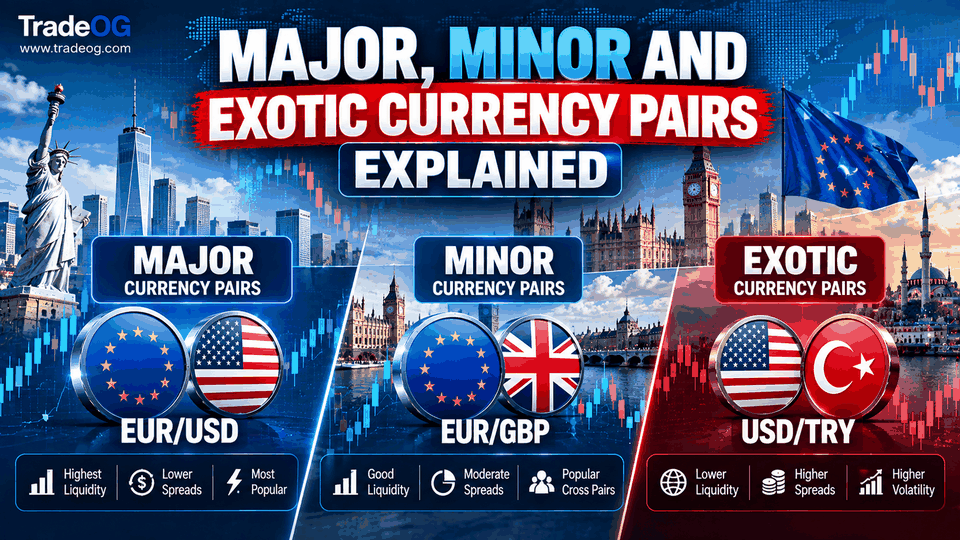
Forex traders often hear terms such as major currency pairs, minor currency pairs and exotic currency pairs. These labels are not simply about which currency is “stronger.” They mainly describe how widely a pair is traded, how liquid the market is, what spreads traders typically face and how the underlying currencies behave.
For Indian traders, understanding these categories is useful before choosing a pair for scalping, intraday trading or swing trading. A pair such as EUR/USD can behave very differently from EUR/GBP, USD/TRY or USD/INR because liquidity, volatility, news sensitivity and transaction costs can differ substantially.
In this guide, TradeOG explains the differences between major, minor and exotic currency pairs, gives practical examples, compares their typical characteristics and shows how Indian traders can decide which category fits their trading style.
What Is a Currency Pair?
A forex quote always contains two currencies. The first is the base currency and the second is the quote currency.
For example, if EUR/USD is quoted at 1.1700, one euro is worth 1.1700 US dollars. If the price rises, the euro has appreciated relative to the US dollar, assuming the quote convention remains unchanged.
Every forex trade therefore involves a relative relationship rather than an isolated currency price. That is why traders analyze both economies, central banks, interest-rate expectations, inflation, employment data and capital flows behind a pair.
Major vs Minor vs Exotic Currency Pairs at a Glance
| Feature | Major Pairs | Minor Pairs | Exotic Pairs |
|---|---|---|---|
| Typical composition | USD + major global currency | Two major currencies without USD in many definitions | Major currency + smaller/emerging-market currency |
| Liquidity | Highest | High to moderate | Lower |
| Typical spreads | Usually tightest | Usually wider | Often widest |
| Volatility | Usually more orderly | Can be higher | Can be significantly higher |
| News sensitivity | High | High | Often very high |
| Beginner suitability | Generally best starting point | Better after understanding majors | Usually better for experienced traders |
| Examples | EUR/USD, USD/JPY, GBP/USD | EUR/GBP, EUR/JPY, GBP/JPY | USD/TRY, USD/ZAR, USD/PLN |
The boundaries are not universal. Different brokers and market-data providers can classify certain pairs differently. The most useful way to understand the categories is to focus on liquidity, trading volume, currency importance and market structure rather than treating the labels as a rigid legal classification.
What Are Major Currency Pairs?
Major currency pairs are the most heavily traded forex pairs and generally involve the US dollar with another widely traded currency. Commonly cited majors include EUR/USD, USD/JPY, GBP/USD, USD/CHF, USD/CAD and AUD/USD. NZD/USD is also widely included in major-pair lists.
Because these markets attract large amounts of global trading activity, they generally have deep liquidity and relatively tight spreads. FOREX.com and IG both describe majors as the most actively traded category, while noting that exact definitions can vary.
1. EUR/USD
EUR/USD represents the euro against the US dollar. It is generally considered the world’s most actively traded forex pair and is heavily followed by banks, institutions, corporations and retail traders.
Its popularity means traders can find extensive economic research, technical analysis and market commentary. The pair is particularly sensitive to Federal Reserve and European Central Bank expectations, US economic releases and changes in interest-rate differentials.
2. USD/JPY
USD/JPY compares the US dollar with the Japanese yen. It is highly sensitive to Federal Reserve policy, Bank of Japan policy, US Treasury yields and changes in global risk sentiment.
The yen also has a reputation as a defensive currency, so USD/JPY can react strongly when investors move between risk-on and risk-off positioning.
3. GBP/USD
GBP/USD, commonly called cable, combines the British pound and US dollar. UK inflation, Bank of England policy, UK employment data, Federal Reserve expectations and US economic releases can all affect the pair.
GBP/USD can also experience sharp intraday movements around high-impact news, making position sizing and stop-loss placement particularly important.
4. USD/CHF
USD/CHF represents the US dollar against the Swiss franc. The franc is often viewed as a defensive currency, which means geopolitical stress and risk aversion can influence the pair.
5. USD/CAD
USD/CAD compares the US dollar with the Canadian dollar. Canada is a major commodity exporter, so oil prices and broader commodity-market conditions can influence CAD and therefore USD/CAD.
6. AUD/USD
AUD/USD compares the Australian dollar with the US dollar. Australian monetary policy, Chinese economic conditions, commodity prices and global risk appetite can all affect the pair.
7. NZD/USD
NZD/USD is commonly included in major-pair lists. The New Zealand dollar can be influenced by Reserve Bank of New Zealand policy, agricultural and commodity conditions, global risk sentiment and developments in Asia-Pacific markets.
Why Major Pairs Usually Have Lower Trading Costs
High trading activity generally means more buyers and sellers are available around current market prices. That depth can contribute to tighter bid-ask spreads under normal conditions.
For a trader, a tighter spread means less price movement is required for a position to cover its immediate transaction cost. This is one reason major pairs are often attractive for scalpers and short-term traders.
However, “major pair” does not mean “spread is always low.” Spreads can widen around major economic announcements, market open/close periods and unusually thin liquidity. Broker execution conditions also vary.
What Are Minor Currency Pairs?
Minor currency pairs are often called cross currency pairs or simply crosses. In the most common definition, they combine major currencies without the US dollar.
Examples include:
- EUR/GBP
- EUR/JPY
- GBP/JPY
- EUR/CHF
- AUD/JPY
- CAD/JPY
- EUR/AUD
- AUD/NZD
Because the US dollar is absent, traders cannot simply treat these pairs as USD-driven markets. Instead, the relative strength of the two currencies becomes especially important.
EUR/GBP
EUR/GBP compares two major European currencies. European Central Bank and Bank of England policy expectations, inflation, employment data and economic growth can influence the pair.
For traders who understand both European and UK monetary policy, EUR/GBP can provide a useful alternative to USD-based pairs.
EUR/JPY
EUR/JPY combines the euro and Japanese yen. It can be affected by both European monetary policy and Japanese monetary policy, while global risk sentiment can add another layer of volatility.
GBP/JPY
GBP/JPY is well known among active traders for potentially large price movements. It combines the pound’s sensitivity to UK economic data with the yen’s sensitivity to Japanese policy and global risk sentiment.
Higher movement can create opportunity, but it also means that a position sized like EUR/USD may be inappropriate for GBP/JPY.
Major vs Minor Currency Pairs: The Key Difference
The simplest distinction is that major pairs normally include USD and another major currency, while minor pairs usually combine two major currencies without USD.
For example:
- EUR/USD: major
- USD/JPY: major
- GBP/USD: major
- EUR/GBP: minor/cross
- EUR/JPY: minor/cross
- GBP/JPY: minor/cross
Minors can still be highly liquid. Calling them “minor” does not mean they are unimportant or necessarily illiquid. It mainly distinguishes them from the highest-volume USD-centered pairs.
What Are Exotic Currency Pairs?
Exotic currency pairs generally combine one widely traded major currency with a currency from a smaller or emerging-market economy. Examples include USD/TRY, USD/ZAR, USD/PLN, USD/MXN and EUR/TRY.
Some currencies that appear in exotic pairs can have large economies or substantial international trade. The term “exotic” primarily refers to how the currency trades in the global FX market, rather than saying the country itself is economically insignificant.
Examples of Exotic Currency Pairs
| Pair | Currency Relationship | Typical Consideration |
|---|---|---|
| USD/TRY | US dollar / Turkish lira | Potentially high volatility and wider spreads |
| USD/ZAR | US dollar / South African rand | Emerging-market and commodity sensitivity |
| USD/PLN | US dollar / Polish zloty | European and emerging-market drivers |
| USD/MXN | US dollar / Mexican peso | US-Mexico trade, rates and risk sentiment |
| EUR/TRY | Euro / Turkish lira | European and Turkish monetary-policy sensitivity |
Why Exotic Pairs Can Be More Expensive to Trade
Lower trading activity can mean less market depth and wider bid-ask spreads. The cost can become particularly noticeable when a trader enters or exits frequently.
Exotic pairs can also experience larger price gaps or rapid repricing when local political, economic or central-bank developments surprise the market.
That does not mean exotic pairs should never be traded. It means traders should understand their execution environment before applying a strategy designed for a highly liquid major pair.
Major, Minor and Exotic Pairs: Liquidity Explained
Liquidity refers broadly to how easily an asset can be bought or sold without causing a large price impact. In forex, liquidity is one of the most important factors behind spreads and execution quality.
Majors generally sit at the high-liquidity end of the spectrum. Many minors also have substantial liquidity, especially popular crosses such as EUR/JPY and GBP/JPY. Exotic pairs tend to have less consistent liquidity.
Liquidity is not constant throughout the day. A currency pair can be more active during the trading session of its underlying economies and less active outside those hours.
For Indian traders, understanding session timing is therefore important. See Forex Trading Sessions in IST: London, New York and Tokyo Explained and Currency Trading Time in India: Forex Market Hours Explained.
How Spreads Differ Between Major, Minor and Exotic Pairs
The spread is the difference between the bid and ask price. It is an important part of the trading cost.
| Pair Category | Typical Spread Environment | Why |
|---|---|---|
| Major | Usually tight | Deep liquidity and high trading activity |
| Minor | Usually moderate | Lower activity than the largest USD pairs |
| Exotic | Often wider | Lower liquidity and higher market-specific risk |
These are general tendencies, not guaranteed broker quotes. A broker’s pricing model, account type, market conditions and news environment can materially change the spread.
For a deeper explanation of transaction costs, read Spread vs Commission in Forex: Which Trading Cost Is Better?.
Volatility: Are Minor and Exotic Pairs More Volatile?
There is a common misconception that every minor or exotic pair is automatically more volatile than every major pair. That is not correct.
Volatility depends on the currencies, economic conditions, time period and market event. However, less-liquid pairs can experience sharper percentage moves when liquidity disappears or a major surprise hits the market.
GBP/JPY, for example, can produce large intraday moves despite being a cross rather than an exotic. Conversely, a major pair can become extremely volatile during a major central-bank announcement.
The correct approach is to measure the actual volatility of the pair rather than choosing a pair simply because it is labelled major, minor or exotic.
How News Affects Different Currency Pairs
Every currency pair is driven by the relative economic outlook of its two currencies.
For EUR/USD, traders may focus heavily on Federal Reserve and ECB expectations. For GBP/JPY, Bank of England and Bank of Japan policy can matter alongside global risk sentiment. For USD/TRY, Turkish monetary policy, inflation, political developments and international capital flows can become especially important.
Before trading a pair around major events, Indian traders should check an economic calendar. TradeOG’s guide Forex Economic Calendar: How Indian Traders Should Read It explains how to interpret Actual, Forecast and Previous figures and convert important releases into Indian Standard Time.
Which Currency Pairs Are Best for Beginners?
For many beginners, major pairs are the easiest place to start because they generally offer high liquidity, extensive market information and relatively competitive spreads.
EUR/USD, USD/JPY and GBP/USD are common starting points because there is a large amount of educational and economic information available about the currencies.
That does not mean a beginner should trade aggressively. A highly liquid market can still produce large losses when leverage is excessive.
Before selecting a position size, understand Forex Leverage Explained for Indian Traders With Examples and Forex Lot Size Explained for Indian Traders.
Which Pair Category Is Better for Scalping?
Scalpers usually care heavily about spread, execution quality, liquidity and short-term volatility. For that reason, major pairs are often a more practical starting point than exotic pairs.
A strategy that targets only a few pips can be severely affected by a wider spread. If the spread consumes a large percentage of the expected profit, the strategy’s mathematical edge can disappear.
Minors can also be suitable for scalping when the selected pair has sufficient liquidity and the trader has tested the actual broker’s spreads and execution.
Which Pair Category Is Better for Swing Trading?
Swing traders have a different cost structure because they may hold positions for days or weeks. Spread remains relevant, but broader macroeconomic factors become increasingly important.
Major pairs can provide cleaner access to central-bank and macroeconomic themes. Minors can be attractive when the trader has a strong view on the relative performance of two major currencies.
Exotic pairs require additional attention to overnight financing, liquidity, local economic events, political developments and sudden repricing.
What About USD/INR for Indian Traders?
USD/INR is particularly relevant to Indian traders and businesses because it directly reflects the rupee’s value against the US dollar. However, it should not be treated like EUR/USD simply because both are quoted as currency pairs.
USD/INR is influenced by factors such as US dollar strength, Indian monetary policy, capital flows, oil prices, inflation, interest-rate expectations and Reserve Bank of India policy.
For background, read Why USD Strength Matters for Indian Forex Traders.
The exact classification of USD/INR as a “major,” “minor” or “exotic” can vary by source. In common retail-forex terminology, it is generally treated as an emerging-market or exotic-style currency pair rather than one of the classic major pairs.
How Currency Pair Selection Changes Risk
Choosing a currency pair is part of risk management. The same lot size can expose a trader to very different levels of price movement depending on the pair.
Before entering a trade, consider:
- Current bid-ask spread
- Average daily volatility
- Typical session liquidity
- Upcoming economic releases
- Stop-loss distance
- Position size
- Leverage and margin requirements
- Overnight financing or swap costs
- Broker execution conditions
Do not assume that a 0.10 lot position has the same practical risk across every currency pair. Pip value, exchange rate, volatility and stop distance all matter.
Major vs Minor vs Exotic: A Practical Example
Imagine three traders each risk a fixed percentage of their account.
Trader A chooses EUR/USD. The trader sees a relatively tight spread and deep liquidity. A stop-loss based on recent volatility is placed, and position size is calculated from the monetary risk.
Trader B chooses GBP/JPY. The spread may still be reasonable, but the pair can move substantially during active sessions. The trader therefore needs to account for greater price movement when calculating the stop distance.
Trader C chooses USD/TRY. The trader may face wider spreads, larger moves and more event-specific risk. A strategy that works on EUR/USD cannot simply be copied with the same position size.
The lesson is simple: risk should be based on the actual characteristics of the pair, not just the lot size.
Common Mistakes Traders Make With Currency Pair Categories
1. Assuming Major Means Safe
Major pairs are generally more liquid, but they are not risk-free. Leverage can turn a relatively small market move into a significant account loss.
2. Trading Exotic Pairs Because They Move More
High volatility can look attractive, but wider spreads and sudden moves can make execution difficult. More movement does not automatically mean more opportunity.
3. Ignoring the Spread
Especially for scalpers, spread is a direct trading cost. Always check the live spread rather than relying on a generic label.
4. Using the Same Stop Size Everywhere
A fixed 20-pip stop may be reasonable in one market condition and completely unsuitable in another. Stop distance should be connected to volatility and market structure.
5. Ignoring Trading Sessions
A pair can behave differently depending on when it is traded. Session liquidity matters, especially for crosses and less-liquid currencies.
6. Using Excessive Leverage
Leverage magnifies both gains and losses. Position sizing should be based on the amount you are prepared to lose if the stop is hit, not on the maximum position your broker allows.
How Indian Traders Can Choose Between Major, Minor and Exotic Pairs
A simple selection framework is:
- Start with liquidity: Prefer markets where your broker provides consistent execution and competitive spreads.
- Check the session: Trade when the currencies involved are actively participating in the market.
- Check the economic calendar: Identify high-impact events before opening a position.
- Measure volatility: Use recent price behaviour rather than assuming volatility from the pair’s label.
- Calculate position size: Match the lot size to your stop-loss and maximum account risk.
- Review the broker’s conditions: Spreads, commissions, swaps and margin requirements can differ significantly.
- Backtest before scaling: A strategy should demonstrate an edge on the specific pair and timeframe you intend to trade.
Are Major Currency Pairs Always Better?
No. Major pairs are often easier to access and cheaper to trade, but the best pair depends on the trader’s strategy.
A trader who specializes in relative monetary-policy divergence may prefer EUR/GBP. A trader who understands commodity currencies may focus on AUD/USD or USD/CAD. An experienced emerging-market specialist may intentionally trade an exotic pair.
The goal is not to find the “best” category. The goal is to find a market whose liquidity, volatility, trading costs and fundamental drivers match your strategy.
Major, Minor and Exotic Currency Pairs: Final Comparison
| Trader Priority | Usually Most Suitable | Reason |
|---|---|---|
| Learning forex basics | Major | High liquidity and extensive information |
| Low transaction costs | Major | Usually tighter spreads |
| Trading two major economies without USD | Minor | Direct cross-currency exposure |
| Higher volatility opportunities | Minor/Exotic | Can experience larger moves, but risk is higher |
| Emerging-market exposure | Exotic | Includes less-traded currencies |
| Simple starting watchlist | Major | Easy to monitor and research |
FAQs
What are major currency pairs?
Major currency pairs are the most actively traded forex pairs and generally include the US dollar with another major global currency. EUR/USD, USD/JPY and GBP/USD are common examples.
What are minor currency pairs?
Minor pairs, also called crosses, generally combine two major currencies without the US dollar. Examples include EUR/GBP, EUR/JPY and GBP/JPY.
What are exotic currency pairs?
Exotic pairs generally combine a major currency with a less-traded currency from a smaller or emerging-market economy. Examples include USD/TRY, USD/ZAR and USD/PLN.
Which currency pair has the lowest spread?
Among widely traded retail forex pairs, EUR/USD is commonly associated with very tight spreads, although the actual spread depends on the broker, account type, liquidity and market conditions.
Are exotic currency pairs risky?
They can carry higher trading and market risk because liquidity may be lower, spreads can be wider and local economic or political developments can cause sharp price movements.
Are minor pairs the same as exotic pairs?
No. Minor pairs usually involve two major currencies without USD. Exotic pairs generally include a major currency and a less-traded emerging-market or smaller currency.
Is USD/INR a major currency pair?
USD/INR is not normally included among the classic major pairs. It is generally treated as an emerging-market currency pair and is often grouped with exotic-style currencies in retail forex terminology.
Which currency pair is best for Indian beginners?
There is no universal best pair, but highly liquid major pairs such as EUR/USD and USD/JPY are commonly easier starting points because spreads, market information and educational resources are widely available.
Bottom Line
Major, minor and exotic currency pairs are different primarily because of liquidity, trading activity, market depth and the currencies involved. Major pairs such as EUR/USD and USD/JPY generally offer the deepest liquidity and tightest spreads. Minor pairs such as EUR/GBP and GBP/JPY provide exposure to two major currencies without the US dollar. Exotic pairs such as USD/TRY and USD/ZAR can offer larger moves but often come with wider spreads and greater market-specific risks.
For Indian traders, pair selection should be connected to the trading session, economic calendar, volatility, spread, leverage and position size. Do not select a pair simply because it moves quickly. Select the market whose behaviour you understand and whose trading costs your strategy can realistically support.


