

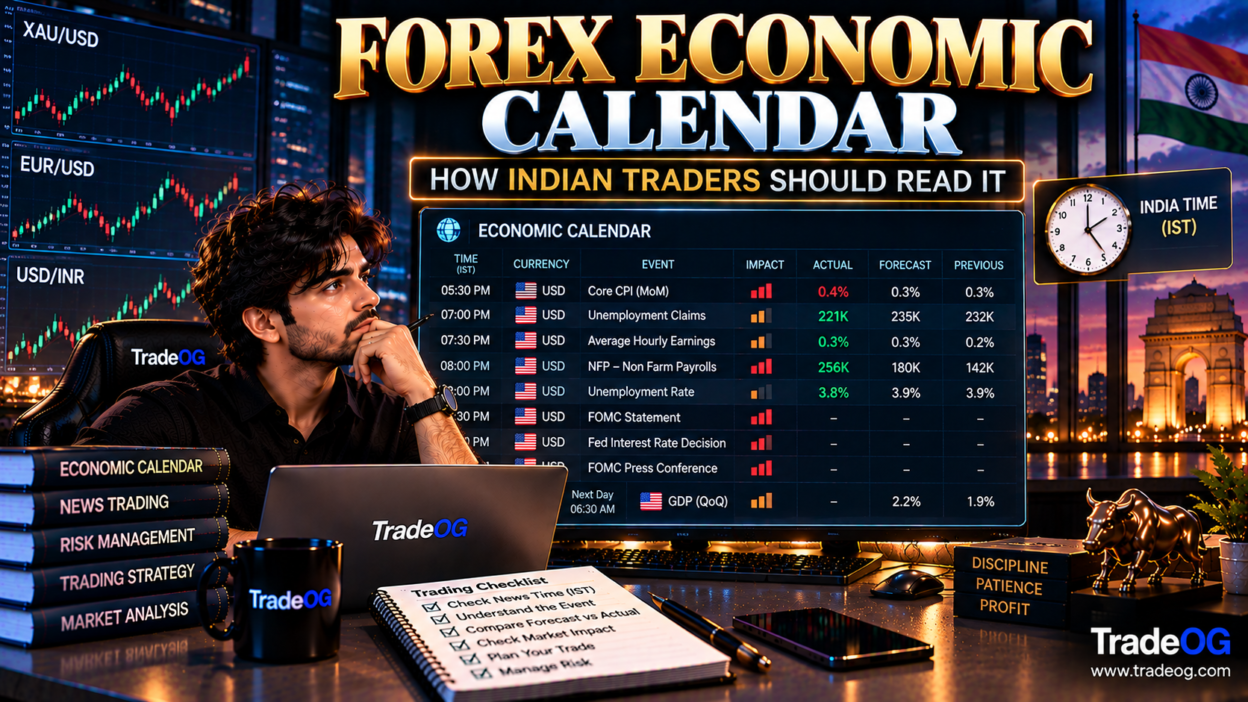
A forex economic calendar is one of the most useful tools for an Indian trader, especially when trading currencies, XAU/USD, indices or other markets that react strongly to US and global economic data. The calendar tells you when important economic releases are scheduled, which currency they affect, how important the event is, and—after the release—how the actual number compared with expectations.
The biggest mistake is to treat the calendar as a list of news headlines. A professional approach is to use it as a risk and market-structure planning tool. Before entering a trade, you want to know whether CPI, NFP, a central-bank decision or another major release is approaching.
What Is a Forex Economic Calendar?
An economic calendar is a schedule of upcoming economic releases, central-bank decisions, speeches and other macroeconomic events. Most calendars show the event time, country or currency, event name, impact rating, forecast, previous value and, after publication, the actual result.
Platforms such as MetaTrader describe the calendar in essentially the same way: traders can filter events by period, importance and currency and compare Actual, Forecast and Previous values. MetaTrader Economic Calendar guide
| Calendar Column | Meaning | Why Traders Care |
|---|---|---|
| Time | Scheduled release time | Tells you when volatility may increase |
| Currency | Currency or country affected | Shows which markets may react |
| Event | Name of the economic release | Explains the macro catalyst |
| Impact | Typical market importance | Helps prioritize events |
| Actual | Newly released figure | Shows what happened |
| Forecast | Consensus expectation | Shows what was already expected |
| Previous | Prior reading | Provides historical comparison |
Why the Economic Calendar Matters for Indian Traders
Many of the most important global economic releases occur during the Indian evening because US markets are active at that time. This is especially relevant for Indian traders who work during the day and trade after office hours.
For example, US CPI, the Employment Situation report commonly called NFP, PPI and several other major US releases are scheduled at 8:30 AM New York time. Depending on US daylight-saving status, that commonly corresponds to either 6:00 PM or 7:00 PM IST.
A current India-focused calendar reference shows the same seasonal shift and notes that the US changes clocks while India does not. Forex economic calendar and news times in IST
This matters because a trader who thinks “US CPI is at 6 PM” throughout the year can be an hour early or late after the US changes between daylight and standard time.
The Most Important Rule: Actual vs Forecast
The economic calendar becomes much more useful when you understand Actual, Forecast and Previous.
Forecast is the market’s expected number before the release.
Previous is the prior published reading, although previous values can sometimes be revised.
Actual is the new number released to the market.
The market often reacts to the surprise rather than simply to whether the actual number looks “good” or “bad.”
Simple Example
| US CPI | Value |
|---|---|
| Previous | 0.3% |
| Forecast | 0.3% |
| Actual | 0.5% |
The actual result is higher than the forecast. If traders interpret that as stronger inflation pressure, expectations for restrictive Fed policy can increase. The dollar and Treasury yields may strengthen, while gold can face pressure.
But this is not an automatic trading formula. The market also considers the details of the report, revisions, positioning and what was already priced in.
Why Forecast Is Often More Important Than Previous
Beginners often compare Actual with Previous and ignore Forecast.
That can be misleading.
Suppose unemployment was 4.0% last month and economists expected it to rise to 4.2%. If the new reading is 4.1%, the number is worse than last month but better than expected.
The market may interpret that as a positive surprise relative to consensus.
Therefore, your first comparison should normally be:
Actual vs Forecast
Then consider:
Actual vs Previous
And finally ask whether the report’s internal details change the interpretation.
High-Impact, Medium-Impact and Low-Impact Events
Most economic calendars use an impact rating to help traders prioritize events.
High Impact
These can include:
- US CPI
- US PCE inflation
- US NFP / Employment Situation
- FOMC rate decisions
- ECB rate decisions
- Bank of England decisions
- Major GDP releases
- Important central-bank speeches
Medium Impact
Examples include retail sales, business surveys, selected employment indicators and other releases that can become important depending on the macro environment.
Low Impact
These releases generally create less volatility by themselves, although a low-impact number can occasionally matter when markets are extremely sensitive to a particular theme.
Do not blindly trust the calendar’s color or impact label. The most relevant event depends on the currency and the market regime.
Which Economic Events Matter Most for Forex Traders?
| Event | Main Theme | Commonly Affected Markets |
|---|---|---|
| CPI | Inflation | USD, gold, bonds, indices |
| NFP | Employment | USD, gold, indices, yields |
| FOMC | Monetary policy | USD, gold, bonds, indices |
| PCE | Inflation | USD, yields, gold |
| GDP | Economic growth | Currency and risk assets |
| Retail Sales | Consumer spending | Currency and indices |
| PMI / ISM | Business activity | Currency, indices, yields |
| Central-bank speeches | Policy expectations | Relevant currency and rates |
How Indian Gold Traders Should Read the Calendar
If you trade XAU/USD, the US section of the calendar deserves special attention.
Before a gold trade, check:
- Is CPI, PCE or NFP scheduled?
- Is an FOMC decision approaching?
- What is the forecast?
- What was the previous reading?
- How has XAU/USD behaved before similar releases?
- What is DXY doing?
- What are US Treasury yields doing?
- What is USD/INR doing?
This creates a cross-market process instead of treating the economic calendar as a simple countdown clock.
CPI: Why Inflation Data Matters
Consumer Price Index data is important because inflation can influence expectations for central-bank policy.
A hotter-than-expected inflation report can increase expectations for tighter policy, potentially supporting the dollar and yields while pressuring gold.
A softer-than-expected reading can have the opposite effect.
But traders should distinguish between headline CPI and core measures. The composition of inflation can influence how the market interprets the report.
The US Bureau of Labor Statistics publishes the official CPI release schedule, including the 8:30 AM Eastern release time for scheduled reports. BLS CPI release schedule
NFP: How to Read the US Jobs Report
NFP is actually part of the broader US Employment Situation report. The headline payroll number is important, but it is not the only number that matters.
Also watch:
- Unemployment rate
- Average hourly earnings
- Prior-month revisions
- Labor-force participation
- Other employment details
This is why a headline payroll beat does not always produce a simple dollar rally. One component can contradict another.
The Bureau of Labor Statistics publishes the official Employment Situation schedule and release information. BLS 2026 release calendar
FOMC: The Event Indian Traders Must Respect
Federal Reserve decisions can generate major moves because the market is not trading only the current interest-rate decision. Traders are also interpreting the statement, economic projections, guidance and press conference.
The Federal Reserve currently schedules eight regular FOMC meetings each year. The official 2026 calendar includes meetings in January, March, April, June, July, September, October and December. Federal Reserve FOMC calendar
For an Indian trader, the FOMC release can occur late at night in IST. During US daylight-saving periods, the decision is commonly around 11:30 PM IST, while the winter conversion can move it to 12:30 AM the following day.
Always verify the specific date and time rather than relying on memory.
How to Read a Calendar Before the News
Before the number is released, the calendar is mainly a planning tool.
Use it to identify:
- Event time
- Currency exposure
- Impact level
- Forecast
- Previous value
- Potentially affected instruments
- Your trading restrictions around news
At this stage, you do not know the Actual number.
Therefore, avoid building a trade around an imagined result.
How to Read the Calendar After the News
Once the Actual number appears, the process changes.
Ask:
- Was Actual above or below Forecast?
- Was the surprise large or small?
- Was Previous revised?
- Did other components confirm the headline?
- How did DXY react?
- How did US yields react?
- How did XAU/USD react?
- Did the initial move hold or reverse?
This is much more useful than simply saying “CPI was high, so gold should fall.”
The First Move Is Not Always the Final Move
Economic releases can create an initial algorithmic reaction within seconds. Human traders then interpret the complete report, revisions and central-bank implications.
This can produce:
Spike → retracement → second move
or:
Initial move → consolidation → trend continuation
That is why traders who enter immediately after the headline can sometimes get stopped out even when their broad interpretation is correct.
News Trading vs News Avoidance
You do not have to trade every economic release.
News Trading
A trader deliberately builds a strategy around scheduled releases. This requires testing, execution discipline and a clear understanding of spread, slippage and volatility.
News Avoidance
A trader checks the calendar specifically to avoid opening new positions immediately before high-impact events.
For many newer traders, the second approach is easier to manage.
Economic Calendar and XAU/USD
Gold is particularly sensitive to several US macro variables:
- Inflation expectations
- Federal Reserve policy
- US Treasury yields
- US dollar strength
- Geopolitical risk
- Investment flows
Therefore, CPI, PCE, NFP and FOMC events deserve special attention when trading XAU/USD.
But do not assume every high-impact event will produce the same gold reaction. Market positioning and expectations matter.
Economic Calendar and USD/INR
For Indian traders, USD/INR adds another layer.
Suppose US CPI is hotter than expected. The dollar strengthens globally and XAU/USD falls. At the same time, USD/INR can rise if the rupee weakens.
That means international gold can fall while the INR translation of gold falls less dramatically.
A useful Indian dashboard is therefore:
Economic Calendar + XAU/USD + DXY + US Yields + USD/INR
This is particularly useful for traders who compare international gold with MCX Gold.
IST Timing: The Most Common Calendar Mistake
India follows Indian Standard Time throughout the year. The United States and Europe use daylight-saving changes. As a result, the same US release can appear at a different Indian clock time during different parts of the year.
| US 8:30 AM ET Release | Typical IST During US Summer Time | Typical IST During US Winter Time |
|---|---|---|
| CPI | 6:00 PM | 7:00 PM |
| NFP / Employment Situation | 6:00 PM | 7:00 PM |
| PPI | 6:00 PM | 7:00 PM |
| PCE | 6:00 PM | 7:00 PM |
| Retail Sales | 6:00 PM | 7:00 PM |
These are typical conversions, not a substitute for checking the exact calendar entry. A calendar configured to your device’s time zone is preferable.
Why DST Creates Problems for Indian Traders
India does not change its clocks, but the US does. The US generally changes to daylight time in March and returns to standard time in November.
This means a trader who has memorized “CPI at 6 PM” can suddenly find the release at 7 PM during the US winter period.
The problem becomes even more important during the short periods when the US and Europe are on different daylight-saving schedules.
A Simple Economic Calendar Workflow
Step 1: Check Tomorrow’s Events
Before the trading day begins, scan the next 24 hours.
Step 2: Filter by Currency
If trading EUR/USD, focus heavily on EUR and USD events. If trading XAU/USD, US events become particularly important.
Step 3: Filter High Impact
Start with high-impact events, then add medium-impact releases that are directly relevant to your currency.
Step 4: Note the IST Time
Write the event time in your trading journal or platform. Do not rely on memory.
Step 5: Record Forecast and Previous
This gives you a baseline for interpreting the Actual number.
Step 6: Define Your News Rule
Decide whether you will trade, reduce exposure or stay flat around the event.
Step 7: After Release, Compare the Markets
Look at Actual versus Forecast, then observe DXY, yields, XAU/USD or the relevant currency pair.
Example: Reading CPI Like a Professional
Imagine the calendar shows:
| Metric | Result |
|---|---|
| Previous | 0.2% |
| Forecast | 0.3% |
| Actual | 0.5% |
Do not immediately press “Sell Gold.” Instead, work through the chain:
- Actual is above Forecast.
- Inflation appears hotter than expected.
- Does the market now expect a more restrictive Fed?
- Is DXY rising?
- Are Treasury yields rising?
- Is XAU/USD breaking technical support?
- Is the move holding after the initial volatility?
If several pieces align, the market narrative becomes stronger. If they conflict, patience may be better.
Example: Reading NFP Like a Professional
Imagine:
| NFP Component | Result |
|---|---|
| Forecast payrolls | 180K |
| Actual payrolls | 240K |
| Unemployment | Higher than expected |
| Wage growth | Lower than expected |
The headline is strong, but other components are weaker.
Instead of assuming an automatic dollar rally, watch the market reaction. If yields rise and DXY confirms, the stronger payroll number may dominate. If yields fall and the dollar reverses, traders may be focusing on the weaker unemployment or wage details.
Economic Calendar for Forex Scalpers
Scalpers should treat high-impact events differently from normal market conditions.
Immediately before a release:
- Spreads can change.
- Liquidity can become uneven.
- Price can jump across levels.
- Stops can be triggered rapidly.
- Slippage can increase.
A scalping strategy that works during normal liquidity may perform very differently during CPI or NFP.
Economic Calendar for Swing Traders
Swing traders should also use the calendar, but for a different reason.
If you plan to hold a gold or forex position for several days, you need to know whether CPI, FOMC, NFP or another major event falls inside your holding period.
The question becomes:
“Am I comfortable holding this position through the event?”
If not, reduce exposure or close according to your trading plan.
Economic Calendar for Prop Firm Traders
Prop firm traders should take the calendar seriously because news volatility can create rapid drawdowns.
Before high-impact events:
- Check the firm’s news-trading rules.
- Check whether holding positions through news is allowed.
- Review maximum daily loss.
- Account for spread and slippage.
- Avoid oversized positions.
- Do not increase risk simply because the forecast appears obvious.
A calendar can protect your account by telling you when not to trade.
Common Economic Calendar Mistakes
1. Looking Only at the Forecast
The forecast is an expectation, not a prediction you can assume will become reality.
2. Ignoring Revisions
Previous values can be revised, particularly in employment data.
3. Trading the Headline Without Reading the Report
Some releases contain several numbers that can point in different directions.
4. Forgetting DST
US release times can shift by one hour in IST.
5. Treating All Red Events the Same
Impact ratings are useful, but relevance depends on the currency, macro environment and current market theme.
6. Entering Seconds Before Major News
This exposes traders to unpredictable volatility and execution conditions.
7. Assuming the First Spike Is the Trend
The initial reaction can reverse once traders digest the full release.
8. Ignoring Your Broker or Prop Firm Rules
Different trading environments can have different execution and news restrictions.
How to Build an Economic Calendar Trading Checklist
| Question | Yes/No |
|---|---|
| Have I checked today’s high-impact events? | ☐ |
| Have I converted the release time to IST? | ☐ |
| Do I know the Forecast? | ☐ |
| Do I know the Previous value? | ☐ |
| Do I know which currency is affected? | ☐ |
| Have I checked XAU/USD or the relevant pair’s structure? | ☐ |
| Have I checked DXY and yields when relevant? | ☐ |
| Do I have a news-risk plan? | ☐ |
| Is my position size appropriate? | ☐ |
Best Economic Calendar Strategy for Indian Traders
The best strategy is not to trade every red event.
Instead, use the calendar to divide your trading day into three categories:
| Period | Approach |
|---|---|
| Before high-impact news | Prepare, mark levels and control exposure |
| During release | Follow your tested news-trading rule or stay flat |
| After release | Wait for the market to digest the data and confirm direction |
This approach is especially useful for Indian traders who focus on the London-New York overlap and XAU/USD.
Final Takeaway
The forex economic calendar is not a prediction tool. It is a planning, risk-management and market-context tool.
The most important fields are Time, Currency, Impact, Actual, Forecast and Previous. For Indian traders, converting the release time to IST is essential because US daylight-saving changes can shift major releases by one hour.
The most useful process is:
Calendar → Forecast → Actual → Surprise → DXY/Yields → Price Reaction → Technical Confirmation → Risk Management
For XAU/USD traders, pay particular attention to US CPI, PCE, NFP, FOMC, GDP, retail sales and other major US releases. For forex traders, also monitor events for the specific currencies in the pair you are trading.
Most importantly, do not trade simply because a number is above or below forecast. Understand why the market cares about the number, how it changes monetary-policy expectations, and whether price confirms the interpretation.
Frequently Asked Questions
What is a forex economic calendar?
It is a schedule of economic releases, central-bank decisions and other macroeconomic events that can influence currencies and related financial markets.
What do Actual, Forecast and Previous mean?
Forecast is the expected result, Previous is the prior published result, and Actual is the newly released figure. Comparing Actual with Forecast is one of the first steps in interpreting a market surprise.
What economic news is most important for Indian forex traders?
US CPI, NFP, FOMC, PCE, GDP and major central-bank decisions are among the most important global events. The relevant currency-specific releases also matter for individual forex pairs.
What time is US CPI in India?
US CPI is normally released at 8:30 AM Eastern Time. Depending on the US daylight-saving period, this is typically 6:00 PM or 7:00 PM IST. Always verify the exact calendar entry.
What time is NFP in India?
The US Employment Situation report is normally released at 8:30 AM Eastern Time, which is typically 6:00 PM IST during US daylight time and 7:00 PM IST during US standard time.
Should beginners trade during NFP or CPI?
Not necessarily. Beginners can use the calendar to avoid the highest-volatility periods until they have a tested strategy for news conditions.
Can an economic calendar help with gold trading?
Yes. US inflation, employment and Federal Reserve events can affect the dollar, Treasury yields and gold. The calendar helps you plan around those catalysts.
Does a better-than-expected economic number always strengthen the currency?
No. The market reaction depends on expectations, revisions, other components of the report, positioning and what the data means for future monetary policy.
Sources and further reading: