

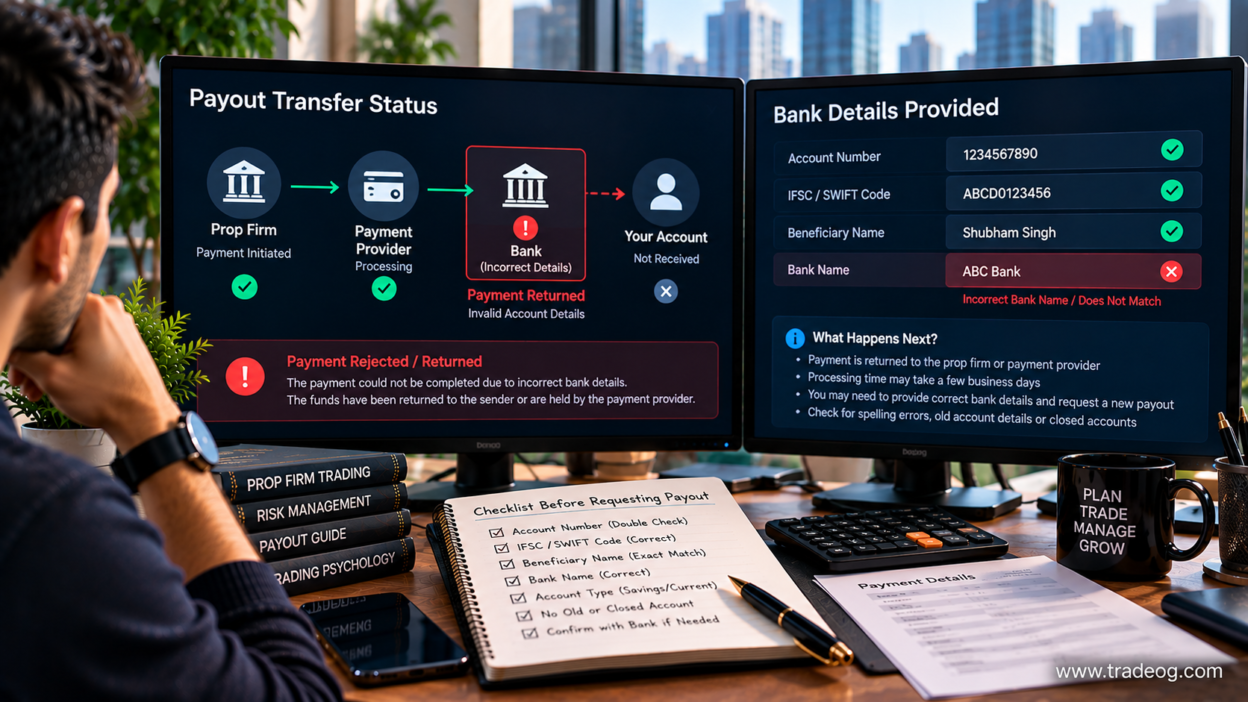
When a prop firm sends a payout using incorrect bank details, the payment does not always disappear or become permanently lost. Depending on which detail is wrong, the receiving bank and the payment route may reject the transfer, place it on hold, return it to the sender or, in some cases, credit an account based on the account number supplied.
This distinction matters for traders because a prop firm may show a payout as sent or completed while the money has not yet reached the trader’s bank account. If the account number, IFSC, SWIFT/BIC, beneficiary name, bank name or other payment information is incorrect, the next step depends on where the payment failed.
For Indian traders receiving an international prop firm payout, the safest approach is to understand the payment status, identify the incorrect field, preserve the transaction reference and ask the prop firm or payment provider whether the funds were rejected, returned or are still being investigated.
What Usually Happens When Bank Details Are Incorrect?
There are several possible outcomes:
- The payment is rejected before settlement.
- The beneficiary bank cannot apply the payment and returns it.
- The payment is held for additional verification.
- An intermediary bank returns the payment to the sender.
- The payment reaches an account based on the account number supplied.
- The payment requires a formal recall or investigation.
There is no single universal result because different payment rails and banks use different validation and processing rules.
For example, RBI guidance for electronic payments in India states that credit can be provided based on the beneficiary account number, while the beneficiary name may be used for verification depending on the bank’s risk controls. That makes the account number one of the most important fields to verify before a payout is sent. RBI guidance on beneficiary account-number based credit explains this principle.
Which Bank Details Can Cause a Prop Firm Payment to Fail?
A payout can contain several pieces of beneficiary information. The exact requirements depend on the payment method and country, but common fields include:
| Bank detail | What can happen if it is wrong |
|---|---|
| Account number | Payment may be rejected, returned or potentially credited to the account number supplied. |
| IFSC | Domestic Indian payment may fail or be routed incorrectly. |
| SWIFT/BIC | International transfer may be rejected, held or returned. |
| Beneficiary name | Payment may be held or rejected depending on bank checks. |
| Bank name or branch | May trigger a mismatch or investigation. |
| Account type | Some payment routes may not support the supplied account type. |
| Address or purpose information | May create compliance or processing questions. |
Not every mismatch has the same impact. A minor name-format difference can be treated differently from an incorrect account number or SWIFT code.
Scenario 1: The Prop Firm Has Not Released the Payment Yet
This is the easiest situation to correct.
If the prop firm or its payment provider has identified the problem before the payment enters the banking network, the payout may simply be cancelled or held. The trader can then correct the bank details and request the payment again.
This is why traders should not assume that a payout showing processing has already reached the bank.
If support tells you that the payment has not yet been released, ask whether they can update the beneficiary information before settlement. Do not submit multiple payout requests unless the firm’s instructions specifically require it.
Scenario 2: The Payment Was Sent but the Bank Rejected It
If the payment has already been sent and the receiving bank cannot process it because of incorrect details, the transaction may be rejected or returned.
Axis Bank’s remittance guidance, for example, states that a transfer can show as returned when beneficiary account details are incorrect, after which correct details can be updated and the transaction reinitiated. Axis Bank’s remittance status guidance provides an example of this workflow.
In a prop firm payout, the same general sequence can look like this:
- Prop firm approves the payout.
- Payment provider sends the payment.
- Receiving bank cannot apply the transaction.
- Payment is rejected or returned.
- Funds move back through the payment chain.
- Prop firm or payment provider receives the returned funds.
- Trader corrects the bank details.
- A new payment is initiated.
The important point is that returned does not necessarily mean lost. It usually means the payment could not complete its intended route.
Scenario 3: The Payment Is Held for Verification
Incorrect information does not always produce an immediate rejection.
A bank or payment provider may place a transaction on hold while it checks beneficiary information, account ownership, payment purpose or other compliance requirements.
RBI rules for certain foreign inward remittances require accurate originator and beneficiary information to travel through the payment chain, and recipient banks may apply KYC and customer-due-diligence requirements before crediting eligible accounts. RBI guidance on foreign inward remittances provides relevant background.
If your payout is held, the correct response is usually to provide the requested information rather than immediately asking for another payout.
Scenario 4: The Wrong Account Number Was Used
This is the most important scenario to understand.
For some Indian electronic payment systems, the account number is a critical routing identifier. RBI guidance says that responsibility for providing the correct beneficiary account number rests with the remitter and that credit may be made based on the account number supplied.
That means a trader should never assume that a correct beneficiary name will automatically protect a payment if the account number is wrong.
In the best-case scenario, the incorrect account number does not correspond to a valid account and the payment is returned. In a more serious scenario, the account number can correspond to another account and the funds may be credited there.
If that happens, recovery can become an investigation between the sending institution and the beneficiary bank rather than a simple correction of bank details.
What If the Money Was Credited to the Wrong Account?
If you discover that a payout was actually credited to an unintended account, contact the prop firm and your bank immediately.
Do not wait several weeks hoping the issue will correct itself.
Give the prop firm:
- Payment reference or transaction ID
- Date and time of payment
- Amount and currency
- Incorrect bank details that were supplied
- Correct bank details
- Any return or rejection message from your bank
Your bank may need to coordinate with the sending or intermediary institution. The exact recovery process depends on the payment rail and whether the funds are still available at the receiving institution.
RBI publications have documented cases involving erroneous credits and recovery efforts, illustrating why an incorrect account number can become significantly more complicated than a normal rejected transfer.
Can the Prop Firm Charge You for Incorrect Bank Details?
Possibly, depending on the firm’s payout terms and the payment provider involved.
Returned international payments can incur intermediary, correspondent or receiving-bank charges. IDFC FIRST Bank, for example, notes that when an outward remittance is returned because beneficiary details are incorrect, the returned amount may differ from the original amount because charges can be deducted by the beneficiary or intermediary bank. IDFC FIRST Bank’s remittance guidance explains this risk.
A prop firm’s own policy may also specify whether the trader is responsible for failed payout costs caused by incorrect information.
Therefore, if your payout is returned, ask for a breakdown rather than assuming the full original amount will automatically be reissued.
Why the Returned Amount Can Be Lower
Suppose a prop firm sends a $2,000 payout and the payment fails because of an incorrect SWIFT code.
The funds may travel through one or more institutions before the error is detected. Depending on the payment route, charges can be deducted during the return process.
The trader may therefore receive a returned amount that is lower than the original amount.
This is separate from currency conversion. If the payment is returned in a different currency or converted during processing, exchange-rate differences can also affect the final amount.
For related reading, see TradeOG’s guides on why your bank statement can show a different amount than a forex withdrawal and how bank conversion charges can reduce trading returns.
How Long Does a Returned Prop Firm Payment Take?
There is no universal number of days.
The return can involve several stages:
- Receiving bank rejects or cannot apply the payment.
- Payment moves back to an intermediary or sending institution.
- Payment provider reconciles the returned funds.
- Prop firm receives confirmation.
- Trader updates bank details.
- New payout is reviewed and released.
Each stage can have its own processing time. Weekends, bank holidays, intermediary banks and manual investigations can extend the timeline.
Swift’s market-practice guidance for returned payments recommends carrying structured information about the original transaction and the reason for the return. This is one reason a transaction reference is so useful when a payment needs to be traced. Swift guidance on payment exceptions and investigations provides background on returned payment information.
What You Should Do If Your Prop Firm Says “Payment Sent”
Do not immediately assume the money is sitting at your bank.
Ask the prop firm or payment provider these specific questions:
- Has the payment actually been released to the banking network?
- What is the transaction reference?
- Which payment method was used?
- What currency was sent?
- Was the payment rejected, returned or simply not credited yet?
- Has the beneficiary bank reported an error?
- If returned, have the funds reached the prop firm or payment provider again?
- Are there any return or intermediary charges?
This gives you much more useful information than repeatedly asking when the payout will arrive.
Correct Bank Details to Check Before the Next Payout
Before requesting another payout, compare the details directly against your bank’s official records.
- Full account holder name
- Account number
- IFSC for Indian domestic transfers
- SWIFT/BIC where required
- Bank name
- Branch information where required
- Account type
- Registered address if required
- Payment purpose or remittance information if requested
Do not copy old details from a previous payout form without checking them. Accounts can be closed, banks can change merger-related identifiers, and payment providers can change their beneficiary requirements.
Use the Bank Account Name Verification Where Available
India has also introduced beneficiary account-name lookup capabilities for NEFT and RTGS-related customer journeys. RBI directed banks to provide facilities that can display the beneficiary account name based on the account number and IFSC, helping customers identify mismatches before sending money. RBI’s beneficiary account-name lookup guidance explains the facility.
Where your bank or payment workflow provides such a verification step, use it before submitting payout details.
Incorrect Bank Details vs Name Mismatch
These problems should not be treated as identical.
| Problem | Typical risk | Best action |
|---|---|---|
| Wrong account number | Rejection, return or potential wrong-account credit | Contact prop firm and bank immediately. |
| Wrong IFSC | Routing failure or return | Confirm the correct IFSC with your bank. |
| Wrong SWIFT/BIC | International payment rejection or investigation | Ask provider to trace or return the payment. |
| Minor name mismatch | Possible hold or additional verification | Use the exact bank-record name. |
| Closed account | Payment normally cannot be credited and may be returned | Provide an active account before reissue. |
What Indian Traders Should Never Do
- Do not create another payout request just because the first one has not appeared.
- Do not provide someone else’s bank account unless the prop firm’s rules explicitly allow it.
- Do not alter bank documents to make beneficiary details appear correct.
- Do not repeatedly change payout details while a transaction is under investigation.
- Do not assume a “completed” status means bank credit.
- Do not ignore a return or rejection notification from your bank.
If a prop firm requires the payout account to belong to the verified trader, the safest approach is to use an account held in the same legal name as the trading account and verified identity documents.
A Simple Example
Imagine an Indian trader is due a $1,500 prop firm payout. The trader accidentally enters an old bank account number.
The prop firm approves and sends the payment. The receiving bank cannot apply the payment because the account is closed. The bank returns the funds to the payment chain.
The trader sees “completed” in the prop firm’s dashboard and initially thinks the money is missing. After contacting support, the trader receives the transaction reference and confirmation that the payment was returned.
The trader then updates the correct account details. The prop firm confirms that the returned funds have been reconciled and reissues the payout.
The delay in this example does not mean the prop firm refused the payout. It means the original payment could not complete because the beneficiary information was wrong.
When Should You Contact Your Bank?
Contact your bank when the prop firm provides evidence that the payment was sent but your bank cannot locate or credit it.
Give the bank:
- Transaction reference
- Payment date
- Amount and currency
- Sender information
- Receiving account number
- Any SWIFT or UTR information available
Ask whether the bank can see an incoming payment, rejected payment, returned transaction or pending compliance review.
If the bank confirms that no payment was received, take that information back to the prop firm or payment provider so they can investigate the sending side.
Final Takeaway
When a prop firm sends a payment with incorrect bank details, the outcome depends on the exact error and the payment route. The payment may be rejected, returned, held for verification or, in the case of an incorrect account number that happens to belong to another account, potentially credited to the wrong account.
For most traders, the best outcome is a rejection or return because the payment can then be corrected and reissued. The situation becomes more complicated when funds have already been credited to an unintended account.
Before requesting another payout, verify your account number, IFSC, SWIFT/BIC, beneficiary name and other required details directly against your bank records. If a payment has already been sent, keep the transaction reference and ask whether it is sent, rejected, returned, held or credited.
That distinction can save days of unnecessary confusion when a prop firm payout does not arrive as expected.
FAQs
What happens if a prop firm sends money to the wrong bank account?
The payment may be rejected or returned if the account cannot be credited. If the incorrect account number belongs to another account, recovery can require an investigation involving the sending and receiving banks.
Can a prop firm resend a payout after incorrect bank details?
Usually, if the original payment has been returned and the prop firm’s policy allows reprocessing. The trader may need to correct and verify the bank details first.
Will I lose money if my prop firm payout is returned?
Not necessarily. However, intermediary or beneficiary-bank charges and currency conversion can reduce the returned amount in some payment routes.
Does a completed prop firm payout mean the bank has received it?
No. Completed can describe the prop firm’s or payment provider’s processing stage. It does not necessarily mean the receiving bank has credited your account.
What is the most important bank detail to check?
The account number is critical because some Indian payment systems can credit based primarily on the account number supplied. Also verify IFSC, SWIFT/BIC and the exact beneficiary name where required.