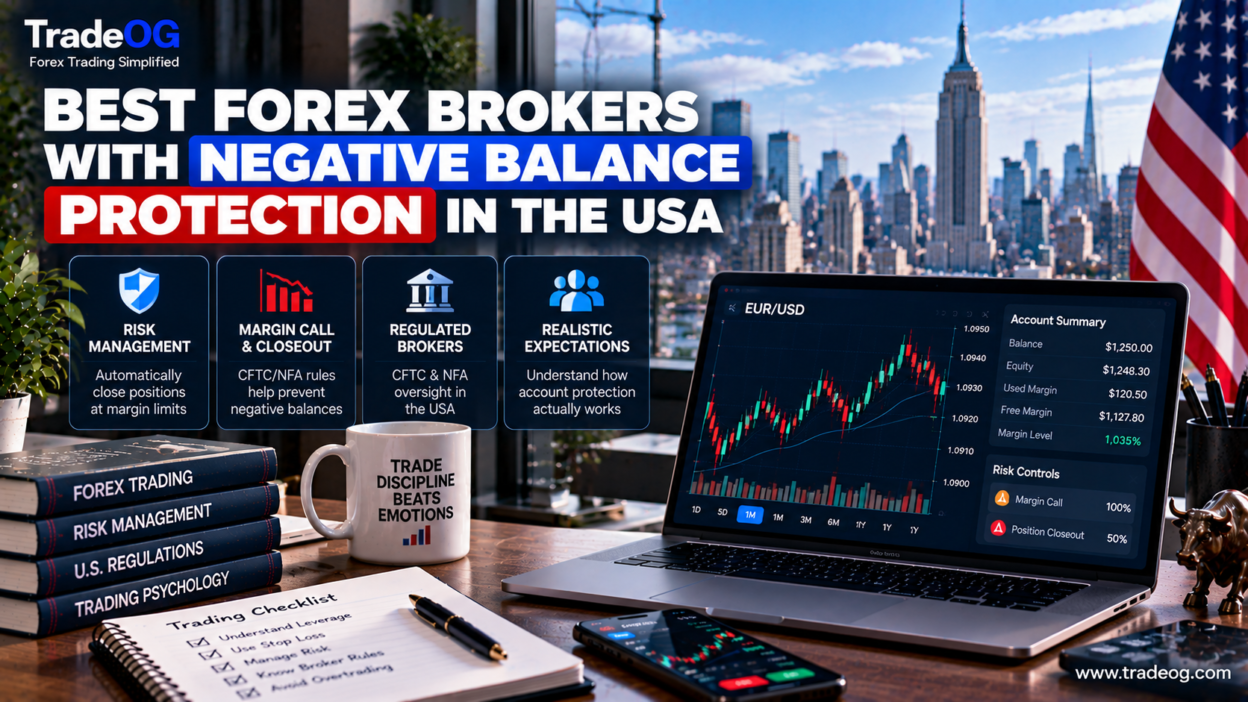
If you’re looking for a U.S. forex broker with negative balance protection, there is an important detail to understand before you open an account: the U.S. market does not work the same way as the UK, Europe, or Australia.
In several overseas markets, retail CFD brokers are required to protect clients from losing more than the money in their account. In the United States, retail OTC forex operates under a different regulatory framework. The CFTC specifically prohibits retail forex dealers from representing that they will guarantee against losses or limit a customer’s losses.
That means you should be careful with articles or broker lists that simply copy an international “negative balance protection” list and label it as a U.S. list.
What Is Negative Balance Protection?
Negative balance protection, usually shortened to NBP, is a policy that prevents a trader’s account from ending up owing the broker money because of trading losses.
Imagine you deposit $1,000 and use leverage to open a position. A sudden market move causes your account equity to fall below zero. With genuine negative balance protection, the broker would normally reset the trading-related negative balance to zero rather than asking you to pay the deficit.
That sounds simple, but the exact rules depend on the jurisdiction, account type and product.
For example, IG states that its negative balance protection applies to certain retail accounts outside the U.S., while its own international comparison page specifically shows that USA (IG) customers can lose more than their deposit.
That is a good example of why you cannot look at a broker’s global website and assume the same protection applies to a U.S. account.
Why U.S. Forex Is Different
U.S. retail forex is regulated differently from the CFD markets found in many other countries.
The CFTC says U.S. retail forex customers should verify that their dealer is registered with the CFTC and check its disciplinary history with the NFA. The CFTC currently identifies registered retail forex dealers including OANDA, FOREX.com, IG US, Interactive Brokers, Trading.com and Charles Schwab Futures and Forex.
U.S. rules also place limits on retail forex leverage. For example, OANDA currently explains that U.S. retail forex leverage is limited to 50:1 for major currency pairs and 20:1 for other pairs.
The combination of leverage limits, margin requirements and automatic liquidation is an important part of how U.S. brokers manage customer exposure.
Do U.S. Forex Brokers Offer Negative Balance Protection?
This is where the answer gets less exciting—but more useful.
You should not treat negative balance protection as a standard feature of U.S. retail forex accounts.
The CFTC’s rules prohibit a retail forex dealer from representing that it will guarantee a customer against loss or limit the customer’s loss.
That is fundamentally different from the European-style NBP model where a retail CFD provider may explicitly promise that an account cannot fall below zero.
So, when comparing U.S. brokers, the better question is often:
“How does this broker prevent or handle a margin deficit?”
That leads us to margin closeouts, liquidation rules, account agreements and the broker’s U.S. legal entity.
U.S. Brokers Worth Comparing for Account Risk Controls
1. OANDA — Strong Margin-Closeout Framework
OANDA is one of the major CFTC-registered U.S. retail forex dealers.
Its U.S. margin rules require traders to maintain sufficient funds against their open positions. OANDA explains that the margin requirement is based on the amount of leverage and that a margin closeout can occur when the account reaches the relevant threshold.
OANDA also warns that in fast-moving markets there may be little time to respond before a margin closeout occurs. Its platform can automatically close open positions when the applicable closeout level is reached.
This is useful risk control, but it should not be described as the same thing as contractual negative balance protection.
Best for: Traders who want a well-established U.S. forex broker with clear margin rules and flexible position sizing.
2. FOREX.com — Established U.S. Dealer With Strong Risk Controls
FOREX.com is operated by Gain Capital Group LLC and has been registered as a U.S. Futures Commission Merchant and Retail Foreign Exchange Dealer with the CFTC and as an NFA member since 2004.
The broker also publishes information about customer-fund segregation, capital strength and risk-management procedures.
For a U.S. trader, the important point is to review the U.S. customer agreement and margin rules rather than assuming that a negative-balance policy found on a FOREX.com page for another country applies to your account.
Best for: Traders who want an established U.S. forex provider and a broad set of trading tools.
3. Trading.com — U.S. Retail Forex Option
Trading.com Markets Inc. is included by the CFTC among the registered U.S. retail forex dealers.
Its customer agreement also shows why traders should read the actual U.S. terms. Trading.com describes situations in which it may restrict withdrawals during extreme market volatility to help prevent an account from sustaining a negative balance.
That kind of provision is a risk-control mechanism, but it should not automatically be interpreted as a blanket guarantee that all trading losses can never exceed your deposit.
Best for: Traders interested in Trading.com’s U.S. forex offering and platform.
4. Interactive Brokers — Best for Multi-Asset Traders
Interactive Brokers is another CFTC-registered U.S. retail forex dealer.
It is particularly different from a traditional forex-only broker because the platform covers multiple asset classes. That can be useful if you want forex alongside stocks, options, futures, bonds or other markets.
For risk protection, focus on the exact account type, margin rules and customer agreement. A multi-asset broker can have different requirements depending on the product you are trading.
Best for: Experienced traders who want forex and multiple other markets in one account.
5. Charles Schwab Futures and Forex — Another U.S. Regulated Choice
Charles Schwab Futures and Forex LLC is also included on the CFTC’s current list of registered retail forex dealers.
For traders considering Schwab, the same rule applies: check the terms for the U.S. entity and the specific forex product instead of relying on a global broker’s NBP policy.
Best for: Traders who already use Schwab’s ecosystem and want access to its forex offering.
Negative Balance Protection vs. Margin Closeout
These two concepts are often confused.
| Feature | Negative balance protection | Margin closeout |
|---|---|---|
| Main purpose | Prevents trading-related debt beyond the protected account balance | Closes positions when available equity/margin becomes insufficient |
| When it matters | After an account falls into a deficit | Before or around a broker’s liquidation threshold |
| Typical result | Negative trading balance may be brought back to zero | Open positions are automatically closed |
| Is it the same thing? | No | No |
OANDA’s U.S. documentation, for example, focuses heavily on margin requirements and automatic closeouts. It explains that positions can be closed when the account reaches its margin closeout threshold.
A margin closeout can reduce the chance of a large deficit, but it is not identical to a promise that your account can never become negative.
Why Offshore Brokers Can Be Dangerous for U.S. Traders
If you search online for “forex broker negative balance protection,” you’ll quickly find brokers regulated in the UK, Europe, Australia, South Africa, or other jurisdictions.
Some of those brokers genuinely offer NBP to retail clients in those jurisdictions.
The problem is that a U.S. resident may not be trading under the same legal entity.
A broker might have:
- a U.S. entity;
- a UK entity;
- an Australian entity;
- an offshore entity.
Each entity can have different leverage, client protections, account agreements and product restrictions.
The CFTC specifically warns U.S. customers about unregistered offshore forex platforms and recommends trading with a CFTC-registered dealer.
Can a U.S. Trader Use a Foreign Broker for Negative Balance Protection?
This is not something you should decide simply because a broker’s website says “negative balance protection.”
First, you need to determine whether the broker legally accepts U.S. residents. Then you need to identify the entity that will actually hold your account. Finally, read that entity’s customer agreement and risk disclosures.
If the broker is not authorized to provide retail forex services to U.S. residents, a promise on an overseas website should not be treated as a substitute for U.S. regulatory protection.
What Happens if a U.S. Forex Account Runs Out of Margin?
Margin requirements are designed to force a broker to reduce exposure when an account no longer has enough equity to support its positions.
OANDA, for example, explains that a margin call can occur when the account falls below its required margin threshold. If the account remains under-margined or reaches the applicable closeout level, positions can be automatically closed.
But traders should never build a strategy around the assumption that liquidation will happen at exactly the price they expect.
During fast markets, spreads can widen and prices can gap. OANDA specifically warns that there may be insufficient time to warn a trader before a margin closeout in rapidly changing conditions.
How to Protect Yourself When Trading Forex in the USA
1. Use a CFTC-registered dealer
Start with regulation. The CFTC recommends verifying registration and checking the dealer’s NFA disciplinary history before depositing funds.
2. Keep leverage under control
U.S. retail forex leverage is limited, but the maximum allowed leverage is not a recommended leverage level. Using the maximum available leverage can make an account much more sensitive to ordinary market movements.
3. Use small position sizes
Position size should be based on the amount you are willing to lose if the stop is hit, not on the maximum position your broker will let you open.
4. Leave unused margin in the account
Running an account close to its margin limit gives you very little room for normal volatility. A trade does not need to reach your stop loss to create a margin problem if your overall exposure is too large.
5. Understand the broker’s liquidation policy
Read the margin section of the customer agreement. Find out when the broker can close positions, whether it can close multiple positions at once, and how it handles market gaps.
6. Don’t rely on negative balance protection
Even where NBP genuinely applies, it should be a final safety net—not a trading strategy.
What About Stop Losses?
A stop loss is different from negative balance protection.
A stop loss attempts to close a specific trade when the market reaches your chosen price. Negative balance protection concerns the overall account balance.
Neither one guarantees that your actual execution price will match your intended price during a fast market.
Gaps, slippage and liquidity conditions can affect execution.
Best U.S. Forex Broker for Risk Protection: Our Take
| Broker | U.S. regulated? | Risk-control focus | Our take |
|---|---|---|---|
| OANDA | Yes | Margin calls and automatic closeouts | Strong choice for clear margin rules |
| FOREX.com | Yes | Margin, account controls and risk management | Strong established option |
| Trading.com | Yes | Margin and volatility-related account controls | Worth comparing |
| Interactive Brokers | Yes | Product-specific margin and liquidation controls | Best suited to experienced multi-asset traders |
| Charles Schwab | Yes | U.S. regulated account framework | Useful for existing Schwab customers |
Important: This is not a ranking of which broker offers contractual negative balance protection. The U.S. regulatory framework is different, and you should not assume that a broker’s NBP policy from another country applies to its U.S. entity.
Frequently Asked Questions
Do U.S. forex brokers offer negative balance protection?
Negative balance protection is not a standard U.S. retail forex feature in the same way it is in some overseas CFD jurisdictions. U.S. retail forex is governed by a different regulatory framework, including CFTC rules that prohibit dealers from representing that they will guarantee against losses or limit a customer’s losses.
Can I lose more than my deposit trading forex in the USA?
You should not assume that your losses are automatically capped at your deposit. Read the U.S. broker’s customer agreement and margin rules carefully. The existence of automatic margin closeouts does not necessarily equal negative balance protection.
Does OANDA USA have negative balance protection?
OANDA’s U.S. materials emphasize margin requirements, margin calls and automatic margin closeouts. They should not be confused with the statutory-style negative balance protection available to retail CFD clients in some other jurisdictions.
Does FOREX.com USA have negative balance protection?
Do not assume that a FOREX.com NBP policy from another country applies to a U.S. account. FOREX.com operates through different legal entities in different jurisdictions, and its U.S. business is regulated by the CFTC and NFA.
Is negative balance protection available in the UK?
Yes, retail clients in the UK generally receive regulatory negative balance protection for applicable leveraged products. This is one reason you should never copy a UK broker comparison and assume the same protections apply to U.S. customers.
Why is U.S. forex different from European CFD trading?
The products, leverage rules, regulators and customer protections are different. U.S. retail OTC forex operates under CFTC/NFA oversight, while many European retail CFD accounts operate under a framework that includes specific negative balance protection requirements.
What is safer: negative balance protection or a margin closeout?
They solve different problems. Margin closeout attempts to reduce open exposure when your account no longer has enough margin. Negative balance protection limits the customer’s trading-related deficit under the applicable rules. Having both can provide more protection, but U.S. traders should not assume that both are available on a U.S. retail forex account.
Bottom Line
If you are searching for the best forex brokers with negative balance protection in the USA, be careful with the wording of the comparison itself.
The U.S. market does not simply copy the UK or Australian NBP model. Major U.S. retail forex dealers operate under CFTC/NFA rules, with leverage limits, margin requirements and liquidation procedures playing a major role in managing account exposure. The CFTC specifically prohibits retail forex dealers from guaranteeing against loss or representing that they will limit a customer’s losses.
For a U.S. trader, OANDA, FOREX.com, Trading.com, Interactive Brokers and Charles Schwab are among the regulated dealers worth researching. But choose based on the actual U.S. entity, margin rules, trading costs, platform and customer agreement—not an NBP badge copied from another country’s website.
If your top priority is never owing more than your account balance, read the broker’s U.S. customer agreement before depositing a single dollar.
Official Sources
- CFTC — Eight Things You Should Know Before Trading Forex
- CFTC — Forex Frauds and Registered Dealers
- OANDA USA — Forex Spreads and Margins
- OANDA USA — Margin Terminology
- FOREX.com USA — Regulation and Funds Security
Risk disclosure: Forex trading involves substantial risk of loss and is not suitable for every investor. Leverage can magnify losses. Negative balance protection, where available, is subject to the applicable entity, account type, product and jurisdiction. This article is educational information, not financial advice. Always verify current terms directly with the broker before opening or funding an account.