
In prop trading, one of the hardest skills is often not finding a trade. It is waiting until there is a trade worth taking.
A trader may open a prop firm challenge with a clear strategy, a fixed risk limit and a defined setup. Then the market stays quiet for an hour. A move starts without them. Another pair begins moving. A small pullback appears on XAU/USD. Suddenly, the pressure to “do something” becomes stronger than the original trading plan.
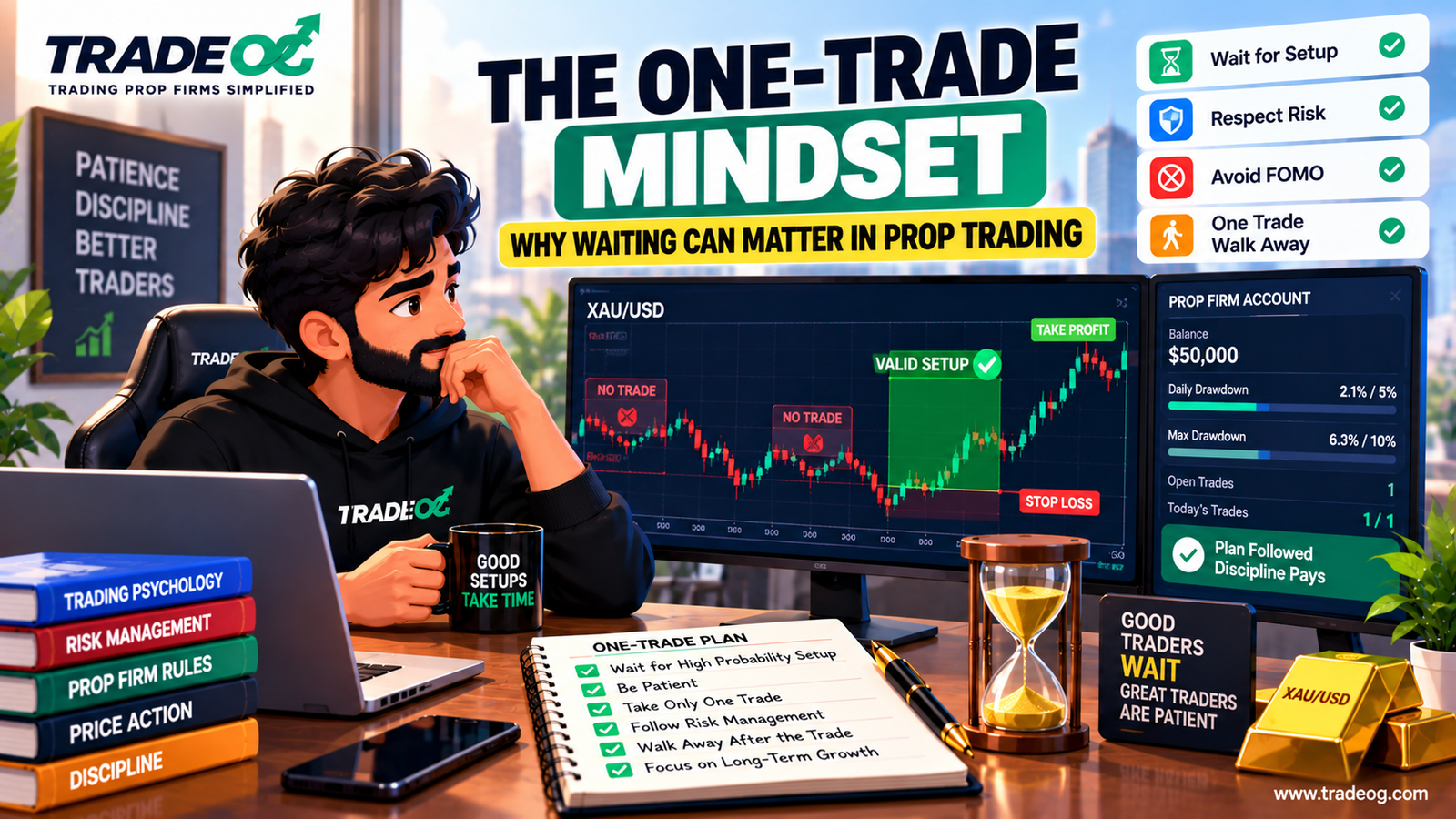
This is where the one-trade mindset can help. The idea is simple: instead of measuring a session by how many trades you take, measure it by whether you waited for and executed your planned setup correctly.
CME Group’s trading-plan guidance emphasizes defining setups and trigger points before entering, while its risk-management material stresses knowing the maximum loss and exposure you are prepared to accept. CME Group: Trading Strategies in Your Trade Plan
What Is the One-Trade Mindset?
The one-trade mindset does not mean that you are only allowed to take one trade every day. It means you approach the market as if you only need one clean opportunity at a time.
If your strategy produces two or three valid setups, your rules can allow those trades. But you do not create extra positions simply because the first setup has not appeared.
The mindset changes the question from:
“How many trades can I take today?”
to:
“Is there a setup that my trading plan actually permits me to trade?”
That distinction is especially relevant in prop trading because unnecessary trades can consume risk capacity even when every individual position looks small.
Why Waiting Can Matter in Prop Trading
Waiting is not the same as doing nothing. Waiting can be an active part of a trading process because it prevents the trader from entering before the required conditions exist.
CME Group’s material on trade planning recommends defining the conditions that must be met before entering or exiting. Its risk-management guidance also says traders should establish maximum trade loss, maximum day loss and acceptable exposure as part of a plan. CME Group: Risk Management and Your Trade Plan
1. Waiting Filters Out Forced Trades
A forced trade usually starts with a reason that has nothing to do with the strategy:
- “The market is moving and I am missing it.”
- “I have not made any profit today.”
- “The challenge target is still far away.”
- “I lost the previous trade, so I need another opportunity.”
- “I have been watching the chart for two hours, so I should trade.”
None of those statements is an entry signal.
A setup should come from predefined market conditions. If those conditions are absent, remaining flat is still a trading decision.
2. Waiting Reduces FOMO Pressure
FOMO often appears after a trader watches price make a large move without entering.
The trader then enters late because the move looks obvious in hindsight. But a late entry can have a completely different risk profile from the original setup. The stop may need to be wider, the target may be closer, and the reward-to-risk structure may no longer match the plan.
The one-trade mindset accepts a simple rule:
If the planned entry is gone, the trade may be gone.
There is no requirement to participate in every market move.
The Difference Between Patience and Hesitation
This distinction is important.
Patience means the setup is incomplete, so you wait.
Hesitation means the setup is valid according to your plan, but fear or uncertainty prevents execution.
For example, suppose your XAU/USD strategy requires a higher-timeframe trend, a liquidity sweep, a confirmation candle and a predefined stop location. If only the first two conditions are present, waiting is patience.
If all your conditions are present and your normal risk has been calculated, but you refuse the trade only because your previous trade lost, that may be hesitation.
The solution is not to force more trades. It is to make the trading plan clear enough that you know what qualifies as a valid setup.
One Trade Does Not Mean One Chance to Recover
A common psychological mistake is treating the next trade as responsible for the previous trade.
For example:
| Situation | Emotional Response | Process-Based Response |
|---|---|---|
| Previous trade lost | Increase size to recover | Return to normal risk rules |
| No setup for 2 hours | Force an entry | Keep waiting |
| Price moves without entry | Chase price | Wait for the next valid setup |
| First trade wins | Double size | Keep planned risk |
| First trade loses | Revenge trade | Review and wait for the next valid setup |
CME Group’s trading-psychology material notes that losses can affect judgment and emphasizes having rules for dealing with losing trades. CME Group: Planning for Trading Losses
The One-Trade Mindset and Prop Firm Drawdown
Prop firm accounts commonly operate under defined loss or drawdown parameters. The exact limits depend on the firm and account model, so traders should always read the current rules for their specific account.
The important principle is that every additional position consumes some amount of risk capacity.
Imagine a trader has a $50,000 account and has decided that the strategy normally risks $250 per trade. If the trader starts taking five weak trades simply because the market feels slow, the planned risk process has changed even if every position individually looks manageable.
By contrast, a selective trader can spend much more time flat and only expose the account when the setup meets the predefined criteria.
CME Group’s position-sizing guidance says position size should be determined using the stop location and the amount of account risk the trader is willing to accept. CME Group: Proper Position Size
Why “I Need to Hit the Target” Can Become Dangerous
Prop firm evaluations can create a visible profit target. That target can unintentionally create urgency.
A trader may start thinking:
- “I need 5% more.”
- “I can finish this challenge this week.”
- “I need a big XAU/USD move.”
- “One large trade could get me there.”
The problem is that the market does not know the trader’s target.
A profit target is an account objective. It is not a market signal.
Your entry should still depend on your setup, risk and execution rules. Trying to make the account reach a target faster can lead to larger positions, lower-quality entries and more exposure than the strategy was designed to handle.
One Good Setup Can Be Enough for the Session
Some traders find it difficult to stop after one trade because they associate productivity with screen time.
But trading is not a factory where more activity automatically produces more output.
If one valid setup appears and your strategy gives you a complete trade, you can evaluate the session based on execution:
- Was the setup valid?
- Was the position size calculated correctly?
- Was the stop placed according to the plan?
- Did you follow the management rules?
- Did you avoid unnecessary re-entry?
If the answer is yes, taking another trade simply to feel active may add risk without adding a genuine opportunity.
When Taking More Than One Trade Makes Sense
The one-trade mindset should not become an excuse to avoid legitimate opportunities.
Multiple trades can be reasonable when they are part of the tested strategy and each trade independently satisfies the entry criteria.
For example, a strategy might have:
- one London-session setup;
- one New York-session setup;
- multiple predefined continuation entries;
- separate rules for trend and range conditions.
In that case, the trader should follow the strategy rather than impose an arbitrary one-trade limit.
The principle is selectivity, not inactivity.
A Simple One-Trade Routine for Indian Prop Traders
Before the Session
- Check the prop firm’s current loss and trading restrictions.
- Mark important support and resistance areas.
- Identify the market session you intend to trade.
- Check major economic events that could affect your instrument.
- Define your maximum planned risk.
- Write down the exact setup conditions.
During the Session
- Wait for the setup.
- Do not chase a move that has already happened.
- Calculate position size from the stop and planned risk.
- Enter only when your conditions are satisfied.
- Once the trade is managed according to plan, step away if your process says the session is finished.
After a Loss
Do not automatically increase size. Do not create another trade to recover the loss. Review whether the trade followed the plan, then wait for the next independent setup.
After a Win
Do not automatically increase size because you feel confident. One winning trade does not change the statistical structure of your strategy.
The Mathematics Behind Waiting
Trading results are not determined only by the number of winning trades. They also depend on the average size of wins and losses, trading frequency and risk per position.
CME Group’s educational material explains the concept of mathematical expectation: the combination of win frequency and average win/loss size matters when evaluating a trading model. CME Group: The Mathematics of Trading Success
This is why taking more trades is not automatically better. If additional trades are lower-quality and produce unnecessary losses, increasing activity can reduce the quality of the overall process.
One-Trade Mindset Checklist
- Do I have a clearly defined setup?
- Has the setup actually appeared?
- Am I entering because of my plan or because I am bored?
- Am I chasing a move I already missed?
- Is my position size based on planned risk?
- Am I trying to recover a previous loss?
- Would I take this trade if the previous trade did not exist?
- Does this trade fit my prop firm’s current rules?
- If there is no setup, am I comfortable staying flat?
- Can I walk away after following my process?
Final Takeaway
The one-trade mindset is not about predicting that the next trade will win. It is about removing the pressure to participate constantly.
Waiting can matter because a trader cannot control when the market creates a valid setup. The trader can control whether they enter before the setup, chase after it, increase risk because of a previous result, or remain patient until their conditions are met.
For prop traders, that distinction is important. A challenge does not require you to trade every hour. Your trading plan should determine when you participate and when you stay flat.
One clean setup taken according to plan can be more meaningful than a session filled with forced trades. The goal is not to make the market give you a trade. The goal is to be ready when your setup actually appears.
For more TradeOG risk-management guides, read Why Traders Increase Lot Size After a Losing Trade and Prop Firm Risk Management Plan for Indian Traders.
Disclaimer: This article is for educational purposes only and is not financial advice. Trading leveraged products involves substantial risk of loss. Prop firm rules vary by firm and account model, so always check the current official rules before trading.