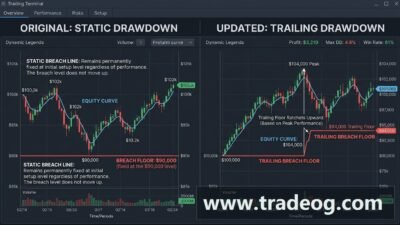


You spent hours evaluating prop firms, comparing fee structures, and testing your trading strategy on demo accounts. You find a firm that aligns with your trading style: static drawdown, unrestricted news trading, and bi-weekly payouts. You purchase a $100,000 challenge, place your initial trades, and build a modest profit cushion.
Three weeks later, you log into your trading terminal or check your email to find an official announcement: “Important Policy Update: Effective immediately, all accounts are transitioning to an intraday trailing drawdown model, and high-impact news trading is restricted.”
Your stomach drops. Your trading strategy relies on swing trades that hold through macroeconomic announcements, and your risk model was built around a fixed, static drawdown floor. Your immediate question is urgent and valid: Does this new rule apply to the challenge I already purchased, or am I protected under the rules active when I paid?

This situation has played out repeatedly across the retail proprietary trading industry. As regulatory frameworks shift, liquidity providers update their parameters, and broker bridges adapt, proprietary firms frequently update their rulebooks.
The central reality every trader must understand is this: A prop firm rule change does not automatically affect every trader in the same way.
Whether a policy modification applies to your active challenge depends on the firm’s legal agreement, the specific wording of the announcement, the stated effective date, your account status, and whether existing accounts are “grandfathered.”
Here is an exhaustive, practical guide to what happens when a prop firm changes rules after purchase, how to determine if your account is affected, the critical difference between new challenges and existing accounts, and the exact steps to protect your capital and funded status.
Can a Prop Firm Change Its Rules After You Buy a Challenge?
Related: how to track prop firm rule changes in 2026 and what to do after a drawdown rule change.
Yes, proprietary trading firms can update their rules, but the critical question is which specific accounts the update applies to.
When you purchase an evaluation, you agree to the firm’s Terms of Service (ToS) and End-User License Agreement (EULA). Virtually every commercial software and prop trading agreement contains an “Amendments” or “Modifications” clause. These standard commercial provisions state that the company reserves the right to alter trading rules, platform features, fee schedules, and operational parameters.
However, when a firm updates its rulebook, the change generally takes one of five operational paths:
- Future Purchases Only: The new rules apply exclusively to evaluations purchased on or after the announcement date. Existing accounts continue trading under their original terms.
- Newly Activated Accounts: The rules apply to existing traders only once they pass to the next phase (e.g., Phase 1 follows old rules, but the Phase 2 or Funded account adopts new rules upon activation).
- Existing Evaluations with a Transition Window: Traders with active evaluation accounts are given a grace period (e.g., 14 to 30 days) to complete their challenge under original terms before the account is migrated.
- Immediate Application Across All Active Accounts: The firm updates server-side risk monitoring, meaning all existing evaluation and funded accounts must comply with the new rule as of a specified effective date.
- Funded-Only Adjustments: The evaluation phase remains unchanged, but payout eligibility criteria, profit splits, or scaling milestones for live simulated funded accounts are modified.
Never assume that an announcement on Twitter, Discord, or YouTube applies universally to your specific account. You must audit the exact legal language of the notice.
Why Prop Firms Change Their Rules
Retail traders often perceive rule changes as arbitrary hurdles designed to make passing challenges harder. While poorly managed firms sometimes tighten rules to restrict payouts during financial stress, reputable firms generally adjust trading conditions due to genuine operational and structural requirements:
- Broker & Liquidity Provider (LP) Shifts: Most prop firms do not operate as regulated retail brokerages; they partner with institutional liquidity providers and technology bridges (such as cTrader, DXtrade, or Match-Trader). If a liquidity bridge changes its margin requirements, overnight swap fees, or weekend exposure terms, the prop firm must update its client rules to reflect those realities.
- Regulatory & Compliance Adjustments: Evolving financial regulations across North America, Europe, and Asia regularly require prop firms to alter their payment processing workflows, KYC identity verification, or leverage limits to maintain institutional banking access.
- Exploitation & Systemic Risk Controls: When mass-market commercial bots, latency arbitrage scripts, or coordinated hedging groups discover a loophole in a firm’s simulated execution bridge, the firm must patch the vulnerability to protect capital pools.
- Market Volatility Regimes: Periods of geopolitical crisis or macroeconomic instability often compel risk desks to introduce news trading blackout windows or restrict weekend holds to protect against catastrophic market gaps.
- Payout Provider Logistics: Banking partner adjustments or cryptocurrency network compliance shifts often lead to changes in withdrawal frequencies, minimum payout thresholds, or payout processing windows.
The Most Important Question: Does the New Rule Apply to Existing Accounts?
When you see a rule-change announcement, your immediate task is to determine account applicability. Review this operational matrix:
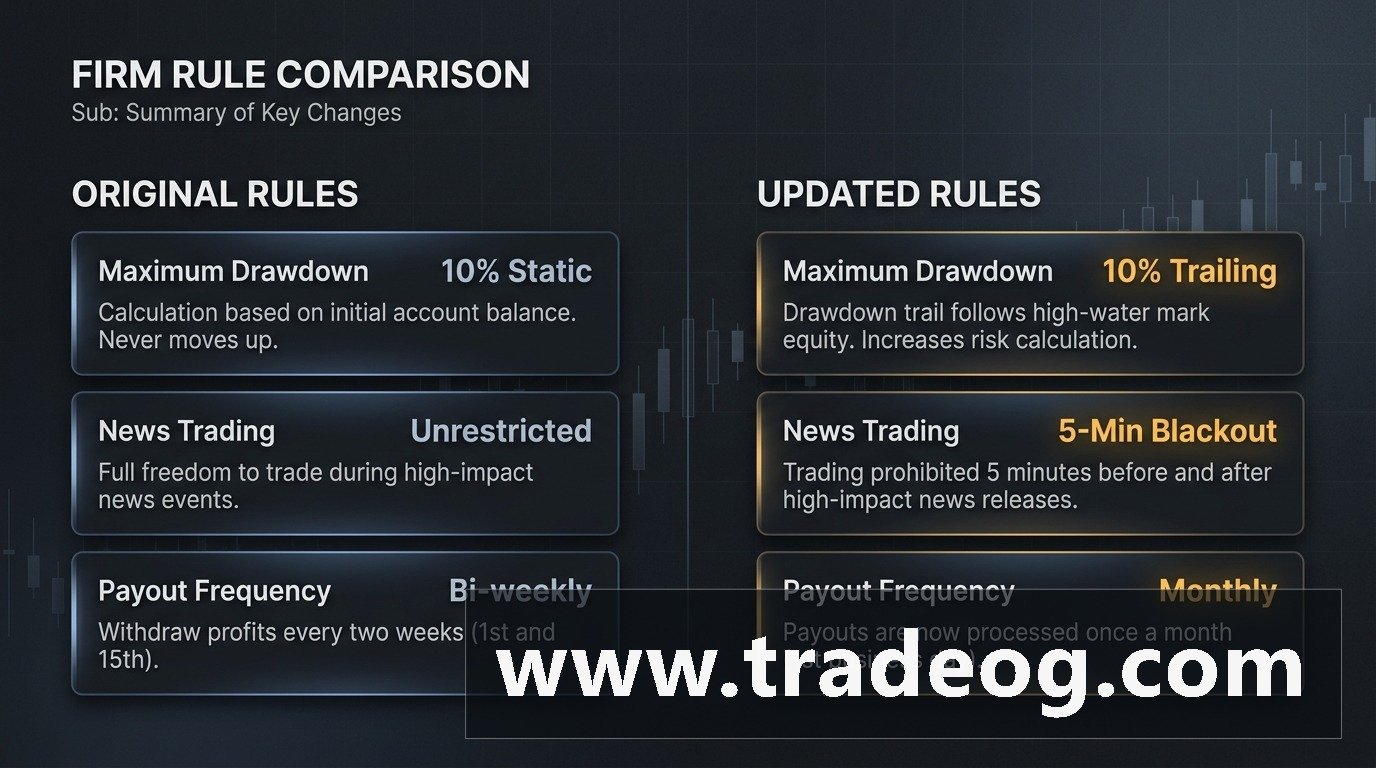
| Rule Category | Application to New Accounts | Application to Existing Accounts | What the Trader Must Verify |
|---|---|---|---|
| Drawdown Methodology | Immediate (Standard) | Firm-Specific / Grandfathered | Check whether your liquidation floor stays static or begins trailing equity. |
| News Trading Restrictions | Immediate (Standard) | Firm-Specific / Immediate Server Rule | Verify if the rule applies to pending orders and holding open trades through red-folder news. |
| Weekend Holding Rules | Immediate (Standard) | Often Applied Globally | Confirm whether you must flatten all open positions by Friday New York close. |
| Payout Frequency & Split | Immediate (Standard) | Firm-Specific / Contractual | Check if your original profit split (e.g., 80% vs 90%) and first withdrawal date are preserved. |
| Consistency Rules | Immediate (Standard) | Transition-Dependent | Verify if single-day profit caps (e.g., 40% rule) apply retroactively to already booked profits. |
| Inactivity Deadlines | Immediate (Standard) | Often Applied Globally | Check if the maximum days between placed trades has shortened (e.g., 30 days to 14 days). |
| Prohibited Strategies / EAs | Immediate (Standard) | Usually Immediate | Confirm whether automated bots or tick-scalping styles are subject to immediate ban. |
The term “Firm-Specific” in the table above is deliberate: There is no universal legal standard in retail prop trading requiring all firms to treat existing accounts identically. You must verify the specific terms published by your provider.
Existing Accounts vs. New Challenges: The Three Operational Models
When analyzing how a policy update impacts active traders, proprietary firms typically utilize one of three distinct administrative models:
Scenario A: The “New Challenges Only” Model
This is the cleanest and most trader-friendly approach. The firm issues a statement such as: “All challenges purchased after October 1st will follow our updated 8% profit target and trailing drawdown rule. All accounts purchased prior to October 1st will remain under their original 10% target and static drawdown parameters.”
Under this structure, your account is completely insulated. The server flags your account ID as belonging to “Rulebook Version 1.0,” and the risk engine evaluates your trades according to the terms you paid for.
Scenario B: The “Global Server-Side Update” Model
In this model, the firm updates its broker bridge or risk management software globally. The announcement states: “Effective November 15th, weekend holding is prohibited across all evaluation and funded accounts.”
Here, existing accounts are directly affected. Even though weekend holding was permitted when you paid your challenge fee on October 10th, continuing to hold trades over the weekend after November 15th constitutes an account violation. The rationale firms provide is that simulated server liquidity cannot support the risk across their entire portfolio.
Scenario C: The “Transitional / Opt-In” Model
Firms frequently introduce positive rule updates (such as removing minimum trading days, raising profit splits from 80% to 90%, or lowering profit targets). In these instances, firms may offer a transitional model:
- Automatic Migration: Existing accounts automatically receive the improved terms.
- Opt-In Migration: Existing traders can choose to adopt the new rules via a dashboard toggle, or remain under their legacy agreement.
- Phase-Transition Migration: Active Phase 1 accounts finish under original rules, but Phase 2 automatically activates under the new rulebook.
What Does “Grandfathered” Mean in Prop Trading?
In proprietary trading, grandfathering refers to an administrative policy where an existing account is permitted to continue operating under the rules that were active on the date of purchase, even after the firm has updated or replaced those rules for new customers.
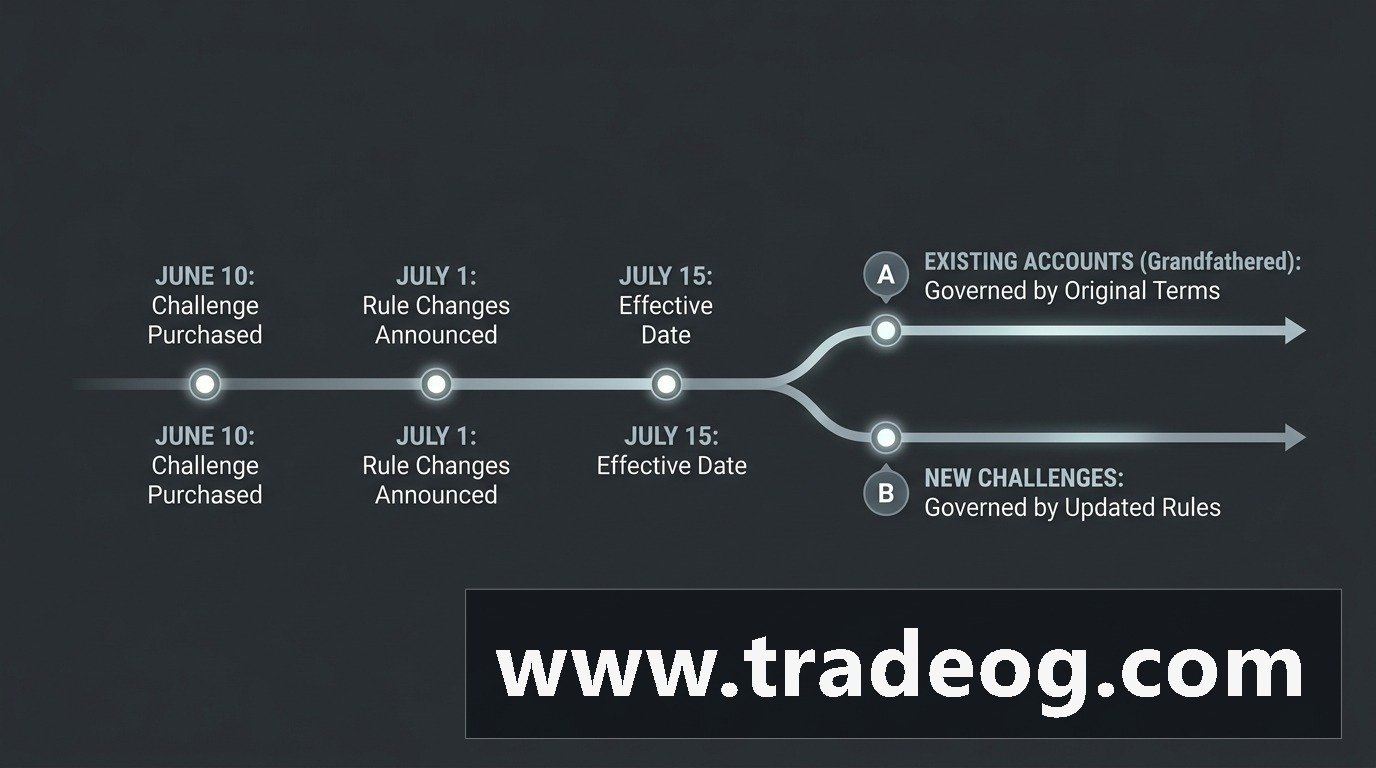
A Practical Grandfathering Timeline Example
- June 10: You purchase a $100,000 challenge with a 10% Static Drawdown floor fixed at $90,000.
- July 1: The prop firm announces that due to liquidity provider terms, all future $100,000 challenges will use a 6% Intraday Trailing Drawdown.
- July 15 (Effective Date): The new rules go live on the firm’s website and checkout portal.
If the firm grandfathers existing accounts, your account purchased on June 10th retains its original 10% static drawdown floor ($90,000) for the lifetime of that evaluation. A new trader purchasing on July 16th is subject to the 6% trailing drawdown.
Critical Legal Note: Grandfathering is a corporate policy decision, not an automatic statutory requirement under international commercial contract law. Unless your specific agreement explicitly guarantees that terms cannot be amended during the evaluation, you cannot assume your account is grandfathered without written confirmation from the firm.
What If the Prop Firm Changes the Drawdown Rule?
Of all potential rule modifications, a change to the drawdown calculation methodology has the most immediate, severe impact on your survival probability.
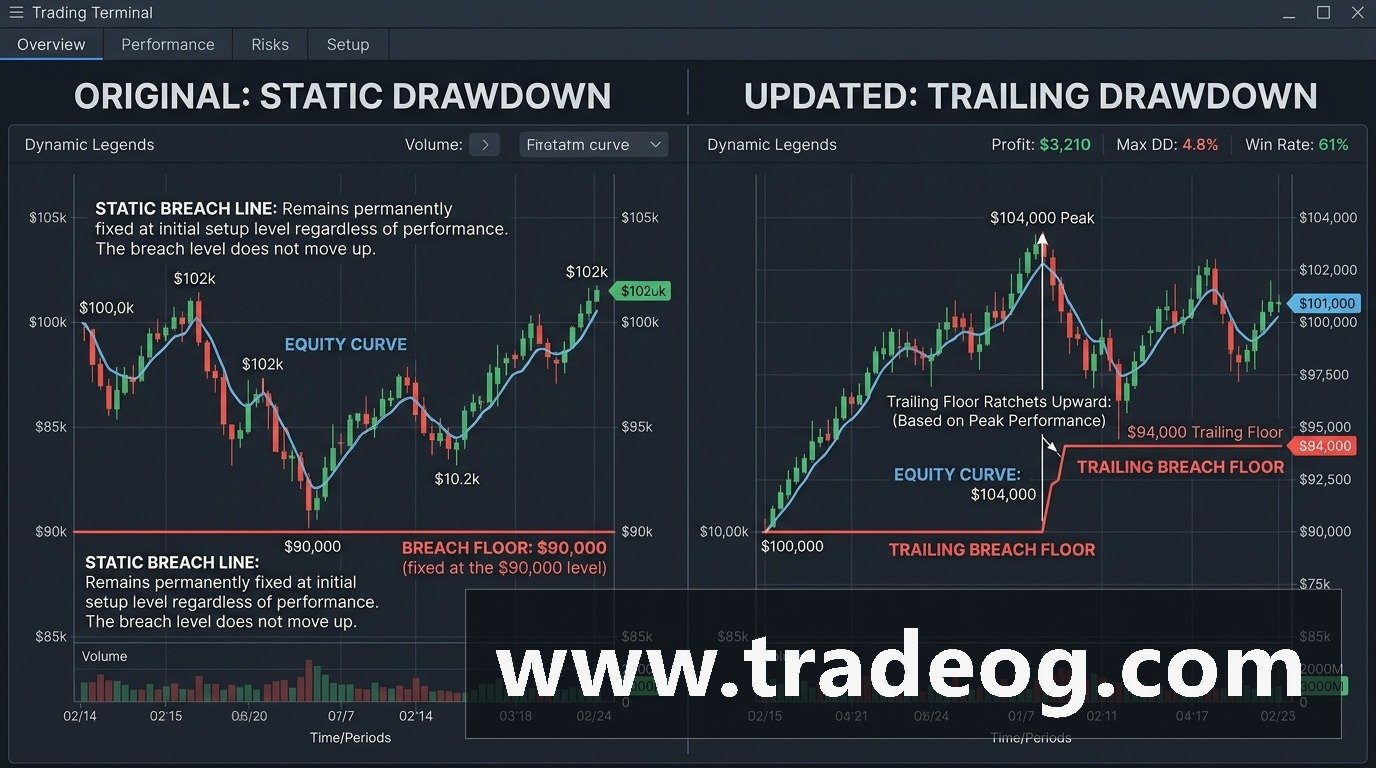
Static Drawdown vs. Trailing Drawdown: The Real Math
Consider a trader managing a $100,000 challenge under an original static drawdown rule, which is then unexpectedly updated to a trailing model:
- Original Static Model:
- Starting Balance: $100,000
- Maximum Drawdown: 10% ($10,000)
- Liquidation Floor: $90,000 (Permanently Fixed)
- Your Account Performance: You generate +$4,000 in profit. Account equity sits at $104,000.
- Your Risk Runway: You are now $14,000 away from account failure ($104,000 minus $90,000). Your accumulated profits expand your safety buffer.
- Updated Trailing Model:
- The firm transitions all accounts to a 10% trailing drawdown based on peak equity (high-water mark).
- Because your equity peaked at $104,000, the trailing algorithm ratchets your liquidation floor up to $94,000 ($104,000 minus $10,000).
- If price pulls back and you close your positions at $98,000, your remaining distance to failure is now only $4,000 ($98,000 minus $94,000).
Under the static rule, you had a $14,000 cushion. Under the new trailing rule, your cushion has been compressed to $4,000—even though you are up $2,000 overall! If a firm announces a retroactive or global shift from static to trailing drawdown, you must immediately recalibrate your lot sizing to prevent an accidental breach. Read our complete guide on trailing drawdown vs EOD drawdown to understand these calculations.
What If the Firm Changes News Trading Rules?
News trading policies are among the most frequently modified conditions in retail prop trading. An announcement may state that trading during high-impact economic releases (red-folder events like CPI, NFP, or FOMC) is no longer permitted.
If news trading rules are updated while you have an active account, you must immediately determine:
- Is the restriction retroactive? Will profits earned on previous news trades prior to the effective date be deducted upon payout review? (Reputable firms never deduct profits earned legitimately prior to an announcement).
- What constitutes a “News Trade”? Does the ban prohibit opening new market orders, or does it also prohibit having existing open positions running through the release?
- What is the blackout window? Is execution banned 2 minutes before and after the release, or 5 minutes?
- Are pending orders affected? Will pending Buy Stops and Sell Stops be automatically cancelled by the broker server prior to the release?
If an account-wide news restriction takes effect, adjust your strategy immediately: close intraday positions 15 minutes before scheduled red-folder releases and remove all pending breakout orders.
What If the Firm Changes Payout Rules?
Generating profits on a simulated terminal is meaningless if the withdrawal conditions are altered. Prop traders must understand the vital distinction between rules for trading capital and rules for withdrawing profits.
Payout condition updates frequently involve:
- Payout Frequency: Transitioning from bi-weekly (14-day) payouts to monthly (30-day) withdrawal cycles.
- Minimum Withdrawal Thresholds: Introducing a rule requiring a minimum dollar profit (e.g., minimum $500 withdrawal) or a minimum percentage gain (e.g., at least 2% above starting balance).
- Profit Consistency Requirements: Implementing a rule where no single trading day can represent more than 30% to 50% of total requested profit. If you booked a large gain on Day 1 before the rule was announced, check whether your historical trading days are subject to dilution. Learn how these formulas work in our guide on prop firm consistency rules explained.
- Buffer Locks: Mandating that traders leave a specific dollar amount (e.g., the amount of the maximum drawdown) inside the account after a payout to preserve future trading runway.
- Disbursement Methods: Shifting from direct international bank wires to cryptocurrency (USDT/BTC) or third-party contract platforms (Rise, Deel).
If a firm alters payout rules, verify whether pending payout requests submitted prior to the announcement are processed under original terms. Legitimate firms always process previously queued requests under legacy terms.
What If the Firm Changes the Profit Split?
A change in the advertised profit split can work for or against the trader:
- The Positive Shift (e.g., 80/20 to 90/10): Competitive pressure frequently prompts firms to increase trader profit splits. When this happens, firms typically apply the higher 90% split to all future payouts across all active funded accounts automatically.
- The Restrictive Shift (e.g., 90/10 to 80/20 or tiered scaling): If a firm reduces baseline splits or introduces tiered milestones (e.g., 70% on month one, scaling to 80% on month three), existing funded contracts are often protected under their signed independent contractor agreements, while new purchases adopt the lower split.
Always review your signed funded trader agreement. The percentage split documented on your legal contract governs your payouts, regardless of what marketing banner appears on the website homepage.
Can a Rule Change Affect a Challenge You Already Purchased? Real Scenarios
To see how these principles apply in practice, examine three common real-world scenarios:
Example 1: The Effective Date Boundary
A trader purchases a $50k challenge on August 10th. On August 25th, the firm announces that minimum trading days are increasing from 4 days to 10 days, effective September 1st. The trader hits their profit target on August 29th and submits for Phase 2. Because the target was reached and submitted prior to the September 1st effective date, the account is evaluated under the 4-day rule.
Example 2: The Mandatory Technical Migration
A trader holds a $100k funded account on MetaTrader 4. Due to broker license updates, the firm announces that all MT4 accounts are being migrated to cTrader or DXtrade by October 15th. In this scenario, the rule change is technically unavoidable. The trader cannot remain on MT4 because the server bridge is shutting down. The trader must export their trade records, familiarize themselves with the new platform interface, and verify that open positions are safely closed prior to migration day.
Example 3: The Retroactive News Dispute
A trader makes $3,000 on a high-impact CPI release on Tuesday. On Thursday, the firm issues an announcement banning news trading, stating: “News trading is prohibited effective immediately.” On Friday, the trader submits a payout request. If the compliance desk attempts to void Tuesday’s $3,000 profit, the trader has clear evidentiary grounds to appeal: Tuesday’s trade occurred 48 hours prior to the rule’s publication and effective date.
Read the Effective Date Carefully: Why Timestamps Matter
When reviewing any prop firm rule announcement, you must identify four distinct administrative dates:
- Announcement Date: The day the firm publishes the news on social media, Discord, or their website blog.
- Publication Date: The day the official Terms of Service document in the website footer is formally updated.
- Effective Date: The exact date and server time when the automated risk monitoring engine begins enforcing the rule on trading accounts.
- Purchase / Activation Date: The timestamp when your challenge invoice was generated and your trading credentials were sent.
Golden Rule of Prop Firm Compliance:
A rule cannot govern your trading until its official Effective Date. Always document the exact hour and server timezone of enforcement.
Where Should You Look for Official Rule Changes?
One of the most dangerous mistakes retail traders make is relying on secondary sources for rulebook updates. Never base your trading decisions on:
- YouTube review walkthroughs recorded four months ago.
- Reddit threads or trading forum rumors.
- Unverified screenshots shared in public Telegram channels.
- Affiliate blog articles that haven’t been updated.
The Official Verification Hierarchy:
- The Official Terms of Service (ToS): The legally binding document linked in the site footer.
- The Official FAQ / Help Center: The firm’s searchable knowledge base containing current rule parameters.
- Official System Emails: Formal notification emails sent directly to your registered user address.
- The Trader Dashboard Notice Banner: Internal platform notifications appearing upon login.
- The Firm’s Official Discord/Telegram Announcement Channel: Specifically the read-only, admin-verified announcement room (not general community chat).
What If the Website and Your Original Rules Conflict?
What happens if the firm’s marketing page displays new, restrictive rules, but your purchase confirmation documents more favorable terms?
This conflict is resolved through contractual documentation. If you can prove that you purchased the challenge under specific terms and never received or accepted updated terms, you have legitimate grounds to request that your account be grandfathered, transferred, or refunded.
If the firm insists on applying restrictive terms retroactively without notice, and customer support refuses to offer a reasonable transition, you have the right to request an official evaluation fee refund based on failure of consideration. For more on your customer protections, read our analysis on prop firm fees explained: what you are paying for.
What Should You Do When a Rule Change Is Announced? A 10-Step Process
When an announcement drops, follow this structured, professional protocol:

- Step 1 — Save the Announcement: Take a full-page timestamped screenshot of the official announcement or save the notification email as a PDF.
- Step 2 — Download the Current Terms: Immediately export a PDF copy of the website’s published Terms of Service and Trading Rules.
- Step 3 — Identify the Exact Effective Date: Note the exact date, time, and server timezone when the update takes effect.
- Step 4 — Check for Grandfathering Clauses: Search the announcement text for phrases like “existing accounts are exempt” or “applies to new purchases only.”
- Step 5 — Identify Specific Rule Mechanics: Determine precisely what changed: drawdown formula, news windows, weekend holding, or payout frequency.
- Step 6 — Audit Open Trades: If the change restricts overnight holding or news, check whether your currently running positions are at risk.
- Step 7 — Review Payout Implications: Confirm whether your next scheduled withdrawal request will be processed under old or new terms.
- Step 8 — Contact Support with a Ticket: If the announcement does not explicitly mention existing accounts, send a formal written ticket to support requesting written confirmation.
- Step 9 — Save Support’s Response: Archive the written reply from customer support in your evidence folder.
- Step 10 — Adjust Your Trading Plan: If the rule validly applies to your account, update your position sizing, stop placement, and trading calendar before the effective date ticks over.
10 Questions to Ask Support About a Rule Change
When submitting an inquiry to the firm’s compliance or support desk, use this precise checklist:
- Does this new rule apply to my active account [#XXXXXX] purchased on [Date]?
- What is the exact server time and timezone when this rule begins enforcement?
- Is my account grandfathered under the rules that were active on my checkout date?
- Does this update apply only to the evaluation phase, or also to future funded stages?
- Will currently open trades be affected, or do I need to close them prior to the effective date?
- Does this modification change my maximum drawdown floor from static to trailing?
- Are previously booked profits subject to new consistency or single-day profit cap rules?
- Will pending payout requests be processed under the previous withdrawal terms?
- Is there an official transition or grace period to complete my challenge under legacy rules?
- If this rule fundamentally conflicts with my strategy, can I receive an account credit or refund?
What Happens If You Ignore the New Rule?
Ignoring a published rule update on the assumption that “they won’t notice” or “I bought this before the change” is a guaranteed path to account liquidation.
Prop firm monitoring systems operate on automated server algorithms, not manual human reviews. If a firm introduces a mandatory Friday close rule and updates its server risk script, the algorithm will automatically flag or liquidate any open position at 5:00 PM EST on Friday—regardless of when you bought your evaluation. If your account is flagged by the risk engine, reversing the automated breach requires submitting evidence and disputing the ticket with compliance. Establishing applicability in advance protects you from unexpected liquidations.
Can a Prop Firm Change Rules Without Notice?
This is a frequent point of frustration for traders. Can a firm change rules overnight with zero warning?
From a contractual perspective, standard commercial terms of service typically include a line stating: “We reserve the right to amend these terms at any time, with or without prior notice, by publishing updated terms on our website.”
However, from a commercial and industry reputation standpoint, reputable proprietary firms virtually never introduce restrictive rule changes without notice. Best practices established by industry monitoring bodies require operators to provide at least 48 hours to 7 business days of advance written notice before altering core trading parameters. If a firm alters rules silently overnight without any public announcement or email notification, it represents a significant operational red flag.
What Evidence Should Every Trader Archive?
Professional traders treat their prop trading accounts like institutional business operations. Always maintain an offline evidence folder containing:
The Prop Trader’s Rulebook Archive:
- ☐ Purchase Invoice & Receipt: Stamped with date, time, account size, and challenge tier.
- ☐ Original Terms of Service PDF: Downloaded on the exact day you purchased the evaluation.
- ☐ Original FAQ / Rule Page Screenshot: Showing the exact drawdown limits, profit targets, and news rules on purchase day.
- ☐ Account Activation Email: Verifying when platform credentials were issued.
- ☐ Rule Update Announcements: Saved screenshots of official emails, website banners, or Discord announcements.
- ☐ Written Support Confirmations: PDF exports of any support ticket conversations clarifying rule applicability.
- ☐ Weekly Trading Statements: Exported HTML/CSV logs of your execution history.
Red Flags in a Rule-Change Announcement
Not all rule updates are handled professionally. Watch for these warning signs when evaluating an announcement:
- Vague or Ambiguous Language: Announcements that state rules are changing but fail to define exact percentages, blackout times, or calculation formulas.
- Missing Effective Dates: Notices that fail to specify whether the change takes effect today, next week, or next month.
- Silence on Existing Accounts: Refusing to clarify whether active challenges are grandfathered or subject to the new terms.
- Silent Website Updates: Quietly altering terms in the website footer without sending an email notification or posting an announcement to users.
- Retroactive Profit Deductions: Attempting to void previously earned profits based on rules that were not published when the trades were placed.
How Rule Changes Impact Different Trading Styles
The severity of a rule update depends entirely on your specific trading strategy:
- Swing Traders: Rule changes involving weekend holding, overnight financing swaps, or server reset times represent critical operational risks. If weekend holds are banned, a multi-day swing strategy cannot function.
- News Momentum Traders: Updates that introduce 2-to-5 minute news blackout windows eliminate breakout news trading strategies.
- Scalpers: Rule updates enforcing minimum trade durations (e.g., prohibiting trades closed in under 30 or 60 seconds) directly impact tick-scalping strategies.
- Algorithmic / EA Traders: Changes to platform bridges, lot-size limits, or automated trading bans require pausing bots until code compliance is verified.
- High-Frequency / Grid Traders: Modifications that clamp down on maximum open orders or restrict grid layering force an immediate strategy overhaul.
Prop Firm Rule Change Checklist
Pre-Purchase Verification
- ☐ Read the firm’s amendment clause in the Terms of Service.
- ☐ Check the firm’s historical announcement channel to see how past rule updates were handled.
- ☐ Confirm whether the firm has a history of grandfathering existing accounts.
- ☐ Ensure the firm’s communication channels (emails, dashboard notices) are active and transparent.
Post-Announcement Action Plan
- ☐ Save the rule-change announcement and updated terms immediately.
- ☐ Verify the exact effective date and timezone.
- ☐ Contact support in writing to confirm if your active account is grandfathered.
- ☐ Review open positions and flatten trades before the effective date if necessary.
- ☐ Recalibrate risk management and position sizes to align with the new parameters.
Frequently Asked Questions (FAQ)
Can a prop firm change its rules after I buy a challenge?
Yes. Prop firm agreements contain amendment clauses that allow companies to update terms. However, whether a specific update applies to your active account depends on the firm’s announcement, the effective date, and whether existing challenges are grandfathered.
Can a prop firm change drawdown rules after purchase?
Yes, firms can modify drawdown calculation methods. Reputable firms typically apply major drawdown changes only to new purchases, but some firms enforce server-wide updates across all active accounts after a stated transition date.
What does grandfathered mean in prop trading?
Grandfathering means an existing trading account is allowed to continue operating under the original rules active when it was purchased, even after the firm has updated or replaced those rules for new customers.
Can payout rules change after I buy a challenge?
Yes. Payout conditions—such as withdrawal frequency, consistency rules, or minimum thresholds—can be updated. Traders should check whether queued withdrawal requests are processed under the legacy terms active when profits were generated.
What should I do if I disagree with a new prop firm rule?
Review the announcement carefully, check your purchase date against the effective date, and contact customer support in writing. If the rule makes your strategy impossible to trade and was introduced without a fair transition, politely request an account credit or challenge fee refund.
Should I save a copy of the original prop firm rules?
Yes, absolutely. Always download and save a timestamped PDF of the Terms of Service and trading rules on the day you purchase an evaluation. This provides essential documentation if a dispute arises.
Can new rules apply to existing funded accounts?
Potentially, yes. While funded traders sign independent contractor agreements that specify profit splits, operational rules (such as news blackouts, platform migrations, or weekend holding) are often updated across all live simulated accounts.
Can a prop firm change news trading rules?
Yes. Prop firms frequently update news trading rules during volatile market conditions. Confirm whether the restriction applies to holding open positions through the release or only to opening new orders.
Where can I find the most up-to-date prop firm rules?
Always consult the official Terms of Service in the website footer, the firm’s searchable knowledge base/FAQ, and the official read-only Discord/Telegram announcement room. Avoid relying on outdated third-party reviews.
Can a prop firm deny my payout based on a rule introduced after I passed?
Reputable firms evaluate payouts based on the rules active during the trading period when profits were earned. If a firm attempts to retroactively apply a new rule to void profits earned prior to the rule’s publication, submit your trade logs and challenge receipt to compliance for review.
Conclusion: Stay Documented, Stay Compliant
Proprietary trading rule changes are an inescapable operational reality of modern retail funding. As the industry matures, firms will continue to refine risk models, adapt to technology bridges, and update their operational parameters.
A rule change does not automatically mean your account is compromised. The difference between blowing an account and navigating a policy shift comes down to professional due diligence:
- Always archive your purchase receipts and original terms of service on day one.
- Monitor official announcement channels directly rather than relying on social media rumors.
- Verify the exact effective date and account applicability with customer support in writing.
- Adapt your position sizing and risk parameters before the new rules take effect on live servers.
By treating your prop firm relationship with institutional rigor and maintaining documented records, you eliminate unforced compliance errors and keep your funded trading journey on solid ground.