


Yes, commission and overnight swap fees can count toward prop firm drawdown. Because most proprietary trading firms monitor daily loss limits and maximum drawdown using real-time floating equity rather than closed account balance, trading fees and overnight financing immediately reduce available equity. If accumulated commissions, swaps, and open losses push your equity past the allowable threshold, your account can breach. However, exact calculation rules vary by firm.
What Is a Prop Firm Commission?
In retail trading, a commission is a distinct transaction fee charged by a broker or proprietary trading firm to execute an order in the market. Unlike spread markups—which are embedded directly into the difference between the Bid and Ask quotes—commissions are explicitly assessed line-item expenses attached to your trade tickets.
In simulated or live-funded prop environments, firms structure commissions in several ways:
- Per-Lot Commission: A fixed fee assessed per standard lot (100,000 units of currency in forex, 100 ounces in gold, or 1 contract in futures). For instance, a firm might charge $3.00 per standard lot.
- Per-Side (Half-Turn) Commission: The fee charged when an order is either opened or closed. If a broker charges $3.50 per side, you pay $3.50 when entering the position and another $3.50 when exiting.
- Round-Trip (Turnaround) Commission: The total fee covering both entry and exit. A $7.00 round-trip fee means you pay a cumulative $7.00 per traded lot from the moment the trade opens until it closes.
- Fixed vs. Variable Commissions: Most currency pairs and index CFDs feature fixed per-lot commission rates. Conversely, single-stock equities or certain crypto CFDs may charge variable percentage commissions based on total notional order value.
Prop firms typically deduct the commission immediately upon order execution. On MetaTrader 4, MetaTrader 5, cTrader, and DXtrade, the moment you click “Buy” or “Sell,” the commission column registers a negative balance deduction. For swing traders holding one position for multiple days, a $7 commission is negligible. However, for intraday scalpers executing 20 to 50 trades per session, commissions become an active, compounding drain on equity.
Does Commission Count Toward Prop Firm Drawdown?
The short answer is yes: commissions can and often do count toward a prop firm’s drawdown limit. The degree to which commissions affect your drawdown depends directly on how the firm defines its loss calculation engine.
Consider a standard evaluation account:
- Starting Account Balance: $100,000
- Maximum Daily Drawdown Limit: 5% ($5,000)
- Trade Result: Closed loss of $400
- Round-Trip Commission Charged: $20
- Effective Account Reduction: $420
If your prop firm evaluates drawdown purely based on net equity—which represents cash balance adjusted for open floating P/L, swaps, and commissions—you have consumed $420 of your allowable $5,000 drawdown allowance, not $400. That $20 fee is not an abstract administrative cost; it directly subtracts from your remaining safety buffer.
Because risk management software continuously tracks tick-by-tick account metrics, commissions reduce the distance between your current equity level and the account termination trigger.
Balance vs Equity — Why Commission Matters
To understand why commissions trigger unexpected breaches, you must distinguish between Account Balance and Account Equity. Many traders look exclusively at their closed balance and assume they are in safe territory, unaware that their live equity is dangerously close to the firm’s liquidation boundary.
| Metric | Technical Meaning | Includes Commission? | Role in Prop Risk Engines |
|---|---|---|---|
| Balance | Realized cash value of the account after closing completed trades. | Yes (deducted upon trade execution/close). | Used for closed-trade daily resets at some firms. |
| Equity | Balance + Floating Unrealized P/L ± Swaps − Open Commissions. | Yes (instant mark-to-market deduction). | The primary metric monitored for intraday breaches. |
| Commission | Direct transaction fee charged by the broker/firm per lot traded. | N/A (it is the fee itself). | Directly reduces equity the instant a ticket opens. |
| Spread | The gap between the current Bid price and Ask price. | Embedded in price. | Drives initial floating negative P/L on open orders. |
| Swap / Financing | Overnight interest debited or credited at 5:00 PM EST rollover. | Separate fee. | Can push overnight floating equity past limits. |
| Drawdown | The total decline from an established balance or equity high-water mark. | Yes, whenever equity is the benchmark. | The contractual ceiling that terminates an account. |
High Breach Risk Window
A trader might hold an account with a $100,000 closed balance. If they open five standard lots with a $7 round-trip commission, $35 is immediately debited. If those positions float at a collective loss of -$500, the account balance remains $100,000, but the live equity drops to $99,465.
If the firm enforces an equity-based daily loss limit, the server evaluates the account at $99,465. Relying on the balance figure creates an optical illusion of safety.
How Commission Can Trigger a Prop Firm Breach
Account liquidations caused by commissions rarely happen in isolation; they occur when trading losses bring equity near the boundary, and transaction fees push it over the edge.
Automated Liquidation Triggered
$90,150.00
-$200.00
$89,950.00
$90,000.00
Example 1: The Marginal Loss Breach
A trader is taking an evaluation challenge on a $100,000 account with a strict 5% ($5,000) Maximum Daily Loss rule:
- Day’s Starting Equity: $100,000
- Maximum Allowable Daily Loss Floor: $95,000
- Cumulative Closed Market Losses: -$4,950
- Accumulated Trading Commissions: -$60
- Net Calculated Equity: $100,000 − $4,950 − $60 = $94,990
While gross market price action accounted for only $4,950 of loss (leaving a theoretical $50 cushion), the $60 in commission caused total equity decline to reach $5,010. The risk daemon detects equity dropping below $95,000, flags a hard breach, and terminates the account.
Example 2: Profitable Trades with Reduced Net Performance
A high-frequency scalper takes a trade on the German DAX (GER40) or Nasdaq (NAS100):
- Gross Trade Profit: +$100
- Round-Trip Commission & Platform Fees: -$30
- Net Account Realization: +$70
Gross profit generates an illusion of robust performance, but net gain is compressed by 30%. If the trader subsequently suffers three consecutive losses of $50 each (gross -$150) with another $90 in accumulated commissions, the actual net drawdown is -$240. Commission amplifies losses and suppresses gains.
Example 3: High-Frequency Scalping Fee Accumulation
Commission impact compounds dramatically with trade volume:
- 10 trades at $15 average commission = $150 in fees
- 50 trades at $15 average commission = $750 in fees
- 100 trades at $15 average commission = $1,500 in fees
On a $25,000 account with a $1,250 daily loss limit, 50 trades consume 60% of the entire daily loss limit in transaction fees alone, even before accounting for market losses.
Do Commissions Count Toward Maximum Daily Loss?
At most major proprietary firms, yes, commissions count toward the Maximum Daily Loss.
Modern prop firms employ automated risk monitoring modules configured to evaluate account equity at high frequencies (often every 250 to 1,000 milliseconds). Because commission is booked immediately upon order entry or settlement, it depresses equity in real time.
For example, in the official trading objectives documentation published by FTMO, the Maximum Daily Loss calculation is explicitly defined as:
Current Daily Loss = Initial Day Balance − Current Equity
Where Current Equity = Balance + Open Positions P/L ± Swaps − Commissions
FTMO’s documented formula demonstrates that daily loss is not merely the sum of closed trading losses. Open floating P/L, overnight swap debits, and trading commissions are explicitly aggregated. If your combined losses, swaps, and commissions exceed the daily allowance at any second during the trading day, a breach occurs.
However, you must review your specific firm’s handbook. While industry leaders like FTMO, FundedNext, and Alpha Capital Group monitor equity including commissions, smaller or offshore platforms may calculate daily limits solely at the end-of-day (EOD) server reset based on closed balance. The difference between an intraday equity model and an EOD balance model can determine whether an account survives.
Do Commissions Count Toward Maximum Drawdown?
Maximum Drawdown (the overall trailing or static loss ceiling across the life of the challenge) behaves similarly to daily loss, but its long-term nature gives commission fees time to compound.
There are four common maximum drawdown models across prop trading:
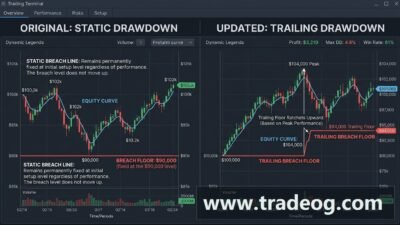
- Static Drawdown: The loss floor is fixed at a specific dollar amount below starting balance (e.g., $90,000 on a $100,000 account). Every commission dollar paid over days or weeks permanently chips away at that static buffer.
- Trailing Drawdown (Intraday Equity): The loss floor ratchets upward whenever open floating equity hits a new peak. In this structure, commission deductions directly lower your trailing buffer, tightening the margin for error.
- Trailing Drawdown (End-of-Day Balance): The loss floor updates only at daily server settlement based on closed balance. Here, commissions are realized upon trade close and adjust the drawdown threshold each night.
- Relative Drawdown: The loss percentage adjusts dynamically to current balance or equity highs.
For swing traders holding 3 to 5 trades per month, total commission represents less than 0.1% of the overall drawdown allowance. For intraday scalpers taking hundreds of trades, cumulative commissions can easily consume 20% to 40% of the entire maximum drawdown allowance over an evaluation period.
Commission vs. Spread vs. Slippage vs. Swap: Cost Comparison
| Trading Cost | Operational Definition | How It Is Charged | Directly Affects Equity? |
|---|---|---|---|
| Commission | Explicit monetary fee charged by the broker/firm per volume unit. | Line-item debit visible in terminal ticket logs. | Yes — subtracted directly from calculated equity. |
| Spread | The differential between market Bid and Ask prices. | Indirect execution markup; trades open in immediate negative P/L. | Yes — reflected directly in open floating P/L. |
| Slippage | Difference between requested price and executed market fill price. | Adverse order fill during rapid volatility or low liquidity. | Yes — results in worse entry/exit execution pricing. |
| Swap Fee | Interest rate differential debited/credited for holding overnight. | Daily ledger debit applied at 5:00 PM EST rollover. | Yes — debited from equity and eventually balance. |
A common scenario involves opening a trade during high volatility: you pay an expanded spread upon entry, incur slippage on your market fill, and are charged a round-trip commission simultaneously. All three frictions subtract from your available drawdown reserve before market price moves a single tick.
Why Scalpers Must Monitor Commission More Closely Than Swing Traders
Scalping strategies are disproportionately vulnerable to commission-driven account breaches due to three structural factors:
- Small Average Target: A scalper targeting 4 to 8 pips on EUR/USD with a $7 round-trip commission per standard lot is surrendering roughly 0.7 pips per trade just to pay execution costs. That represents 10% to 15% of the gross profit target.
- High Lot Size: To generate meaningful gains from tiny pip targets, scalpers trade large position sizes. A 10-lot scalping ticket incurs $70 in instant commission per trade. Ten quick scalps equal $700 in guaranteed equity deductions.
- Drawdown Velocity: In prop firm evaluation models featuring a 4% to 5% daily limit, high trade frequency causes commission burn to outpace risk recovery. Even a break-even trading session (e.g., 15 wins and 15 losses) can result in a -$400 equity drawdown exclusively from transaction friction.
Before launching an automated Expert Advisor (EA) or scalping strategy on an evaluation account, backtest your setup with real-world commission, spread, and slippage parameters factored into the code.
Real-World Calculations: Forex vs. Gold (XAU/USD)
Forex Majors Example (EUR/USD)
Suppose you are trading a $50,000 evaluation account with a firm charging $3.50 per lot per side ($7.00 round-trip). You enter 2 standard lots on EUR/USD:
- Opening Commission: 2 lots × $3.50 = $7.00
- Closing Commission: 2 lots × $3.50 = $7.00
- Total Round-Trip Commission: $14.00
- Market Movement: The trade moves against you by 15 pips before your stop-loss hits:15 pips × $10 per pip per lot × 2 lots = -$300.00
- Net Loss Realized: -$300.00 (Market) + (-$14.00 Commission) = -$314.00
Your account drawdown is reduced by $314.00. While $14 seems small on an isolated ticket, taking six similar trades per day accumulates $84 in commission alone.
Precious Metals Example (Gold — XAU/USD)
Gold trading introduces higher volatility and wider contract exposure. On a $100,000 account, you open 3 standard lots (300 troy ounces) of XAU/USD:
- Commission Rate: $6.00 round-trip per standard lot ($18.00 total)
- Raw Spread at Entry: $0.30 ($30.00 per lot × 3 = $90.00 initial spread drag)
- Total Instant Drag at Fill: $18.00 (Commission) + $90.00 (Spread) = -$108.00
The instant your 3-lot order executes, your floating equity is down -$108.00 before price has moved. If Gold experiences a sudden $5.00 adverse swing, you lose $1,500 on market price plus the $108 execution drag, yielding a net drawdown impact of -$1,608.00.
Can Commission Alone Cause a Prop Firm Breach?
While possible in extreme mathematical edge cases, commission alone rarely causes an account breach from a fresh balance. Rather, commission serves as the final catalyst that tips a distressed account into an automated liquidation.
Whether commission contributes to a breach depends on several interacting variables:
- Available Buffer: How close the account’s open equity sits relative to the daily or maximum drawdown floor.
- Lot Size Intensity: Larger lot sizes incur higher dollar-value commissions per order.
- Trade Frequency: Taking 40 trades in a single session multiplies fee drag.
- Firm Calculation Engine: Whether the prop firm monitors tick-by-tick equity or simple end-of-day balances.
If an account has $25 of remaining buffer before reaching its daily limit, clicking “Buy” on a 4-lot position with a $28 round-trip commission will breach the account the instant the order registers on the server—even if the market immediately moves in your favor.
10-Step Checklist: How to Verify Prop Firm Commission Rules
Pre-Trade Verification
Never assume two prop firms treat trading costs identically. Before purchasing a challenge, run through this practical verification checklist:
- Access the Official Help Center: Navigate to the prop firm’s official knowledge base or FAQ documentation. Avoid relying on third-party marketing blogs.
- Search for “Commission”: Check the exact commission charged per instrument (Forex, Indices, Commodities, Crypto).
- Search for “Maximum Daily Loss”: Read the exact mathematical formula used to calculate daily drawdown.
- Verify the Equity Clause: Check whether daily drawdown states “based on starting balance” or “based on starting equity.”
- Check Floating Loss Rules: Confirm whether unrealized open trades count toward the drawdown ceiling.
- Inspect Swap Policies: Determine whether overnight swap debits are included in daily loss tracking.
- Identify the Server Reset Time: Find the exact platform timezone (typically 00:00 CE(S)T or 17:00 EST) when daily loss metrics reset.
- Determine Drawdown Type: Identify whether the maximum loss is static, balance-based trailing, or intraday equity-based trailing.
- Contact Live Support for Ambiguities: If documentation is vague, ask support directly: “Does your risk engine include open commissions and swaps when calculating whether an account has breached the daily loss limit?”
- Archive Official Responses: Take date-stamped screenshots of the rules and support conversations. If a disputed breach occurs, this documentation is essential for appeals.
10 Questions to Ask Prop Firm Support About Trading Costs
When evaluating a proprietary trading firm, submit these targeted questions to their customer support desk:
- Does your risk engine include trading commissions in the Maximum Daily Loss calculation?
- Are commissions deducted from floating equity immediately upon order execution?
- Is Maximum Drawdown calculated using closed balance, end-of-day equity, or continuous tick-by-tick equity?
- Are commission rates fixed across all assets, or do they vary by asset class and liquidity provider?
- Are overnight swap fees included in daily drawdown evaluations?
- Does your platform charge commission on index and commodity CFDs, or are those costs built into the spread?
- If an open trade’s commission pushes equity below the drawdown limit for a fraction of a second, does that trigger a hard breach?
- Where can I review your official mathematical formula for daily equity calculation?
- What liquidity provider feeds do your simulated servers use for pricing and execution?
- Do you offer “raw spread” accounts with commissions, or “zero commission” accounts with marked-up spreads?
How to Protect Your Account from Commission-Driven Breaches
Professional risk management accounts for transaction costs alongside market volatility. To protect your funded capital:
- Establish a Safety Buffer: Never treat your nominal daily loss limit as your operational stop. If your daily limit is $2,500, set a personal rule to cease trading when losses reach $1,800 to $2,000. This buffer absorbs commissions, spreads, and slippage.
- Track Net P/L, Not Gross P/L: Configure your trading terminal to display Net P/L including commission and swap columns. Do not base risk decisions on gross profit figures.
- Cap Daily Trade Frequency: Limit your strategy to a fixed number of high-probability setups per session (e.g., 2 to 4 trades). Overtrading is the primary driver of runaway commission drag.
- Factor Fees into Backtesting: Always test algorithmic and manual strategies with realistic commission fees ($7/lot) and average spreads enabled in your simulator.
- Select the Right Account Structure: If you trade high-frequency scalping strategies, compare raw spread accounts with commission against standard commission-free accounts to determine which structure minimizes total drag for your average hold time.
7 Common Mistakes Traders Make with Prop Firm Commissions
- Monitoring Closed Balance Instead of Live Equity: Watching balance while ignoring negative floating P/L and accumulated commissions leaves traders blind to impending breaches.
- Backtesting with Zero Commission: Testing strategies on raw historical charts without modeling transaction costs produces misleading win rates and inflated profit factors.
- Assuming Universal Industry Standards: Believing every prop firm handles commissions identically leads to unpleasant surprises when switching platforms.
- Treating the Full Drawdown Limit as Risk Capital: Sizing trades up to the absolute dollar limit of the drawdown leaves zero margin for execution friction.
- Ignoring Overnight Rollover Swaps: Holding open positions across the 5:00 PM EST rollover window can add swap debits to existing commission deductions, breaching fragile accounts.
- Revenge Trading with High Frequency: Rapidly opening multiple recovery trades generates rapid fee accumulation, accelerating account termination.
- Failing to Audit Broker Trade Logs: Never reviewing execution reports means traders miss discrepancies between expected commission rates and actual debits.
Real-World Firm Comparison: How Rules Differ
Proprietary trading firms vary in how their software calculates account equity and handles transaction costs. Always verify terms directly with each platform.
Example: FTMO Official Documentation
According to FTMO’s officially published trading rules and FAQ documentation, daily loss limits and maximum loss limits are evaluated against account equity. FTMO explicitly specifies that the equity calculation incorporates starting balance, realized P/L, unrealized floating P/L, overnight financing (swaps), and trading commissions. Consequently, at FTMO, commissions are an active component of your drawdown calculation.
Alternative Prop Firm Architectures
Other firms in the proprietary trading space implement different operational frameworks:
- Spread-Only Models: Some firms eliminate separate per-lot commission fees entirely, instead embedding their operating margins into wider spreads. In this structure, commission is zero, but the wider spread creates higher initial floating unrealized losses.
- End-of-Day (EOD) Balance Engines: Certain futures-focused prop firms evaluate daily loss rules exclusively based on closed trades at market settlement, meaning intraday floating equity and open commissions do not trigger intraday breaches unless positions are closed.
Because platforms frequently update their terms of service, traders must review the current rulebook of their specific provider before risking evaluation capital.
Commission and Drawdown Calculator: Conceptual Framework
To determine your true available drawdown buffer before entering a trade, apply this formula:
Effective Drawdown Buffer = Contractual Loss Limit − Net Closed Losses − Unrealized Floating Losses − Estimated Round-Trip Commissions − Swaps
Practical Calculation Example
- Contractual Daily Limit: $5,000
- Current Closed Loss: $2,200
- Current Floating Loss: $600
- Planned New Order: 4 standard lots on Gold
- Round-Trip Commission on New Order: 4 × $6.00 = $24
- Initial Spread Drag (approx. $0.25 on Gold): 4 × $25 = $100
$$\text{Effective Buffer} = \$5,000 – \$2,200 – \$600 – \$24 – \$100 = \mathbf{\$2,076}$$
Rather than having $2,800 of room based purely on closed trades ($5,000 − $2,200), your true operational buffer is $2,076. Factoring in commissions and spread prevents premature liquidations.
Frequently Asked Questions
Does commission count toward prop firm drawdown?
Yes. At most prop firms, drawdown is monitored via real-time floating equity. Commissions are deducted directly from your account upon trade execution, which reduces equity and decreases the remaining distance to your allowable drawdown limit.
Does commission count toward daily loss?
Yes. If your prop firm calculates its Maximum Daily Loss using equity (such as FTMO’s formula: Balance + Open P/L ± Swaps − Commissions), every dollar paid in commission increases your calculated daily loss.
Does commission reduce prop firm equity?
Yes. The standard accounting formula across trading terminals defines Equity as Balance plus or minus floating P/L, minus commissions and applicable financing fees. Commission debits reduce equity immediately.
Can commission cause a prop firm breach?
Yes. While commission rarely breaches an account on its own from a fresh balance, it can cause a breach if an account is already nursing losses near the maximum limit and added commission fees push equity past the allowable threshold.
Does spread count toward drawdown?
Yes. When you open a position, the Bid-Ask spread immediately places the trade in a floating loss. Because equity accounts for open floating losses, spread expansion directly reduces your available drawdown.
Does slippage count toward drawdown?
Yes. Adverse slippage causes your market order or stop-loss to fill at a worse price than anticipated. That additional market loss reduces your realized balance and floating equity, consuming more drawdown.
Are commissions included in FTMO drawdown?
Yes. FTMO’s official documentation explicitly specifies that commissions and swaps are deducted in the equity formula used to track both Maximum Daily Loss and Maximum Loss.
Do all prop firms calculate drawdown the same way?
No. Prop firms utilize different calculation engines. Some monitor tick-by-tick equity, others evaluate end-of-day balances, and some use trailing high-water marks. You must verify each firm’s individual rulebook.
Should I include commission in my trading risk calculation?
Yes. Professional risk management requires factoring round-trip commissions, average spreads, and potential slippage into position sizing so that total trade risk remains strictly within your predefined limits.
How can I calculate my real risk after commission?
Calculate your real risk by adding your monetary stop-loss distance to your total round-trip commission and estimated entry spread: Real Risk = (Stop Distance in Pips × Pip Value) + Round-Trip Commission + (Spread in Pips × Pip Value).

[…] and a modest additional price move that combined to push equity over the line. See our article on does commission count toward prop firm drawdown for a full analysis of how fees interact with your risk […]
[…] with your account metrics. If you trade high frequency or volume, examine our detailed study on does commission count toward prop firm drawdown. Here is how each factor influences equity and prop firm breach […]
[…] Because commissions are debited from your account balance immediately upon execution, they reduce your remaining daily drawdown buffer before the market moves a single tick. Learn how fees impact drawdown in our guide on commission and drawdown. […]
[…] If your prop firm resets at 00:00 CE(S)T, its daily loss reset occurs several hours before the New York 5:00 PM rollover. Consequently, your account experiences two distinct adjustments: your daily drawdown limit refreshes first, and overnight swap charges hit hours later. To learn how financing charges impact risk calculations, read our guides on swap fees and drawdown and commissions and prop firm drawdown. […]