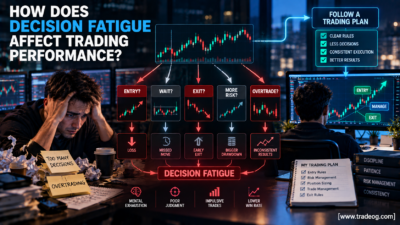

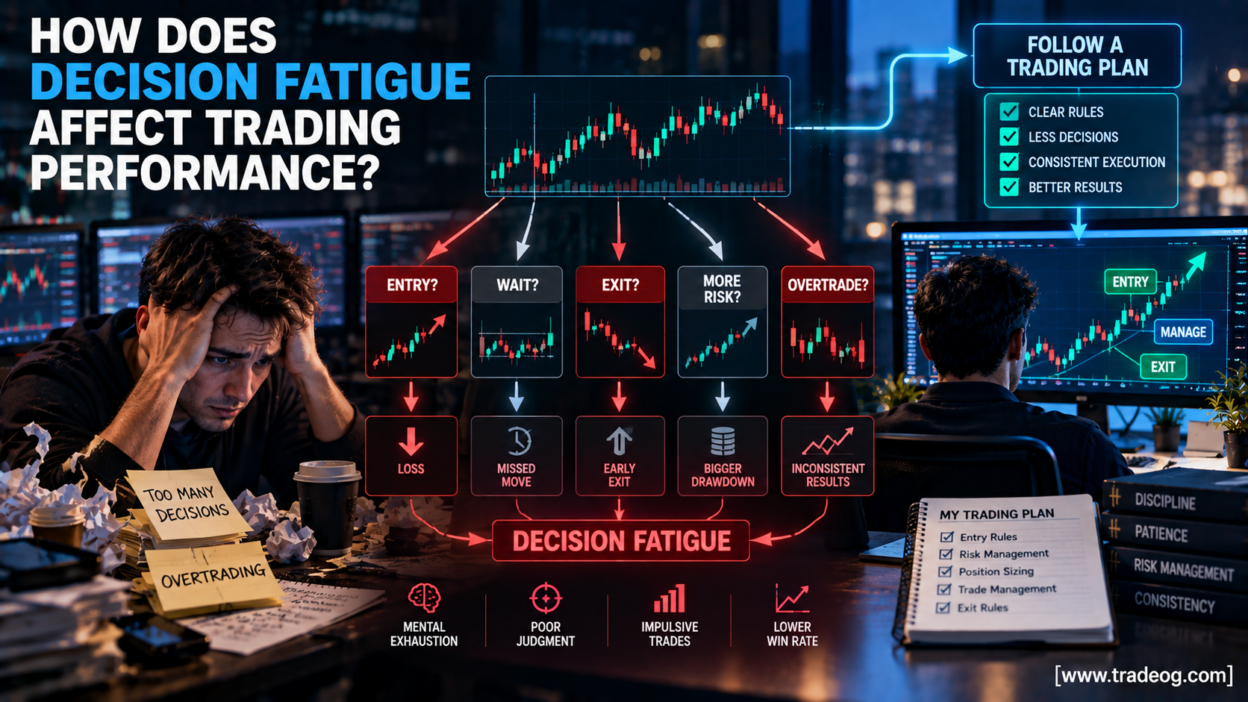
Trading looks like a numbers game, but every trade also requires a chain of decisions. You choose a market, timeframe, setup, entry, position size, stop-loss, profit target and sometimes whether to manage or exit the position early.
One or two decisions may feel effortless. After dozens of decisions, however, the quality of those choices can change. This is where decision fatigue becomes relevant to trading performance.
Decision fatigue describes a decline in decision quality, efficiency or willingness to engage with difficult choices after prolonged decision-making. Research across professional settings suggests that repeated decision-making can increase cognitive burden and make people more likely to choose easier, more conservative, inconsistent or impulsive options. It does not mean that a trader’s brain simply “runs out of energy,” and the scientific literature is more nuanced than the popular version of the concept. But the underlying problem is highly relevant to trading: the more discretionary decisions you make, the more opportunities you create for inconsistency.
For traders, decision fatigue can show up as late entries, unnecessary trades, moving stops, changing strategies mid-session, abandoning a trading plan, or continuing to trade after the best opportunities have already passed.
This article explains how decision fatigue can affect trading performance, how to recognise it, and how to reduce unnecessary decisions without turning your trading system into a rigid mechanical strategy.
What Is Decision Fatigue?
Decision fatigue is commonly used to describe the deterioration of decision-making after repeated acts of decision-making or sustained cognitive effort.
A conceptual analysis published in the medical psychology literature identified decisional, self-regulatory and situational factors as important components of decision fatigue. More recent research has also found associations between high decision-making demands and reduced efficiency, inconsistent decisions, decision avoidance and greater reliance on easier choices.
For a trader, the important point is not whether every decision literally consumes a fixed amount of mental energy. The practical issue is that complex, repeated and emotionally important decisions can make disciplined execution harder to maintain.
Why Trading Is Especially Vulnerable to Decision Fatigue
Trading creates an unusual combination of uncertainty, repetition, financial consequences and constant feedback.
A trader may have to answer questions such as:
- Which market should I trade?
- Which timeframe should I use?
- Is this a valid setup?
- Is the market trending or ranging?
- Should I enter now or wait?
- Where should the stop-loss go?
- How large should the position be?
- Should I take partial profit?
- Should I move the stop?
- Should I hold through news?
- Should I take another setup after a loss?
- Should I stop trading for the day?
None of these decisions is necessarily difficult in isolation. The problem is that a discretionary trader can make dozens or hundreds of small decisions during a single session.
That creates a large number of opportunities for judgment to drift away from the original trading plan.
Decision Fatigue Does Not Automatically Mean Poor Trading
This distinction matters.
Decision fatigue should not be treated as a diagnosis or as proof that every trader becomes irrational after a certain number of trades. Research on the subject is mixed and context-dependent. Some studies support reductions in decision quality under high cognitive demand, while other reviews have found inconsistent effects in specific professional environments.
Therefore, the useful trading interpretation is more conservative:
Repeated decision-making can increase cognitive workload, and reducing unnecessary discretionary decisions may make consistent execution easier.
This is a process-management problem rather than a reason to blame every losing trade on psychology.
1. Decision Fatigue Can Reduce Setup Selectivity
One of the first problems can be a gradual reduction in selectivity.
Imagine a trader starts the session with a strict rule:
“I will only trade when price reaches my predefined level and the setup satisfies my confirmation rules.”
After several hours of watching charts, the trader sees a setup that is almost valid.
Instead of waiting, the trader thinks:
“It is close enough.”
That small compromise can be the beginning of a different trading process.
After another losing trade, the trader may become even more reactive and start taking setups that would normally be rejected.
The result is not necessarily one large mistake. It can be a gradual lowering of standards.
2. It Can Increase Overtrading
Overtrading is one of the clearest ways decision overload can damage trading performance.
When a trader has spent hours monitoring markets, every new price movement creates another potential decision. A trader who is mentally tired may start interpreting ordinary market noise as an opportunity.
This can produce a cycle:
More screen time → more decisions → lower selectivity → more trades → more emotional feedback → even more decisions.
That cycle is particularly dangerous in short-term trading because there can be hundreds of small price movements that appear tradable.
The solution is not necessarily to stop trading after a fixed number of candles. A better approach is to define the conditions under which trading is allowed and the conditions under which the session ends.
TradeOG also covers the broader problem of building a rule-based trading routine, which can help reduce unnecessary discretionary decisions.
3. It Can Make Traders More Impulsive
Decision fatigue may push decision-making toward simpler or less effortful choices.
In trading, an impulsive decision might look like:
- entering because price is moving quickly;
- chasing a candle after missing the initial move;
- closing a position without checking the original exit condition;
- moving a stop because accepting the loss feels difficult;
- increasing position size after a losing trade;
- taking a low-quality setup because the market has been quiet.
These actions can feel easier in the moment because they eliminate uncertainty.
But removing uncertainty by making a quick decision is not the same as making a good decision.
4. Stop-Loss Decisions Can Become Harder
Risk management often requires uncomfortable decisions.
Suppose a trader enters a valid setup with a predefined stop-loss. The market moves against the position.
A disciplined trader follows the invalidation rule.
A fatigued trader may start asking:
- “Should I give it more room?”
- “Maybe it will reverse.”
- “Should I move the stop below the next candle?”
- “I do not want to take another loss.”
Every additional thought creates another opportunity to override the original plan.
This is why defining risk before entering the trade can be so useful. The difficult decision is made when the trader is calm rather than while the position is losing.
5. Position Sizing Can Drift
Position sizing is another area where decision fatigue can create inconsistency.
A trader might normally risk 0.5% per trade. After several losing trades or several hours of screen time, the trader may change the size because of frustration, confidence or a desire to finish the session profitably.
For example:
| Situation | Planned Risk | Fatigue-Driven Behaviour |
|---|---|---|
| Normal setup | 0.5% | 0.5% |
| After a loss | 0.5% | 1% |
| Strong-looking setup | 0.5% | 1.5% |
| Late-session trade | 0.5% | 0.75% |
The problem is not only the larger risk. It is the loss of consistency.
If position size changes according to mood or mental state, the trader’s historical statistics become harder to interpret.
6. It Can Increase Strategy Switching
Another common symptom is changing the trading method too frequently.
A trader starts with a breakout strategy. After several failed breakouts, they switch to mean reversion. Then they see a trend and switch to a moving-average strategy. After another loss, they add an indicator.
Eventually the trading process becomes a collection of reactions rather than a coherent system.
This is especially damaging because strategy performance cannot be evaluated properly when the rules are constantly changing.
Decision fatigue can make the newest idea appear attractive simply because it offers a fresh and easier explanation for the current market.
7. More Screen Time Does Not Necessarily Mean Better Performance
Many traders assume that watching charts for longer must create an advantage.
Sometimes it does. But more screen time also creates more decision points.
Consider two traders:
| Trader | Screen Time | Trading Process |
|---|---|---|
| A | 2 focused hours | Only predefined setups |
| B | 8 hours | Continuous discretionary decisions |
Trader B has four times as much exposure to market information, but that does not automatically mean four times as much opportunity.
It may simply mean four times as many chances to become distracted, impatient or inconsistent.
8. Decision Fatigue Can Change How Traders Interpret Charts
Charts are not objective instructions. Traders interpret patterns.
When a trader is fresh, a small candle may simply be noise.
Later in the session, the same candle might be interpreted as:
- a breakout signal;
- a reversal signal;
- a liquidity sweep;
- a continuation pattern;
- an entry opportunity.
The market has not necessarily changed. The trader’s attention and interpretation may have changed.
This is one reason pre-trade criteria are useful. They create an external reference against which subjective interpretation can be checked.
9. Losses Can Make Decision Fatigue Worse
A losing trade does more than affect account equity. It also creates another emotional decision.
After a loss, a trader must decide whether:
- the setup was valid;
- the execution was poor;
- the market regime changed;
- the strategy remains valid;
- another trade should be taken.
After several losses, the cognitive and emotional burden can increase further.
This can produce two opposite reactions:
- revenge trading: taking more risk to recover losses;
- decision avoidance: refusing valid setups because of fear of another loss.
Both can damage the consistency of a trading system.
10. Winning Streaks Can Also Create Decision Problems
Decision fatigue is not only a problem after losses.
After several successful trades, traders can become overconfident and start modifying their normal rules.
A trader who normally risks 0.5% may suddenly think:
“The strategy is working perfectly today. I can increase size.”
The decision itself may feel rational because recent results support it.
But a short-term winning streak does not prove that future trades have higher expected value.
Consistency requires the same discipline during both winning and losing periods.
How to Recognise Decision Fatigue While Trading
There is no universal number of trades or hours that proves a trader is experiencing decision fatigue.
Instead, look for behavioural changes.
| Possible Sign | What It May Look Like |
|---|---|
| Lower selectivity | Taking setups you normally reject |
| Decision avoidance | Ignoring a valid setup because it feels complicated |
| Impulsivity | Entering without completing the checklist |
| Rule changes | Moving stops or changing targets without a predefined reason |
| Overtrading | Taking trades simply because the market is moving |
| Strategy switching | Changing indicators or systems during the session |
| Reduced attention | Missing important conditions or execution details |
How to Reduce Decision Fatigue in Trading
1. Decide Important Rules Before the Session
Predefine the decisions that can be standardised:
- markets traded;
- trading sessions;
- timeframes;
- maximum risk per trade;
- maximum daily loss;
- allowed setups;
- stop-loss methodology;
- profit-taking rules;
- conditions for stopping the session.
The more important decisions are made before the emotional pressure of live trading begins, the fewer decisions have to be invented in real time.
2. Use a Short Pre-Trade Checklist
A checklist should reduce cognitive load, not create another complicated task.
A simple checklist might ask:
- Is the market condition suitable?
- Is this one of my approved setups?
- Is the entry level defined?
- Is the stop-loss defined?
- Is position size within risk limits?
- Is there a major event that changes the setup?
- What invalidates the trade?
If the answer to an important question is unclear, waiting can be better than improvising.
3. Limit the Number of Markets You Monitor
Watching 20 markets can create more opportunities, but it also creates more information and more decisions.
Many traders can improve process consistency by maintaining a focused watchlist rather than trying to trade every available instrument.
4. Separate Analysis From Execution
One useful approach is to perform market analysis before the active trading window.
Mark important levels, define scenarios and identify invalidation points. During the session, the job becomes checking whether price is actually reaching one of those scenarios.
This reduces the temptation to invent a new thesis every few minutes.
5. Create a Hard Stop for the Trading Session
A session stop does not have to be based only on profit or loss.
You can also define process-based stopping conditions such as:
- breaking your rules twice;
- taking an unplanned trade;
- moving a stop without justification;
- feeling unable to explain why a trade is valid;
- losing concentration;
- continuing to trade purely because you want action.
These rules are particularly useful because they target the behaviour that often precedes larger mistakes.
Decision Fatigue and Algorithmic Trading
Automated or semi-automated trading can reduce some discretionary decisions, but it does not eliminate decision fatigue completely.
Systematic traders still have to decide:
- which strategy to use;
- how to test it;
- when to modify parameters;
- which markets to include;
- how to interpret performance changes;
- when a strategy may have entered a different market regime.
In fact, excessive optimisation can create a different kind of decision overload. A trader may keep changing parameters because every new backtest produces another choice.
This is one reason robust testing and predefined evaluation rules matter.
Decision Fatigue vs Trading Fatigue
These concepts overlap but are not identical.
| Decision Fatigue | General Trading Fatigue |
|---|---|
| Primarily related to repeated decisions and cognitive demand | Can include mental, emotional and physical tiredness |
| May show as poorer judgment or more difficult choices | May show as reduced attention, motivation or alertness |
| Can occur during a long sequence of complex decisions | Can result from insufficient rest, stress or prolonged screen time |
| Can be reduced through process design | May require broader recovery and workload changes |
A trader can experience either one or both at the same time.
A Practical Decision-Fatigue Trading Routine
Here is a simple framework that can be adapted to different trading styles.
Before the session
- Select the instruments.
- Identify the higher-timeframe trend or range.
- Mark important levels.
- Write down the approved setups.
- Set maximum risk.
- Check major scheduled events.
During the session
- Wait for the predefined conditions.
- Use the checklist before entering.
- Do not change risk because of the previous trade.
- Record the reason for each trade.
- Avoid creating new strategies during live execution.
After the session
- Review execution rather than only profit and loss.
- Identify rule violations.
- Record whether decisions became harder later in the session.
- Separate strategy problems from execution problems.
- Stop changing the strategy based on one or two trades.
Example: How Decision Fatigue Can Change a Trading Day
Consider a trader who normally takes two or three high-quality setups.
During the first two hours, the trader waits patiently and takes one valid trade. The trade loses.
Instead of reacting, the trader follows the plan.
Two hours later, price approaches another setup. The trader enters correctly, and the trade wins.
Later, after several hours of chart watching, the trader sees a move that is not part of the system. Because the market has been quiet, the trader enters anyway.
The trade loses.
The trader then changes the stop on the next trade, increases position size and starts looking for another setup to recover the loss.
The final loss may have little to do with the original strategy.
The real problem was the gradual deterioration of decision quality.
This is why a trading journal should record how decisions were made, not just whether trades won or lost.
Does Reducing Decisions Always Improve Trading?
No.
Removing decisions without understanding the strategy can make a system too rigid.
Markets change. A trader may sometimes need discretion because of unusual liquidity, news, execution conditions or market structure.
The objective is not to eliminate thinking.
The objective is to eliminate unnecessary decisions so that mental attention can be reserved for decisions that genuinely require judgment.
The Best Decisions to Automate or Standardise
Some decisions are particularly suitable for predefined rules:
- maximum risk per trade;
- maximum daily loss;
- position-size calculation;
- approved trading hours;
- minimum setup requirements;
- stop-loss placement methodology;
- daily trade limits;
- conditions for ending the session.
Other decisions may reasonably remain discretionary:
- interpreting unusual market structure;
- assessing conflicting higher-timeframe information;
- evaluating abnormal liquidity conditions;
- deciding whether market conditions are outside the strategy’s normal operating environment.
A good trading process therefore combines rules for consistency with discretion for genuinely complex situations.
Decision Fatigue and Prop Firm Trading
Decision fatigue can be particularly relevant in funded-account environments because traders often operate under explicit drawdown, daily loss and consistency rules.
A trader who makes unnecessary decisions may accidentally violate a rule even when the original strategy is profitable.
For example, after a losing trade, increasing position size can accelerate drawdown. After a winning trade, continuing to trade simply because the daily target has not been reached can expose already-earned profit to unnecessary risk.
The best response is not to predict when fatigue will appear. It is to create a process that becomes harder to break when fatigue does appear.
How to Measure Whether Decision Fatigue Is Affecting You
Instead of relying on feelings alone, track behaviour for several weeks.
Record:
- time of each trade;
- setup type;
- planned risk;
- actual risk;
- whether the checklist was completed;
- whether the trade was planned;
- reason for entry;
- reason for exit;
- rule violations;
- self-rated concentration from 1 to 5.
Then compare early-session and late-session behaviour.
If unplanned trades, rule violations or risk changes consistently increase later in the session, that is useful evidence that your trading process may be affected by accumulated cognitive load.
Decision Fatigue Trading Checklist
- Am I trading a predefined setup?
- Have I already exceeded my planned trading window?
- Has my position size changed from the plan?
- Am I changing rules because of the previous trade?
- Am I trying to recover a loss?
- Am I trading because there is a genuine setup or because I am bored?
- Can I explain the trade in one clear sentence?
- Is my stop-loss defined before entry?
- Would I take this trade if the previous trade did not exist?
- Am I still following the same strategy I started the session with?
Final Takeaway
Decision fatigue can affect trading performance because trading requires repeated decisions under uncertainty, financial pressure and constant market feedback.
It may appear as lower setup selectivity, impulsive entries, overtrading, changing position size, moving stops, switching strategies or continuing to trade after concentration has deteriorated.
However, decision fatigue should not be used as a universal explanation for trading losses. The research is nuanced, and individual responses vary. The more useful lesson is process-oriented: reduce unnecessary discretionary decisions and protect the decisions that genuinely require judgment.
A well-designed trading routine can move important choices—risk, position size, trading hours, setup criteria and session limits—out of the heat of live execution. This leaves the trader with fewer decisions to make and a clearer framework for the decisions that remain.
In trading, better performance does not necessarily come from making more decisions. Sometimes it comes from knowing which decisions do not need to be made at all.
Frequently Asked Questions
What is decision fatigue in trading?
Decision fatigue in trading refers to the potential decline in decision quality or consistency after prolonged periods of repeated and demanding decisions. It can contribute to impulsive or inconsistent execution.
Can decision fatigue cause overtrading?
It can contribute to overtrading by reducing selectivity and making market activity feel like an opportunity that must be acted upon. A predefined trade limit and setup checklist can help.
How can traders reduce decision fatigue?
Traders can reduce unnecessary decision-making by defining risk, position sizing, trading hours, setup criteria, stop-loss rules and session-ending conditions before trading begins.
Is decision fatigue the same as being tired?
No. Decision fatigue specifically concerns the burden and potential deterioration associated with repeated decision-making. General fatigue can involve physical tiredness, reduced alertness, stress and other factors.
Should traders stop after a certain number of trades?
There is no universal number that applies to every trader. A better approach is to define a maximum based on your strategy, risk limits and evidence from your own trading journal.
Can a trading checklist help?
Yes. A short checklist can standardise important decisions and reduce the number of conditions a trader has to remember during live execution. It should remain simple enough to use consistently.
Does decision fatigue prove that discretionary trading is bad?
No. Discretion can be valuable when market conditions are unusual or ambiguous. The goal is to standardise repetitive decisions while preserving discretion for situations that genuinely require judgment.
Sources and Further Reading
- Decision Fatigue: A Conceptual Analysis — National Library of Medicine / PMC
- An Integrative Review on Decision Fatigue — PubMed
- Making Choices Impairs Subsequent Self-Control — PubMed
- Deciding How to Decide: Self-Control and Meta-Decision Making — PubMed
Disclaimer: This article is for educational and informational purposes only. Trading and investing involve substantial risk, and psychological or behavioural frameworks cannot guarantee profitable results. Always consider your own risk tolerance, financial circumstances and applicable regulations before trading.