

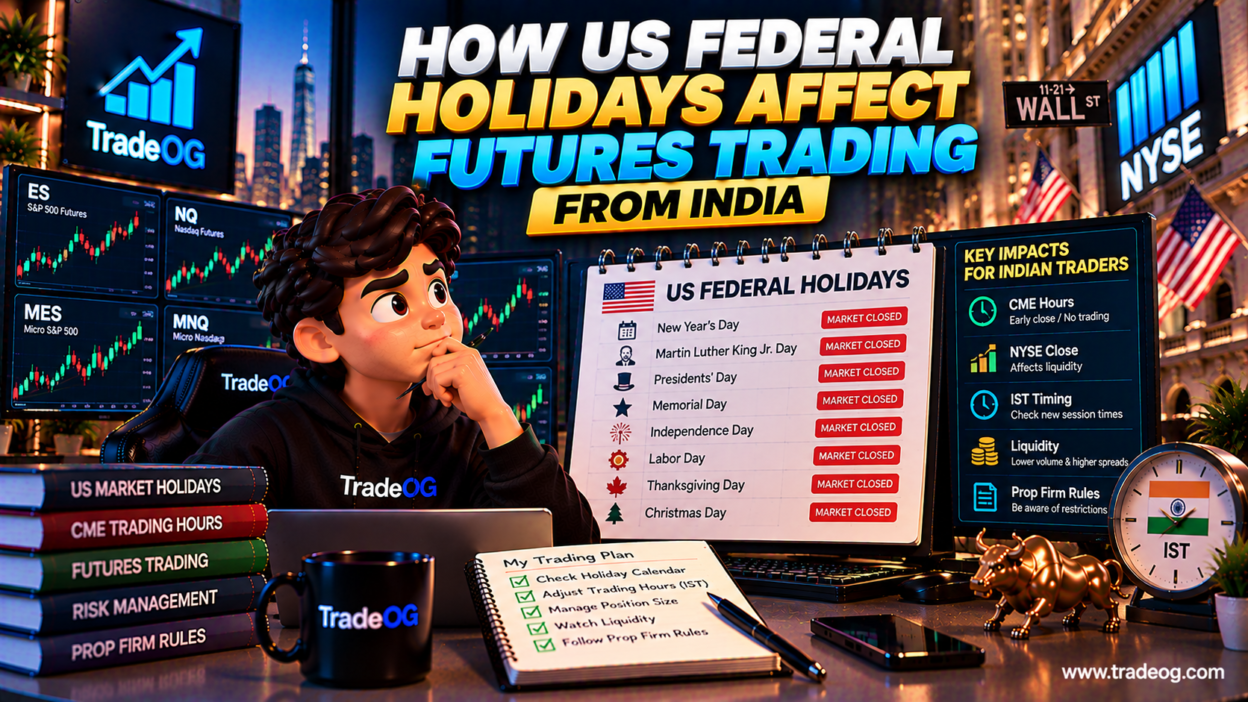
For Indian futures traders, a U.S. federal holiday can change much more than a date on the calendar. A holiday may coincide with a U.S. stock-market closure, an amended CME Globex schedule, lower participation, different liquidity conditions, early settlement or special prop-firm restrictions.
This matters because traders in India experience U.S. futures during Indian evening and night hours. A normal strategy built around the New York cash open can behave differently when the underlying U.S. equity market is closed or when the futures session has reduced hours.
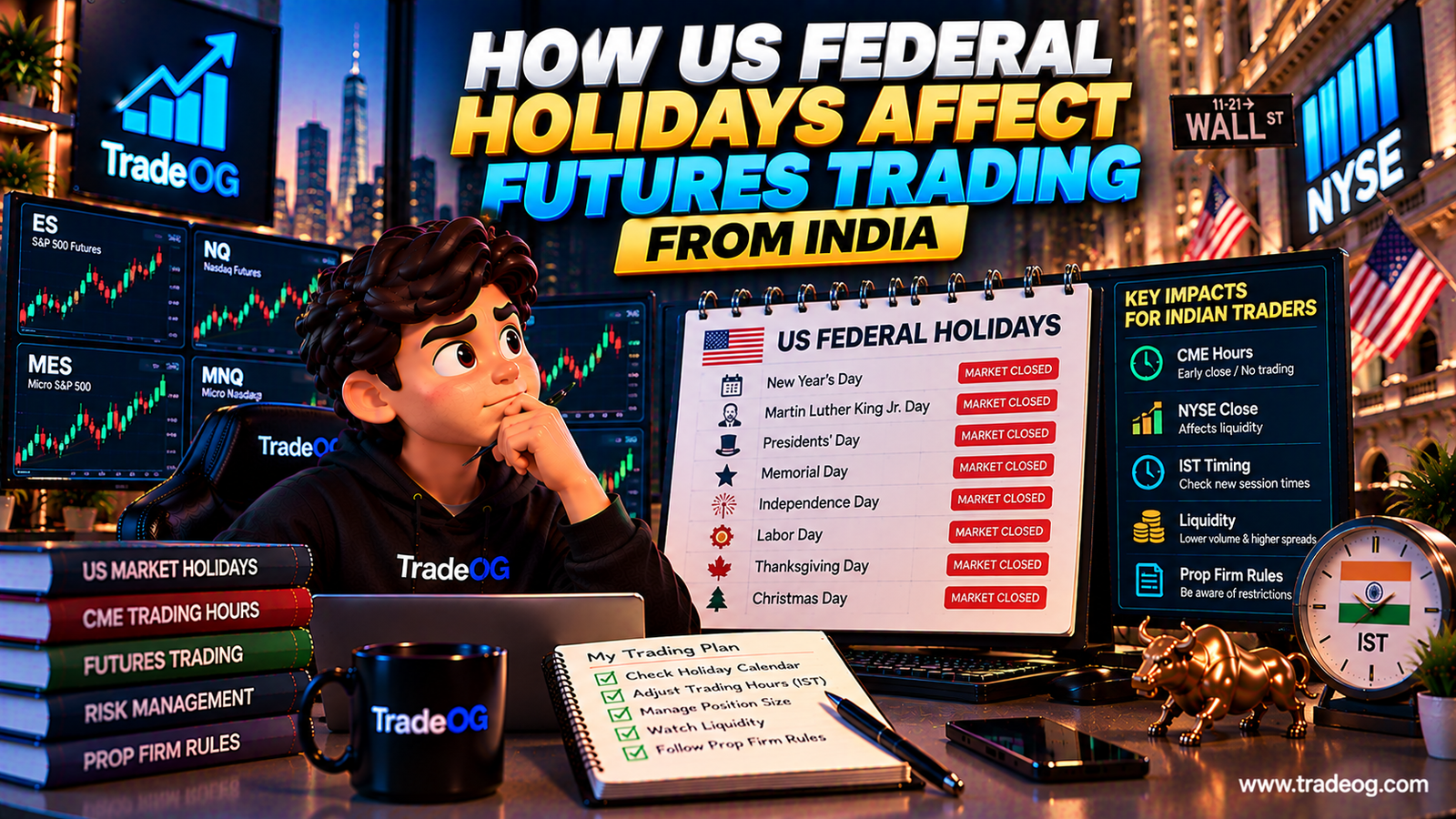
What Is a U.S. Federal Holiday?
U.S. federal holidays are holidays established by U.S. federal law. The Office of Personnel Management lists 11 federal holidays in 2026, including New Year’s Day, Martin Luther King Jr. Day, Washington’s Birthday, Memorial Day, Juneteenth, Independence Day, Labor Day, Columbus Day, Veterans Day, Thanksgiving Day and Christmas Day.
However, federal holiday does not automatically mean every financial market is closed. This distinction is critical for futures traders.
Financial exchanges publish their own trading calendars. NYSE has its own holiday schedule, while CME publishes a separate Globex holiday schedule for its futures and options markets. CME’s 2026 schedule covers New Year’s, Martin Luther King Jr. Day, Presidents Day, Good Friday, Memorial Day, Juneteenth, Independence Day, Labor Day, Thanksgiving and Christmas.
Federal Holiday vs Exchange Holiday: The Difference
One of the easiest mistakes is to treat the terms federal holiday, NYSE holiday and CME holiday as interchangeable.
| Calendar | What It Tells You | Why Indian Futures Traders Care |
|---|---|---|
| U.S. Federal Calendar | Federal holidays established by law | Useful broad reference, but not a complete futures trading schedule |
| NYSE Calendar | U.S. stock-market closures and early closes | Important for ES/NQ because cash-equity participation can change |
| CME Globex Calendar | Futures and options holiday hours | Determines when specific CME products can trade |
| Prop Firm Calendar | Firm-specific restrictions and liquidation times | Can add another layer of restrictions |
Therefore, a trader should never stop at “Is today a U.S. federal holiday?” The more useful question is: What are the exact trading hours for my contract, broker and prop firm today?
How Federal Holidays Affect Futures Trading From India
There are several ways a U.S. holiday can affect an Indian futures trader:
- The U.S. cash market may be closed.
- The futures market may have modified hours.
- A session may close earlier than normal.
- Liquidity may be different from an ordinary trading day.
- Economic releases may occur on a different schedule.
- Settlement or trade-date processing may follow a holiday-specific timetable.
- Prop firms may impose additional restrictions.
- Your normal opening-range setup may no longer have the same market structure.
CME describes its Globex markets as operating nearly continuously, with regular maintenance windows, but it separately publishes holiday schedules because trading hours can change around holidays. CME also notes that holiday and weekend trading can receive the following business day’s trade date.
Why the NYSE Close Matters Even When Futures Are Available
Suppose you normally trade ES or NQ around the U.S. cash open. Your strategy may depend on the arrival of stock-market participants at 9:30 a.m. Eastern Time.
If NYSE is closed for a holiday, that normal cash-market event does not occur.
Futures may still have a trading session, but the environment is different. The futures price can continue reacting to global information and other market participants, yet the specific liquidity and order flow associated with the U.S. cash equity session may be absent or altered.
NYSE’s official 2026 calendar lists full closures for New Year’s Day, Martin Luther King Jr. Day, Washington’s Birthday, Good Friday, Memorial Day, Juneteenth, Independence Day observed, Labor Day, Thanksgiving and Christmas. It also lists early closes at 1:00 p.m. Eastern on the day after Thanksgiving and on Christmas Eve.
How CME Futures Hours Differ
CME’s 2026 Globex holiday schedule is the reference point for CME futures traders. It lists holiday periods rather than simply saying “market closed,” because different products can have different holiday arrangements. CME also warns that the schedule is subject to change and that holiday trading hours are generally finalized approximately two weeks before the holiday.
This is especially important for traders using:
- ES — E-mini S&P 500
- MES — Micro E-mini S&P 500
- NQ — E-mini Nasdaq-100
- MNQ — Micro E-mini Nasdaq-100
- GC — Gold futures
- CL — Crude oil futures
- Other CME Group futures products
Do not assume that because ES has a particular holiday schedule, every other futures product has exactly the same hours.
2026 Federal Holidays and What Indian Traders Should Watch
New Year’s Day — January 1, 2026
New Year’s Day is a U.S. federal holiday and NYSE is closed. CME’s New Year’s holiday period covers December 31, 2025 through January 2, 2026.
For Indian traders, the surrounding sessions are also worth watching because year-end positioning and reduced participation can make the final December and first January sessions different from ordinary sessions.
Martin Luther King Jr. Day — January 19, 2026
January 19 is a federal holiday, NYSE is closed, and CME lists January 18–20 as its relevant Globex holiday period.
If your strategy relies on the U.S. cash open, treat this as a separate session type rather than automatically applying normal Monday rules.
Washington’s Birthday — February 16, 2026
Washington’s Birthday is the statutory federal holiday name used by OPM. NYSE is closed on February 16, while CME’s holiday period covers February 15–17.
Again, the correct action is to check the contract-specific CME schedule before trading.
Good Friday — April 3, 2026
Good Friday is not one of the federal holidays listed by OPM, but it is an important U.S. financial-market holiday. NYSE is closed and CME includes April 2–4 in its 2026 holiday schedule.
This is a useful example of why a futures trader must maintain an exchange holiday calendar, not just a federal holiday calendar.
Memorial Day — May 25, 2026
Memorial Day is a federal holiday. NYSE is closed, and CME lists May 24–26 as its holiday period.
For an Indian trader, the normal U.S. evening session may therefore have a different structure from an ordinary Monday.
Juneteenth — June 19, 2026
Juneteenth National Independence Day is a federal holiday. NYSE is closed on June 19 and CME lists June 18–19 as its holiday period.
Because the holiday occurs on a Friday in 2026, traders should also check the preceding Thursday’s and weekend transition schedules.
Independence Day Observed — July 3, 2026
Independence Day falls on Saturday in 2026, so the federal holiday is observed on Friday, July 3 for most federal employees. NYSE also observes July 3 as its market holiday, while CME lists July 3–5 in its holiday period.
This is a good example of why traders should check the observed market date instead of simply marking July 4 on a calendar.
Labor Day — September 7, 2026
Labor Day is a federal holiday, NYSE is closed and CME’s holiday period covers September 6–8.
Holiday liquidity can be different from normal conditions, so position sizing and execution rules should come from the trading plan rather than from assumptions about a typical Monday.
Columbus Day and Veterans Day — October 12 and November 11
These are federal holidays listed by OPM, but they demonstrate another important distinction: a federal holiday does not automatically mean NYSE is closed. OPM lists Columbus Day on October 12 and Veterans Day on November 11 as federal holidays, while the NYSE 2026 calendar does not list either as a full NYSE market closure.
For an Indian futures trader, this is exactly why a federal-holiday-only calendar can be misleading.
Thanksgiving Day — November 26, 2026
Thanksgiving is both a federal holiday and an NYSE market holiday. NYSE is closed on November 26 and has an early 1:00 p.m. Eastern close on Friday, November 27. CME’s holiday period covers November 26–28.
Thanksgiving week is therefore a particularly important period to mark separately in a trading journal.
Christmas Day — December 25, 2026
Christmas Day is a federal holiday and NYSE is closed on December 25. NYSE also has a 1:00 p.m. Eastern early close on Christmas Eve, December 24. CME lists December 24–26 as its Christmas holiday period.
For Indian traders, this period also overlaps with the year-end trading environment, making the entire Christmas-to-New-Year period worth checking carefully.
Federal Holidays That Do Not Close the NYSE
This deserves its own section because it prevents a common calendar mistake.
The 2026 OPM federal-holiday list includes Columbus Day and Veterans Day. NYSE’s official 2026 holiday calendar does not list either date as a full NYSE market closure.
So if an Indian trader simply searches “U.S. federal holiday today” and assumes the U.S. equity market is closed, the conclusion can be wrong.
The practical hierarchy should be:
- Federal calendar: broad U.S. holiday context.
- NYSE calendar: cash-equity market status.
- CME calendar: futures trading hours.
- Prop firm rules: account-specific restrictions.
How U.S. Holidays Affect ES and MES
ES and MES are equity-index futures, so the relationship with the U.S. cash equity market is especially relevant.
When the cash market is closed, the futures contract can still have an electronic session depending on the CME schedule. But the trader should not assume that a chart moving normally means market conditions are normal.
Questions to ask before trading include:
- Is the NYSE cash market open?
- Is the CME contract trading normally?
- Is there an early settlement or close?
- Is my prop firm allowing the session?
- Does my setup require the cash open?
- Has this session type been included in my backtest?
How U.S. Holidays Affect NQ and MNQ
NQ and MNQ are also closely associated with the U.S. equity market. If your strategy depends on the first 15 or 30 minutes after the cash open, a full market holiday removes that particular event altogether.
That does not mean NQ or MNQ cannot move. It means the reason for the movement and the available liquidity can differ from what your strategy normally expects.
For example, a trader who normally waits for a 9:30 a.m. Eastern opening-range breakout should not automatically run the same setup on a day when the cash equity market is closed.
Why Holiday Liquidity Can Matter More Than the Holiday Itself
The key trading issue is often not the word “holiday.” It is the change in participation and liquidity.
When participation changes, traders can encounter:
- Lower volume
- Wider spreads in some conditions
- Less consistent order-book depth
- Different breakout behaviour
- Sudden moves around relatively small order flow
- More difficult stop execution
- Different intraday ranges
None of these outcomes is guaranteed on every holiday. They are reasons to treat the session as a potentially different market regime and compare it with your historical data.
Holiday Trading and Slippage
Slippage becomes particularly important when a trader is operating close to a prop firm’s daily loss or maximum drawdown limit.
Suppose a trader plans a $300 stop but receives a materially worse execution during a fast or thin market. The actual loss can be larger than the planned loss. If several positions experience poor fills, the difference can become significant relative to a small evaluation-account drawdown.
This is why a holiday rule should not simply say “trade smaller.” A more precise rule is to define what market conditions justify smaller exposure or no trade.
How Federal Holidays Affect Prop Firm Traders
Prop firms can add another layer of restrictions. Their schedules can specify when positions must be closed, when trading is halted, or which holiday sessions are permitted.
Topstep, for example, publishes trading-product and trading-hour information separately from general market calendars. CME’s own schedule also remains the primary reference for the exchange’s holiday periods.
The correct sequence for a prop trader is therefore:
- Check the federal holiday calendar.
- Check NYSE market status.
- Check CME’s exact contract schedule.
- Check the prop firm’s holiday announcement.
- Convert the relevant times to IST.
- Check whether your strategy is valid under those conditions.
IST Timing: Why Indian Traders Need Extra Attention
Indian Standard Time is fixed at UTC+5:30, while U.S. Eastern Time changes between standard time and daylight time. Therefore, the same U.S. session can appear at a different Indian clock time during the year.
For example, the NYSE’s regular core session begins at 9:30 a.m. Eastern Time. The Indian time corresponding to that open changes when the U.S. switches between EST and EDT.
For holiday sessions, this becomes even more important because an early close or modified futures schedule may fall during an Indian evening or night trading window that looks normal on a platform.
Federal Holiday Calendar vs Futures Holiday Calendar
| Question | Calendar to Check |
|---|---|
| Is it a U.S. federal holiday? | OPM federal holiday calendar |
| Is the U.S. stock market closed? | NYSE calendar |
| Can ES/MES/NQ/MNQ trade? | CME Globex schedule |
| What time does the contract close? | CME product/holiday schedule |
| Can I hold a prop account position? | Prop firm’s rules |
| What time is the session in India? | Convert Eastern/Central exchange time to IST |
How to Build a Holiday Rule Into Your Trading Plan
A simple rule can prevent many avoidable mistakes:
“Before every U.S. holiday, I will verify the NYSE calendar, CME contract hours, prop-firm restrictions and IST conversion before deciding whether my setup is valid.”
You can make the rule more specific for an opening-range strategy:
“I will not classify a holiday session as a normal U.S. cash-open session unless the cash market is open and the session matches the conditions included in my backtest.”
The advantage is consistency. You are not deciding after the chart starts moving whether the holiday matters.
Should Indian Traders Avoid Futures on U.S. Federal Holidays?
There is no single rule that applies to every trader or every contract.
If your strategy has been tested specifically on holiday sessions and the exchange and prop firm permit trading, the data can inform your process. If your strategy depends on a normal cash-market open and that market is closed, the setup may not exist at all.
The important distinction is between market availability and strategy validity.
A contract being available for trading does not automatically mean that your normal setup should be traded.
What About Columbus Day and Veterans Day?
This is one of the best examples of why Indian traders should avoid using only a federal-holiday list.
OPM lists Columbus Day and Veterans Day as federal holidays in 2026. NYSE’s official 2026 holiday calendar does not list those dates as full NYSE closures.
Therefore, a federal holiday can exist while the stock exchange remains open. The futures trader should check the exchange calendar rather than assuming a closure.
What Happens on the Day Before and Day After a Holiday?
Holiday effects can extend beyond the actual holiday date. This is especially relevant around Thanksgiving, Christmas and New Year’s.
The day before a holiday can have different participation because some market participants reduce activity. The day after can also have a different participant mix.
For example, NYSE officially schedules an early close on the Friday after Thanksgiving and on Christmas Eve.
For your journal, it can therefore be useful to tag:
- Holiday
- Holiday eve
- Early-close day
- Day after holiday
- Normal session
How to Backtest Holiday Sessions
If you want to know whether holidays affect your strategy, separate them from normal sessions in your historical data.
Track:
- Win rate
- Average R per trade
- Average range
- Maximum drawdown
- Average slippage
- Number of trades
- Time of entry
- Contract traded
- Holiday type
Then compare holiday and normal-session statistics. A small sample should not be treated as proof of a permanent edge or disadvantage, but it can reveal whether your strategy behaves differently when market structure changes.
Common Mistakes Indian Futures Traders Make
1. Using only the federal holiday calendar
Federal holidays are a broad reference, not a futures trading schedule.
2. Assuming NYSE and CME have identical hours
They do not. The exchanges publish separate schedules.
3. Assuming every futures contract follows the same holiday hours
Always check the exact product.
4. Ignoring IST conversion
U.S. time-zone changes can shift the Indian clock time of the same session.
5. Forgetting prop-firm restrictions
Your prop account can impose rules beyond the exchange schedule.
6. Trading an opening strategy when the cash market is closed
If the setup depends on the cash open, the setup may not exist on a full market holiday.
7. Treating lower participation as automatically safer
Different liquidity conditions can create different execution behaviour.
2026 Quick Reference
| Date | Holiday | Federal? | NYSE Closed? | Futures Trader Action |
|---|---|---|---|---|
| Jan 1 | New Year’s Day | Yes | Yes | Check CME holiday hours |
| Jan 19 | MLK Jr. Day | Yes | Yes | Check CME schedule |
| Feb 16 | Washington’s Birthday | Yes | Yes | Check CME schedule |
| Apr 3 | Good Friday | No | Yes | Important exchange holiday |
| May 25 | Memorial Day | Yes | Yes | Check futures hours |
| Jun 19 | Juneteenth | Yes | Yes | Check futures hours |
| Jul 3 | Independence Day observed | Yes | Yes | Check holiday schedule |
| Sep 7 | Labor Day | Yes | Yes | Check CME schedule |
| Oct 12 | Columbus Day | Yes | No | Do not assume market closure |
| Nov 11 | Veterans Day | Yes | No | Check exchange/product status |
| Nov 26 | Thanksgiving | Yes | Yes | Check Thu/Fri schedule |
| Dec 25 | Christmas Day | Yes | Yes | Check Christmas Eve/holiday hours |
Frequently Asked Questions
Does a U.S. federal holiday mean futures are closed?
No. Federal holidays, exchange holidays and futures trading schedules are different. CME publishes a separate Globex holiday schedule.
Can I trade futures when NYSE is closed?
Depending on the product and holiday schedule, futures may have an electronic session even when the cash equity market is closed. Check the exact CME contract schedule before trading.
Are all U.S. federal holidays NYSE holidays?
No. In 2026, OPM lists Columbus Day and Veterans Day as federal holidays, while NYSE does not list them as full market closures.
Does Good Friday count as a U.S. federal holiday?
No, but it is an important financial-market holiday. NYSE is closed and CME includes Good Friday in its 2026 holiday schedule.
Can a prop firm have different holiday rules?
Yes. Prop firms can establish their own trading hours, liquidation deadlines and restrictions. Check the firm’s current holiday announcement in addition to the exchange schedule.
How far in advance should I check CME holiday hours?
CME says its holiday schedules are subject to change and that trading hours are usually finalized approximately two weeks before the holiday. Recheck the schedule close to the trading date.
What is the best calendar for an Indian futures trader?
Use a combined workflow: OPM for federal holidays, NYSE for the U.S. cash market, CME for the exact futures product, and your prop firm for account-specific restrictions.
Official Sources
- U.S. Office of Personnel Management — Federal Holidays
- NYSE — Holidays & Trading Hours
- CME Group — Holiday and Trading Hours
- CME Group — 24/7 Futures and Options Trading
Final Takeaway
How U.S. federal holidays affect futures trading from India depends on which calendar you are looking at. A federal holiday can be a useful warning, but it does not by itself tell you whether NYSE is closed, whether CME futures are trading, what time the contract closes, or whether your prop firm permits the session.
For an Indian futures trader, the practical process is straightforward: check the federal calendar, verify NYSE status, verify CME contract hours, check prop-firm restrictions, convert the session to IST, and then decide whether your strategy has been tested for those conditions.
The goal is not to avoid every holiday. The goal is to avoid treating an unusual session as though it were a normal one.