

If you are trading NQ futures from India through a prop firm, one of the most important numbers is not the account size shown on the dashboard. It is the amount you are willing to lose if one trade reaches its stop loss.
NQ can move quickly, and the full-size E-mini Nasdaq-100 contract has a value of $20 per index point. Its minimum tick is 0.25 point, worth $5 per contract. The Micro E-mini Nasdaq-100 (MNQ) is one-tenth the size at $2 per point, with a 0.25-point tick worth $0.50. These contract specifications come from CME Group. CME NQ contract specifications and CME Micro E-mini specifications.
That difference is huge for risk management. A 20-point stop on one NQ contract represents $400 of price risk before commissions and other trading costs. The same 20-point stop on one MNQ contract represents $40.
This guide explains how Indian traders can calculate risk per trade for NQ and MNQ, how to connect that risk to a prop firm’s drawdown limit, and how to choose contract size without treating the advertised account size as if it were cash available to lose.
What Does Risk Per Trade Mean in NQ Futures?
Risk per trade is the maximum planned loss on a single position if your stop loss is hit. It should be defined before entering the trade.
For futures, the calculation is straightforward:
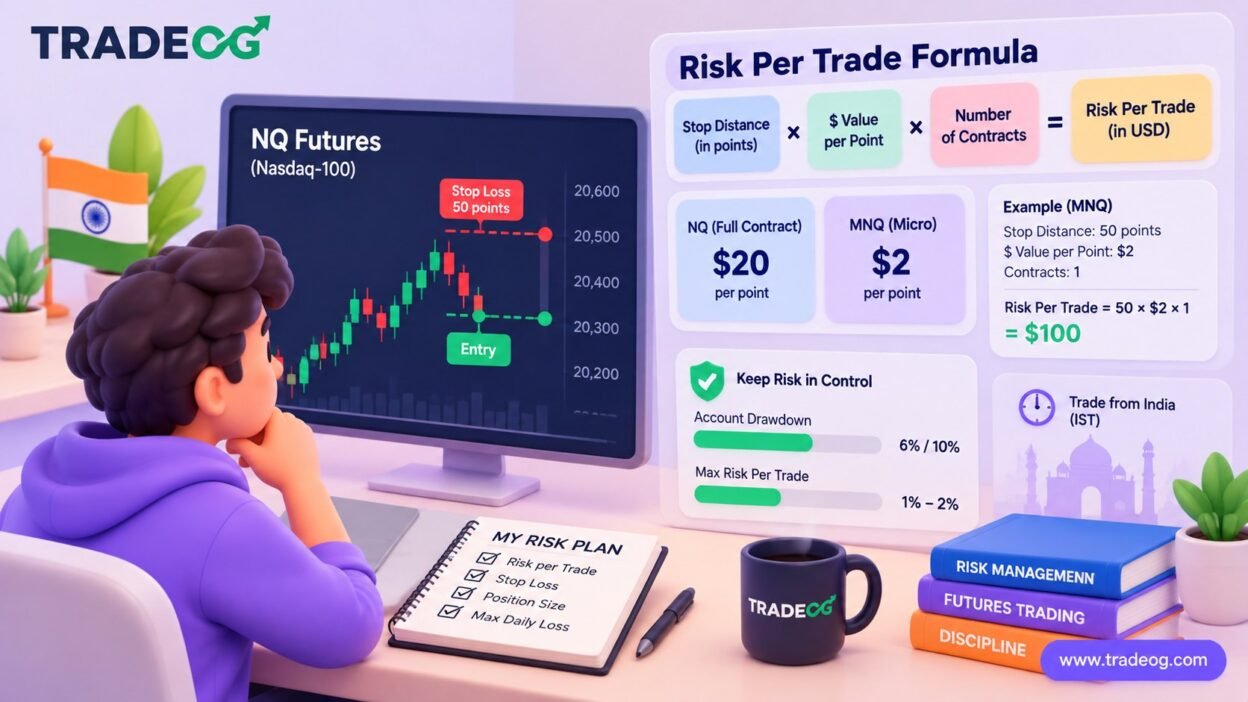
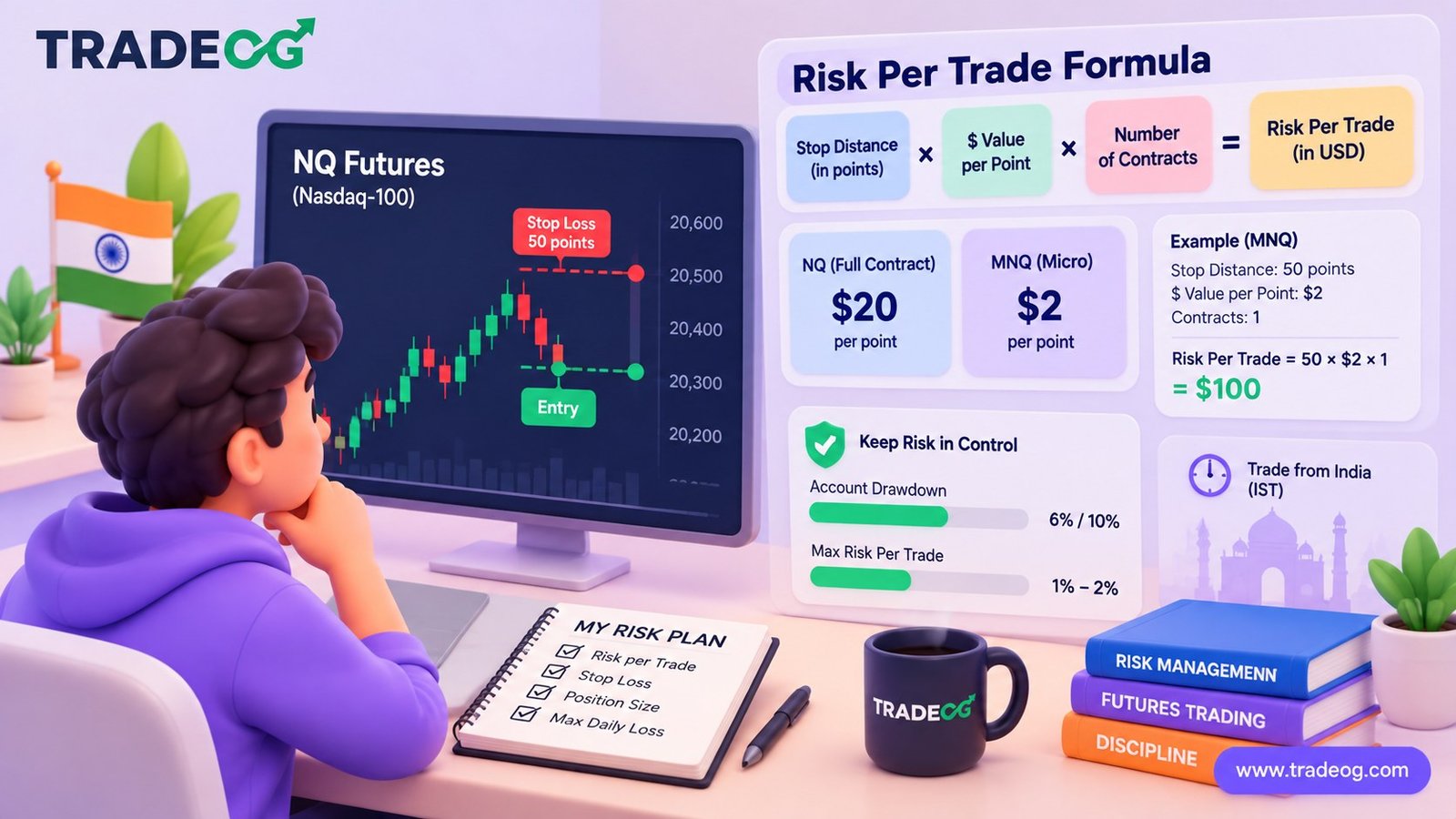
Risk per trade = Stop-loss distance in points × Dollar value per point × Number of contracts
For NQ:
- 1 NQ = $20 per point
- 0.25 point = $5 per tick
- 1 point = 4 ticks
For MNQ:
- 1 MNQ = $2 per point
- 0.25 point = $0.50 per tick
- 1 point = $2
So if your NQ stop is 10 points and you trade one contract:
10 × $20 × 1 = $200 planned risk
If you trade one MNQ with the same 10-point stop:
10 × $2 × 1 = $20 planned risk
This is why MNQ can be useful for traders who need finer position sizing. It lets you keep the same market exposure while reducing the dollar amount at risk per contract.
NQ vs MNQ: Why Contract Size Matters
| Contract | Dollar Value Per Point | 0.25-Point Tick | 50-Point Move |
|---|---|---|---|
| NQ | $20 | $5 | $1,000 |
| MNQ | $2 | $0.50 | $100 |
The important lesson is that the number of contracts should come after the stop distance, not before it.
A common mistake is deciding, “I will trade two NQ contracts,” and then searching for a stop that fits. A risk-based approach works in the opposite direction:
- Identify the technical invalidation level.
- Calculate the stop distance.
- Choose the maximum dollar risk.
- Calculate the contract quantity.
- Round down to an allowed whole number of contracts.
How to Calculate NQ Risk Per Trade From India
Suppose an Indian trader has a prop account with a $2,000 maximum loss buffer. The trader does not need to risk 1% of the advertised $50,000 account size simply because the dashboard says “$50K.” The relevant number for survival is the firm’s actual loss limit and the trader’s remaining buffer.
For example, assume the trader chooses a $100 maximum planned risk per trade.
If the setup needs a 50-point stop:
NQ: 50 × $20 = $1,000
One NQ contract would therefore be too large for a $100 risk target.
With MNQ:
50 × $2 = $100
One MNQ contract fits the planned $100 risk before costs and execution differences.
This is a simple example, but it shows the key idea: your stop distance determines whether NQ or MNQ is practical for the risk budget you have chosen.
A Simple Risk Per Trade Formula for Prop Traders
You can reverse the formula when you already know your maximum risk:
Maximum Stop Distance = Maximum Risk ÷ (Dollar Value Per Point × Contracts)
For one MNQ contract and a $100 risk limit:
$100 ÷ $2 = 50 points
For one NQ contract and a $100 risk limit:
$100 ÷ $20 = 5 points
That means the same $100 risk budget allows a 50-point stop on one MNQ, but only a 5-point stop on one NQ.
This matters because forcing an NQ position into a stop that is technically too tight can create a different problem: the trade may be stopped out by normal market noise rather than by a genuine invalidation of the setup.
How Much Should an Indian Trader Risk Per Trade?
There is no universal prop-firm risk percentage that applies to every account. Each firm’s rules, drawdown methodology, contract limits, daily loss limits and trading conditions can differ.
A practical way to think about the problem is to start with the actual drawdown buffer, not the headline account size.
For example, suppose your usable risk buffer is $2,000. A trader could choose a planning limit such as:
| Planned Risk | Share of $2,000 Buffer | Comment |
|---|---|---|
| $50 | 2.5% | Very small single-trade exposure |
| $100 | 5% | Moderate example for planning |
| $150 | 7.5% | Higher exposure per trade |
| $200 | 10% | Leaves less room for repeated losses |
These are planning examples, not a recommendation or a universal rule. The correct figure depends on the firm’s rules, strategy, expected stop distance, trading frequency and the trader’s tolerance for a sequence of losing trades.
Why 1% of the Account Size Can Be Misleading
This is one of the biggest differences between normal investing language and prop-firm risk management.
If someone says “1% risk on a $50,000 account,” the number is $500. But a prop firm may have a much smaller maximum loss threshold than $50,000. For example, Topstep currently lists a $2,000 Maximum Loss Limit for its $50K account, $3,000 for its $100K account and $4,500 for its $150K account. Its MLL is a trailing limit that rises with end-of-day balance and eventually locks at the starting balance. Topstep Maximum Loss Limit.
Therefore, risk calculations should be connected to the firm’s actual rule set. The account label is not the same thing as the amount you can safely lose.
For a deeper explanation, see TradeOG’s How Futures Prop Firm Maximum Loss Limit Is Calculated.
Example: $100 Risk on MNQ
Assume an MNQ setup has:
- Entry: 20,500
- Stop loss: 20,450
- Stop distance: 50 points
- Contracts: 1 MNQ
- Value per point: $2
The planned price risk is:
50 × $2 × 1 = $100
If the stop is hit, the theoretical futures loss is approximately $100 before commissions, fees and execution differences.
If the trader instead uses two MNQ contracts:
50 × $2 × 2 = $200
With five MNQ contracts:
50 × $2 × 5 = $500
The stop distance did not change. Only the position size changed.
Example: Why One NQ Contract Can Become Large Risk Quickly
Now use the same 50-point stop with one NQ contract.
50 × $20 × 1 = $1,000
A $1,000 loss on a single trade may represent a large portion of a prop account’s drawdown buffer. This is why traders should calculate the dollar exposure before placing the order rather than relying on the apparent size of the account.
If the setup genuinely requires a 50-point stop, reducing the number of contracts is not possible below one full NQ contract. In that situation, MNQ can provide a smaller position size.
What If Your Stop Is 25 Points?
| Position | 25-Point Stop | Planned Risk |
|---|---|---|
| 1 NQ | 25 points | $500 |
| 1 MNQ | 25 points | $50 |
| 2 MNQ | 25 points | $100 |
| 4 MNQ | 25 points | $200 |
This table makes position sizing much easier. If your maximum planned loss is $100 and your technical stop is 25 points, two MNQ contracts fit the simple calculation:
25 × $2 × 2 = $100
Do Not Forget Slippage and Trading Costs
The formula above calculates planned price risk. Actual account impact can differ because of commissions, exchange fees and execution.
During fast markets, the price at which an order actually fills may differ from the stop price. Prop firms can also use their own liquidation and risk-management systems.
For example, Topstep says its Maximum Loss Limit is monitored using real-time net P&L, including unrealized P&L. If the limit is touched, liquidation can occur immediately, and slippage can affect the final realized balance. Topstep’s MLL documentation.
So if your maximum acceptable loss is $100, treating exactly $100 as your entire operational cushion may be too aggressive. A trader should leave room for costs and execution conditions.
NQ Risk Per Trade During News
NQ can become particularly fast around major U.S. economic releases, Federal Reserve events and large technology-stock news. A stop that normally takes seconds to fill can behave differently when liquidity and volatility change.
This does not mean every news trade will produce slippage. It means the trader should understand that the simple stop-distance calculation is an estimate of planned risk, not a guarantee of the exact final loss.
For a prop account, the distinction is important because a drawdown rule may use real-time equity rather than only closed-trade balance.
Indian Trading Hours and NQ Risk
NQ trades on CME Globex for most of the trading week. For an Indian trader, the U.S. session is usually the most important period for Nasdaq volatility, but the exact Indian Standard Time conversion changes when the United States moves between daylight and standard time.
The U.S. cash market opens at 9:30 a.m. New York time. That corresponds to approximately 7:00 p.m. IST during U.S. daylight saving time and approximately 8:00 p.m. IST during U.S. standard time.
That timing matters for risk planning because the same stop size can behave very differently during quiet overnight conditions versus the U.S. cash-session open.
If your strategy is designed around the U.S. open, define the risk before the session starts instead of increasing size because the market suddenly becomes active.
A Practical NQ Risk Calculator
You can calculate your position size using this formula:
Contracts = Maximum Dollar Risk ÷ (Stop Distance × Dollar Value Per Point)
Example:
- Maximum risk = $150
- Stop = 30 points
- MNQ value = $2 per point
$150 ÷ (30 × $2) = 2.5 contracts
You cannot trade 2.5 MNQ contracts, so you round down to 2 MNQ contracts.
Actual planned risk:
30 × $2 × 2 = $120
Rounding down keeps the calculated price risk below the selected $150 limit.
How Many Losing Trades Can Your Buffer Handle?
Risk per trade should also be evaluated as a sequence rather than as a single trade.
If your planned risk is $100:
- 1 loss = approximately $100
- 3 losses = approximately $300
- 5 losses = approximately $500
- 8 losses = approximately $800
This simple exercise shows why a trader should not choose position size only because the first trade looks affordable. A strategy can experience several losing trades before its statistical edge appears.
The purpose of a controlled risk-per-trade rule is to keep a normal losing sequence from consuming the entire prop-firm drawdown buffer.
Common NQ Risk Management Mistakes
1. Using the account size as the risk budget
A $50K prop account does not mean you should calculate risk as if you personally have $50,000 available to lose. Check the actual drawdown and daily loss rules.
2. Choosing contracts before the stop
Position size should follow the technical stop, not the other way around.
3. Moving the stop after entry
Moving a stop farther away can increase the actual risk beyond the amount calculated before entry. If the trade thesis is invalidated, adding risk can turn one planned loss into a much larger account drawdown.
TradeOG has also covered why traders move their stop loss after entering a trade.
4. Ignoring unrealized P&L
Some prop firms monitor risk using equity or real-time net P&L. An open loss can therefore matter even before the position is closed.
5. Trading NQ when MNQ fits the risk better
If one NQ contract is too large for your planned risk, MNQ may allow the same Nasdaq-100 market exposure with smaller dollar increments.
6. Treating every prop firm’s rules as identical
Prop firms can differ in MLL methodology, daily loss limits, contract limits, news rules, trading hours and liquidation procedures. Always check the current rules of the specific firm before trading.
NQ Risk Per Trade Checklist for Indian Traders
- Know whether you are trading NQ or MNQ.
- Know the dollar value per point.
- Define the technical stop before entry.
- Calculate planned dollar risk.
- Compare that risk with the firm’s actual drawdown buffer.
- Leave room for fees and execution differences.
- Check daily loss and maximum loss rules.
- Know the firm’s contract-size limit.
- Reduce size when volatility or execution conditions change.
- Never move the stop farther away simply to avoid taking the planned loss.
Final Takeaway
NQ futures risk per trade is a position-sizing problem, not an account-size problem.
The basic calculation is simple:
Stop distance × dollar value per point × contracts = planned price risk.
For NQ, the value is $20 per point. For MNQ, it is $2 per point. That ten-to-one difference can make MNQ much easier to size when your prop-firm risk budget is relatively small.
For an Indian trader, the most important workflow is to determine the technical stop first, choose a maximum dollar risk that fits comfortably inside the firm’s actual drawdown rules, and then calculate the number of contracts. Do not let the headline account size determine your position size.
Also remember that prop-firm rules are contractual and can change. Verify the current rules of your specific firm before placing a trade. CME Group’s contract specifications and the firm’s own risk documentation should be treated as the primary references.
Sources
- CME Group — E-mini Nasdaq-100 Futures Contract Specifications
- CME Group — Micro E-mini Equity Index Futures FAQ
- CME Group — Nasdaq-100 Futures
- Topstep — What Is the Maximum Loss Limit?
- Topstep — When and What Products Can I Trade?
Educational content only. Futures and prop trading involve substantial risk, and prop-firm rules vary. Check the current rules, contract specifications and risk disclosures of the provider you use.



[…] you are building a CME futures prop-trading routine from India, also read NQ Futures Prop Trading From India: Risk Per Trade for contract sizing and stop-loss calculations, and How Futures Prop Firm Maximum Loss Limit Is […]
[…] whether you will trade or avoid the initial news spike. If NQ is your main instrument, our guide to NQ futures prop trading risk per trade covers contract value, stop sizing and drawdown management. The goal is not simply to catch a large […]
[…] See also: NQ Futures Prop Trading From India: Risk Per Trade. […]