

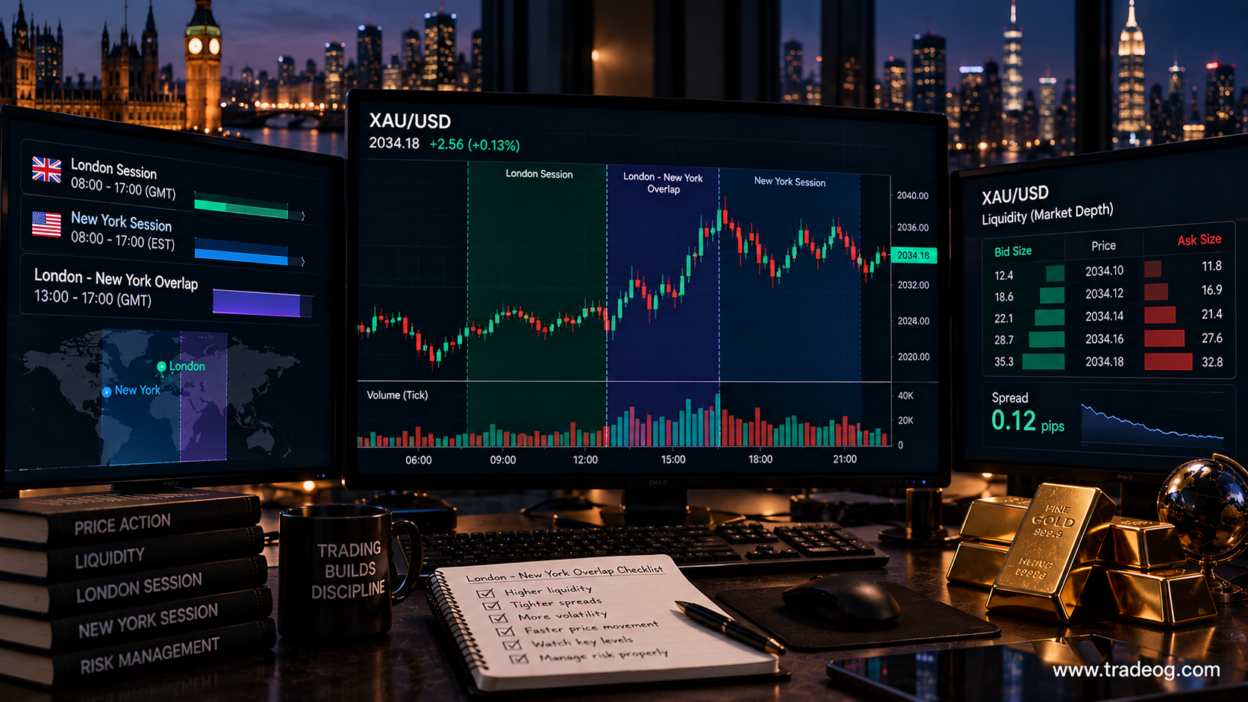
Forex traders often hear that the currency market is the world’s most liquid financial market. That is true at the broad market level, but it does not mean liquidity is equally available at every price, at every time, or through every broker.
When liquidity disappears, the market does not simply stop trading. Instead, the cost and difficulty of execution can change dramatically. Bid-ask spreads can widen, available order size can shrink, price can jump between levels, slippage can increase, and a relatively modest order can have a much larger impact on the quoted price.
This matters especially during major economic announcements, sudden risk-off moves, market transitions, thin trading periods and episodes when banks or other liquidity providers reduce their willingness to quote aggressively.
In this guide, TradeOG explains what actually happens when forex liquidity disappears, how the change appears on a trading platform, why spreads and slippage can rise together, and what retail traders can do to reduce execution risk.
What Does It Mean When Forex Liquidity Disappears?
Market liquidity describes how easily a trader can buy or sell without causing a large price concession. It is multidimensional: bid-ask spread, market depth, trading cost, price impact and execution speed all matter. The BIS notes that liquidity is dynamic and cannot be captured reliably by one measure alone. citeturn0search14
In spot forex, liquidity is also different from the liquidity of a centrally listed stock or futures contract. Spot FX is predominantly over the counter, with dealers, banks, non-bank liquidity providers and electronic venues participating across a fragmented market. There is therefore no single central order book containing every EUR/USD or GBP/USD order in existence. citeturn0search1turn0search7
So when traders say “liquidity disappeared,” they usually mean that fewer executable quotes or smaller amounts of risk-bearing capacity are available around the current market price.
What Happens First When Liquidity Falls?
The first visible effect is often a deterioration in execution quality rather than an immediate giant candle.
- Bid-ask spreads widen: market makers demand more compensation for taking risk.
- Quoted depth falls: fewer units may be available near the current price.
- Price impact increases: larger orders can move the market more.
- Quotes can change faster: liquidity providers continuously reassess risk.
- Slippage becomes more likely: an order may be filled at a less favorable price.
- Price can jump between levels: if intermediate liquidity is thin, there may be fewer executable prices between two points.
These effects can reinforce each other. A widening spread makes trading more expensive, while a thin market can make price more sensitive to incoming orders. In stressed conditions, the result can look like a market that suddenly becomes “air pocket” thin.
1. Bid-Ask Spreads Can Expand Sharply
The bid is the price at which you can sell immediately, while the ask is the price at which you can buy immediately. The difference is the spread.
When liquidity providers are comfortable carrying risk, competition between quotes can keep spreads relatively tight. When market conditions become uncertain, providers may widen their quotes or reduce the amount they are willing to trade.
That means a trader who normally sees a small spread can suddenly see a much larger transaction cost.
For a scalper, this is particularly important. Suppose a strategy normally seeks a 5-pip gross move and the usual spread is 0.8 pips. If the spread temporarily expands to 4 pips, a large portion of the expected price movement can be consumed before commissions and slippage are even considered.
The problem is not necessarily that the broker is malfunctioning. A broker may simply be passing through or marking up a much thinner underlying liquidity environment.
2. Market Depth Becomes Thinner
Liquidity is not just about the best bid and best ask. It is also about how much executable interest exists at prices beyond the top quote.
In a deep market, a large order may be absorbed across several nearby price levels. In a thin market, those levels can contain much less size.
This is why two markets with the same quoted spread can behave very differently. A 1-pip spread with substantial available size can provide very different execution conditions from a 1-pip spread supported by very small amounts of liquidity.
For traders who want a deeper explanation of this concept, see What Is Forex Market Depth and Does It Matter?.
3. Price Impact Increases
When liquidity is abundant, a trade can be relatively small compared with the available risk-bearing capacity. When liquidity disappears, the same order becomes larger relative to what is available.
That increases price impact.
Imagine a currency pair trading around 1.1000. Under normal conditions, there may be multiple liquidity providers quoting around that level. If several providers reduce their exposure simultaneously, fewer executable prices may remain.
An incoming market order can then consume the best available quote and continue into the next level. The resulting transaction price may be materially different from the price displayed a fraction of a second earlier.
This is one reason liquidity conditions matter even when the headline news itself does not appear large.
4. Slippage Becomes More Common
Slippage occurs when the final execution price differs from the price a trader expected when submitting the order.
Low liquidity does not automatically guarantee negative slippage on every trade, but it increases execution uncertainty because fewer prices and smaller quantities may be available.
Consider a trader who sends a market buy order while EUR/USD is displayed at 1.0800. If the liquidity available at the ask is insufficient, part or all of the order may execute at higher prices.
During an extremely fast move, the platform may show one price while the underlying executable quote has already moved. This is closely related to the execution and quote-refresh issues discussed in Why Forex Quotes Can Change Before Your Trading Platform Refreshes.
5. Price Can Jump Between Levels
Thin liquidity can create a visual impression that price “teleported.” The market is still trading, but there may have been very little executable interest between the previous transaction and the next available quote.
This can produce:
- large candle wicks;
- fast multi-pip moves;
- gaps between consecutive executable prices;
- unexpected stop-loss fills;
- rapid reversals when liquidity returns.
A chart cannot show every quote that existed in the underlying market. It records transactions or broker-generated price updates according to the feed and timeframe. Therefore, a candle can hide the detailed sequence of quote changes that occurred during a fast liquidity event.
Why Does Forex Liquidity Disappear?
Major Economic News
CPI, NFP, FOMC decisions, central-bank announcements and unexpected geopolitical developments can cause liquidity providers to reduce risk temporarily.
The important point is that volatility and liquidity are connected but not identical. A market can become highly volatile because liquidity is thin, and liquidity providers can also withdraw or widen prices because volatility has suddenly increased.
The Federal Reserve’s discussion of April 2025 market conditions noted that FX liquidity deteriorated as volatility increased, illustrating how liquidity conditions can change during periods of market stress. citeturn0search6
Market Open and Session Transitions
Liquidity is not constant across the 24-hour forex cycle. Participation changes as Asian, European and North American centres become active or wind down.
Some transition periods can temporarily produce thinner conditions, particularly when one major liquidity centre is closing before another has fully taken over.
For XAU/USD traders, session liquidity is especially important. See How XAU/USD Liquidity Changes During the London-New York Overlap for a detailed example of how participation changes during a major overlap.
Unexpected Market Stress
Liquidity providers are businesses managing inventory, hedging exposure, balance-sheet capacity and market risk. During severe uncertainty, they may become less willing to quote large amounts at tight prices.
The BIS has documented how FX dealers, venues and liquidity providers interact in a fragmented market and has noted that stress can test the resilience of liquidity provision. citeturn0search7
Funding and Dealer Constraints
Liquidity in related FX markets can also matter. BIS research has found links between FX funding liquidity and spot-market bid-ask spreads, showing that liquidity conditions in FX swaps can spill over into spot FX. citeturn0search8
Liquidity Disappearing Does Not Mean the Forex Market Stops
This distinction is important.
Forex is enormous and highly diversified. A temporary withdrawal of liquidity from one venue, broker or group of providers does not mean there are literally no buyers or sellers anywhere in the global market.
The modern FX market is fragmented across dealers, electronic venues and liquidity providers. BIS research shows that dealers can internalise a large share of customer flow, while liquidity aggregators can combine access to multiple sources. citeturn0search1
Therefore, “liquidity disappears” should normally be interpreted as liquidity becoming materially thinner at the prices and sizes relevant to execution, not as every participant leaving the market.
What Happens to Stop-Loss Orders?
Stop-loss orders can behave differently from what a trader expects when liquidity becomes thin.
A stop order generally becomes executable when its trigger condition is reached, but the eventual fill depends on available liquidity and the execution mechanism. If the market moves rapidly through the trigger level, the fill can occur at a worse price.
This is why a stop loss is a risk-management instruction, not a guarantee that the trade will close at the exact price printed on the chart.
For XAU/USD specifically, this issue can become confusing because different brokers can have different price feeds. TradeOG explains the mechanics in Why XAU/USD Can Hit Your Stop Loss Without Breaking the Candle Low.
Liquidity Shock vs Spread Expansion vs Slippage
| Condition | What Changes? | Typical Trading Effect |
|---|---|---|
| Liquidity falls | Less executable interest or risk capacity | Higher execution uncertainty |
| Spread expands | Bid and ask move farther apart | Higher immediate transaction cost |
| Slippage increases | Execution differs from expected price | Worse or occasionally better fill |
| Volatility rises | Price changes become larger/faster | Higher movement and execution risk |
| Price gaps between levels | Fewer executable prices in between | Stops and market orders can fill farther away |
These conditions can occur together, but they are not interchangeable terms.
Why Liquidity Can Make a Normal Strategy Suddenly Look Broken
A strategy can appear to stop working even when its directional logic has not changed.
Suppose a short-term strategy was tested using normal spreads and ordinary execution. If the live market suddenly develops wider spreads and more slippage, the strategy’s effective entry price, stop distance and reward-to-risk ratio can all deteriorate.
This is one reason backtests can be misleading when they assume ideal or static transaction costs.
TradeOG’s article Why Do Trading Strategies Stop Working During Different Market Conditions? explores the broader problem of strategy behaviour across changing market regimes.
How Traders Can Recognise a Liquidity Problem
You do not need access to an institutional order book to notice deteriorating conditions. Watch for several signals appearing together:
- Spread suddenly widens.
- Quotes change unusually quickly.
- Market orders receive more slippage than usual.
- Price moves several times faster than the recent average.
- Wicks become unusually large.
- Different brokers show larger price differences.
- Economic news or a major market event is approaching.
No single signal proves that liquidity has disappeared. The stronger indication is a combination of wider spreads, faster price updates, larger execution differences and abnormal volatility.
What Should Retail Forex Traders Do?
Reduce Position Size
When execution conditions deteriorate, smaller exposure reduces the financial impact of unexpected slippage.
Avoid Treating the Normal Spread as Guaranteed
Use the current spread rather than yesterday’s average spread when evaluating a trade. A strategy that needs a very tight spread should have a clear rule for when trading conditions are no longer acceptable.
Give High-Impact News More Respect
If your strategy is not specifically designed for event-driven volatility, waiting for the initial liquidity shock to settle can be more rational than chasing the first candle.
Prop-firm traders should be especially careful because execution rules, news restrictions and slippage policies can differ by firm. See How Prop Firms Handle Slippage During High-Impact News.
Compare More Than One Price Feed
If you see an unusually large spike, compare the same instrument across your broker and an independent reference source. This does not prove which price is “correct,” but it can help identify whether the move is broad or isolated to a particular feed.
Do Not Confuse Thin Liquidity With a Trading Signal
A sudden wick through a high or low is not automatically a reversal signal. It may reflect stops, changing liquidity, aggressive orders, news or a temporary imbalance.
Liquidity conditions should be treated as an execution and market-structure variable, not as a standalone buy or sell signal.
Does Low Liquidity Always Mean a Huge Move?
No.
Thin liquidity can make the market more sensitive to orders, but the direction and magnitude of the eventual move depend on the balance of buying and selling interest, incoming information, positioning and the liquidity that remains.
A market can become thin and then stabilise. It can also become thin and produce a sharp directional move. That is why liquidity should be monitored together with volatility, market structure and the catalyst driving the move.
Why Liquidity Is Different Across Forex Pairs
Major pairs such as EUR/USD generally have a broader ecosystem of dealers and participants than many exotic currency pairs. Smaller or less actively traded currencies can experience wider spreads and more pronounced execution costs, particularly during stress or off-peak periods.
The same principle applies within one pair across different times of day. A pair can be highly liquid during one session and materially thinner several hours later.
This is one reason traders should avoid assuming that a backtest’s average spread represents the spread they will receive at every possible entry.
A Simple Mental Model
Think of forex liquidity as the number and quality of available bridges between buyers and sellers.
When many strong bridges are available, traffic can move smoothly. When several bridges close, the remaining routes become crowded. The cost of crossing increases, delays become more important and a sudden surge of traffic can create much larger disruption.
In trading terms, those “bridges” are executable prices and available risk-bearing capacity from dealers and other liquidity providers.
Final Takeaway
When liquidity disappears from the forex market, trading usually does not stop. What changes is the quality of execution around the current price.
Spreads can widen. Available depth can shrink. Price impact can increase. Slippage can become more frequent. Quotes can move faster, and price can jump across levels when there is insufficient executable interest between them.
The effect is particularly important during major news, market stress and thin trading periods. Because spot FX is decentralised and fragmented, liquidity conditions can also differ across venues and brokers rather than changing identically everywhere. citeturn0search1turn0search7
The practical lesson for retail traders is simple: when liquidity deteriorates, focus less on predicting the next candle and more on controlling execution risk. Check the live spread, reduce size when appropriate, understand your broker’s execution model, respect major news and avoid assuming that normal market conditions will remain normal during a liquidity shock.
FAQs
Can forex liquidity completely disappear?
For the global FX market as a whole, a literal complete disappearance of liquidity is an extreme concept. More commonly, liquidity becomes severely impaired in a particular currency, venue, time window or price range. The fragmented FX structure means other sources of liquidity may continue operating.
Does low liquidity always cause wider spreads?
Not necessarily at every instant, but reduced liquidity commonly increases the risk of wider spreads because liquidity providers face greater uncertainty and may quote less aggressively.
Why does slippage increase when liquidity is low?
There may be fewer executable prices and less available size near the requested price. A market order can therefore consume available liquidity and execute farther away from the expected price.
Is low liquidity good for scalping?
Usually it creates additional execution risk for short-term strategies because spread and slippage can consume a larger percentage of a small target. A scalper should evaluate actual trading costs rather than assuming the normal spread will remain stable.
Can liquidity problems affect stop losses?
Yes. A rapid move through a stop trigger can result in a fill away from the trigger price, depending on the order type, broker execution model and available liquidity.
Does liquidity disappearing mean the broker is manipulating price?
No. A sudden price difference or spread expansion can have legitimate market-structure explanations, including changing liquidity-provider quotes, aggregation, latency and fast market conditions. Suspicious behaviour should be investigated using timestamped execution records and independent price references rather than assumed from one chart alone.

[…] What Happens When Liquidity Disappears From the Forex Market explains why thin liquidity can lead to wider spreads, greater slippage and larger price […]