
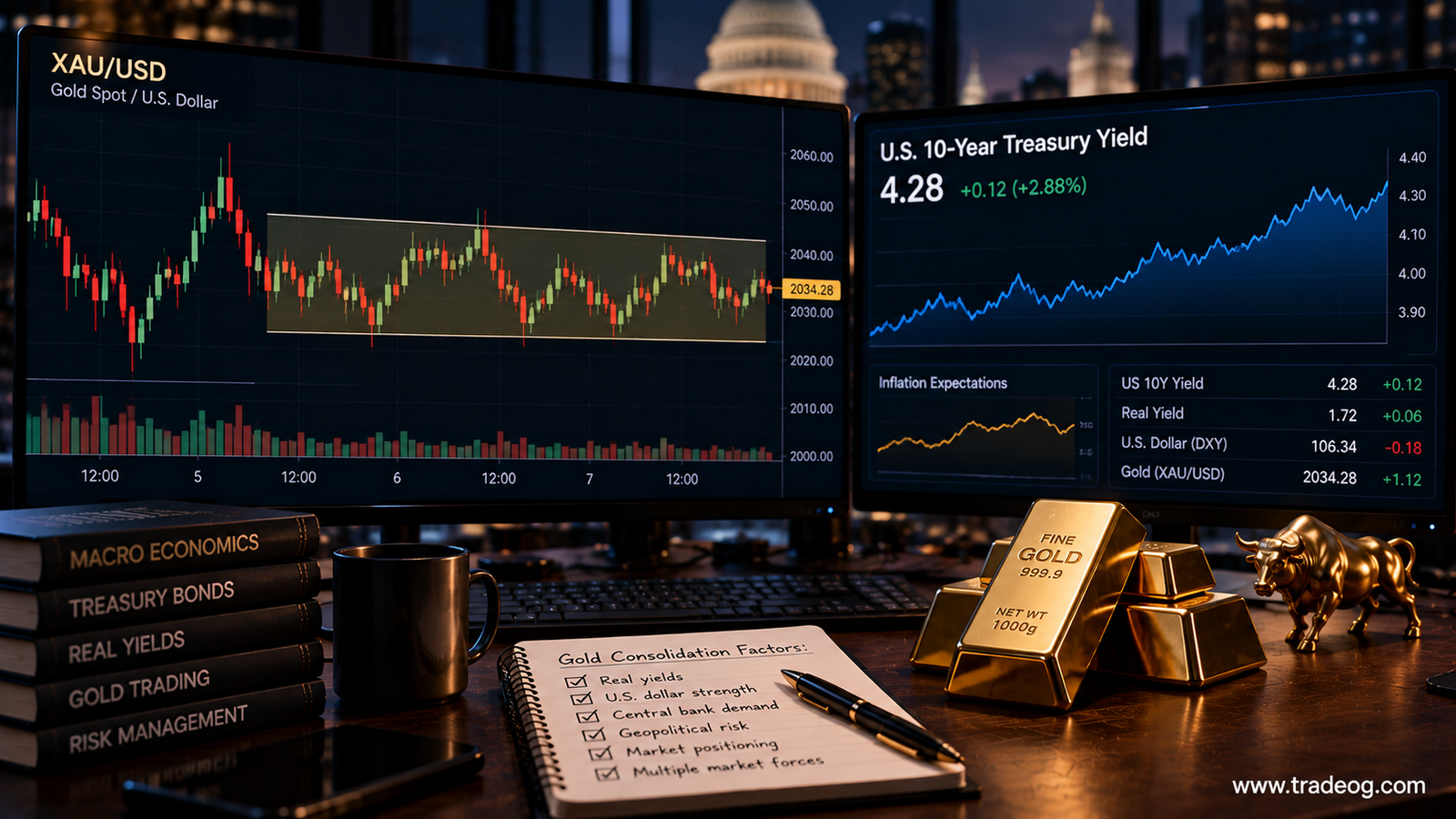
Gold does not always react immediately when U.S. Treasury yields move. That can look strange at first, especially because traders are often taught that higher yields are negative for XAU/USD while lower yields are supportive.
In practice, the relationship is more complicated. Treasury yields are only one part of the gold pricing equation, and the type of yield move matters just as much as its direction. Gold can remain inside a narrow range while the 10-year Treasury yield rises or falls because the dollar, real yields, inflation expectations, positioning, safe-haven demand, central-bank buying and technical market structure may be offsetting the bond-market signal.
This is particularly important for traders who use Treasury yields as a confirmation tool for XAU/USD. A moving yield does not automatically mean gold should break out.
Why Traders Watch Treasury Yields When Trading Gold
Gold does not pay interest. U.S. Treasury securities do. Therefore, when the return available from relatively safe U.S. government debt changes, the opportunity cost of holding non-yielding gold can change as well.
Historically, real interest rates have been especially important. The World Gold Council notes that real rates have been a prominent driver of gold, but also highlights that the relationship can be counterbalanced by other forces. World Gold Council research on gold, real yields and other drivers
That distinction explains why looking only at the headline 10-year yield can produce misleading trading signals.
1. Nominal Treasury Yields Can Move Because Inflation Expectations Are Changing
The U.S. 10-year Treasury yield is a nominal yield. A simplified way to think about it is:
Nominal yield ≈ real yield + inflation expectations
Suppose the 10-year yield rises because investors expect higher inflation, while the real yield barely changes. The headline yield has moved, but the opportunity cost of holding gold may not have changed by the same amount.
That can leave XAU/USD surprisingly stable.
For gold traders, this is one reason the 10-year TIPS yield can be more informative than simply watching the nominal 10-year Treasury yield.
2. The Dollar Can Offset the Yield Signal
Gold is priced internationally in U.S. dollars, so the dollar itself is a major variable.
Imagine Treasury yields rise, which would normally create a headwind for gold. At the same time, the dollar weakens because markets expect softer U.S. growth, changing policy expectations or stronger demand for other currencies.
The weaker dollar can support gold and offset part or all of the pressure created by higher yields.
This is why a trader may see:
- 10-year Treasury yield rising
- DXY falling
- XAU/USD moving sideways
There is no contradiction. Two important gold drivers are simply pushing in opposite directions.
TradeOG has covered this broader relationship in Why Does Gold Sometimes Ignore a Strong US Dollar? and How US Dollar Strength Affects Gold Prices for Indian Traders.
3. Real Yields Matter More Than the Headline Yield
A rising nominal yield does not necessarily mean real yields are rising by the same amount.
For example, consider a simplified scenario:
| Variable | Before | After |
|---|---|---|
| 10-year nominal yield | 4.10% | 4.30% |
| Inflation expectations | 2.30% | 2.50% |
| Approx. real yield | 1.80% | 1.80% |
The nominal yield has increased by 20 basis points, but the simplified real-yield estimate has not changed.
In that situation, it would be unreasonable to expect gold to automatically sell off simply because the 10-year yield printed higher.
The World Gold Council has also documented periods when rising real yields did not prevent gold from remaining resilient because other sources of demand offset the traditional rate headwind. World Gold Council analysis of gold resilience despite rising real yields
4. Gold Can Enter Consolidation When Macro Forces Are Balanced
Sometimes the simplest explanation is that buyers and sellers are evenly matched.
Suppose:
- bond yields are rising
- the dollar is slightly weaker
- safe-haven demand is steady
- central-bank demand remains supportive
- traders are waiting for major U.S. data
There may be no strong enough catalyst to force XAU/USD out of its existing range.
Price can therefore spend hours or even days moving between clearly defined support and resistance levels while Treasury yields continue to fluctuate.
This is a normal market condition, not evidence that the Treasury market is “wrong.”
5. Central-Bank and Physical Demand Can Absorb Rate Pressure
Gold demand is not limited to short-term futures traders.
Central banks, investors, jewellery buyers, ETFs and physical-market participants can all influence the balance between buyers and sellers. The World Gold Council has highlighted central-bank buying as an increasingly important factor that can counterbalance the traditional negative relationship between gold and real rates. World Gold Council research on gold, real yields and other drivers
This matters because a yield-driven sell signal may be weaker when another large source of demand is absorbing offers.
6. Positioning Can Keep Gold Trapped in a Range
Markets do not move purely because a fundamental variable changes. Positioning matters.
If many traders already expected Treasury yields to rise, the actual yield increase may produce little additional selling in gold. The information may already be priced in.
Conversely, if traders are heavily positioned short gold, even a rise in yields may fail to produce a large decline if sellers are unable to push price through major technical support.
This is why the same Treasury-yield move can produce a very different XAU/USD reaction on different days.
7. Technical Support and Resistance Can Override a Macro Signal
Imagine XAU/USD is trading between $2,320 and $2,345.
The 10-year Treasury yield rises sharply, but gold approaches $2,320 and repeatedly finds buyers. Unless support breaks, the yield move may simply create temporary pressure inside the range.
Traders who sell every time yields rise can therefore get caught repeatedly selling near support.
Macro analysis works best when combined with market structure:
- Identify the current range.
- Mark major support and resistance.
- Watch whether real yields confirm the Treasury move.
- Check DXY for confirmation or divergence.
- Wait for price to actually break structure.
For more on consolidation and breakout conditions, see Why Does Forex Price Consolidation Often Happen Before a Major Breakout?.
8. The Timing of the Yield Move Matters
A Treasury-yield move during a quiet trading period may have a smaller immediate impact on XAU/USD than a yield move occurring alongside a major U.S. economic release.
Liquidity, session overlap and the type of catalyst matter.
For Indian traders, this is especially relevant because the London and New York sessions can produce very different XAU/USD behaviour. A yield move that occurs during a relatively quiet period may not immediately translate into a large gold move, while the same-sized move during a high-impact U.S. data release can trigger much faster repricing.
See XAU/USD London Session Behavior Explained and XAU/USD New York Session Behavior Explained for session-specific context.
9. Why Gold Can Consolidate Even While Yields Trend
Consider a hypothetical trading session:
- 10-year Treasury yield: rising steadily
- 10-year real yield: nearly unchanged
- DXY: falling modestly
- Gold: holding above technical support
- Central-bank demand: supportive
- Major U.S. data: still ahead
In this environment, gold has several reasons not to sell aggressively.
The result may be a narrow XAU/USD range with repeated rejection from both sides. Treasury yields can keep moving while gold waits for a stronger catalyst.
What Traders Should Watch Instead of Treasury Yields Alone
A better XAU/USD macro dashboard includes several variables.
| Indicator | What to Ask |
|---|---|
| U.S. 10-year yield | Are nominal yields rising or falling? |
| 10-year real yield / TIPS | Is the actual opportunity cost of gold changing? |
| DXY | Is the dollar confirming or offsetting the yield move? |
| Inflation expectations | Is the yield move driven by inflation expectations? |
| U.S. economic data | Is a new fundamental catalyst repricing rates? |
| Gold structure | Is XAU/USD breaking support/resistance or remaining inside a range? |
| Market positioning | Could crowded trades amplify or suppress the reaction? |
A Practical Rule for XAU/USD Traders
Do not treat Treasury yields as a standalone buy-or-sell signal.
A stronger approach is to look for yield direction + real-yield confirmation + dollar confirmation + XAU/USD price structure.
For example, a bearish gold setup becomes more convincing when:
- nominal yields rise
- real yields rise
- DXY strengthens
- XAU/USD breaks a well-defined support level
- the move occurs with strong market participation
On the other hand, if yields rise but real yields remain stable, DXY falls and gold repeatedly holds support, consolidation may be the more logical interpretation.
Why This Matters for Gold Scalpers
Scalpers should be particularly careful with the assumption that a yield move guarantees an immediate XAU/USD breakout.
Gold can remain range-bound while the bond market is active. Entering repeatedly in anticipation of a breakout can create a series of small losses, especially after spread and execution costs are included.
For short-term traders, price confirmation should usually come before treating the macro move as a trade trigger.
Final Takeaway
Gold can consolidate even when Treasury yields are moving because Treasury yields are only one of several forces affecting XAU/USD.
The most important distinction is between nominal and real yields. A rising 10-year yield caused primarily by higher inflation expectations does not necessarily create the same pressure on gold as a comparable rise in real yields. At the same time, a weaker dollar, central-bank demand, safe-haven flows, positioning and technical support can absorb yield-driven selling.
For traders, the lesson is simple: watch the relationship, not just the number. When Treasury yields move, check what is driving the move, whether real yields confirm it, what DXY is doing and whether XAU/USD actually breaks market structure.
That approach can help prevent one of the most common gold-trading mistakes: assuming that every move in Treasury yields must immediately produce a move in gold.
FAQs
Does gold always fall when Treasury yields rise?
No. Higher yields can create a headwind for gold, but the relationship is not one-to-one. Other variables can offset the effect.
Are real yields more important than nominal Treasury yields for gold?
Real yields are generally more useful for assessing the opportunity cost of holding gold because they account for inflation expectations. However, they should still be interpreted alongside the dollar, risk conditions and gold-specific demand.
Why can XAU/USD stay flat while the 10-year yield rises?
Gold may be receiving offsetting support from a weaker dollar, safe-haven demand, central-bank buying, technical support or market positioning.
Should traders short gold whenever Treasury yields rise?
No. A yield move should be treated as macro context rather than an automatic trade signal. Price structure and confirmation are important before entering a position.
Trading involves substantial risk. This article is for educational purposes only and is not financial advice.