

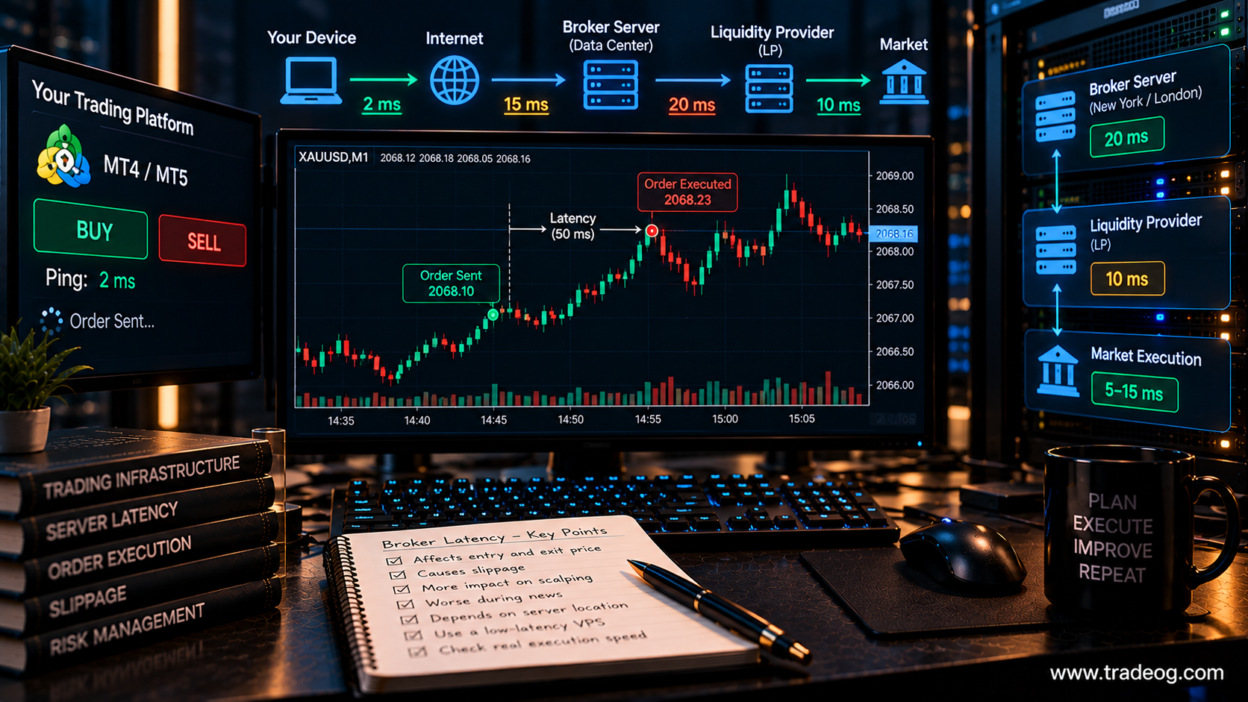
Short-term trading depends on timing. A trade that is profitable at one price can become marginal or unprofitable only a fraction of a second later. That is why broker server latency matters more to scalpers, news traders and automated strategies than it does to many swing traders.
Latency is simply the delay involved in moving information or an order from one point to another. In a retail trading setup, that can include the path from your platform to your broker’s trade server, processing at the broker, routing to a liquidity provider or execution venue, and the return of the execution response.
The important point is that latency does not automatically mean your broker is giving you a bad price. In a fast market, however, even a small delay can mean that the price available when the order reaches the execution system is different from the price you saw when you clicked Buy or Sell.
MetaTrader 5 documentation explicitly notes that lower network latency provides better conditions for trade execution, including lower slippage and a lower probability of requotes. Its strategy tester can also emulate network delays because prices may change between sending a request and its execution. MetaTrader 5 documentation and its strategy-testing documentation describe these mechanics.
What Is Broker Server Latency?
Broker server latency is the time involved in communication between your trading environment and the broker’s trading infrastructure.
A simplified path looks like:
Your device → Internet connection → broker access point/trade server → execution infrastructure/liquidity → execution response → your platform.
The actual architecture differs between brokers and products. Some brokers use multiple access points, liquidity aggregators, internal matching or other execution arrangements.
This means the number shown as “ping” in a trading platform is useful, but it is not necessarily the complete measurement of end-to-end execution latency.
Why Latency Matters More in Short-Term Trading
Suppose a scalper enters a trade expecting EUR/USD at 1.08634. If the market is moving slowly, a small network delay may have little practical effect.
Now imagine the pair is moving rapidly after a major economic release. During the time between clicking Buy and the order reaching the execution system, the available quote may have changed.
The trader could receive:
- a different execution price;
- negative or positive slippage;
- a requote, depending on the execution model;
- a partial fill in some environments;
- or a rejection if the order no longer meets the relevant execution conditions.
For a swing trader targeting hundreds of pips, a tiny execution difference may be insignificant. For a scalper targeting a few pips, the same difference can materially affect the trade’s expected value.
Latency Is Not the Same as Slippage
These terms are closely related but should not be treated as synonyms.
| Term | Meaning |
|---|---|
| Latency | Delay in communication, processing or execution |
| Slippage | Difference between a reference/expected price and actual fill |
| Spread | Difference between bid and ask |
| Requote | A new price offered when the original requested price is no longer available under the execution model |
| Market impact | Price movement associated with trading relative to available liquidity |
Latency can contribute to slippage, but slippage can also result from volatility, changing liquidity, order size, spread expansion and execution mechanics.
TradeOG explains another side of this problem in Why Forex Quotes Can Change Before Your Trading Platform Refreshes.
1. Price Can Change Before Your Order Arrives
The most intuitive latency problem is simple: the market keeps moving while your order is travelling.
Imagine:
- EUR/USD displayed ask: 1.08634
- You click Buy.
- The market moves quickly higher.
- Your request reaches the broker after the original quote has changed.
- The available execution price is now 1.08636.
The 2-pip difference is not necessarily caused by the broker intentionally delaying your order. The market itself changed during the execution window.
In highly electronic markets, this process can happen extremely quickly. The BIS notes that modern FX execution is increasingly electronic, automated and fragmented across multiple venues and liquidity sources. BIS research on the 2025 FX execution landscape describes the complexity of this environment.
2. The Broker Server’s Location Can Matter
Physical and network distance can influence latency.
If a trader’s platform is far from the broker’s relevant trading infrastructure, network packets generally have a longer path to travel than if the systems are geographically and network-wise closer.
This is one reason traders using automated systems sometimes place their VPS close to the broker’s trading infrastructure.
MetaTrader 5’s virtual hosting documentation specifically presents lower network latency as a benefit because it can improve the conditions for trading operations and reduce slippage or requote probability. MetaTrader 5 virtual hosting documentation.
3. Your Internet Connection Is Only One Part of the Problem
Traders often blame everything on their home internet connection.
That is too simplistic.
The total execution path can involve:
- Your device.
- Your local network or Wi-Fi.
- Your Internet service provider.
- Internet routing.
- The broker’s network gateway or access point.
- The broker’s trade server.
- Execution or liquidity infrastructure.
- The return path carrying the execution response.
A fast broadband connection does not guarantee low end-to-end execution latency if the route to the broker is inefficient or the relevant trading infrastructure is overloaded.
Conversely, a trader with an ordinary connection may still receive perfectly acceptable execution if the network path and broker infrastructure are efficient.
4. Ping Time Is Useful—but It Is Not the Whole Story
Trading platforms often display a ping measurement in milliseconds.
A lower number is generally preferable, but traders should not treat a single ping value as a complete execution-quality score.
Why?
- Ping can vary over time.
- Network latency can be asymmetric.
- Execution processing adds additional time.
- Liquidity-provider routing can add another layer.
- Market conditions can change while the request is being processed.
- The broker’s execution model matters.
A trader should therefore evaluate actual execution outcomes rather than choosing a broker solely because its displayed ping is low.
5. Latency Matters More When Liquidity Is Thin
Latency and liquidity interact.
If there is abundant liquidity close to the current price, a small delay may still result in a reasonably close execution.
If liquidity suddenly disappears, the same delay can become much more expensive because there may be fewer executable prices between the old quote and the new market price.
TradeOG’s What Happens When Liquidity Disappears From the Forex Market explains why thin liquidity can lead to wider spreads, greater slippage and larger price jumps.
6. News Trading Makes Latency More Important
Major releases such as CPI, NFP and FOMC decisions can cause price changes that are much faster than normal market conditions.
During these periods:
- quotes can update rapidly;
- spreads can widen;
- liquidity can change;
- orders can encounter more slippage;
- execution conditions can differ significantly from normal conditions.
A low-latency setup does not eliminate these risks. It only reduces one part of the delay chain.
This distinction is critical. A trader with a 5 ms network path can still receive a poor fill if liquidity disappears or the market reprices dramatically before sufficient executable liquidity is available.
Latency vs Liquidity vs Volatility
| Factor | What It Changes | Short-Term Risk |
|---|---|---|
| Latency | How quickly information/orders travel and are processed | Stale quote or delayed execution |
| Liquidity | How much executable interest is available | Price impact and slippage |
| Volatility | How rapidly price changes | Larger price differences during delays |
| Spread | Distance between bid and ask | Higher immediate trading cost |
The most difficult conditions occur when several deteriorate at the same time: high volatility, thin liquidity, wider spreads and a slower execution path.
7. Latency Can Hurt Scalping More Than Swing Trading
Consider two traders.
Trader A targets a 3-pip move and normally risks 5 pips.
Trader B targets a 150-pip move and risks 80 pips.
If execution becomes 1 pip worse than expected, Trader A has lost a substantial percentage of the intended reward. Trader B may barely notice it relative to the trade’s overall range.
This is why latency is primarily an execution-quality variable for short-term traders.
It does not automatically make a strategy profitable or unprofitable. It changes how closely live execution can match the assumptions behind the strategy.
8. Automated Trading Can Be More Sensitive
Expert Advisors and other automated systems can submit orders according to predefined rules without waiting for a human click.
That makes execution timing important.
If an algorithm is designed around very short holding periods, even small differences between signal generation and execution can change its results.
MetaTrader 5’s strategy tester includes network-delay simulation specifically because execution delays can cause prices to change between trade-request submission and execution. MetaTrader 5 strategy testing documentation.
This is particularly relevant when evaluating strategies that appear highly profitable under ideal “zero-delay” assumptions.
9. Backtests Can Hide Latency Problems
A strategy may look excellent in a backtest because the historical model assumes idealised fills or does not reproduce real network and execution conditions.
That does not mean the strategy is fake. It means the test may not be measuring the same environment as the live account.
A more realistic testing process should consider:
- spread;
- commission;
- execution delay;
- slippage;
- news conditions;
- liquidity changes;
- broker-specific execution rules.
For automated traders, it is particularly useful to compare results under no-delay and realistic-delay assumptions.
10. Pending Orders Work Differently From Manual Market Orders
This distinction is often misunderstood.
With a pending order already placed on the broker’s server, the order can potentially be triggered by the server without requiring a new round trip from your local device at the exact moment of the trigger.
MetaTrader 5’s documentation notes that, in its strategy tester, network delays are applied to placing or modifying certain EA requests, while pending orders that are already on the server are executed without that client-side network delay when triggered in real conditions.
However, this does not mean a pending order guarantees an exact fill price. Fast markets, gaps and available liquidity can still affect execution.
11. Latency Does Not Mean Your Broker Is Manipulating Price
A delayed or different fill can feel suspicious, particularly when the trader sees price move immediately after clicking.
But a difference between displayed price and executed price can have several legitimate causes:
- network latency;
- quote updates;
- spread changes;
- liquidity-provider repricing;
- broker aggregation;
- execution latency;
- market volatility.
Because FX is fragmented across dealers, venues and liquidity sources, there is also no single universal retail spot-FX price that every broker must display at exactly the same millisecond. BIS research describes FX as decentralised and fragmented, with multiple execution methods and liquidity sources. BIS: FX trade execution is complex and highly fragmented.
How to Measure Whether Latency Is Affecting Your Trading
Do not judge latency from one bad trade.
Instead, collect a meaningful sample of executions.
Record:
- Timestamp when the trading decision was made.
- Displayed bid/ask immediately before submission.
- Order submission time if available.
- Execution time.
- Requested/reference price.
- Actual fill price.
- Spread at entry.
- Slippage.
- Market volatility at the time.
- Whether major news was occurring.
After enough trades, compare normal-market executions with fast-market executions.
This is much more useful than saying “my ping was 80 ms, so the broker is slow.”
What Is a Good Latency for Forex Trading?
There is no universal number that makes a broker “fast enough.”
The appropriate latency depends on the strategy, instrument, trading frequency, execution model and market conditions.
For a swing trader, tens of milliseconds may have almost no practical significance.
For a very short-term automated strategy, latency can become materially more important.
The right question is therefore not:
“What is the lowest ping I can get?”
It is:
“Does my complete execution environment introduce enough delay to materially change my strategy’s expected results?”
How Traders Can Reduce Latency
Use a Stable Wired Connection
For a fixed trading workstation, Ethernet can reduce the variability associated with Wi-Fi.
Choose the Broker’s Closest Access Point
Some brokers operate multiple access points or data centres. The closest network route can reduce latency.
Consider VPS Hosting for Automated Strategies
A VPS located close to the broker’s trading infrastructure can reduce network distance. MetaTrader’s virtual hosting service is one example of this approach.
Avoid Overloading Your Trading Machine
Too many applications, browser tabs or resource-intensive processes can create local delays even when the Internet connection itself is fast.
Measure Stability, Not Just the Minimum Ping
A connection with a 10 ms minimum ping that occasionally jumps to 300 ms may be less useful than a stable connection with slightly higher but consistent latency.
Latency Checklist for Short-Term Traders
- Check your broker-server ping.
- Measure latency at different times of day.
- Compare execution price with displayed price.
- Track slippage over many trades.
- Separate normal conditions from news conditions.
- Check whether the broker offers nearby VPS/server infrastructure.
- Test automated strategies with realistic execution delays.
- Do not confuse latency with spread or liquidity.
- Do not blame latency for every unexpected fill.
- Evaluate actual execution statistics rather than marketing claims.
Final Takeaway
Broker server latency can affect short-term trading because the market continues moving while information and orders travel through the trading infrastructure.
For a long-term trader, a small execution difference may be insignificant. For a scalper or fast automated strategy, the same delay can consume a meaningful part of the expected edge.
But latency is only one part of execution quality. Liquidity, spread, volatility, broker routing, order type and market conditions can be equally or more important.
The best approach is therefore not to chase the lowest advertised ping. Instead, measure the complete execution process and determine whether latency materially changes your live results.
For short-term trading, milliseconds matter only when they are large enough relative to the strategy’s edge and the speed of the market.
FAQs
What is broker server latency?
It is the delay involved in communication and processing between a trader’s platform and the broker’s trading infrastructure. The exact path varies by broker and execution model.
Can broker latency cause slippage?
Yes. If the market moves while an order is travelling or being processed, the price available at execution can differ from the reference price. However, slippage also has other causes, including volatility and liquidity.
Does low ping guarantee better execution?
No. Low network latency is helpful, but execution also depends on liquidity, spread, routing, broker infrastructure, order type and market conditions.
Does latency matter for scalping?
Yes. Scalping strategies usually have smaller profit targets, so a small execution difference can represent a larger percentage of the expected trade return.
Is VPS hosting useful for forex robots?
It can be. A VPS located close to the broker’s trading infrastructure can reduce network latency and improve connection stability, although it cannot eliminate market volatility or liquidity-related slippage.
Can latency affect manual traders?
Yes, especially when markets move rapidly. The effect is usually less important for slower strategies than for very short-term entries.
[…] TradeOG has covered related execution issues in Spread Expansion vs Slippage: What’s Actually Happening? and How Broker Server Latency Can Affect Short-Term Trading. […]