

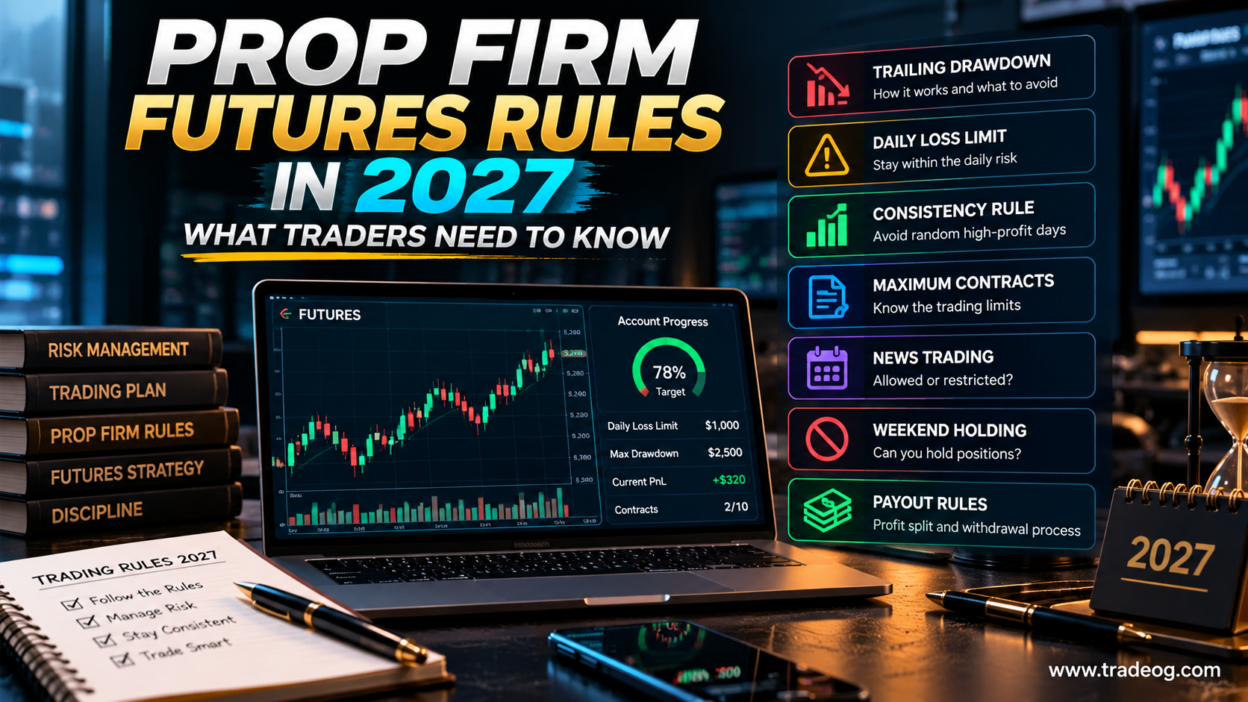
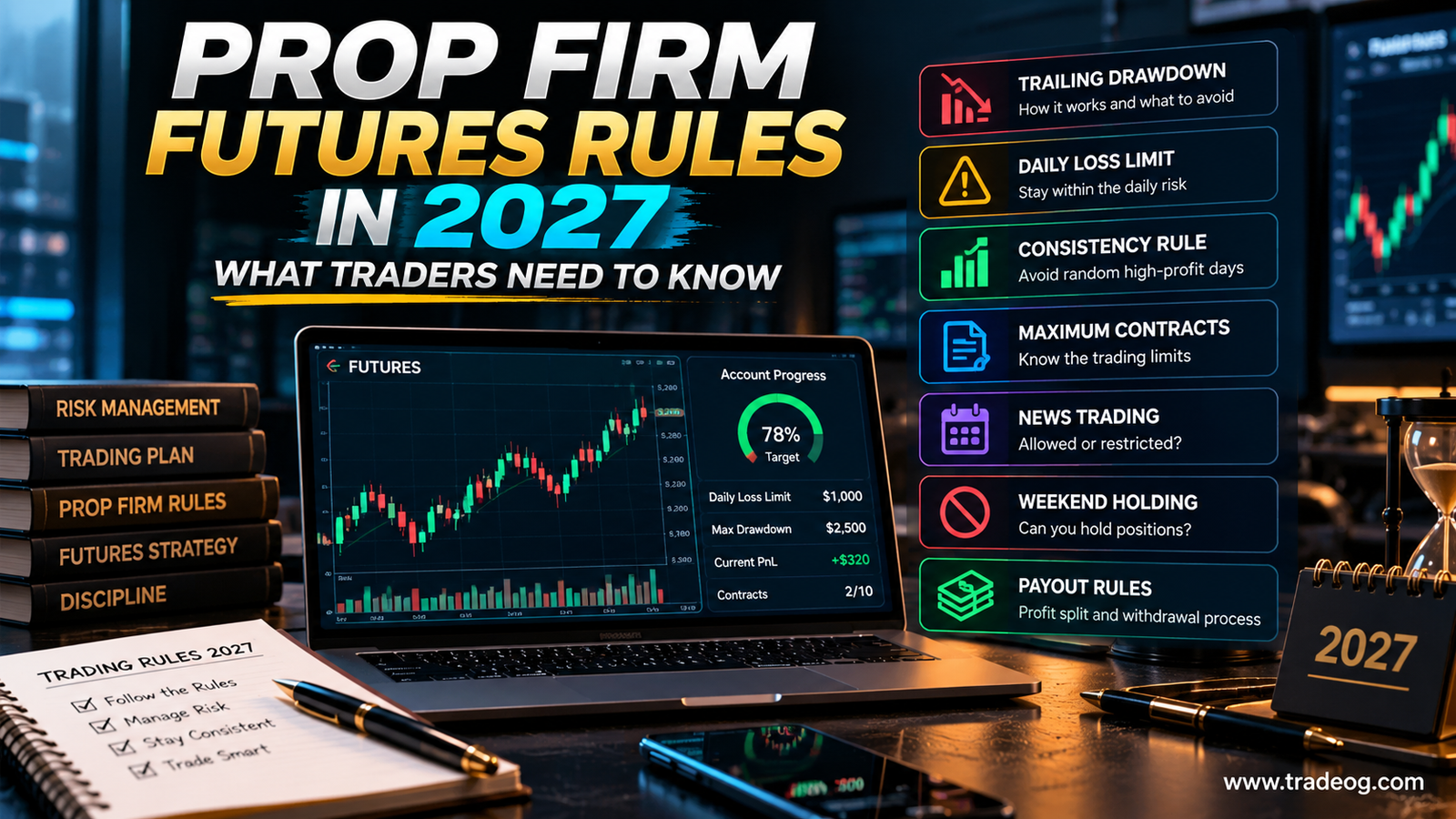
Futures prop trading is moving quickly, and traders planning for 2027 need to understand one important point: there is no single universal “prop firm rulebook.” Each futures prop firm can set its own evaluation, drawdown, daily-loss, consistency, position-size, news, weekend and payout conditions. Current 2026 comparisons show that these rules already vary materially between firms and can change during the year.
So what should futures traders expect when looking at prop firm rules in 2027? The safest approach is not to assume a specific number will remain unchanged. Instead, learn the rule categories, understand how they affect your trading, and verify the live rulebook immediately before purchasing an evaluation.
What Are Futures Prop Firm Rules?
Futures prop firm rules are the conditions attached to an evaluation or funded/sim-funded account. They determine how much you can lose, how much you need to make, how large your positions can be, when you can trade, and what conditions apply before a payout.
In 2026, commonly tracked futures rules include trailing or end-of-day drawdown, daily loss limits, consistency requirements, profit targets, contract limits, news restrictions, weekend restrictions and payout conditions. Some firms use different rules for evaluation and funded stages.
Will Prop Firm Rules Change in 2027?
They can. A 2027 rule should not be treated as known until the firm publishes it. Current market data already shows firms changing their pricing, drawdown models and consistency requirements during 2026, which is a useful warning for traders planning ahead.
For that reason, this guide focuses on the rules traders should understand before 2027 rather than inventing future percentages or claiming that every firm will adopt the same system.
1. Maximum Drawdown Will Remain a Core Rule
Maximum drawdown is the loss boundary that can cause an account breach. The important question is not only the size of the drawdown but how the drawdown moves.
Common models include:
- Static drawdown: the loss floor remains fixed.
- End-of-day (EOD) trailing drawdown: the floor is recalculated using the applicable end-of-day balance.
- Intraday trailing drawdown: the floor can move as account equity or balance reaches new highs during the session.
Current futures comparisons show that trailing drawdown is extremely common, while the exact calculation and lock point differ by firm.
Why Drawdown Matters More Than the Headline Account Size
A “$50K account” does not necessarily mean you can lose $50,000. The usable risk is determined by the firm’s actual drawdown rule. Before buying an evaluation, calculate the distance between your starting balance and the active liquidation or breach threshold.
2. Daily Loss Limits May Work Differently in 2027
A daily loss limit, often called DLL, restricts how much can be lost during a trading session. The consequence depends on the firm’s rulebook.
Current futures programs use different approaches. Some daily limits pause trading for the remainder of the session, while certain programs can treat the limit as an account-failure condition.
For 2027, never assume that “daily loss limit” means the same thing everywhere. Check:
- Whether the limit is hard or soft.
- Whether unrealized P&L counts.
- When the trading day resets.
- Whether commissions and fees are included.
- Whether the rule applies during evaluation, funded trading, or both.
3. Consistency Rules Are Likely to Stay Important
A consistency rule limits how much of your total profit can come from your best trading day. A common calculation is:
Best Day ÷ Total Net Profit × 100 = Consistency Percentage
For example, if your best day is $1,200 and your total profit is $3,000, your best-day percentage is 40%.
The exact threshold varies. Current 2026 tracking shows consistency rules ranging across different firms and stages, rather than one industry-wide percentage.
For 2027, traders should check whether the consistency rule applies to the evaluation, funded account, payout request, or more than one stage.
4. Profit Targets Will Still Be Separate From Risk Limits
A profit target tells you how much profit is required to complete an evaluation. It does not tell you how much risk you should take per trade.
A common mistake is increasing position size simply because the target looks close. That can make the drawdown or daily-loss limit the real constraint.
A better process is to calculate your maximum planned loss first, then determine a position size that fits the firm’s current contract and drawdown rules.
5. Maximum Contracts and Position Scaling
Futures prop firms can restrict the number of contracts or micros that can be traded. Some programs also use scaling rules, where the permitted position size changes as the account grows or moves through stages.
Before trading in 2027, check both:
- Maximum contracts allowed.
- Maximum micros allowed.
- Whether micros and minis have separate limits.
- Whether position limits change after reaching a profit threshold.
- Whether the limit differs between evaluation and funded stages.
Current comparison data shows that contract limits are one of the rule categories that differ between futures firms.
6. News Trading Rules
High-impact economic releases can create extreme futures volatility. Some prop firms restrict trading around selected news events, while others permit it under their published rules.
The important detail is that news rules can differ by program and account stage. Current 2026 tracking shows examples where news restrictions apply only to funded accounts.
If your strategy trades CPI, NFP, FOMC, Fed decisions or other major releases, read the exact news policy before entering an evaluation.
7. Weekend and Holiday Holding Rules
Some futures prop programs require positions to be closed before a specified market cutoff, while others may allow different holding arrangements.
Current futures rule tracking shows that weekend holding is restricted by most of the firms examined, but the exact cutoff and exceptions vary.
For 2027, check the exact Friday close requirement, holiday schedule, permitted holding period and consequences of carrying a position beyond the allowed time.
8. Trading Hours and Market-Close Rules
Futures markets have defined trading sessions and scheduled maintenance periods. A prop firm can impose additional rules around when positions must be closed.
Do not build a strategy around a generic “futures market closes” time. Your firm’s trading platform, contract, timezone and rulebook may define the relevant cutoff differently.
9. Payout Rules Can Be More Important Than the Evaluation Rules
Passing an evaluation is not the same thing as receiving a payout. Traders should review the funded-stage conditions separately.
Important payout questions include:
- How many trading days are required before the first payout?
- Is there a minimum withdrawal amount?
- Is there a payout cap or ladder?
- Does a consistency requirement apply at payout?
- Does the drawdown reset or change after a payout?
- Are there additional funded-account restrictions?
Current comparisons show that payout conditions vary considerably between futures programs.
10. Evaluation Rules and Funded Rules May Not Match
This is one of the biggest points traders should remember for 2027.
A firm can use one set of conditions during an evaluation and different conditions after passing. For example, the drawdown method, consistency requirement or news policy can change between stages. Current 2026 rule tracking documents multiple examples of stage-specific differences.
Therefore, reading only the evaluation page is not enough if your objective is eventually receiving payouts.
11. Rule Changes Could Become a Bigger Risk
Prop firms can update their terms, pricing, payout conditions or trading restrictions. Current 2026 sources document multiple rule changes and emphasize checking the firm’s current official rules before trading.
For 2027, save a copy or screenshot of the rules that apply when you purchase an evaluation, and then check the official rule page again before major changes to your strategy or before requesting a payout.
12. What Indian Futures Traders Should Check
Indian traders should separate two questions: Can I trade under this firm’s rules? and How should my income and transactions be handled under Indian law?
A prop firm’s trading rules do not determine Indian tax treatment. If you receive payouts from an overseas business or through a payment provider, maintain payout statements, transaction confirmations, bank records and other supporting documents. For tax or FEMA questions, use current official guidance and professional advice rather than relying on a prop firm’s marketing page.
2027 Futures Prop Firm Rules Checklist
| Rule | What to Check |
|---|---|
| Drawdown | Static, EOD trailing or intraday trailing; exact breach level |
| Daily loss | Limit, reset time, hard vs soft consequence |
| Consistency | Percentage, calculation and stage where it applies |
| Profit target | Target and whether it changes by account size |
| Contracts | Maximum minis, micros and scaling rules |
| News | Restricted events, time windows and account stages |
| Weekend | Friday cutoff, holiday rules and permitted holding |
| Payout | Minimum days, caps, frequency and payout conditions |
| Platform | Supported platform and data-feed requirements |
| Rule changes | Where official updates are published |
How to Prepare for 2027
- Read the complete rulebook, not just the pricing page.
- Calculate your actual drawdown room before choosing position size.
- Know the daily-loss reset time in the firm’s stated timezone.
- Understand consistency calculations before trying to hit the profit target quickly.
- Check news and weekend restrictions if your strategy depends on major events or overnight positions.
- Read funded-stage payout rules before purchasing an evaluation.
- Check the official rules again before your first payout request.
Final Takeaway
There is unlikely to be one universal set of “2027 futures prop firm rules.” The industry is made up of individual firms with different evaluation models, drawdown calculations, daily-loss limits, consistency requirements, contract limits and payout conditions. Current 2026 evidence shows that these rules already differ substantially and can change over time.
The most useful 2027 strategy is therefore simple: understand the rule mechanics, calculate your real risk allowance, and verify the firm’s official rules immediately before you trade. A rule that looks small on a marketing page can have a major impact on an otherwise valid futures strategy.
Important: This article is for educational purposes only and is not financial, legal, tax or investment advice. Prop firm rules can change without notice. Always verify the current official terms of the specific futures program before paying for an evaluation or requesting a payout.