

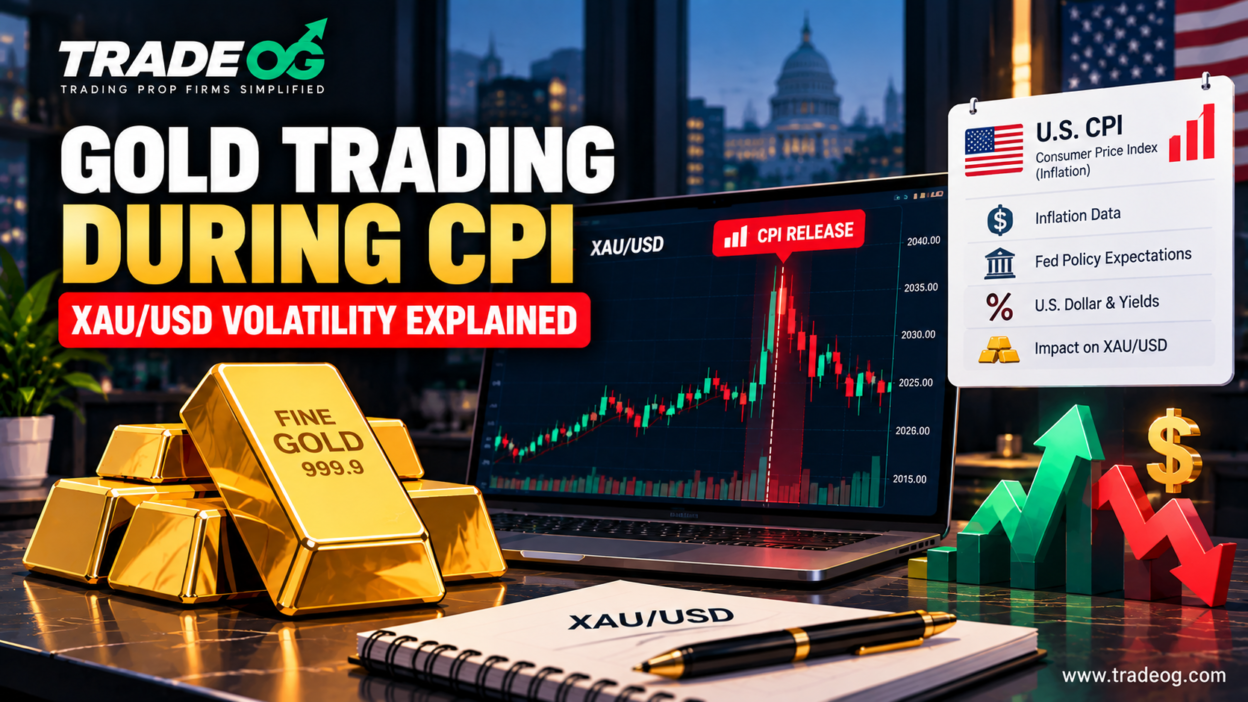
Gold trading during CPI can be very different from normal XAU/USD trading. When the U.S. Consumer Price Index is released, gold can move sharply because the inflation data can change expectations about Federal Reserve policy, U.S. Treasury yields and the U.S. dollar.
For Indian traders, CPI is one of the U.S. economic releases worth putting on the trading calendar before planning a gold trade. The key is not to assume that a higher CPI automatically means gold will fall or that lower CPI automatically means gold will rise. The market reacts to the actual number versus expectations, the details inside the report, the existing positioning and the resulting move in yields and the dollar.
The U.S. Bureau of Labor Statistics defines the CPI as a measure of the average change over time in the prices paid by urban consumers for a market basket of goods and services. The BLS currently lists the September 2026 CPI release for October 14, 2026 at 8:30 a.m. Eastern Time. Release dates should always be checked against the official BLS calendar because schedules can change. BLS CPI release schedule.
What Is CPI?
CPI stands for Consumer Price Index. It measures changes in consumer prices across a broad basket of goods and services. Traders follow it because inflation is an important part of the Federal Reserve’s monetary-policy decision-making process.
The CPI report includes an overall or “headline” measure as well as measures that exclude food and energy. The latter is commonly called core CPI.
The distinction matters because food and energy prices can be volatile. The Federal Reserve has explained that policymakers examine several inflation measures and often look at core measures to help identify underlying inflation trends. The Fed’s preferred inflation gauge for policy analysis is PCE, but it closely tracks CPI and other price indexes as well. Federal Reserve: How inflation is measured.
Why Does CPI Matter for Gold?
The connection between CPI and gold usually works through interest-rate expectations, Treasury yields and the U.S. dollar.
Imagine inflation comes in hotter than traders expected. The market may interpret that as evidence that price pressures are proving persistent. If traders then expect the Federal Reserve to keep policy restrictive for longer, short-term interest-rate expectations and Treasury yields can rise.
Higher yields can increase the opportunity cost of holding gold because gold itself does not pay interest. A stronger dollar can also weigh on dollar-denominated gold. Reuters has reported examples where persistent inflation concerns, a stronger dollar and higher Treasury yields pressured gold prices. citeturn0news6
The opposite can happen after a cooler-than-expected inflation report: yields may fall, the dollar may weaken and gold may receive support. Reuters reported that after June 2026 U.S. inflation slowed more than expected, Treasury yields fell and the dollar declined as markets interpreted the data as reducing the likelihood of near-term rate increases. citeturn0news7
But this is not a guaranteed formula. Gold can move differently if the market has already priced in the CPI result or if another major macro factor dominates the session.
Headline CPI vs Core CPI
| Measure | What it means | Why traders watch it |
|---|---|---|
| Headline CPI | Broad consumer-price measure including food and energy | Shows the overall inflation picture |
| Core CPI | CPI excluding food and energy | Helps traders assess underlying inflation pressure |
| Monthly CPI | Change from the previous month | Shows recent inflation momentum |
| Year-over-year CPI | Change compared with the same month a year earlier | Shows the annual inflation rate |
For a short-term XAU/USD trader, the market’s reaction can depend heavily on the difference between the actual reading and the consensus expectation. A number that looks high in isolation may produce little reaction if traders had already expected it.
What Happens to XAU/USD When CPI Is Higher Than Expected?
Suppose the market expects inflation to remain relatively contained, but the CPI report comes in significantly hotter than expected.
A possible reaction chain is:
- Higher-than-expected inflation increases concern about persistent price pressure.
- Traders reassess the expected path of Federal Reserve policy.
- U.S. Treasury yields may rise.
- The U.S. dollar may strengthen.
- XAU/USD may come under selling pressure.
However, this is a possible pathway rather than a guaranteed trade signal. Gold can rise even after hot CPI if other market forces are stronger, such as safe-haven demand, geopolitical risk or a different interpretation of the report.
What Happens When CPI Is Lower Than Expected?
Now suppose inflation comes in below expectations.
A possible chain reaction is:
- Inflation looks softer than the market expected.
- Traders reduce expectations for restrictive monetary policy.
- U.S. Treasury yields may fall.
- The U.S. dollar may weaken.
- XAU/USD may receive upward support.
Again, the market is not required to follow this sequence. The important variable is the change in expectations. If a “cool” CPI report was already fully priced into gold, the initial reaction may be small or even move in the opposite direction.
Example: Hot CPI and XAU/USD
Imagine the market expects headline CPI to rise 3.0% year over year, but the actual number is 3.4%. Assume core CPI is also stronger than expected.
A trader might see:
| Factor | Possible market interpretation |
|---|---|
| Headline CPI | Hotter than expected |
| Core CPI | Underlying inflation also firm |
| Fed expectations | Potentially more restrictive |
| Treasury yields | May move higher |
| U.S. dollar | May strengthen |
| XAU/USD | May face selling pressure |
This is only an educational example. It does not mean XAU/USD must fall whenever CPI is above expectations.
Example: Cool CPI and XAU/USD
Now assume the market expects 3.0% annual inflation, but the report shows 2.7% and core inflation also comes in softer than expected.
The market could interpret this as evidence that inflation pressure is easing. If that causes Treasury yields and the dollar to fall, gold can receive support.
But the reaction can still be messy. The market may first push gold higher, reverse the move, and then establish a direction after traders analyse the complete release.
Why the First CPI Candle Can Be Misleading
The first few seconds after CPI can be extremely fast. Automated systems and short-term traders react almost immediately, while human traders may still be reading the numbers.
This can create a sharp first move followed by a reversal. For example, XAU/USD might initially fall because headline CPI is hot, then recover if another part of the release changes the interest-rate interpretation.
That is why traders should avoid treating the first candle as a guaranteed signal. A better process is to know the expected number, read the complete release and watch how the dollar and Treasury yields respond.
What Other CPI Details Should Gold Traders Watch?
1. Core CPI
Core CPI can matter because it removes food and energy components that can be unusually volatile. A hot headline with soft core inflation can produce a different interpretation from a report where both measures are strong.
2. Monthly Change
A monthly CPI number shows the recent pace of price changes. A small annual change can hide a recent acceleration or slowdown, so traders often examine both monthly and annual figures.
3. Shelter
Shelter is an important CPI component. Traders watching inflation trends may pay attention to whether shelter inflation is accelerating, slowing or remaining persistent.
4. Energy
Energy prices can produce large changes in headline CPI. Because energy is excluded from core CPI, a sharp energy move can create a noticeable difference between headline and core readings.
5. The Surprise vs Expectations
This is one of the most important concepts for news trading. The market does not react only to whether CPI is “high” or “low.” It reacts to how the actual result compares with what was expected and what was already priced into markets.
How CPI Can Affect Gold Volatility
CPI can change XAU/USD volatility within seconds. A quiet gold market before the release can suddenly produce large candles and rapid price swings.
Higher volatility can also change the trading environment:
- Bid-Ask spreads can widen.
- Slippage can increase.
- Stop-losses can be hit quickly.
- Market orders can receive unexpected execution prices.
- Floating profit and loss can change rapidly.
- Liquidity can become less stable around the release.
For a detailed explanation of this issue, see our guide on XAU/USD spread during news.
CPI Trading and Prop Firm Accounts
If you trade XAU/USD through a prop firm, CPI is not only a market-analysis issue. It is also a rule-management issue.
Before trading a CPI release, check your firm’s current rules for:
- Trading during high-impact economic news.
- Opening trades immediately before or after CPI.
- Holding positions through the announcement.
- Pending orders around news.
- Stop-loss and take-profit execution.
- Daily drawdown.
- Maximum drawdown.
- Challenge-stage versus funded-stage restrictions.
Two prop firms can have completely different news policies. Never assume that because one firm permits CPI trading, another firm does too.
For a broader framework, read our guide to prop firm risk management for Indian traders.
Gold Trading During CPI for Indian Traders
Indian traders should pay particular attention to the time-zone conversion. U.S. CPI is released at a U.S. Eastern Time release time, so the corresponding Indian time changes depending on U.S. daylight-saving time.
For example, the BLS currently lists the September 2026 CPI release for October 14 at 8:30 a.m. Eastern Time. Indian traders should convert the current release time to IST using the correct U.S. daylight-saving status rather than relying on an old screenshot or a fixed “IST time” remembered from a previous month.
The safest workflow is:
- Open the official BLS CPI calendar.
- Confirm the release date and Eastern Time.
- Convert that time to IST for the specific date.
- Check your broker’s trading session and quote conditions.
- Check your prop firm’s current news rules.
Should You Trade XAU/USD Immediately at CPI?
There is no universal answer. The first moments around CPI can offer large price movement, but they can also create the highest execution risk.
A trader using a news strategy may have predefined rules for entering after the release. Another trader may wait for the first reaction to finish and then look for a technical setup. Both approaches require a clear plan rather than an emotional reaction to the first candle.
For a funded account, this matters even more because one oversized XAU/USD position can consume a large part of the daily drawdown allowance very quickly.
A Practical CPI Trading Checklist
Before CPI
- Check the official release time.
- Know the market consensus.
- Mark important XAU/USD support and resistance levels.
- Check your broker’s normal spread.
- Review your prop firm’s news restrictions.
- Define your maximum acceptable risk.
At the Release
- Read headline CPI and core CPI.
- Compare actual data with expectations.
- Watch the U.S. dollar.
- Watch Treasury yields.
- Check whether the XAU/USD spread has widened.
- Do not assume the first candle is the final direction.
After the Release
- Wait for market conditions to stabilise if your strategy requires it.
- Reassess support and resistance.
- Check whether the initial move held or reversed.
- Review your risk before entering.
- Do not chase a move simply because gold has already moved sharply.
Common Mistakes When Trading Gold During CPI
- Thinking higher CPI automatically means lower gold.
- Ignoring core CPI.
- Ignoring market expectations.
- Trading the first candle without a plan.
- Using a normal-market stop during extreme volatility.
- Ignoring spread widening.
- Using excessive leverage on XAU/USD.
- Forgetting to check prop firm news restrictions.
- Using an old CPI release time in IST.
- Assuming a previous CPI reaction will repeat exactly.
CPI vs NFP for Gold Traders
| Factor | CPI | NFP |
|---|---|---|
| Main theme | Inflation | Employment |
| Important market link | Inflation and Fed expectations | Labour market and Fed expectations |
| Key data to watch | Headline CPI, core CPI, monthly and annual changes | Payrolls, unemployment, wages, revisions |
| Potential XAU/USD impact | Dollar, yields and inflation expectations | Dollar, yields and growth/rate expectations |
| Execution risk | Can increase sharply around release | Can increase sharply around release |
Both reports can create significant volatility, but neither provides a guaranteed directional signal for gold.
What Recent CPI Data Shows
The BLS reported that U.S. CPI increased 0.4% in August 2026 and was up 3.4% over the previous 12 months. Core CPI, which excludes food and energy, increased 0.3% in August and was up 2.4% year over year. The next scheduled CPI release is September 2026 data on October 14, 2026 at 8:30 a.m. Eastern Time. citeturn0search1turn0search0
These figures show why traders should look at the full report rather than only the headline. The monthly move, annual rate and core measure can tell different parts of the inflation story.
Final Takeaway
Gold trading during CPI is mainly about understanding the chain from inflation data to Federal Reserve expectations, Treasury yields, the U.S. dollar and finally XAU/USD. A hotter-than-expected report can sometimes pressure gold, while a cooler-than-expected report can sometimes support it, but the reaction is never guaranteed.
For Indian traders, the practical approach is simple: know the official release time, compare actual CPI with expectations, check core CPI, watch the dollar and Treasury yields, monitor the XAU/USD spread, and follow your prop firm’s current news rules.
Do not build a strategy around “CPI high = gold down” or “CPI low = gold up.” Build it around expectations, market reaction, execution conditions and controlled risk.

[…] guides on gold trading during CPI and gold trading on NFP explain these two major drivers in more […]