

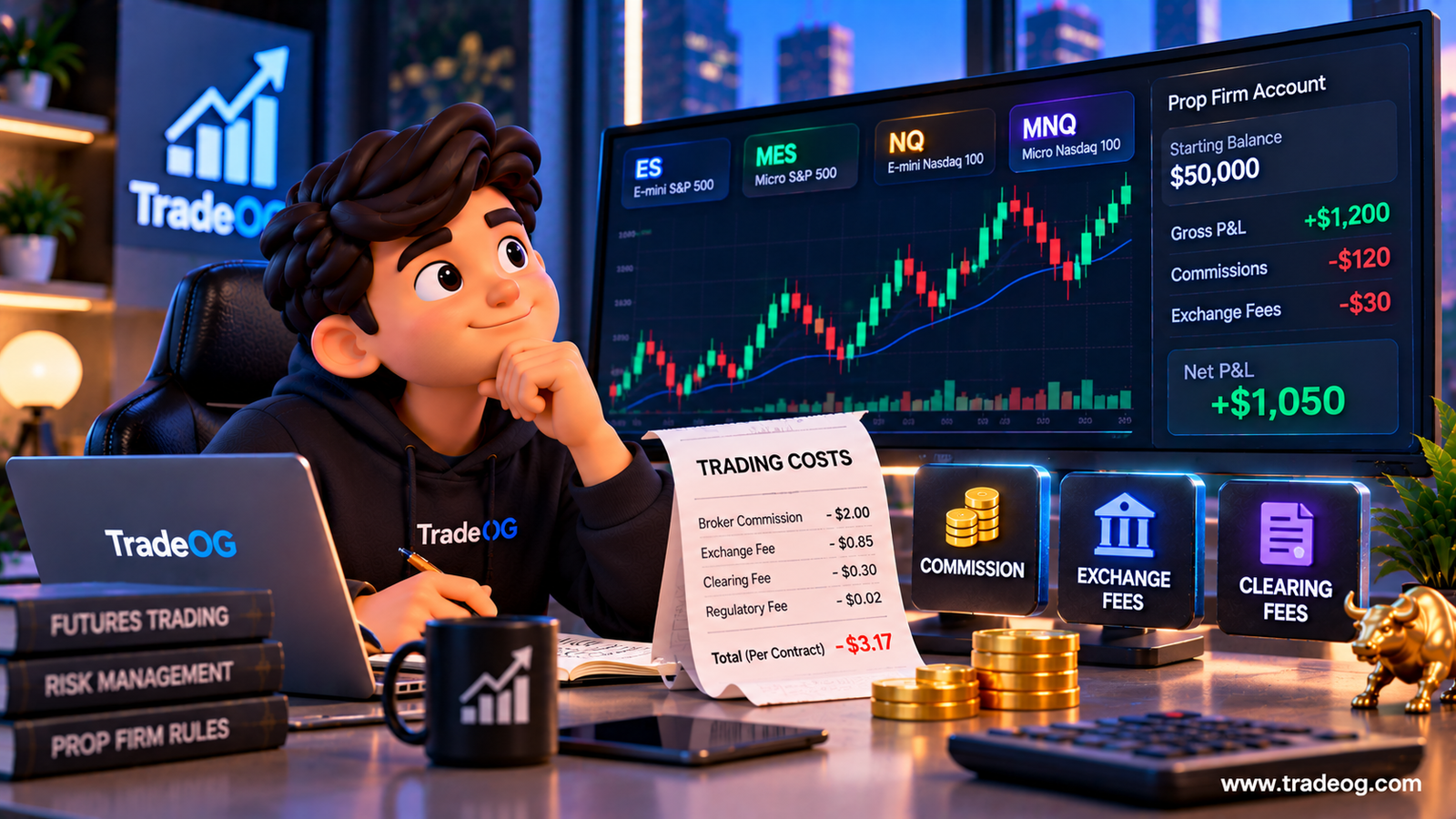
Futures trading costs can look small on a single trade, but commissions and exchange-related fees can become meaningful when a prop trader executes many contracts or trades frequently. For prop firm accounts, the important number is not only gross profit or loss but the result after applicable trading costs.
CME Group explains that futures traders can encounter commissions, platform fees and market-data fees, with commissions generally including a broker component and an exchange component. CME also notes that exchange fees vary by product, venue, transaction type and membership status.
What Are Futures Commission Costs?
A futures trading commission is a fee associated with executing an order. Depending on the trading setup, the total transaction cost can include broker commission, exchange fees, clearing-related charges and regulatory fees.
The exact structure varies by broker, trading platform and prop firm. Some firms quote an all-in per-contract cost, while others may show different components separately.
Why Fees Matter More to Active Prop Traders
Suppose a trader makes only a few trades per week. A small per-contract cost may have a limited effect on the overall result. But a high-frequency trader who opens and closes multiple contracts every session can accumulate substantial costs.
Consider a hypothetical all-in cost of $3 per contract per side. A trader who opens and closes 10 contracts generates 20 contract executions:
20 × $3 = $60
That $60 is a trading cost before considering the market’s price movement, slippage or other applicable charges.
The example is purely illustrative. Actual prop firm and broker costs can differ significantly.
Round-Trip Commission vs One-Side Commission
One common source of confusion is whether a quoted commission applies to one side or the complete round trip.
If a fee is quoted per contract per side, opening one contract creates one charge and closing it creates another. Therefore:
Round-trip cost = Entry cost + Exit cost
If the stated commission is $2 per contract per side, one complete trade costs $4 per contract before any additional exchange or regulatory charges.
Always check whether the published figure is quoted per side, per contract, or as an all-in round-trip amount.
Commission Can Change the Real Break-Even Point
Trading costs mean that a trade generally needs to generate enough gross profit to cover its costs before producing the desired net result.
For example, assume a trader makes $150 gross profit on a trade and incurs $12 in total commissions and fees:
Net result = $150 − $12 = $138
For a losing trade, the same principle works in reverse. A trade that loses $100 before costs may produce a slightly larger realized loss after commissions and fees.
Futures Commissions and Prop Firm Drawdown
This becomes especially important when a prop account has a defined maximum loss or drawdown threshold. Trading costs reduce the account’s net equity just like other realized expenses associated with trading.
Imagine a hypothetical account with $2,000 of remaining drawdown room. If a trader incurs $150 of cumulative commissions during a trading session, the remaining economic cushion is lower than it would have been without those costs.
This is why traders should calculate risk using realistic net outcomes rather than assuming that every dollar of gross trading profit remains available.
Contract Count Multiplies Commission Costs
Commission is commonly charged per contract, so increasing the position size can increase transaction costs even when the strategy and stop distance remain unchanged.
| Contracts | Illustrative Round-Trip Cost/Contract | Total Cost |
|---|---|---|
| 1 | $3 | $3 |
| 5 | $3 | $15 |
| 10 | $3 | $30 |
| 20 | $3 | $60 |
These figures are examples only. Your actual cost should come from the current fee schedule applicable to your prop firm and trading platform.
Micro Futures Can Still Create Significant Costs
Micro contracts have smaller contract multipliers than their larger E-mini counterparts. CME states that Micro E-mini equity index futures trade at one-tenth the size of their larger E-mini counterparts.
Smaller contracts can provide more granular position sizing, but traders should not assume that trading many Micro contracts makes transaction costs irrelevant. If the per-contract fee applies separately to each contract, a large Micro position can still create meaningful cumulative costs.
ES vs MES: Why Contract Count Matters
CME lists the E-mini S&P 500 at $50 times the S&P 500 Index and the Micro E-mini S&P 500 at $5 times the index.
For example, ten MES contracts provide approximately the same index-point dollar multiplier as one ES contract, although the transaction-cost structure may not be identical. The trader therefore needs to compare both market exposure and the applicable per-contract fees.
Commission vs Spread vs Slippage
Trading costs are not limited to the explicit commission shown on a statement.
- Commission: the execution-related fee charged by the broker or trading provider.
- Exchange fee: a transaction fee associated with the relevant exchange and product.
- Spread: the difference between bid and ask prices.
- Slippage: the difference between expected and actual execution price.
- Data or platform costs: charges that may apply depending on the trading arrangement.
CME’s recent discussion of trading costs separates direct transaction fees from bid-ask spread and other trading-cost components.
How Fees Affect a Prop Firm Strategy
Consider two hypothetical strategies that each produce $1,000 of gross monthly profit.
Trader A generates that result with 50 round-trip contracts and $4 of total cost per contract. Total trading costs are $200, leaving $800 before other applicable expenses.
Trader B generates the same gross profit through 500 round-trip contracts at the same illustrative cost. Total trading costs are $2,000, which would turn the gross result into a negative net result.
The numbers are deliberately simplified, but they demonstrate why gross P&L alone can be misleading when comparing trading approaches.
High-Frequency Trading Needs a Cost Check
Scalpers and traders who enter and exit repeatedly should track transaction costs alongside gross P&L. A strategy can have a positive gross expectancy but a much smaller—or even negative—net expectancy after costs.
A useful metric is:
Net P&L = Gross P&L − Commissions − Exchange/Other Fees − Slippage Impact
For a serious prop trader, this number provides a more realistic view of the strategy’s economic performance.
Do Prop Firms All Charge the Same Futures Fees?
No. Prop firms can structure their trading costs differently. The amount a trader sees may depend on the firm’s platform, broker or futures infrastructure, account type, contract, and whether the displayed figure is all-inclusive.
Some firms may publish commission schedules directly, while others incorporate certain costs into their trading conditions. Never assume that a fee from one futures prop firm applies to another.
How to Calculate Your Monthly Futures Commission Cost
You can estimate the cost with a simple formula:
Monthly Commission Cost = Total Contracts Traded × Cost Per Contract
If you execute 800 contract sides during a month and the applicable cost is $2.50 per contract side:
800 × $2.50 = $2,000
If the quoted cost excludes other exchange or regulatory charges, those need to be added separately.
Five Numbers Prop Traders Should Track
- Gross P&L: result before trading costs.
- Total contracts: number of contracts executed.
- Total commissions: broker and execution-related costs.
- Other fees: exchange, regulatory or platform charges where applicable.
- Net P&L: actual result after relevant trading costs.
Tracking these numbers can reveal whether excessive trading activity is consuming a significant portion of the strategy’s gross edge.
How to Reduce the Impact of Futures Fees
Trade Only When the Setup Meets Your Rules
Reducing low-quality trades can reduce unnecessary commission without changing the underlying strategy.
Avoid Oversizing
More contracts increase both market exposure and, in per-contract fee structures, transaction costs.
Compare Micro and Mini Economics
Micro contracts can provide finer sizing, but compare the total cost of the required contract count rather than looking only at the dollar value per point.
Review Your Statement
Use the actual account statement or prop firm’s fee schedule to determine what you are paying rather than relying on generic futures commission numbers.
Include Fees in Your Backtesting
If a strategy depends on small price targets, model realistic commissions, spreads and slippage. A backtest that ignores transaction costs can overstate expected performance.
Final Takeaway
Futures commissions may appear small on an individual contract, but they can become material when a prop trader executes a large number of contracts. The right way to evaluate a futures strategy is to look beyond gross P&L and calculate the net result after applicable commissions, exchange charges, spread and slippage.
CME Group confirms that futures trading involves multiple possible cost components and that exchange fees vary by product and transaction characteristics.
For prop traders, the practical rule is simple: know your actual cost per contract, multiply it by your trading volume, and include the result in your risk and expectancy calculations.