
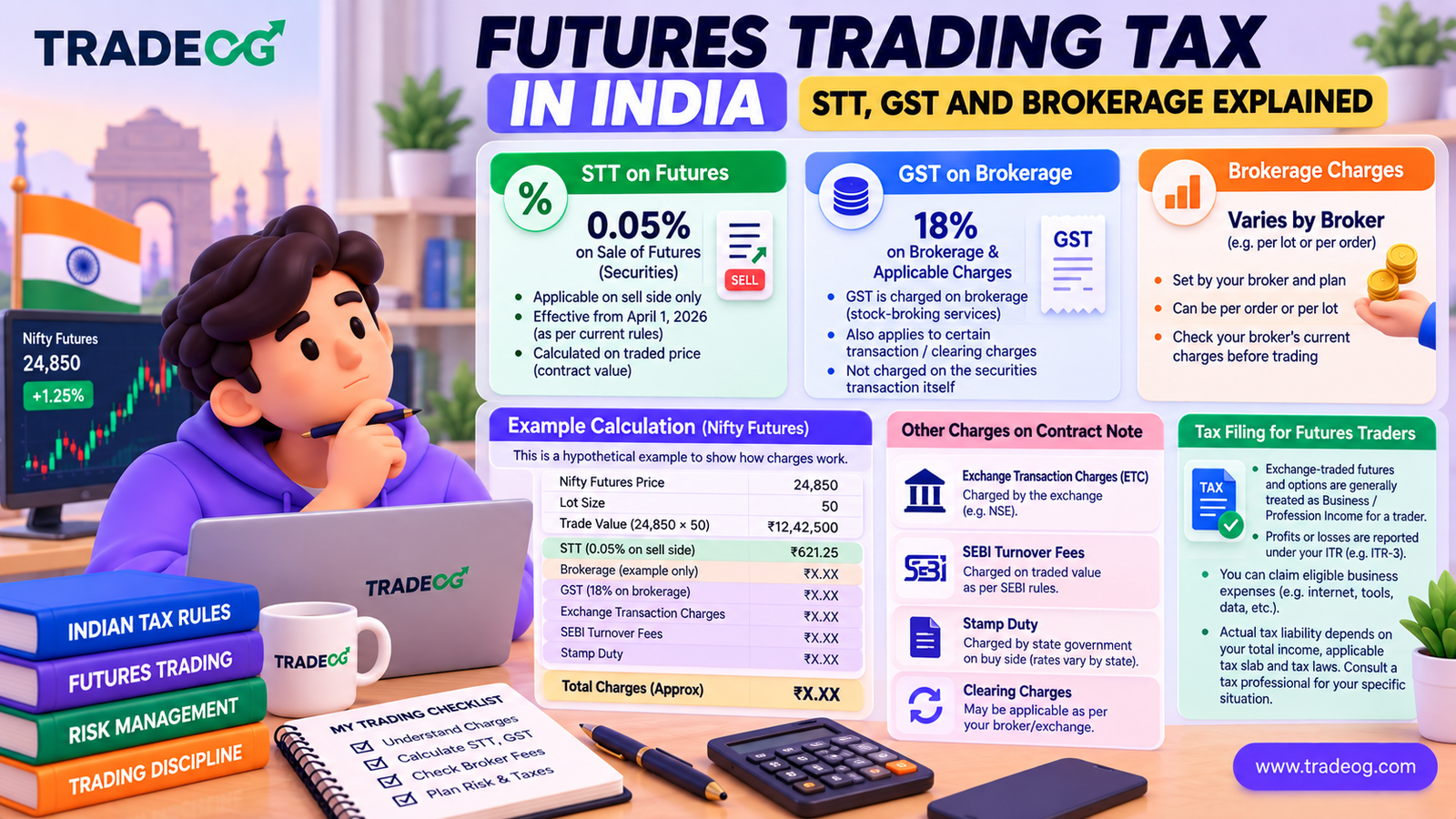
If you trade futures from India, your actual trading cost is not just the profit or loss shown on your trading terminal. Every futures trade can involve STT, brokerage, GST, exchange transaction charges, SEBI turnover fees, stamp duty and other applicable charges. Your trading profit is then generally considered under the income-tax rules applicable to futures and options trading, subject to the nature of the transaction and the taxpayer’s circumstances.
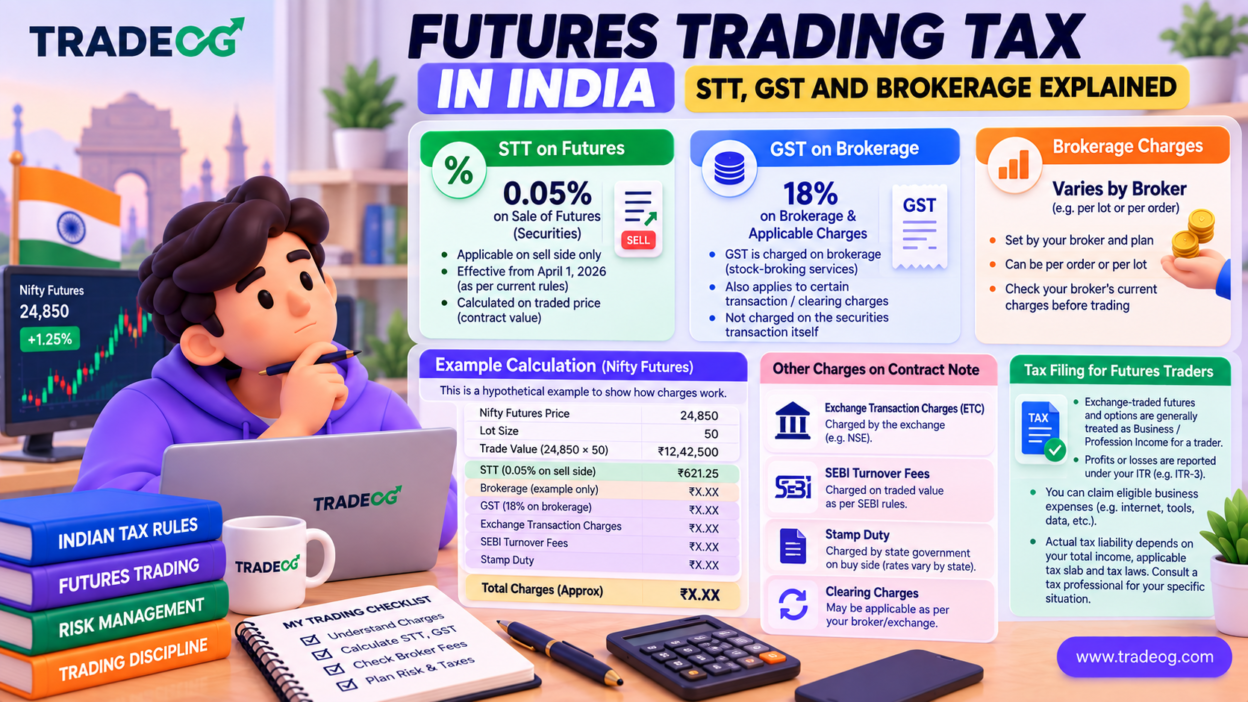
One important update for Indian futures traders in 2026 is the change in Securities Transaction Tax (STT). From April 1, 2026, STT on the sale of futures in securities is 0.05% of the traded value and is payable by the seller. Before April 1, 2026, the rate was 0.02%. The current rate is published by both the Income Tax Department and NSE. Income Tax Department: Budget 2026 STT rates | NSE: Securities Transaction Tax
This guide explains the major costs in simple language, with examples for Indian futures traders. Because tax rules, exchange charges and broker pricing can change, always check your current contract note and the latest government or exchange information before filing your return.
Futures Trading Tax in India: Quick Overview
| Cost / Tax | What It Applies To | Who Generally Bears It |
|---|---|---|
| STT | Sale of futures in securities | Seller |
| GST | Brokerage and taxable brokerage-related services/charges | Client through broker |
| Brokerage | Broker’s trading service | Client |
| Exchange transaction charges | Exchange-traded transactions | Client through broker |
| SEBI turnover fee | Applicable securities transactions | Client through broker |
| Stamp duty | Applicable securities transactions | Generally buyer for futures |
| Income tax | Taxable trading/business income | Trader |
The exact amount of each charge depends on the product, exchange, broker, transaction value and applicable rules.
1. What Is STT on Futures in India?
STT means Securities Transaction Tax. It is a transaction-level tax on specified securities transactions carried out through recognised stock exchanges.
For futures in securities, the current rate from April 1, 2026 is 0.05% of the traded price/value on the sale of the futures contract. NSE states that STT applies to the sell side for futures and that the futures transaction is valued at the actual traded price for STT computation. NSE STT computation rules
This is a major change compared with the previous rate of 0.02%, so older articles and calculators showing 0.0125% or 0.02% for equity futures should not be used as the current 2026 rate.
Is STT Charged on Both Buy and Sell in Futures?
For futures in securities, the current STT is charged on the sale transaction. NSE explicitly states that STT is applicable on sell transactions for futures and options. NSE: STT on derivatives
That means a futures position that you buy to open and later sell to close will generally have STT on the closing sale, based on the applicable taxable value.
2. STT Example for an Equity Futures Trade
Suppose a hypothetical Nifty futures transaction has a traded contract value of ₹10,00,000 on the sell side.
At the current 0.05% STT rate:
STT = ₹10,00,000 × 0.05% = ₹500
This is only the STT component. Your contract note can also contain brokerage, GST, exchange charges, SEBI turnover fees, stamp duty and other applicable costs.
The calculation is deliberately shown as a simple example. Your actual taxable value depends on the futures transaction recorded by the exchange and broker.
3. What Is GST on Futures Trading?
GST is not generally a tax on the futures contract itself. Securities are outside the normal GST supply framework, while services provided by stock brokers can be taxable.
CBIC’s sectoral FAQ states that stock-broking services are subject to GST and that brokerage earned by stock brokers is liable to GST. It also explains that STT, stamp duty and similar recoveries can have specific valuation treatment depending on whether the broker satisfies the conditions for acting as a pure agent. CBIC: Stock Broking Services GST FAQ
For normal retail trading, you will commonly see 18% GST applied to taxable brokerage and relevant service/transaction charges on your contract note.
Simple GST Example
Suppose your broker charges:
- Brokerage: ₹40
- Other taxable brokerage-related charges: ₹10
- Taxable service charges: ₹50
At 18% GST:
GST = ₹50 × 18% = ₹9
The actual GST base can vary according to the charges appearing on your contract note, so do not assume that GST is always exactly 18% of STT.
4. Brokerage on Futures Trading
Brokerage is the fee charged by your broker for providing trading/broking services. Unlike STT, there is no single universal brokerage amount for every Indian broker.
Depending on the broker and plan, brokerage may be structured as:
- A fixed rupee amount per order
- A percentage of turnover
- A capped amount
- A special pricing plan for high-volume traders
- Different rates for different segments
Always check whether your broker’s advertised price is per order, per executed order, per lot or based on turnover. A low headline brokerage number does not necessarily mean the lowest total trading cost because other charges can still apply.
5. Exchange Transaction Charges
Stock exchanges and market infrastructure institutions can levy transaction-related charges. These can change over time and can differ by exchange and product.
For example, NSE revised its equity-futures transaction charge structure effective March 1, 2026. Its February 2026 circular lists the revised exchange transaction charge for equity futures at ₹182.99 per crore of traded value for the trading-member outflow, with a separate IPFT contribution of ₹0.01 per crore, making the stated total ₹183 per crore. The amount appearing on an individual client’s contract note depends on the broker’s billing and applicable exchange rules. NSE February 2026 transaction-charge circular
This illustrates why a futures trader should use the latest contract note rather than an old blog post when calculating trading costs.
6. SEBI Turnover Fees
SEBI turnover fees are another small component of transaction costs. NSE currently lists the fee for applicable securities transactions other than debt securities at 0.0001% of the transaction value, equivalent to ₹10 per crore. NSE: SEBI Turnover Fees and Other Levies
The percentage looks tiny, but high-frequency or high-turnover traders should still include it when calculating their annual trading cost.
7. Stamp Duty on Futures
Stamp duty is separate from STT and GST. NSE currently lists 0.002% for equity futures, applicable to the buyer, under its published stamp-duty table. The actual collection is handled through the exchange/clearing mechanism under the applicable framework. NSE: Stamp Duty
Stamp duty rates can depend on the security/derivative category and applicable state framework, so traders should verify the rate shown on their contract note.
8. Other Charges You May See on a Futures Contract Note
Your total trading cost can contain more items than just STT, GST and brokerage.
Depending on the broker and product, you may see:
- Exchange transaction charges
- SEBI turnover fees
- Stamp duty
- GST
- Brokerage
- Clearing charges, where applicable
- IPFT or related exchange-level contributions, where applicable
- Other broker-specific statutory or service charges
NSE’s revised contract-note framework requires exchange transaction charges to be presented in the prescribed reporting format for relevant equity and derivatives segments. NSE: Contract Note FAQ
9. Futures Trading Profit: Is It Capital Gain or Business Income?
For many Indian resident traders carrying out exchange-traded futures and options transactions, the tax treatment is generally under business/profession income rather than capital gains when the transactions fall within the relevant non-speculative derivative provisions.
The Income Tax framework has historically provided that an eligible transaction in derivatives of securities carried out on a recognised stock exchange is not treated as a speculative transaction under the relevant section 43(5) exception. The Income Tax Department’s explanatory material describes this treatment for eligible exchange-traded securities derivatives. Income Tax Department: Derivatives and speculative transactions
This does not mean every derivatives activity in every situation automatically receives the same tax treatment. The exchange, instrument, transaction structure, taxpayer status and applicable law matter.
10. How Futures Profit Is Generally Taxed
If your futures activity is taxable as business income, your taxable result is not simply “winning trades minus losing trades.” You need to consider the applicable business-income computation, eligible expenses, brought-forward losses where relevant, and the tax regime/rates applicable to you.
For example, a simplified illustration could look like:
- Trading profit before expenses: ₹6,00,000
- Eligible trading-related business expenses: ₹1,00,000
- Illustrative business profit: ₹5,00,000
This is only a simplified accounting illustration. Your actual taxable income can be affected by other income, deductions, tax regime, loss adjustments and other provisions.
11. Can Trading Expenses Be Deducted?
Where futures trading is carried on as a business and the normal conditions for deduction are satisfied, certain expenses incurred wholly and exclusively for the business may be relevant to the computation of taxable business income.
Potential examples can include legitimate trading-related expenses such as:
- Brokerage and exchange-related charges
- Eligible data or software expenses
- Trading terminal or platform expenses, where applicable
- Internet expenses to the extent legitimately attributable to the business
- Professional accounting or tax-preparation fees, where allowable
Whether a particular expense is deductible depends on the facts, documentation and applicable tax provisions. Do not automatically claim a percentage of personal expenses without proper records.
12. How Are Futures Losses Treated?
Eligible exchange-traded futures losses that are treated as non-speculative business losses are subject to the business-loss rules rather than the rules for speculative losses.
The treatment of a loss can involve questions such as:
- Whether the transaction qualifies as non-speculative
- Whether the loss can be set off against another eligible head of income
- Whether it can be carried forward
- Whether the return was filed within the required time for preserving carry-forward rights
- Whether tax-audit or other compliance requirements apply
Because loss set-off and carry-forward rules can materially affect your tax position, a trader with a significant F&O loss should have the return reviewed by a qualified tax professional rather than relying on a generic online calculator.
13. What ITR Should Futures Traders Use?
The Income Tax Department’s current guidance for individuals with business or professional income states that ITR-3 applies to individuals and HUFs having income under the head “Profits or Gains of Business or Profession” when they are not eligible for the simpler ITR forms. Income Tax Department: Individual Having Income From Business/Profession
The exact return form depends on your complete income profile. Do not choose a return form solely because you trade futures; consider salary, capital gains, house property, foreign income and other sources as applicable.
The Income Tax Department’s current ITR materials also contain specific fields for turnover from Futures & Options Trading and income from F&O trading in the profit-and-loss section. Income Tax Department: ITR-3 form notification
14. Futures Turnover Is Not the Same as Trading Profit
This is a critical point for Indian futures traders.
Turnover for tax/compliance purposes is not necessarily the same number as the contract value of every buy and sell added together. Derivative turnover is calculated using the applicable tax-accounting methodology, and the exact computation can depend on the nature of the derivative transactions.
Do not use the “total traded value” displayed in your broker dashboard as your final F&O turnover figure without checking how it needs to be computed for your return and audit requirements.
This is particularly important for traders with a large number of trades because tax-audit thresholds and return requirements can depend on turnover and other conditions.
15. Example: Complete Cost of a Futures Trade
Consider a hypothetical equity-futures sell transaction with a taxable traded value of ₹10,00,000.
| Component | Illustrative Amount |
|---|---|
| Futures traded value | ₹10,00,000 |
| STT at 0.05% on sell side | ₹500 |
| Brokerage | ₹40 |
| GST on ₹40 brokerage | ₹7.20 |
| SEBI turnover fee at 0.0001% | ₹1 |
| Exchange charges | Depends on exchange/broker |
| Stamp duty | Depends on applicable buy-side transaction/rate |
The total cost cannot be finalized from this table because brokerage, exchange charges, stamp duty and other applicable components depend on the actual transaction and broker. The example is designed to show how the charges stack together.
16. Why High Turnover Can Make Small Charges Important
A trader might look at a ₹20 or ₹40 brokerage amount and think it is insignificant. But if the trader executes hundreds or thousands of orders, small per-trade charges can become a meaningful annual cost.
For example, if a hypothetical trader incurs an average ₹60 of total non-STT transaction costs on each completed order and executes 2,000 orders during the year, that alone would represent ₹1,20,000 of transaction costs before considering other differences in the actual contract notes.
This is why serious futures traders should track:
- Gross trading P&L
- STT
- Brokerage
- GST
- Exchange charges
- SEBI turnover fees
- Stamp duty
- Net P&L after all charges
17. Intraday Futures vs Overnight Futures: Does Tax Change?
The basic transaction taxes and charges are generally determined by the applicable transaction type, product and exchange rules rather than simply whether you call a trade “intraday” or “overnight.”
However, the number and value of transactions can change significantly depending on your trading style. A trader who enters and exits several times a day can generate much higher cumulative turnover and transaction costs than a trader who holds a position longer.
Therefore, compare your net P&L after charges, not just your gross winning trades.
18. Equity Futures vs Commodity Futures
Do not automatically apply equity-futures tax rates to commodity futures.
Different derivative categories can have different STT or commodity transaction-tax frameworks, stamp-duty treatment and exchange charges. For example, NSE’s published levy table separately lists commodity futures stamp duty and equity-futures stamp duty. NSE: STT, Stamp Duty and Other Levies
If you trade crude oil, gold, silver or other commodity derivatives, verify the applicable exchange and tax treatment for that specific product instead of copying an equity-futures calculator.
19. Futures Trading Tax for Indian Traders: A Practical Record-Keeping System
A simple record-keeping system can make tax filing much easier.
Keep:
- Broker contract notes
- Annual profit-and-loss statement
- Trade book
- Ledger
- STT and tax details
- Brokerage and other charges
- Bank statements used for trading
- Relevant business-expense invoices
- Previous-year loss records, if any
- Filed ITR and acknowledgement
Do not rely only on screenshots of your trading platform. Your broker’s downloadable reports and contract notes are much more useful for reconciliation.
20. Common Futures Tax Mistakes in India
Mistake 1: Using an Old STT Rate
Older websites may still show 0.0125% or 0.02% for futures. From April 1, 2026, the current STT rate on sale of futures in securities is 0.05%. NSE current STT schedule
Mistake 2: Thinking GST Is Charged on the Futures Contract
GST generally relates to taxable services such as brokerage and applicable charges, while securities themselves are outside the normal GST supply definition. CBIC GST FAQ
Mistake 3: Calculating Only Brokerage
Brokerage is only one component. STT, GST, exchange charges, SEBI fees and stamp duty can all affect net trading cost.
Mistake 4: Treating F&O Profit Automatically as Capital Gains
Eligible exchange-traded securities derivatives are generally covered by the non-speculative business treatment under the relevant rules, but the exact tax position depends on the transaction and taxpayer. Income Tax Department guidance
Mistake 5: Confusing Turnover With Profit
Tax turnover calculations for derivatives have their own methodology. Do not simply copy the notional value displayed by your broker into every tax field.
Mistake 6: Ignoring Loss Reporting
Futures losses can have tax-compliance consequences, particularly when you want to carry losses forward. Get the filing treatment right in the year the loss occurs.
21. A Simple Futures Tax Checklist for Indian Traders
- Download your annual broker P&L.
- Download your trade book and contract notes.
- Check the STT shown by the broker.
- Separate brokerage from GST.
- Check exchange transaction charges.
- Check SEBI turnover fees.
- Check stamp duty.
- Calculate the appropriate F&O turnover for tax purposes.
- Determine whether your futures activity is treated as non-speculative business income.
- Review eligible business expenses and supporting invoices.
- Check whether tax-audit requirements apply to your facts.
- Report profits or losses using the appropriate ITR.
- Keep all supporting records.
22. Final Takeaway
Futures trading tax in India is more than just STT. Your overall cost can include STT, GST, brokerage, exchange transaction charges, SEBI turnover fees, stamp duty and other applicable charges. Then, separately, your net trading result may have income-tax consequences under the business-income framework applicable to your futures activity.
For equity futures, the key 2026 update is the 0.05% STT on sale of futures in securities from April 1, 2026. GST is generally associated with taxable brokerage and broking services rather than the securities transaction itself, while brokerage and exchange-related charges depend on the broker and market infrastructure. NSE: Current levies and charges
If you are an active Indian futures trader, the safest approach is to calculate your performance after all transaction costs, maintain complete broker records, and have your tax return reviewed by a qualified CA or tax professional when your turnover, losses or business expenses become significant. For related futures education, see CME Futures Prop Trading Time in India and NQ Futures Prop Trading From India: Risk Per Trade.
Disclaimer: This article is for educational purposes and is not tax, legal or financial advice. Tax rates, exchange charges, filing rules and interpretations can change. Commodity, currency, equity and other derivatives can have different rules. Always verify the current provisions with the Income Tax Department, GST authorities, relevant exchange/broker and a qualified tax professional before filing your return.