

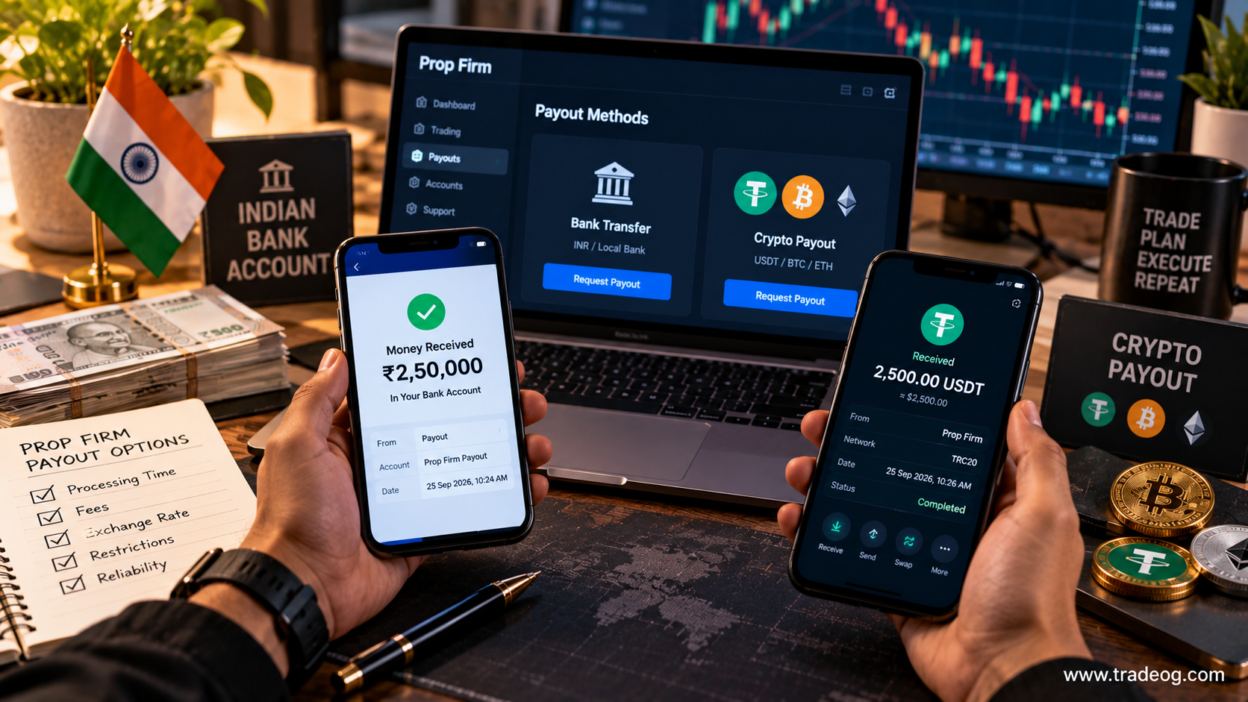
Prop Firm Payout to Indian Bank Account vs Crypto
SEO Title: Prop Firm Payout to Indian Bank Account vs Crypto
Suggested URL Slug: `/prop-firm-payout-indian-bank-account-vs-crypto/`
Meta Description: Compare bank transfer vs crypto prop firm payouts in India. Understand fees, conversion rates, processing times, and tax compliance before withdrawing.
Primary Keyword: `prop firm payout to Indian bank account vs crypto`
Featured Image Details
- SEO Image Title: Prop Firm Payout to Indian Bank Account vs Crypto
- SEO Filename: `prop-firm-payout-indian-bank-account-vs-crypto.webp`
- Alt Text: Prop firm payout comparison between Indian bank account and crypto for traders
- Caption: Comparing bank and crypto payout methods for Indian prop firm traders.
- Description: Realistic trading workspace showing a comparison between receiving a prop firm payout through an Indian bank account and cryptocurrency.
!Prop Firm Payout to Indian Bank Account vs Crypto
When an Indian trader earns simulated trading profits and requests a withdrawal, one practical question arises: should the money be received through a direct domestic bank transfer or cryptocurrency? Evaluating a prop firm payout to Indian bank account vs crypto is not merely a matter of convenience; it impacts transaction fees, processing speed, foreign exchange conversion spreads, audit documentation, and tax reporting.
Proprietary trading firms do not all offer identical withdrawal rails. Payout channels vary depending on:
- The prop firm’s corporate banking and liquidity relationships
- The evaluation program or account model
- The trader’s country of residence
- Supported third-party payout processors (such as Rise, Deel, or direct crypto gateways)
- Changing commercial policies and local compliance requirements
Neither payment method is universally superior for every trader. Choosing your prop firm payout method requires balancing speed against banking documentation and regulatory clarity. In this guide, we analyze both channels factually to help Indian traders make informed, compliant decisions.
1. How Prop Firm Payouts Work for Indian Traders
This guide compares the two main routes. See the dedicated guides for USDT payouts and Wise payouts.
Related guides: prop firm profit split and TDS on prop firm payouts.
The withdrawal lifecycle from an international proprietary trading firm follows a structured process:
- Meet Payout Conditions: The trader achieves rule-compliant profits while respecting drawdown limits and minimum trading days.
- Submit Withdrawal Request: The trader requests a withdrawal via the dashboard and selects an available payout method.
- Prop Firm Verification: The firm reviews trading logs to confirm rule compliance.
- Disbursement Processing: Funds are transferred via the chosen payment channel.
- Receipt and Archiving: The trader receives the funds and retains records for tax reporting.
To successfully receive prop firm payout in India, traders must remember that a trading balance shown on a platform dashboard is not cash in an Indian bank account; it is a contractual entitlement that must clear verification and conversion rails.
2. What Is a Bank-Based Prop Firm Payout?
A prop firm payout to Indian bank account routes funds through conventional fiat financial infrastructure. International prop firms rarely execute direct domestic NEFT or IMPS transfers from within India. Instead, fiat withdrawals typically arrive through:
- Direct International Wire (SWIFT): The prop firm’s bank transmits USD or EUR through global correspondent banks to your Indian commercial bank (e.g., HDFC, ICICI, SBI).
- Contractor Platforms: Leading firms partner with payout processors like Rise or Deel. The firm funds your platform balance in USD, and the processor routes local INR transfers directly to your bank account.
When comparing available prop firm withdrawal methods, completing a prop firm bank transfer India disbursement requires valid beneficiary details, SWIFT/BIC and IFSC codes, KYC verification, and transaction purpose declarations.
3. What Is a Crypto Prop Firm Payout?
A prop firm crypto payout delivers your trading reward using blockchain infrastructure. Prop firms generally disburse payments in dollar-pegged stablecoins to protect traders from market volatility during transit:
- USDT (Tether): Disbursed on networks like Tron (TRC-20) or Ethereum (ERC-20).
- USDC (USD Coin): Disbursed on networks like Polygon, Solana, or Ethereum.
The flow operates as follows:
Once the crypto payout for Indian traders arrives, you can hold the stablecoin, transfer it, or convert it to INR via an Indian crypto exchange registered with the Financial Intelligence Unit (FIU-IND).
4. Bank vs Crypto: Quick Comparison
The table below provides a neutral comparison between receiving funds through an Indian bank account versus cryptocurrency. When evaluating crypto vs bank payout for traders, comparing these core factors is essential:
| Factor | Indian Bank / Fiat Route | Cryptocurrency Route (USDT/USDC) |
|---|---|---|
| Disbursed Currency | Foreign currency converted to INR, or direct INR via processor | USD-pegged stablecoins (USDT, USDC) or crypto |
| Conversion Process | Bank or payment processor executes FX conversion | Trader executes conversion via compliant exchange or P2P |
| Price Volatility | Governed by macroeconomic USD/INR movements | Stablecoins track USD; non-stable crypto has high volatility |
| Audit Documentation | Bank statements, SWIFT advices, FIRC / FIRS | Blockchain tx hashes, wallet records, exchange slips |
| Processing Speed | 1 to 5 business days (SWIFT wires take longer) | 15 minutes to 24 hours depending on network confirmation |
| Fee Structure | Intermediary wire fees (15–30), bank retail spreads |
Network gas fees, exchange trading fees, conversion spread |
| Firm Availability | Varies by company; some rely exclusively on processors | Widely available across modern prop firm platforms |
| Tax Considerations | Evaluated under general Indian Income-tax provisions | Subject to VDA regulations (Section 115BBH & 194S) |
| Compliance Requirements | Bank KYC, FEMA documentation, source-of-funds verification | Platform KYC, exchange reporting, wallet verification |
5. Prop Firm Payout to Indian Bank Account
Receiving payouts through banking channels provides familiar, structured financial management.
Potential Advantages
- Conventional Infrastructure: Funds arrive directly into your regular checking or savings account.
- Clear Audit Trail: Generates formal banking records and Foreign Inward Remittance Certificates (FIRC), which streamline tax filing.
- Automated INR Conversion: Eliminates the need to navigate external crypto exchanges or digital asset conversions.
Critical Points to Verify
- Inward Wire Deductions: Correspondent banks in the SWIFT network frequently deduct
15 to35 from international wires. - Retail FX Spreads: Banks apply a retail TT Buying Rate that is typically 1.5% to 2.5% lower than wholesale rates.
- Documentation Requests: Banks may temporarily place incoming funds on hold until you submit supporting documents (contractor agreement, payout invoice).
- Processing Delays: International wires do not settle on weekends or banking holidays.
6. Prop Firm Crypto Payout
Cryptocurrency has become a popular prop firm withdrawal India mechanism due to its speed and borderless infrastructure.
Potential Advantages
- Rapid Settlement: Once approved, stablecoin transfers usually confirm on the blockchain within minutes.
- Accessibility: Useful alternative for traders whose domestic banks face delays with foreign wires.
- Direct Custody: Traders retain immediate control of digital dollar assets before converting them to INR.
Critical Points to Verify
- Network Compatibility: Sending prop firm payout USDT or prop firm payout USDC on the Tron (TRC-20) network to an Ethereum (ERC-20) address will result in permanent, irrecoverable loss of funds. Always double-check deposit addresses and chain compatibility.
- Exchange KYC & FIU Compliance: Converting crypto to INR requires using an exchange compliant with Indian anti-money laundering regulations.
- Conversion Fees & Spreads: Crypto-to-INR conversions incur platform trading fees (0.1% to 0.5%) and withdrawal charges.
- VDA Tax Obligations: Cryptocurrency transactions in India trigger specific digital asset tax rules.
7. Which Is Cheaper: Bank or Crypto?
Neither method is universally cheaper. The most cost-effective prop firm payout crypto vs bank route depends entirely on the payout size and the firm’s fee structure.
Understanding how prop firm payout fees interact with currency conversion spreads helps you identify the true net disbursement:
- Bank Route Costs: Intermediary bank fees (
15–30), domestic inward wire charges (₹200–₹1,000 + GST), and bank FX conversion spreads (1.5%–2.5%). Fixed wire fees represent a large percentage of smaller payouts (500) but become negligible on larger sums (5,000+). - Crypto Route Costs: Blockchain network gas fees (
1–3 on Tron/Polygon), domestic exchange trading fees (0.1%–0.2%), and IMPS/NEFT withdrawal fees (₹10–₹50).
Crypto is often more economical for smaller payouts (500 to 1,500) where fixed SWIFT wire fees would consume a noticeable portion of earnings.
8. Example: $1,000 Prop Firm Payout
To see how costs compare, consider an approved USD prop firm payout India of $1,000 under our illustrative reference exchange rate of ₹95.89:
Pathway A: Bank Wire (SWIFT)
- Gross Payout: $1,000 USD
- Intermediary Wire Fee: –
20 USD (980 reaches Indian bank) - Bank TT Buying Rate (e.g., ₹94.50):
\980 \times ₹94.50 = ₹92,610$ - Inward Remittance Fee & GST: -₹590
- Net Bank Credit: ₹92,020 INR
Pathway B: Crypto (USDT on TRC-20)
- Gross Payout: $1,000 USDT (firm absorbs or charges nominal network fee)
- Net Received in Wallet: 1,000 USDT
- Conversion on Indian Exchange (e.g., ₹94.80 net rate):
1,000 \times ₹94.80 = ₹94,800 - Exchange Trading & Withdrawal Fee: -₹150
- Net Bank Credit: ₹94,650 INR
These figures are educational simulations. Actual credits vary based on live exchange rates, intermediary routes, and exchange spreads.
9. USD to INR Conversion Matters
Understanding foreign exchange mechanics prevents surprise shortfalls regardless of whether you choose a bank transfer or crypto.
Consider an illustrative funded account payout India disbursement of $2,000:
The exact rupee value you realize depends on:
- Interbank Mid-Market Rate: The baseline financial benchmark.
- Retail Banking Spreads: The spread between the interbank rate and the bank’s TT Buying rate.
- Timing of Conversion: Exchange rate swings between payout approval and domestic settlement.
For a detailed analysis of exchange rate dynamics, read USD to INR Conversion: How It Affects Prop Firm Costs and Foreign Currency Prop Firm Payments and Indian Traders.
10. Crypto Payout Does Not Automatically Mean Tax-Free Income
There is a widespread, dangerous myth among beginner traders that receiving prop firm payouts in cryptocurrency avoids taxation in India.
> Under Indian law, tax liability is determined by the commercial nature of the income, not by the technological medium used to deliver the money.
Evaluating your prop firm payout tax India obligations requires analyzing your service contract rather than looking solely at the transfer method. Receiving USDT or USDC constitutes economic income earned from overseas service agreements. Storing funds in private software or hardware wallets does not eliminate your legal obligation to declare global income.
11. Crypto Tax vs Prop Firm Income: Do Not Mix the Two
Indian traders using crypto payout channels navigate two separate legal events that must not be confused:
[Event 1: Prop Firm Service Income]
Trader completes challenge -> Earns contractor reward -> Receives $1,000 in USDT
    │
    ▼ Evaluated as Business / Professional Income
[Event 2: Virtual Digital Asset (VDA) Transaction]
Trader holds USDT -> USDT appreciates -> Sells USDT for INR
    │
    ▼ Evaluated under Section 115BBH (30% tax on crypto gains + 1% TDS)
- The Underlying Income Event: The initial receipt of trading profits from an overseas prop firm under a service contract.
- The Subsequent Crypto Asset Event: Any subsequent transfer, trade, or conversion of that Virtual Digital Asset (VDA) into INR or another asset, which falls under Section 115BBH (flat 30% tax on net VDA gains) and Section 194S (1% TDS on crypto transfers).
Conflating these two events leads to erroneous tax filing. Read TDS on Prop Firm Payouts: What Indian Traders Should Know for comprehensive compliance guidance.
12. What Records Should Indian Traders Keep?
Meticulous documentation is essential for verifying source of funds and satisfying bank compliance:
- Signed prop firm terms and independent contractor agreement
- Account dashboard statements showing closed trades and net profits
- Official email confirmations approving the withdrawal request
- Commercial invoice issued to the prop firm for professional trading performance
- Inward SWIFT payment advices, bank statements, and Foreign Inward Remittance Certificates (FIRC)
- Crypto transaction hashes (TxID), wallet address confirmations, exchange deposit slips, and INR conversion receipts
- Advance tax challans and annual ITR filing acknowledgments
13. Can an Indian Bank Ask About a Prop Firm Payout?
Yes. Commercial banks in India are required under Reserve Bank of India (RBI) regulations and the Prevention of Money Laundering Act (PMLA) to monitor international inward remittances.
Banks may reach out to request:
- The commercial purpose of the inward remittance
- A copy of your contract or service agreement with the foreign entity
- Proof that the funds do not represent prohibited speculative retail margin activities under the Liberalised Remittance Scheme (LRS)
- Tax invoice supporting the transaction
Having organized documentation ready ensures prompt clearance. For guidance on regulatory parameters, review Can Indians Join Prop Firms in 2026?.
14. What If the Prop Firm Pays in USDT?
If your prop firm offers prop firm payout USDT, follow this disciplined process:
- Verify Network Compatibility: Confirm whether the firm sends USDT on TRC-20, ERC-20, or Polygon. Match the network precisely on your receiving wallet.
- Use a Personal Intermediate Wallet: Transfer funds from the prop firm into your private non-custodial wallet before transferring to a domestic exchange.
- Transfer to an FIU-Registered Exchange: Deposit stablecoins into an Indian exchange that complies with FIU-IND reporting rules.
- Execute Trade to INR: Sell USDT for INR on the platform’s order book or compliant OTC desk.
- Withdraw to Verified Bank Account: Transfer the resulting rupees to your linked bank account via standard IMPS or NEFT.
15. Bank Payout vs Crypto Payout for Large Amounts
When managing large disbursements (5,000 to 20,000+), the trade-offs shift:
- Bank Route: While subject to scrutiny, routing large sums through official banking channels generates standard institutional paperwork (FIRC), making it straightforward to substantiate large income amounts to tax authorities.
- Crypto Route: Liquidating large volumes of stablecoins on domestic crypto exchanges can attract high slippage, strict exchange withdrawal limits, and intense anti-money laundering monitoring.
For high-volume traders, dividing payouts or utilizing specialized contractor platforms like Rise often provides an optimal balance between compliance and liquidity.
16. Questions to Ask a Prop Firm Before Choosing a Payout Method
Before committing to a specific withdrawal method, review this operational checklist:
- What payout channels are currently active for Indian residents?
- Is direct bank wire (SWIFT) available to Indian commercial banks?
- Does the firm disburse payments through third-party platforms like Rise or Deel?
- Are stablecoins (USDT, USDC) supported for withdrawals?
- Which specific blockchain networks are supported (TRC-20, ERC-20, Polygon)?
- Does the firm charge a withdrawal processing fee?
- What is the minimum payout amount for bank vs crypto?
- What is the typical payout processing timeline?
- Are there country-specific restrictions for Indian traders?
- Is additional KYC required prior to approving the first withdrawal?
- What resolution procedure exists if a wire or crypto transfer fails?
- Can I modify my payout method between billing cycles?
- Does the dashboard provide formal PDF payout statements for tax records?
17. Common Mistakes Indian Traders Should Avoid
Avoid these eight frequent pitfalls:
- Selecting Methods Solely on Headline Fees: Overlooking hidden currency conversion markups while chasing low advertised withdrawal fees.
- Ignoring FX Spreads: Failing to factor in bank TT Buying spreads that erode net rupee receipts.
- Sending Crypto on Mismatched Networks: Transferring ERC-20 tokens to a TRC-20 address, causing total loss of funds.
- Neglecting Transaction Paperwork: Failing to archive payout invoices and bank FIRCs, leading to tax filing difficulties.
- Believing Crypto Bypasses Indian Tax: Assuming digital assets are untraceable, risking severe non-compliance penalties.
- Assuming All Firms Support Indian Banks: Discovering too late that a firm only supports European SEPA or domestic US ACH transfers.
- Relying on Outdated Information: Basing withdrawal strategies on obsolete forum threads rather than current 2026 firm terms.
- Violating Payout Rules: Initiating withdrawals before fulfilling minimum trading days or consistency requirements. Check Prop Firm Payout Rules.
18. Practical Example for an Indian Trader
Consider an Indian funded trader who achieves an approved $2,500 prop firm payout:
Option 1: Direct Bank Transfer
- The firm wires $2,500 USD via SWIFT.
- Correspondent banking network deducts a $25 transit fee.
- Your bank applies a retail TT Buying rate of ₹94.60 per USD on the remaining $2,475.
- Converted Rupee Value:
\2,475 \times ₹94.60 = ₹234,135$ - Less Inward Processing Fee & GST: -₹750
- Actual Rupee Deposit: ₹233,385 INR
Result:* The trader receives a clear bank audit trail and FIRC document.
Option 2: Stablecoin Payout (USDT on TRC-20)
- The firm sends 2,500 USDT to the trader’s wallet.
- Network fee: negligible (
1 to2). - Trader transfers 2,500 USDT to an FIU-compliant exchange and sells at a net market rate of ₹94.90.
- Gross Rupee Value:
2,500 \times ₹94.90 = ₹237,250 - Less Exchange Fee & IMPS Transfer: -₹250
- Actual Rupee Deposit: ₹237,000 INR
Result:* The trader realizes approximately ₹3,600 more upfront, but must maintain comprehensive exchange records to fulfill digital asset reporting rules.
19. Bank or Crypto: What Should Indian Traders Check?
Use this decision matrix to evaluate which payout channel suits your operational preferences:
If Choosing an Indian Bank Route:
- Confirm your bank’s foreign inward remittance processing fees.
- Verify your bank’s historical TT Buying Rate spreads.
- Ensure your bank account details and PAN match your prop firm KYC profile.
- Request and archive Foreign Inward Remittance Certificates (FIRC).
If Choosing a Cryptocurrency Route:
- Verify supported stablecoins (USDT vs USDC) and exact network protocols.
- Use private non-custodial wallets for intermediate custody.
- Ensure your domestic crypto exchange account is fully KYC-verified and FIU-compliant.
- Maintain complete records of blockchain hashes, exchange trades, and 1% TDS certificates.
20. Frequently Asked Questions (FAQ)
Can Indian traders receive prop firm payouts in a bank account?
Yes. Indian traders can receive prop firm payouts via direct international SWIFT wire or through contractor payment platforms like Rise and Deel.
Can prop firms pay Indian traders in crypto?
Yes. Many international prop firms support cryptocurrency withdrawals, primarily using dollar-pegged stablecoins like USDT and USDC.
Can a prop firm payout be received in USDT?
Yes. USDT is one of the most widely accepted payout currencies across prop firms. Traders must ensure they use the exact blockchain network supported by the firm (such as TRC-20 or ERC-20).
Is a crypto prop firm payout taxable in India?
Yes. All income earned from proprietary trading is taxable under Indian law regardless of whether it is paid in fiat currency or cryptocurrency. Subsequent digital asset transfers are subject to Section 115BBH VDA tax rules.
Is a bank prop firm payout taxable in India?
Yes. Inward remittances from overseas prop firms are subject to domestic income tax based on the trader’s overall professional or business income classification.
What happens when USD is converted into INR?
When USD arrives at an Indian bank, it is converted into Indian Rupees using the bank’s daily commercial TT Buying Rate, which is typically 1.5% to 2.5% below the interbank mid-market rate.
Are crypto payout fees lower than bank fees?
For smaller payouts (500 to 1,500), crypto is often cheaper because it avoids fixed 15 to 35 SWIFT wire charges. For large payouts, banking channels offer institutional documentation and eliminate crypto exchange conversion slippage.
What records should Indian traders keep?
Traders should archive prop firm contractor agreements, monthly payout statements, invoices, bank remittance certificates (FIRC), and crypto transaction hashes.
Can a bank ask about the source of a prop firm payout?
Yes. Under RBI and PMLA guidelines, Indian banks may request proof of the commercial source of inward funds, including your contractor agreement and payout statement.
What should I check before choosing a prop firm payout method?
Confirm supported currencies, blockchain networks, transaction fees, processing timelines, and domestic tax implications before submitting your withdrawal request.
Conclusion
Deciding between a prop firm payout to Indian bank account vs crypto requires balancing speed and cost against documentation and regulatory compliance. Receiving payouts directly through an Indian bank account offers traditional security, transparent institutional records, and straightforward tax filings. On the other hand, stablecoin withdrawals provide rapid settlement, lower transaction overhead on smaller amounts, and flexible access to digital assets.
Regardless of which channel you choose, never assume that payment technology alters your underlying tax obligations. Maintain meticulous records of every withdrawal, consult a qualified tax professional, and confirm your prop firm’s current payout terms to ensure seamless, compliant transfers.
For further reading on prop firm rules and payouts in India, explore:




[…] KYC Mismatch: Discrepancies with your prop firm KYC IP address invite scrutiny before payouts to an Indian bank account or crypto wallet. […]
[…] Account Ownership & Payments: Matching registration details with payment records, such as an Indian bank account or crypto payout. […]
[…] For an in-depth analysis of banking channels, explore Prop Firm Payout to Indian Bank Account vs Crypto. […]
[…] For alternative payout rails, read Prop Firm Payout to Indian Bank Account vs Crypto. […]
[…] payout methods and currency routes, see bank vs crypto payouts and foreign currency […]