
Forex price gaps are most often noticed around market reopening because the market has had time to absorb new information while normal spot trading activity was closed or significantly reduced. When trading resumes, the first available prices can be different from the last quoted prices before the closure.
For traders, this is especially noticeable after the weekend. A currency pair can close at one level on Friday and reopen on Sunday at a different level, creating a visible gap on the chart.
What Is a Forex Price Gap?
A forex price gap occurs when the next available quoted price is materially above or below the previous quoted price, leaving a visible space between the two price areas on a chart.
The important point is that a gap does not necessarily mean that the market suddenly moved through every intermediate price while you were watching. It can mean that the market reopened with a new set of available prices after information and positioning changed during the closure.
Why Forex Price Gaps Are More Common Around Market Reopening
1. New information arrives while the main market is closed
Markets do not stop receiving information simply because normal forex trading activity has paused. Political developments, geopolitical events, economic announcements, central-bank comments and unexpected weekend events can change expectations about a currency.
When trading resumes, that information can be incorporated into the first available quotes. If the new consensus is significantly different from Friday’s closing pricing, the market can reopen at a different level.
2. Liquidity is different when trading resumes
Liquidity is not constant throughout the trading week. Around a reopening, fewer participants may initially be active, and available quotes can be thinner than during the busiest London-New York overlap.
Thin liquidity can make prices more sensitive to incoming orders. This connects directly with how liquidity affects the price of a forex pair.
3. Traders reposition before the new week begins
Institutions, funds, companies and individual traders may adjust their currency exposure after the weekend. Some may hedge new risks, while others may react to developments that occurred when markets were closed.
If positioning becomes heavily one-sided when trading resumes, the first available prices can move sharply as orders are matched against available liquidity.
4. Price discovery starts again after the closure
A market reopening is effectively a fresh period of price discovery. Buyers and sellers reassess where they are willing to transact based on the information available at that moment.
This is one reason the first few quotes can behave differently from the stable pricing seen later in the session.
Why the Sunday Forex Open Can Look Different From Friday’s Close
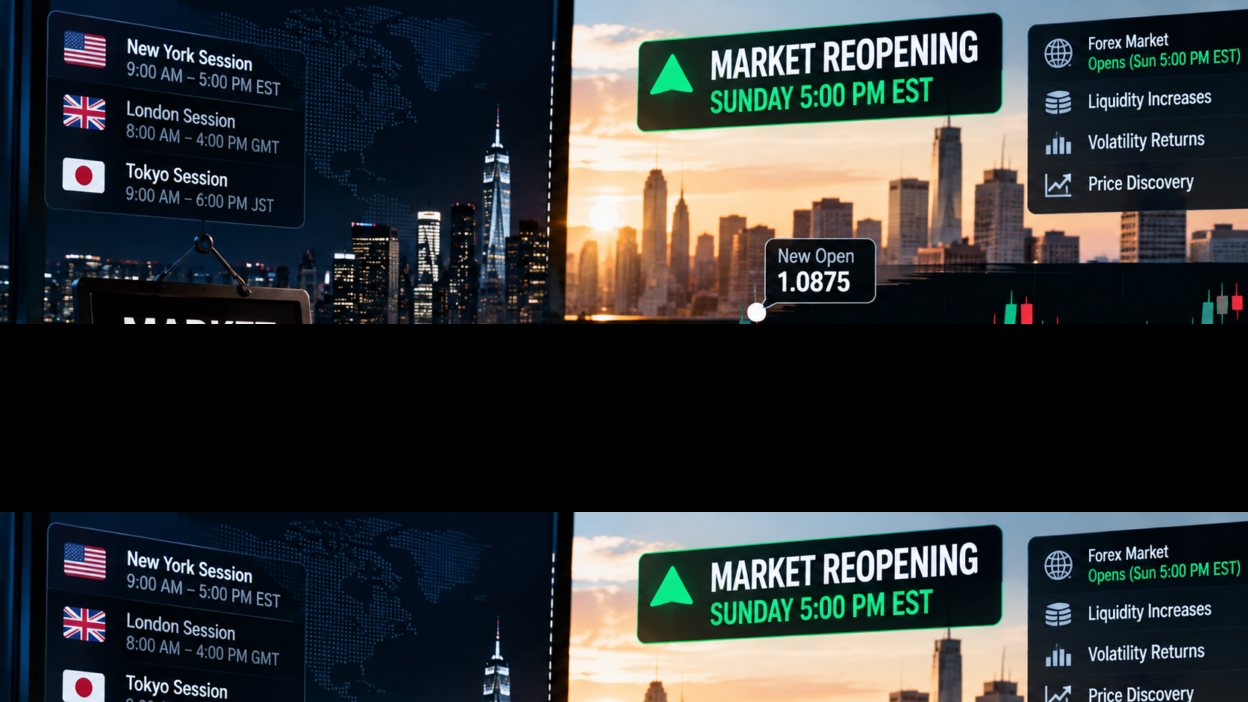
The weekend is the clearest example. Major spot forex trading activity normally pauses over the weekend and resumes for the new trading week.
During that period, currency-sensitive information can accumulate. When trading begins again, the market may immediately reflect a changed expectation.
For example, imagine EUR/USD finishes Friday near 1.0820. If traders return to the market with a significantly different view of the euro or US dollar, the first available quotes could be around 1.0875. The chart would show a gap between the two areas.
Is Every Monday Opening Move a Gap?
No. A market can reopen close to the previous price and then move normally. A visible gap becomes more meaningful when there is a clear discontinuity between the previous quoted area and the new available prices.
It is also important not to confuse a small spread change with a genuine price gap. Bid and ask prices can change independently, particularly when liquidity is limited.
How Low Liquidity Can Make Reopening Gaps Larger
Suppose there are many buyers and sellers around a price. A new order can potentially be absorbed without a major change in price. If fewer orders are available, the same imbalance can push the market farther before sufficient opposing liquidity appears.
This is why traders should also understand forex market depth. Depth helps explain why the market can move differently when there is less available liquidity around the current price.
Why Spreads Can Widen Around Reopening
Bid-ask spreads can become wider when market makers face greater uncertainty or when fewer competitive quotes are available. A wider spread means the price available for buying may be noticeably different from the price available for selling.
This can make the opening market appear more volatile than it actually is once normal liquidity returns.
The relationship between volatility, liquidity and execution is also important when studying why slippage increases during high market volatility.
Can a Forex Gap Close Again?
Sometimes a price moves back toward the previous closing area after reopening. Traders often call this “filling the gap.” However, there is no rule that a gap must close.
A gap may partially retrace, fully retrace, or continue in the original direction. Whether it retraces depends on the information behind the move, order flow, liquidity and the broader market trend.
What Causes a Weekend Gap?
- Unexpected geopolitical developments
- Election or political news
- Central-bank communication
- Economic developments released during the weekend
- Changes in risk sentiment
- Large institutional repositioning
- Major moves in related markets
- Changes in expectations for interest rates
The important idea is that the market does not need to be actively trading every minute for expectations to change. Once trading resumes, the new information can be reflected quickly.
How Forex Gaps Differ From Normal Intraday Price Jumps
A normal intraday price jump can happen while the market is already active. It may be caused by fast order flow, changing liquidity, news or rapidly updated quotes.
A reopening gap has a different context because there has been a period in which normal continuous spot-market pricing was interrupted. That makes the previous close and the new opening price particularly important reference points.
This distinction also helps explain why forex prices can jump between consecutive quotes during active trading.
Should Traders Enter Immediately After a Market Reopening?
There is no universal rule that traders should buy or sell immediately after a gap. The first minutes of a reopening can have unusual spreads, changing liquidity and fast price discovery.
Traders should consider waiting for the market to stabilise, checking the spread, reviewing the broader trend and deciding in advance how much risk they are willing to accept if execution is worse than expected.
How Indian Forex Traders Should Think About Reopening Gaps
Indian traders should pay particular attention to the difference between their broker’s displayed price and the underlying market conditions. The reopening occurs in global FX markets, while the trader may be monitoring the market from India and using a broker with its own liquidity and execution setup.
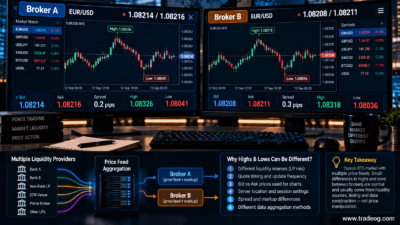
Do not assume that a gap shown on one platform will look exactly the same on another platform. Different pricing feeds can produce small differences, particularly when liquidity is thin.
Can a Stop-Loss Be Affected by a Reopening Gap?
Yes. If the market reopens beyond your stop level, there may be no executable quote exactly at the stop price. The position can therefore be filled at the next available price under the broker’s execution model.
This is one reason traders should avoid treating a stop-loss as an absolute guarantee of a specific exit price during a discontinuous market move.
How to Manage Risk Around Market Reopening
- Avoid oversized positions going into periods when the market will be closed.
- Know your broker’s weekend and reopening policies.
- Check spreads before entering immediately after reopening.
- Keep sufficient account risk tolerance for unexpected gaps.
- Do not assume every gap will fill.
- Review the fundamental reason behind a gap instead of trading the visual gap alone.
Final Takeaway
Forex price gaps are more common around market reopening because new information, changing expectations, repositioning and thinner initial liquidity can all be reflected in the first available quotes.
The Sunday reopening is particularly important because the market has had an extended closure. A large difference between Friday’s final pricing and the new week’s first available quotes can create a visible gap.
For traders, the safest approach is to understand the reason behind the gap, check liquidity and spreads, and size positions so that an unexpected opening price does not create disproportionate risk.
Frequently Asked Questions
Why are forex gaps common at market reopening?
Because new information and changed market expectations can accumulate during the closure and be reflected when trading resumes.
Why does forex sometimes gap on Sunday?
The weekend creates a period when normal spot forex trading activity is paused. When the new trading week begins, prices can reopen at a different level.
Do forex gaps always fill?
No. Some gaps retrace, while others continue in the direction of the initial move.
Can low liquidity make a reopening gap larger?
Yes. When fewer executable orders are available, an imbalance can move prices more sharply before sufficient opposing liquidity appears.
Can a stop-loss be executed beyond its stop level?
Yes. If the market reopens beyond the stop price, the next available executable price may be materially different from the requested level.