

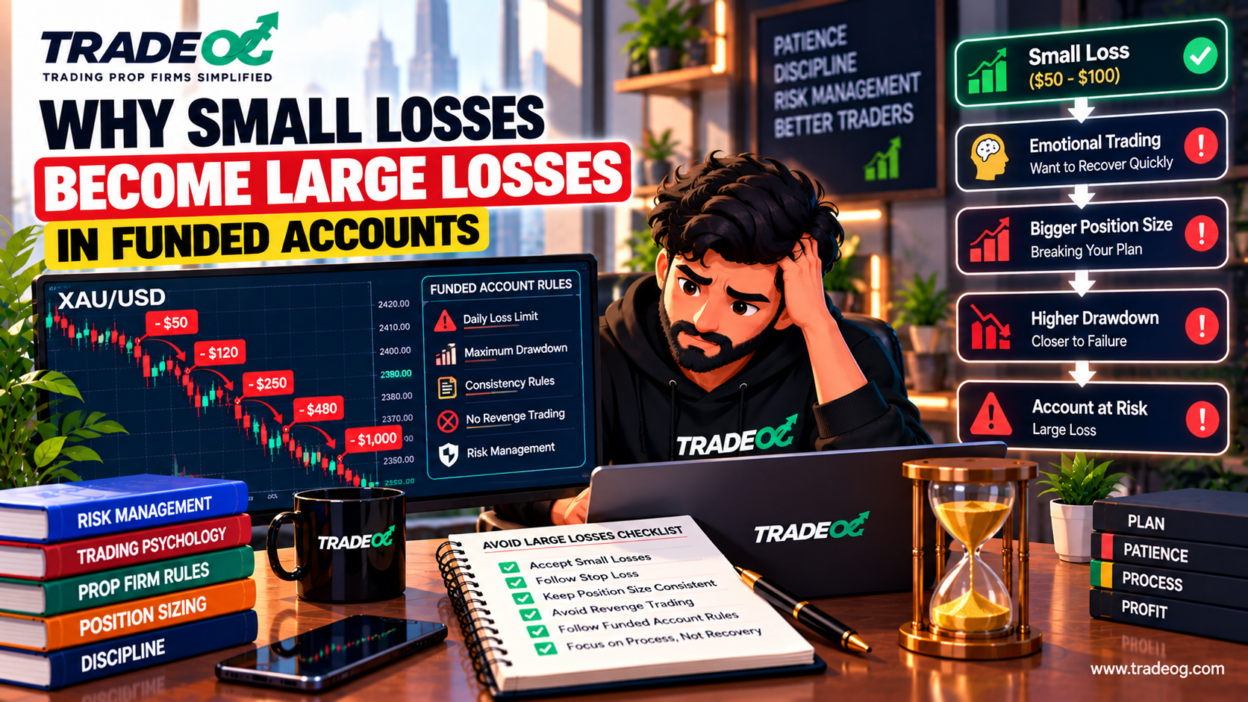
A small loss is not usually what destroys a funded trading account. The bigger problem is what happens after that small loss.
A trader loses $50, then increases position size to recover it. The next trade loses $120. Frustration increases, so the trader takes another trade with even more exposure. A few decisions later, a manageable losing session has turned into a serious drawdown.
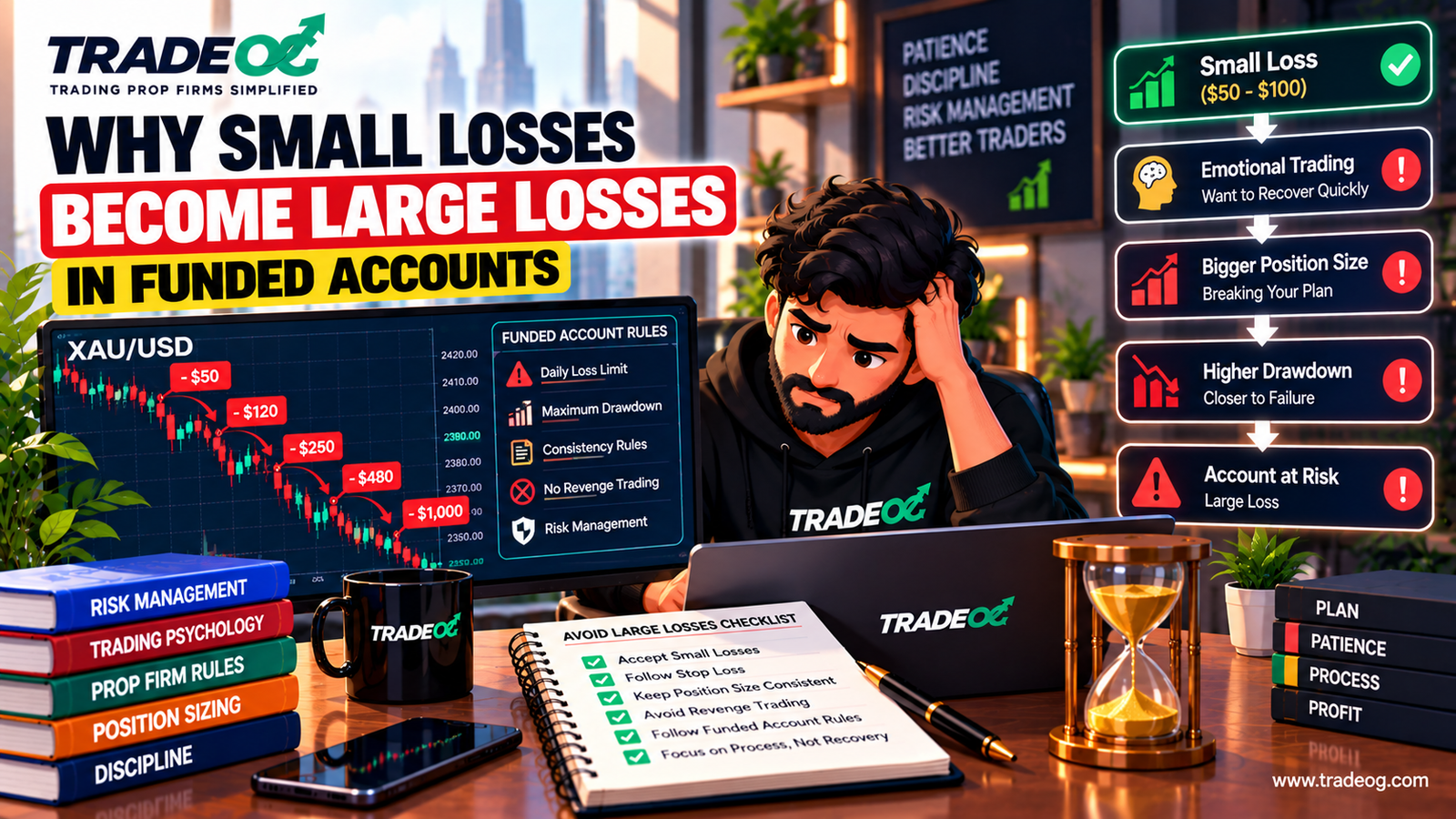
This is why risk management in a funded account is not only about avoiding large losses. It is also about preventing small losses from changing your behavior.
CME Group’s risk-management education recommends defining maximum trade loss, maximum day loss and acceptable exposure before trading. Its position-sizing guidance also explains that position size should be based on the stop location and the amount of account risk a trader is willing to accept. CME Group: Risk Management and Your Trade Plan and CME Group: Proper Position Size.
How Does a Small Loss Become a Large Loss?
The process usually happens gradually rather than in one dramatic trade.
A typical sequence can look like this:
- The trader takes a normal setup.
- The trade loses a small amount.
- The trader becomes focused on recovering the loss.
- The next position is larger or lower quality.
- That trade loses too.
- The trader feels pressure to recover faster.
- Trading frequency or position size increases.
- The account approaches its daily loss or maximum drawdown limit.
The original $50 loss was not necessarily the major problem. The behavioral reaction to the $50 loss created the larger risk.
1. The Recovery Mindset Changes the Next Trade
After a loss, traders often stop evaluating the next setup independently.
Instead of asking, “Does this trade meet my rules?” they start asking, “Can this trade make back what I just lost?”
Those are completely different questions.
The first is strategy-based. The second is recovery-based.
Once recovery becomes the objective, a normal position can suddenly feel too small. The trader may increase size because they want the account back to its previous balance immediately.
2. Position Size Can Escalate Faster Than the Trader Realizes
Consider a simple illustration:
| Trade | Planned/Actual Loss | Cumulative Loss |
|---|---|---|
| Trade 1 | -$50 | -$50 |
| Trade 2 | -$100 | -$150 |
| Trade 3 | -$200 | -$350 |
| Trade 4 | -$400 | -$750 |
| Trade 5 | -$700 | -$1,450 |
This is only an illustration; actual trading losses depend on the instrument, stop distance, contract specifications and execution.
The important point is that losses can grow non-linearly when position size keeps increasing.
CME Group’s risk-management material illustrates how fixed-percentage risk can reduce the size of successive trades during a losing streak, slowing account decay compared with maintaining a larger fixed dollar exposure. CME Group: Controlling Risk.
3. A Funded Account Has a Limited Drawdown Buffer
This is where funded accounts differ from the way many traders mentally view a headline account size.
If a program describes an account as $50,000, that does not mean the trader can freely lose $50,000. The applicable daily loss, maximum loss or drawdown rules depend on the firm and account model.
Therefore, the relevant question is not simply:
“How much is my account?”
It is:
“How much loss can my specific account absorb before a rule is breached?”
A trader with a limited drawdown buffer has to treat every position as part of a larger risk budget.
4. Small Losses Can Trigger Revenge Trading
Revenge trading happens when the trader reacts to a previous loss rather than evaluating the next opportunity on its own merits.
Common thoughts include:
- “I need to make that money back.”
- “The next trade has to work.”
- “I cannot finish the day negative.”
- “I will use a bigger lot just this once.”
- “The market owes me a recovery.”
The market does not know what happened on the previous trade. The next setup has its own probability, entry, stop and target.
CME Group’s trading-plan material recommends defining entry and exit conditions in advance because emotional reactions can make managing positions harder once a trade is active. CME Group: Trading Strategies in Your Trade Plan.
5. Overtrading Turns a Normal Loss Into a Bad Session
A trader might normally take two or three carefully selected trades. After a loss, that number can suddenly become eight, ten or fifteen.
More trades mean more opportunities for:
- spread and transaction costs;
- slippage;
- lower-quality setups;
- correlated exposure;
- emotional decisions;
- additional drawdown.
The problem is not that every additional trade will lose. The problem is that the trader is no longer following the same selection process that produced the original risk plan.
6. XAU/USD Can Make the Problem More Noticeable
Gold is popular among prop traders, including Indian traders, but XAU/USD can move quickly around major economic releases and periods of changing liquidity.
If a trader increases position size after a small loss and then enters during a fast market, the dollar impact of a normal price movement can become much larger than expected.
That makes position sizing especially important for traders who focus on gold.
7. The Mathematics of Loss Recovery Gets Harder
Another reason small losses matter is that recovering a percentage loss requires a larger percentage gain.
| Account Loss | Gain Needed to Return to Starting Balance |
|---|---|
| 5% | 5.26% |
| 10% | 11.11% |
| 20% | 25% |
| 30% | 42.86% |
| 50% | 100% |
CME Group provides the same basic mathematical relationship in its risk-management education: after a loss, the required recovery percentage is larger than the percentage that was lost. CME Group: Controlling Risk.
For a funded account, the situation can be even more restrictive because the trader may have a specific maximum drawdown threshold rather than unlimited capital to recover from a losing period.
8. The Best Protection Is a Predefined Risk Rule
Before entering a trade, the trader should already know:
- where the stop belongs;
- how much money the stop represents;
- what percentage of available equity is at risk;
- how much daily loss has already been used;
- how much drawdown remains under the account’s rules.
CME Group explains that proper position sizing starts with the stop-loss and the percentage or dollar amount the trader is prepared to risk. CME Group: Proper Position Size.
9. Do Not Increase Size Because of the Previous Result
There is an important distinction between a legitimate position-size change and emotional size escalation.
| Reason for Size Change | What It Means |
|---|---|
| Stop is wider | Position may need to be smaller to keep risk controlled |
| Stop is tighter | Position may be larger while maintaining the same planned risk |
| Strategy has predefined volatility rules | Size changes according to the tested process |
| Previous trade lost | Not, by itself, a valid reason to increase risk |
| Need to recover today’s loss | Warning sign for emotional risk escalation |
The objective is not necessarily to use exactly the same lot size on every trade. The objective is to keep risk controlled according to the current trade and your predefined plan.
10. A Simple Rule After a Losing Trade
When a trade closes at a loss, use a short reset process:
- Accept the loss. The trade is finished.
- Record what happened. Was it a valid setup?
- Check remaining drawdown. Know your actual risk capacity.
- Return to normal position sizing.
- Wait for the next valid setup.
- Do not trade to recover a specific rupee or dollar amount.
This process prevents one result from controlling the next decision.
Funded Account Example
Imagine a trader has a funded account with a $2,500 maximum drawdown allowance under the applicable account rules.
The trader takes a normal setup and loses $100. Nothing unusual has happened.
Instead of returning to the normal plan, the trader decides to risk $250 on the next trade because the first loss feels insignificant.
If another trade loses $250, the combined loss is now $350.
If the trader continues increasing exposure, the remaining drawdown buffer can disappear surprisingly quickly.
The key lesson is that the first $100 did not force the account into danger. The decision to change the risk process after the $100 loss created the escalation.
Small Losses Are Part of Trading
A trading strategy can contain losing trades even when it has a positive long-term expectancy. Trying to eliminate every small loss can actually create a larger problem.
The practical objective is to make losing trades predictable and controlled.
A $50 loss that stays within the trading plan is very different from a $50 loss that triggers revenge trading, larger positions and ten additional trades.
The first is a normal business expense of trading. The second can become a behavioral risk event.
Checklist for Indian Funded Traders
- Do I know my account’s exact daily loss and maximum drawdown rules?
- Do I calculate position size from my stop and planned risk?
- Am I increasing size because the previous trade lost?
- Am I trying to recover a specific amount today?
- Have I already used part of my daily loss allowance?
- Am I taking more trades than my normal strategy allows?
- Am I trading XAU/USD during a high-volatility period?
- Would I take this trade if the previous trade had been a winner?
- Do I have a predefined stopping point for a bad session?
- Have I checked the current rules for my specific prop firm account?
Final Takeaway
Small losses become large losses in funded accounts when the trader changes behavior after the initial loss.
The most common escalation is simple: small loss → emotional pressure → bigger position → another loss → more recovery pressure → larger drawdown.
The solution is not to become afraid of small losses. It is to keep them inside a predefined risk framework.
For funded traders, the goal should be to protect the drawdown buffer, follow the account rules and let the strategy determine when and how much to risk.
A controlled small loss is part of trading. A small loss that changes your entire risk process is where the real danger begins.
For more TradeOG guides, read Why Traders Increase Lot Size After a Losing Trade and Drawdown Recovery: How Much Profit Is Needed After a Loss?.
Disclaimer: This article is for educational purposes only and is not financial advice. Trading leveraged products involves substantial risk of loss. Prop firm rules vary by firm and account model, so always check the current official rules before trading.

[…] guide on why small losses become large losses in funded accounts explains how this type of escalation can affect a funded […]
[…] related risk-management concepts, see our guides on why small losses become large losses in funded accounts and why traders move their stop loss after entering a […]