

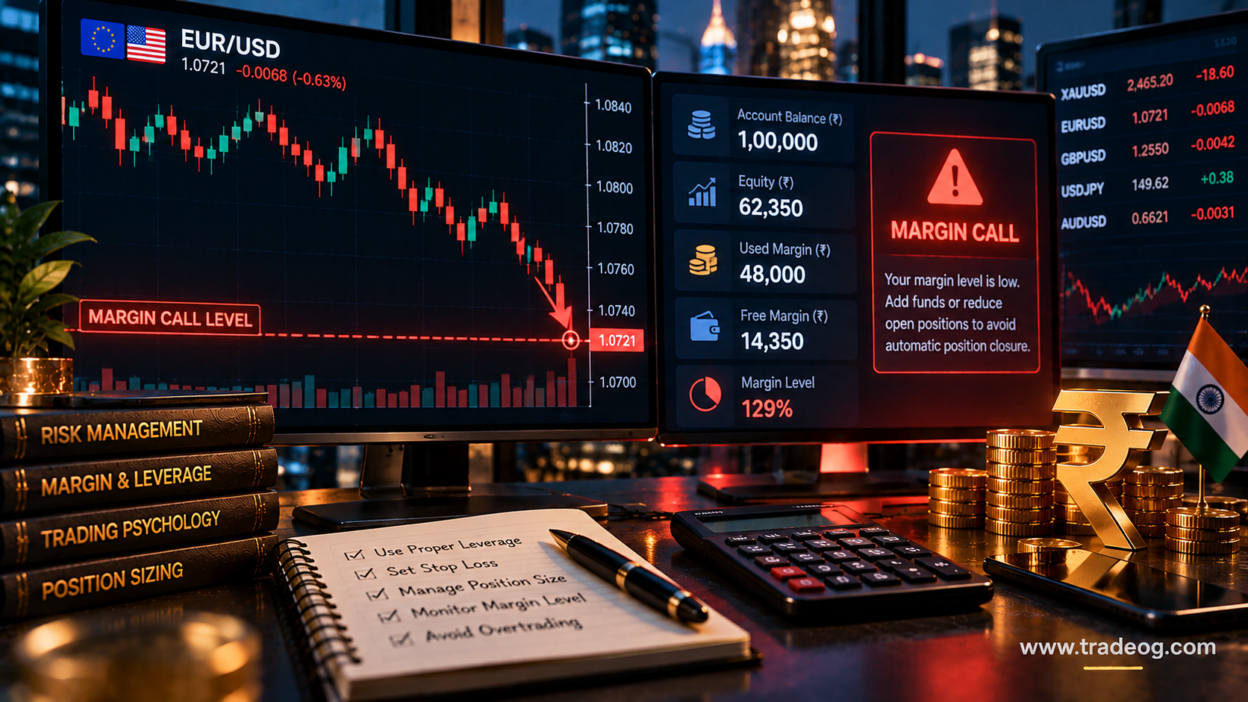
A forex margin call happens when the equity in a leveraged trading account falls too close to, or below, the margin required to keep open positions. Depending on the broker or trading venue, the trader may be warned, prevented from opening new positions, asked to add funds, or have positions reduced or closed automatically.
For traders, the important lesson is simple: a margin call is usually a symptom of excessive exposure, insufficient free margin, or both. It is not a trading strategy problem that should be solved by depositing more money blindly. The better solution is to control position size before the trade becomes dangerous.
Quick answer:
A margin call occurs when your account equity becomes too low relative to the margin required for your open leveraged positions. Traders can reduce the risk by using smaller positions, keeping sufficient free margin, setting logical stop losses, avoiding excessive leverage, limiting correlated trades and monitoring margin level before and after major market events.
What Is a Forex Margin Call?
When you trade a leveraged forex position, you normally do not need to provide the full notional value of the position as cash. Instead, the trading venue requires a certain amount of capital as margin.
Your account has several important numbers:
| Term | Meaning | Why It Matters |
|---|---|---|
| Balance | Account value excluding current floating P&L | Shows the settled account balance |
| Equity | Balance plus or minus floating profit/loss | Shows the account’s current value |
| Used Margin | Capital currently required to support open positions | Shows how much margin is tied up |
| Free Margin | Equity minus used margin | Shows remaining margin capacity |
| Margin Level | Equity ÷ used margin × 100 | Shows how close the account is to a broker’s margin threshold |
A margin call is therefore closely connected to equity, used margin and margin level. The exact warning and liquidation thresholds vary by broker and product, so traders should always read the specific margin policy for their account.
Margin Call vs Stop Out
These terms are often used interchangeably, but they can describe different stages of the risk process.
| Stage | What It Means | Typical Trader Action |
|---|---|---|
| Healthy margin | Account has comfortable equity relative to used margin | Monitor normally |
| Low margin level | Free margin is shrinking and the account is becoming more exposed | Reduce exposure or avoid adding positions |
| Margin call | Account reaches the broker’s defined warning/restriction threshold | Add funds or reduce/close positions if appropriate |
| Stop out | Account reaches the broker’s automatic close-out threshold | Broker may automatically close positions |
There is no universal margin-call percentage that applies to every forex account. For example, one broker may use a 100% margin-call threshold and a lower stop-out level, while another may have different rules. Some venues may also change requirements when market conditions become more volatile.
IG explains that its margin call occurs when account equity falls below the relevant margin requirement and that positions can become subject to automatic closure. Its published thresholds are specific to its products and account rules, illustrating why traders should not assume one broker’s percentages apply everywhere. IG margin call guidance.
How the Margin Call Formula Works
A commonly used margin-level formula is:
Margin Level = (Equity ÷ Used Margin) × 100
Suppose an account has:
- Equity: ₹60,000
- Used margin: ₹30,000
The margin level is:
(₹60,000 ÷ ₹30,000) × 100 = 200%
Now imagine the market moves against the trader and equity falls to ₹36,000 while used margin remains ₹30,000:
(₹36,000 ÷ ₹30,000) × 100 = 120%
The trader has not necessarily received a margin call yet, because the applicable threshold depends on the broker. But the account has become much more vulnerable.
If equity falls to ₹30,000:
(₹30,000 ÷ ₹30,000) × 100 = 100%
At this point, a broker using a 100% margin-call threshold could restrict new trades or issue a warning. The actual rule must be checked against the relevant broker’s agreement.
What Is Free Margin?
Free margin is one of the most useful numbers for monitoring an open leveraged account.
The simplified relationship is:
Free Margin = Equity − Used Margin
For example:
| Account Item | Value |
|---|---|
| Balance | ₹1,00,000 |
| Floating loss | −₹20,000 |
| Equity | ₹80,000 |
| Used margin | ₹50,000 |
| Free margin | ₹30,000 |
The trader still has ₹1 lakh as the original balance, but current equity is only ₹80,000 because of the floating loss. After supporting the open positions with ₹50,000 of used margin, only ₹30,000 remains as free margin.
This is why looking only at account balance can be misleading when positions are open.
Why Margin Calls Happen
There are several common causes.
1. Position Size Is Too Large
The most common cause is excessive exposure relative to account equity.
If a trader uses a large position on a small account, even a normal market move can produce a large floating loss. As equity falls, the margin level falls with it.
2. Too Much Effective Leverage
A broker may make high leverage available, but the trader controls how much of that capacity is actually used.
Effective leverage can be approximated as:
Effective Leverage = Total Position Exposure ÷ Account Equity
For example, ₹5 lakh of exposure on ₹1 lakh of equity represents approximately 5:1 effective leverage, regardless of whether the platform makes 1:20 or 1:100 available.
3. Multiple Open Positions
Five small trades can become a large portfolio exposure when their risks are added together.
This is especially dangerous when several positions require margin simultaneously.
4. Correlated Positions
EUR/USD, GBP/USD and AUD/USD may not move identically, but they can share significant USD exposure. A trader who treats each position as an independent bet may underestimate total portfolio risk.
5. Sudden Market Volatility
CPI, NFP, central-bank decisions, geopolitical events and unexpected economic data can produce rapid price movements. A position that looks comfortable during normal conditions can become highly stressed when volatility expands.
6. Spread Expansion and Slippage
A temporary widening of the bid-ask spread can increase the floating loss shown on a leveraged position even if the underlying market has not moved dramatically.
Slippage can also make the actual exit price worse than the planned price during fast markets.
7. Overnight or Weekend Risk
Holding leveraged positions through periods of reduced liquidity or major scheduled events can increase the probability of large price gaps or rapid moves.
8. Margin Requirement Changes
Some trading venues can increase margin requirements when market risk rises. CME Group, for example, explains that margin requirements can be adjusted as volatility and market conditions change. CME Group: Understanding Margin Changes.
A Simple Margin Call Example for an Indian Trader
Consider an illustrative account of ₹1,00,000.
| Metric | Starting Position | After Loss |
|---|---|---|
| Balance | ₹1,00,000 | ₹1,00,000 |
| Floating P&L | ₹0 | −₹40,000 |
| Equity | ₹1,00,000 | ₹60,000 |
| Used Margin | ₹50,000 | ₹50,000 |
| Free Margin | ₹50,000 | ₹10,000 |
| Margin Level | 200% | 120% |
The account has not necessarily reached a margin call, but its safety buffer has fallen sharply.
Another ₹10,000 floating loss would reduce equity to ₹50,000. With ₹50,000 used margin, the margin level would become 100%.
If the broker’s margin-call threshold is 100%, the account could now enter the broker’s margin-call state.
The key lesson is that the trader did not suddenly become “wrong” when the margin call appeared. The position was becoming too large relative to the account long before the warning.
Margin Call Example With 1:100 Leverage
Suppose a trader has ₹50,000 of equity and access to 1:100 leverage.
It may be mathematically possible to control a much larger notional position than the account balance. But using that full capacity would leave almost no room for adverse price movement.
For example, if the trader controls ₹20,00,000 of exposure, a simplified 1% adverse move corresponds to approximately ₹20,000 of exposure loss before costs and instrument-specific mechanics.
That would consume 40% of a ₹50,000 account from a single 1% move in the underlying exposure.
This is why maximum available leverage should never be confused with sensible trading exposure.
Margin Call vs Stop Loss
A stop loss is a trading decision made by the trader. A margin call is an account-risk condition created when equity and margin requirements become unfavorable.
| Stop Loss | Margin Call |
|---|---|
| Planned before the trade | Triggered by account margin conditions |
| Based on market structure or risk limit | Based on equity and margin requirements |
| Can limit a single trade’s planned loss | Can affect the whole leveraged account |
| Trader controls placement | Broker/platform rules determine thresholds |
| Should be part of the trade plan | Should be avoided through adequate risk management |
A trader should not wait for a margin call to decide where to exit a losing trade.
CME’s educational material similarly emphasizes setting stops within risk tolerance and maintaining sufficient margin for open positions. CME Group: Position and Risk Management.
How to Avoid a Forex Margin Call
1. Keep Position Size Small Enough
Start with your maximum acceptable loss, not your maximum available leverage.
A simple risk framework is:
Risk Budget = Account Equity × Risk Percentage
For a ₹1,00,000 account with a 1% risk budget:
₹1,00,000 × 1% = ₹1,000
The position should then be sized so that a stop-loss hit produces approximately that planned loss, allowing for spread, slippage and other costs.
2. Maintain a Free-Margin Buffer
Do not operate an account close to its broker’s margin threshold simply because the platform still allows the positions to remain open.
A large free-margin buffer gives the account more room to absorb normal price fluctuations.
3. Use a Logical Stop Loss
A stop should be placed where the trade thesis is invalidated, not at an arbitrary distance designed only to maximize position size.
If the logical stop is too wide for the account’s risk budget, reduce the position size or skip the trade.
4. Limit Total Portfolio Exposure
Do not calculate risk only trade by trade.
If four trades each risk 1%, the account could potentially be exposed to approximately 4% of planned risk before considering correlation, gaps, slippage and simultaneous losses.
Set a maximum total exposure rule for the account.
5. Watch Correlation
If you are long EUR/USD, GBP/USD and AUD/USD simultaneously, you may be taking several versions of the same USD-directional trade.
Correlation should therefore be considered when calculating total exposure.
6. Reduce Exposure Before Major News
Major economic releases can produce fast moves and wider execution costs.
If your strategy does not specifically require holding through an event, reducing exposure beforehand can materially lower the chance of an unexpected margin problem.
7. Avoid Revenge Trading
A trader who loses money and immediately increases position size to recover the loss can move from a normal drawdown to a margin crisis very quickly.
After a large loss, the correct response is usually to reduce exposure, review the trade and protect remaining capital.
8. Know Your Broker’s Exact Thresholds
Before trading, find out:
- Margin-call threshold
- Stop-out threshold
- How margin level is calculated
- Whether positions are closed individually or collectively
- How close-out order is determined
- Whether margin requirements can change
- How spreads and overnight financing affect equity
- Whether the broker provides negative-balance protection and under what conditions
What Should You Do After Receiving a Margin Call?
Do not treat the warning as a signal to immediately deposit more money and continue trading the same position size.
First identify why the account reached the threshold.
- Check current equity.
- Check used margin.
- Calculate free margin.
- Identify the positions creating the largest exposure.
- Check whether positions are correlated.
- Review upcoming market events.
- Reduce positions if appropriate.
- Only add funds if doing so fits a deliberate capital and risk plan.
- Recalculate the account’s effective leverage after any adjustment.
Adding capital can improve margin headroom, but it does not make an oversized position less risky. If the underlying exposure remains excessive, the same problem can return.
Can a Margin Call Happen Without a Huge Market Move?
Yes.
A margin call does not require a spectacular crash.
It can occur because:
- The trader opened a position that was too large.
- Several positions consumed margin at the same time.
- Floating losses accumulated across multiple trades.
- Spread widened temporarily.
- Margin requirements increased.
- A highly correlated portfolio moved against the trader.
This is why margin management should be monitored continuously rather than only after a major losing trade.
Margin Call Risk During Gold Trading
Indian traders often combine forex exposure with XAU/USD. Gold can make margin management more demanding because its price can move sharply around US inflation data, employment reports, central-bank decisions, real-yield changes and geopolitical developments.
A trader who already has large USD exposure and then adds a highly leveraged gold position may increase total portfolio risk without realizing how much exposure has been concentrated around the same macro drivers.
The solution is not simply to avoid gold. It is to calculate the total exposure of the account rather than evaluating every position in isolation.
For the relationship between the dollar and gold, see How US Dollar Strength Affects Gold Prices for Indian Traders.
Margin Call Risk for Indian Traders
Indian traders should separate the educational concept of margin calls from the question of whether a particular leveraged forex platform or product is permitted for an Indian resident.
RBI states that resident persons may undertake forex transactions only with authorised persons and for permitted purposes under FEMA. RBI has also cautioned residents against unauthorised electronic trading platforms and states that permitted electronic forex transactions should be undertaken through RBI-authorised ETPs or recognised stock exchanges under the applicable conditions. RBI: Caution against unauthorised forex trading platforms.
Therefore, an Indian trader should not select a platform simply because it advertises very high leverage or a low margin requirement. The legal, regulatory and product framework must be checked separately.
For exchange-traded derivatives, SEBI explains that relatively small margin amounts can create significant leverage and that losses can be substantial relative to margin. SEBI derivatives risk disclosure.
How Much Free Margin Should You Keep?
There is no universal percentage that guarantees safety.
However, a useful risk-management principle is to avoid operating close to the broker’s margin-call threshold during normal trading.
Think of free margin as a shock absorber.
The more volatile the instrument and the larger the position, the more important that buffer becomes.
For a highly leveraged account, keeping only a tiny amount of free margin can mean a relatively normal market movement creates a serious account problem.
A Practical Margin Safety Framework
| Account Condition | Interpretation | Action |
|---|---|---|
| High free margin | Comfortable capacity | Continue monitoring risk |
| Free margin falling quickly | Exposure is increasing or trades are losing | Stop adding positions and review exposure |
| Margin level approaching broker warning zone | Account buffer is becoming thin | Reduce exposure promptly |
| Margin call | Account has reached broker-defined threshold | Follow broker rules; reduce positions or add funds only as appropriate |
| Stop out | Automatic close-out risk | Positions may be closed without waiting for trader action |
Five Numbers Every Leveraged Trader Should Know
Before opening a leveraged position, know these five numbers:
- Account equity
- Used margin
- Free margin
- Margin level
- Maximum planned loss
If you cannot calculate these numbers, you should not increase position size simply because additional leverage is available.
Margin Call Checklist Before Opening a Trade
- Is my position size appropriate for my account?
- What percentage of equity am I risking?
- Where is the logical stop loss?
- How much will the stop cost in INR?
- How much margin will the position consume?
- How much free margin will remain?
- What happens if the market moves 1% against me?
- What happens if two correlated trades lose together?
- Is major economic news approaching?
- Do I know my broker’s margin-call and stop-out thresholds?
- Is the platform and product appropriate and permitted for my circumstances?
Margin Call vs Leverage: The Key Difference
Leverage determines how much exposure can be supported with a given amount of margin.
A margin call occurs when the account no longer has enough equity relative to the margin requirement under the broker’s rules.
So the chain is:
Higher exposure → larger potential P&L swings → falling equity during a loss → lower free margin → lower margin level → possible margin call → possible stop out.
This is why the most effective way to avoid margin calls is not to search for a broker with a higher margin threshold. It is to control the exposure that creates the problem in the first place.
Final Takeaway
A forex margin call is a warning that your leveraged account has lost too much of its safety buffer. It happens when equity becomes too low relative to the margin required to maintain open positions, according to the rules of the relevant trading venue.
The strongest protection is preventive:
- Use sensible position sizes.
- Control effective leverage.
- Keep sufficient free margin.
- Use logical stop losses.
- Limit correlated exposure.
- Reduce risk around major volatility events.
- Know your broker’s margin and stop-out rules.
- Do not treat a deposit as a substitute for risk management.
The professional objective is not to find out how close your account can get to a margin call. The objective is to structure trades so that a normal losing sequence does not put the account anywhere near that threshold.
FAQs
What is a forex margin call?
A forex margin call occurs when account equity falls to a broker-defined level relative to the margin required for open leveraged positions. Depending on the broker, the trader may be restricted from opening new positions, asked to add funds, or required to reduce exposure.
What is the difference between margin call and stop out?
A margin call generally refers to a warning or restriction threshold, while stop out refers to a broker’s automatic position-close process at a more severe margin level. The exact thresholds differ by broker and product.
Can a stop loss prevent a margin call?
A properly sized position and logical stop loss can greatly reduce the probability of a margin call, but a stop is not a guarantee against every margin event. Gaps, slippage, spread expansion and rapid markets can cause execution to differ from the planned level.
What is free margin in forex?
Free margin is generally the equity remaining after subtracting used margin. It represents the capital available to support additional positions or absorb floating losses, subject to the broker’s rules.
What happens if free margin reaches zero?
The exact result depends on the broker and product. The account may be unable to open additional trades and could approach or enter a margin-call or automatic liquidation state. Traders should not assume that zero free margin is a safe boundary.
Can high leverage cause a margin call?
High available leverage does not automatically cause a margin call, but it can make very large positions possible with relatively little margin. If the trader uses that capacity to take excessive exposure, a relatively small market move can reduce equity rapidly.
Can Indian traders use high-leverage offshore forex platforms?
Do not assume that a platform’s advertised leverage makes it permissible for an Indian resident. RBI states that resident forex transactions must comply with FEMA and applicable authorised-person, ETP and recognised-exchange requirements. Verify the current regulatory position before depositing or trading.
How can I calculate margin level?
A commonly used formula is Margin Level = (Equity ÷ Used Margin) × 100. The broker’s platform may calculate it automatically, but traders should understand the formula and the broker’s specific thresholds.
Related TradeOG Guides
- Forex Leverage Explained for Indian Traders With Examples
- Pip Value Calculator Explained: How Indian Forex Traders Calculate Risk
- Why USD Strength Matters for Indian Forex Traders
- How US Dollar Strength Affects Gold Prices for Indian Traders
Sources & Further Reading
IG — What Is a Margin Call?
Margin call mechanics and account equity guidance
CME Group — Position and Risk Management
Position sizing, stops and margin risk management
CME Group — Understanding Margin Changes
How margin requirements can change with market conditions
Reserve Bank of India — Caution Against Unauthorised Forex Trading Platforms
RBI guidance for Indian residents undertaking forex transactions
SEBI — Derivatives Risk Disclosure
Leverage, margin and currency-derivative risk information
Risk Disclaimer: This article is for educational and informational purposes only and does not constitute financial, investment, legal or regulatory advice. Leveraged trading can result in rapid and substantial losses. Margin-call and stop-out rules vary by broker, exchange, instrument and account type. Indian residents should independently verify the current RBI/SEBI framework and the exact terms of the authorised intermediary or trading venue before trading.