

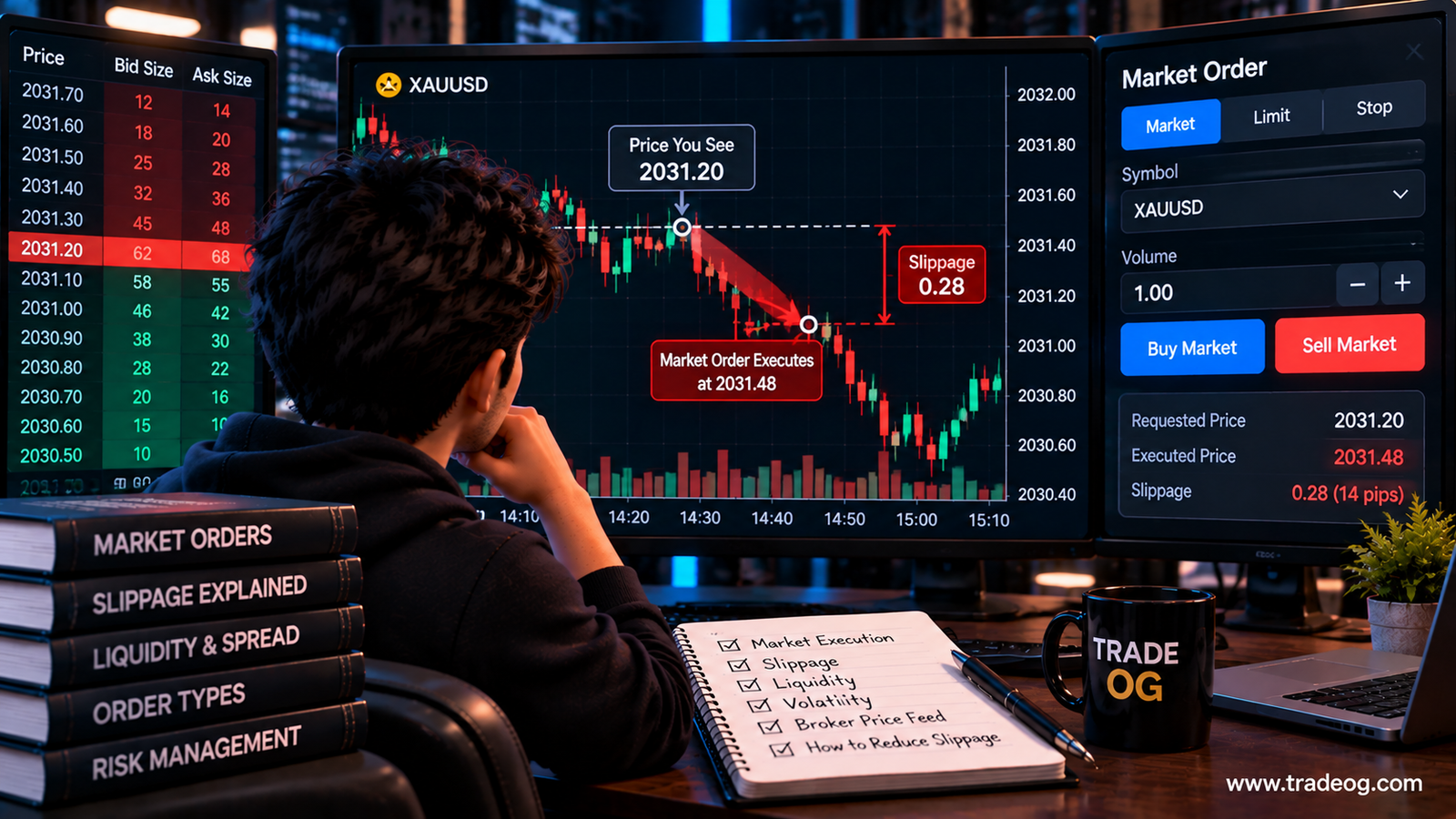
Have you ever clicked Buy or Sell at one price and received a different entry price? That is usually not a chart error. It is a normal consequence of how market orders interact with bid-ask quotes, available liquidity, order routing, execution speed and market conditions.
A market order is designed to prioritize execution rather than guarantee a particular price. Investor.gov explains that a market order generally executes immediately at the best available price, but the execution price is not guaranteed. The last-traded price or quote displayed on your screen may therefore differ from the price at which your order is actually filled.
This matters enormously for forex, gold, futures, CFDs and other fast-moving instruments. During major news, low-liquidity periods or large orders, the difference between the displayed price and the actual fill can become much larger.
In this guide, we will explain why market orders can fill away from the price you see, how bid and ask prices work, what slippage really means, why order size matters, how spreads affect fills, why charts can be misleading, and what traders can do to improve execution quality.
What Is a Market Order?
A market order tells your broker or trading venue to execute the trade at the best available price rather than waiting for a specific price.
For a buy order, you normally interact with available ask liquidity. For a sell order, you normally interact with available bid liquidity. The displayed last-traded price is not necessarily the price available to you.
That distinction is the starting point for understanding unexpected fills.
Investor.gov describes the advantage of a market order as a high likelihood of execution when willing buyers and sellers are available, while the disadvantage is that the execution price may not be the price you expected.
The Three Prices Traders Commonly Confuse
| Price | Meaning | Why it matters |
|---|---|---|
| Bid | Price available to sell into | Relevant when closing a long position or entering a short |
| Ask | Price available to buy at | Relevant when entering a long position or closing a short |
| Last traded price | Most recent transaction price | May not be immediately available for your next market order |
The difference between the bid and ask is the bid-ask spread. Investor.gov defines the bid as the highest price a buyer will pay and the ask as the lowest price at which a seller will sell. The spread is the difference between those two prices.
Therefore, if a chart shows a last price of 2,458.00 but the current ask is 2,458.10, a market buy may be filled around 2,458.10 rather than 2,458.00.
Why the Price on Your Chart Is Not Always Your Execution Price
Most trading platforms display a chart based on a particular price stream. Depending on the instrument and platform, that can be bid, ask, last trade, midpoint or another derived price.
Even when the displayed price is accurate, it may represent only one point in the market’s available liquidity.
Consider a simplified example:
| Ask price | Available quantity |
|---|---|
| 2,458.00 | 0.80 lots |
| 2,458.10 | 1.00 lot |
| 2,458.20 | 1.50 lots |
| 2,458.30 | 2.00 lots |
Suppose you send a market buy for 5 lots. There may not be enough sellers at 2,458.00 to fill the entire order. Your order can therefore consume liquidity at multiple price levels.
The result is a blended average execution price above the first available ask.
This is called market impact or, depending on the reference price, slippage.
What Is Slippage?
Slippage is the difference between the price you expected or referenced and the price at which your trade actually executes.
Slippage can be:
- Negative slippage: you receive a worse price than expected.
- Positive slippage: you receive a better price than expected.
- Zero slippage: your execution matches the reference price.
For a buy order, negative slippage generally means paying more. For a sell order, it generally means receiving less.
Slippage is not automatically evidence that a broker manipulated your trade. In a fast or thin market, available liquidity can genuinely change between the moment you send the order and the moment it is matched.
Investor.gov specifically notes that execution can differ from the displayed quote because quotes are available for a particular quantity and prices can change while an order is being transmitted and executed.
Market Orders and Liquidity
Liquidity is one of the biggest factors behind execution quality.
CME Group’s liquidity education explains that a liquid market has substantial trading interest and that tight bid-offer spreads make it easier to trade near the prevailing market price. CME’s liquidity tools also measure bid-ask spread, book depth and the cost of trading different order sizes.
When liquidity is deep, a market order is more likely to find enough opposing interest close to the top of the book.
When liquidity is thin, even a relatively modest order can consume several price levels.
Deep liquidity example
Imagine there are 100 contracts available near the current ask. A 5-contract market buy may have almost no measurable impact.
Thin liquidity example
Now imagine only 2 contracts are available at the best ask, followed by small quantities at progressively higher prices. A 5-contract order may need to sweep several levels.
The larger the order relative to available liquidity, the more important market depth becomes.
Why Large Market Orders Can Get Multiple Fills
A market order is not necessarily one transaction at one price.
On an electronic order book, a large order may match with multiple resting orders. The first part can execute at the best available price, while subsequent portions execute at progressively worse prices if the initial liquidity is exhausted.
Investor.gov gives a similar concept in its market-order guidance: parts of a large market order can execute at different prices when sufficient liquidity is not available at one price.
This is why the final fill price can look surprising when you compare it with the first price shown on your screen.
Why Fast Markets Create More Slippage
Market conditions can change in milliseconds.
During a fast move:
- Quotes can update rapidly.
- Orders can be cancelled or replaced.
- New liquidity can appear at different levels.
- Existing liquidity can be consumed immediately.
- The spread can widen.
- Your order can reach the venue after the displayed quote has changed.
Investor.gov notes that execution is not instantaneous and that prices can change between the time an order is submitted and the time it reaches the market.
This becomes especially important around CPI, NFP, FOMC decisions, central-bank announcements and unexpected geopolitical headlines.
News Trading and Market-Order Slippage
News releases can create an unusual combination: high demand for immediate execution and rapidly changing liquidity.
Imagine XAU/USD trading around 2,458.00 immediately before a major U.S. inflation release. The number surprises the market and gold jumps.
Traders may simultaneously send buy orders, while liquidity providers update their quotes. A trader who sees 2,458.00 immediately before clicking Buy may receive a fill at 2,458.40, 2,458.80 or another available price depending on the instrument, broker, market depth and speed of the move.
The chart may subsequently show a candle whose opening or visible price does not match the trader’s execution.
This is one reason experienced news traders care about execution quality as much as directional analysis.
The Bid-Ask Spread Can Make Your Fill Look “Wrong”
Sometimes there is no unusual slippage at all. The difference you are seeing is simply the spread.
Suppose:
- Bid = 2,457.90
- Ask = 2,458.00
- Spread = 0.10
If your chart is displaying the bid and you click Buy, your order interacts with the ask. You can therefore enter at 2,458.00 while the chart appears to show 2,457.90.
That is not necessarily slippage. It is the normal cost of crossing the spread.
For a better understanding of this mechanism, see Forex Spread Explained: How Bid-Ask Spread Affects Trading Costs.
Market Order vs Limit Order
| Feature | Market order | Limit order |
|---|---|---|
| Primary goal | Execution | Price control |
| Execution price guaranteed? | No | At limit or better if executed |
| Execution guaranteed? | Generally more likely when liquidity exists | No |
| Slippage risk | Yes | Price slippage beyond limit is generally prevented |
| Missed-trade risk | Lower | Higher |
A limit order gives you price protection but introduces execution uncertainty. If the market never reaches your specified price, the order may remain unfilled.
CME Group explains that limit orders in centralized futures markets cannot be filled worse than their limit price, while execution depends on whether sufficient liquidity reaches the order and where it sits in the queue.
Why a Stop-Loss Can Also Fill Away From Its Trigger
This is an important extension of the same concept.
A standard stop order is generally a trigger, not a guaranteed execution price. When the stop is reached, the order can become a market order, after which available liquidity determines the actual fill.
Investor.gov explicitly warns that the execution price of a stop order can deviate significantly from its stop price when available liquidity changes.
For example:
| Event | Price |
|---|---|
| Long entry | 2,458.00 |
| Stop level | 2,450.00 |
| Fast selloff reaches stop | 2,450.00 |
| Available sell-side liquidity / quote moves | 2,448.80 |
| Possible market stop fill | 2,448.80 or another available price |
This is why a trader should not assume that “my stop is 8 points away, so my maximum loss is exactly 8 points.” Under normal conditions that may be approximately true, but extreme conditions can produce a different result.
Why Gold Traders Need to Understand Slippage
XAU/USD can move quickly around U.S. data and major market transitions. Gold traders therefore need to understand the difference between the chart price, quote, spread and actual execution.
For example, a trader may see a technical breakout and enter with a market order. If volatility is already elevated, the fill may occur significantly beyond the breakout level. The effective risk-to-reward ratio can therefore be worse than the setup looked on the chart.
This is especially relevant when trading large position sizes or prop-firm accounts with strict drawdown limits.
See XAU/USD Risk Management for Prop Firm Trading for a broader risk framework.
Why Forex Traders Can See Different Prices Across Brokers
Forex is decentralized rather than one single centralized exchange. Retail brokers can receive and stream prices from their own liquidity providers or execution arrangements.
That means two brokers can sometimes display slightly different bid and ask prices at the same moment.
CME Group’s 2026 discussion of retail FX/CFD execution also highlights an important distinction: a retail broker’s quote stream and order handling should not automatically be treated as equivalent to a centralized exchange order book.
This is why comparing your fill with a random screenshot or another broker’s chart may not provide a complete picture.
Why the Same Trade Can Fill Differently on Two Accounts
Two traders can click Buy at nearly the same moment and receive different results because of:
- Different brokers or liquidity providers
- Different account types
- Different spread conditions
- Different order sizes
- Different execution latency
- Different server locations
- Different market conditions
- Different order-routing arrangements
The key question is therefore not “Why didn’t I get the exact chart price?” but “What price was actually available for my order when it reached the execution venue?”
How Order Size Changes Execution Quality
Position size should be considered relative to available liquidity rather than in isolation.
A 0.01-lot order and a 10-lot order may interact with the same market very differently. The larger order has a greater chance of consuming multiple price levels, especially during fast conditions.
CME’s liquidity tools specifically evaluate how order quantity affects market impact and cost to trade. This is a practical reminder that execution quality is not independent of size.
Common Situations Where Market Orders Fill Away From the Displayed Price
| Situation | Why the fill can differ |
|---|---|
| Major news | Quotes and liquidity change extremely quickly |
| Large order | Available liquidity at the best price may be insufficient |
| Low liquidity | There may be fewer orders near the current price |
| Wide spread | Buy and sell prices are farther apart |
| Fast breakout | Price moves before the order reaches the venue |
| Market gap | There may be no available prices between the old and new market |
| Broker quote update | The displayed quote may change before execution |
How to Reduce Unexpected Slippage
1. Trade during liquid periods
Higher liquidity generally makes it easier to execute close to the prevailing market price. It does not eliminate slippage, but it can improve execution conditions.
2. Avoid oversized market orders
If your order is large relative to available liquidity, splitting execution or reducing size may lower market impact, depending on the instrument and strategy.
3. Use limit orders when price matters more than immediate execution
A limit order can prevent execution beyond your specified price, but it can also leave you unfilled. Use it when price control is more important than certainty of execution.
4. Be cautious around major news
If you do not specifically need to trade the release, waiting for the first burst of volatility can reduce exposure to extreme execution conditions.
5. Understand your broker’s execution policy
Check how the broker handles market orders, stop orders, slippage, partial fills, requotes and fast-market conditions.
6. Monitor actual fills, not just charts
Your trading journal should record order time, requested price, fill price, spread and market conditions. This lets you identify whether the issue is spread, slippage, latency or strategy design.
Should You Stop Using Market Orders?
No. Market orders have a legitimate purpose.
If immediate execution is more important than price certainty, a market order may be appropriate. For example, a trader closing a position during a rapidly developing risk event may prefer execution now rather than waiting for a limit price that might never trade.
The important thing is to understand the trade-off:
Market order = higher execution certainty, lower price certainty.
Limit order = higher price control, lower execution certainty.
Neither is universally better.
Market Orders in Prop-Firm Trading
Prop-firm traders should pay particular attention to execution because a small difference in fill price can matter when a daily loss limit or maximum drawdown is tight.
Suppose your planned risk is 0.5% of the account. If an unexpected fill increases the effective stop distance, your actual risk may be higher than the planned percentage.
For this reason, traders should avoid calculating risk solely from the theoretical entry shown on a chart. Use the actual fill price when evaluating realized risk.
A Practical Execution Checklist
- Check the current bid and ask.
- Know whether your chart displays bid, ask or last price.
- Check the spread before entering.
- Check whether major news is approaching.
- Consider current volatility.
- Consider your position size relative to liquidity.
- Know whether your order can be partially filled.
- Record the actual fill price.
- Compare the fill with the relevant bid/ask rather than only the chart candle.
- Review repeated execution differences in your trading journal.
Example: Why Your Gold Buy Filled Higher
Imagine your XAU/USD platform displays 2,458.00.
You click Buy.
At that exact moment, the displayed chart may represent the bid while the ask is 2,458.10. Your order therefore starts from 2,458.10. A fast move then pushes the available ask to 2,458.20 before the order is fully processed.
You receive a fill at 2,458.20.
From your perspective, the chart appeared to show 2,458.00 and the trade filled 0.20 higher. But the market may have moved through the bid-ask spread and changed during execution.
The correct analysis is therefore not simply “the broker gave me the wrong price.” You need to examine the quote, spread, timestamp, execution venue and market conditions.
Market Price vs Execution Price: The Key Difference
One of the most important concepts in trading is that there is no single universal “price” at every instant.
There can be:
- A bid price
- An ask price
- A last-traded price
- A midpoint
- Multiple order-book levels
- Different broker quotes
- Different prices milliseconds apart
Your market order interacts with the liquidity available to it. That is why execution price can differ from what your chart seems to show.
Final Takeaway
Market orders can fill away from the price you see because the displayed price is not a guaranteed execution price. The actual fill depends on whether you are buying or selling, the bid-ask spread, available liquidity, order size, execution latency, market volatility and the way your broker or trading venue handles the order.
In a liquid, calm market, the difference may be tiny. During major news or a rapid price move, it can become much larger. Large orders can also sweep multiple levels of available liquidity and receive a blended average fill.
The practical solution is not to fear market orders. It is to understand their purpose and limitations. Use market orders when immediate execution matters, use limit orders when price control matters more, and always evaluate your actual fill against the correct bid/ask reference.
For serious forex, gold and futures traders, execution is part of the strategy. A strategy that looks profitable on historical candles can produce very different results once spread, slippage, liquidity and real-world fills are included.
FAQs
Why did my market order not fill at the price shown on the chart?
The chart may show the bid, ask or last-traded price rather than the price available for your order. Market orders execute against available liquidity, which can change rapidly.
Is slippage always caused by the broker?
No. Slippage can occur naturally when prices move quickly or available liquidity changes. Broker-specific execution practices can also affect results, so repeated unusual fills should be investigated using execution records.
Can a market order be filled at multiple prices?
Yes. A large order can consume available liquidity at multiple price levels, producing several fills and a final average execution price.
Are limit orders safer than market orders?
They provide greater price control, but they do not guarantee execution. A limit order may remain unfilled if the market does not reach the specified price.
Why is slippage worse during news?
News can cause rapid price changes, wider spreads and changing liquidity. Your order may reach the market after the price has already moved.
How can I check whether I received a bad fill?
Compare your actual execution with the bid/ask available at the execution timestamp, not just the candle price on your chart. Also review spread, order size, market conditions and your broker’s execution report.
Sources and further reading: Investor.gov: Understanding Order Types, Investor.gov: Executing an Order, CME Group: Liquidity Tool Methodology, CME Group: Futures Order Types, and CME Group: Retail FX/CFD Order Execution.
[…] For a practical explanation of this problem, see Why Market Orders Can Fill Away From the Price You See. […]