
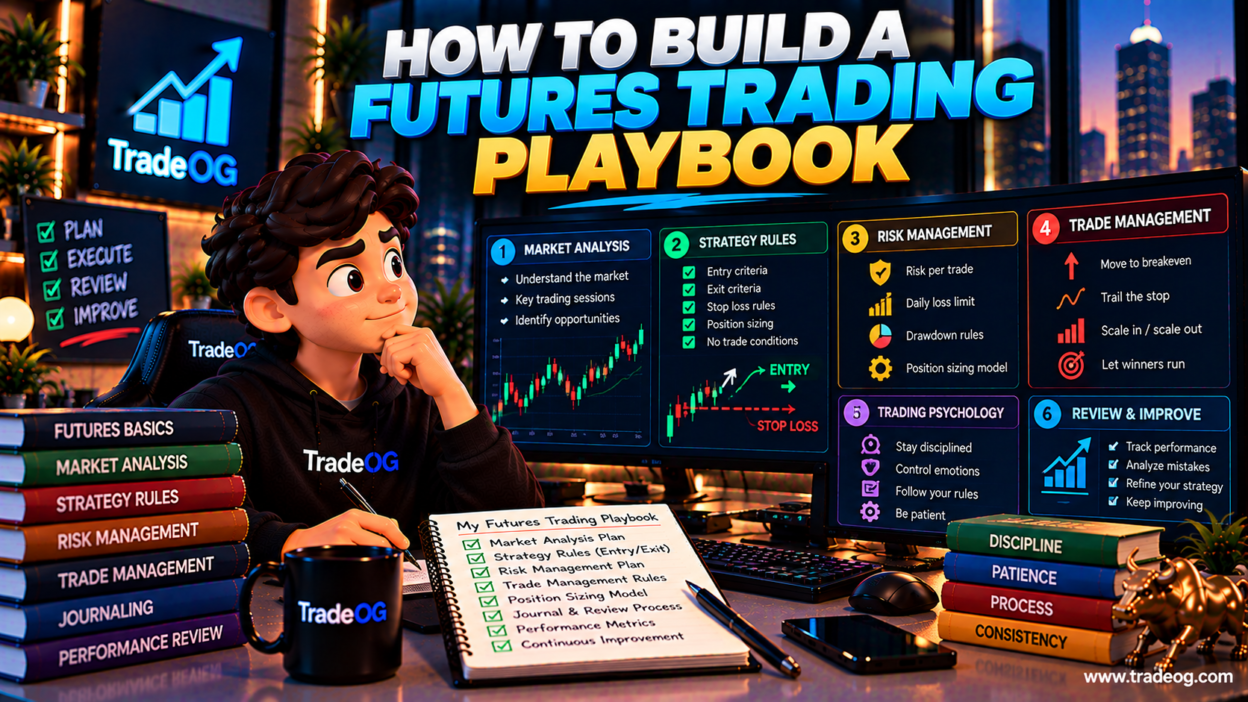
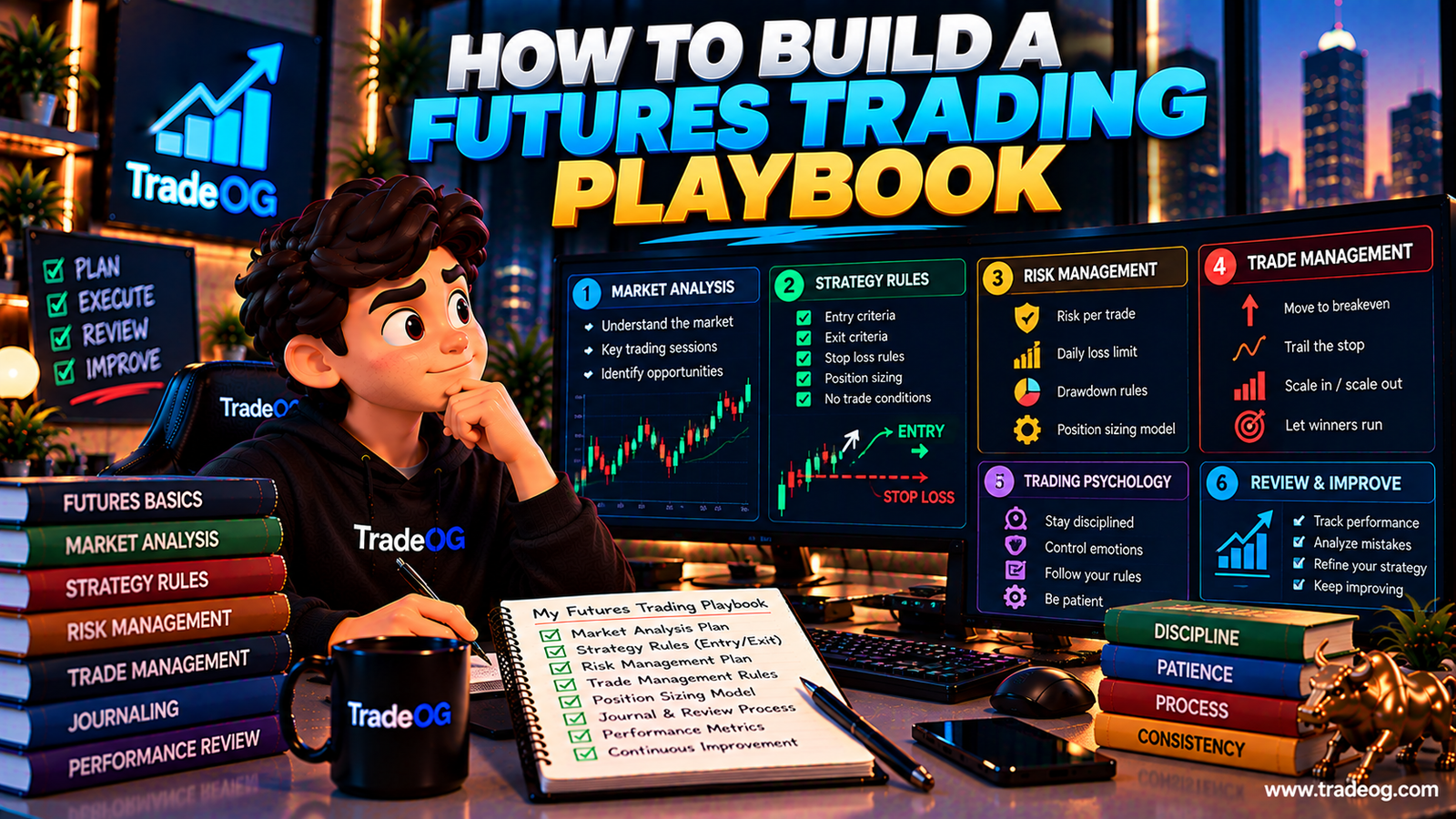
A futures trading playbook is more than a list of indicators or a collection of chart patterns. It is a practical operating manual for how you trade. A well-built playbook tells you what markets you trade, when you trade them, what conditions qualify as a setup, where an entry is allowed, where the trade becomes invalid, how much risk you can take, how open positions are managed, and what you do when the market does not match your plan.
This structure becomes especially useful in futures trading because leverage, contract specifications, volatility, margin, execution and daily risk limits can make small changes in position size or stop distance produce large changes in dollar risk. CME Group describes a trade plan as a working document covering objectives, methodology, risk management, trading strategies and a trader log. CME Group — Building a Trade Plan
A playbook turns that broad plan into something you can use before, during and after each trading session.
What Is a Futures Trading Playbook?
A futures trading playbook is a structured collection of repeatable trading rules and decision frameworks. It can contain several setups, but each setup should have its own conditions and management rules.
For example, a futures trader might have separate playbook sections for:
- Opening Range Breakout.
- Trend pullback.
- VWAP continuation.
- Previous-day high or low rejection.
- Liquidity sweep and reversal.
- Range breakout and retest.
- News-session no-trade conditions.
The important point is that the playbook should define when a setup qualifies and when it does not. It should reduce improvisation rather than create more reasons to trade.
Trading Plan vs Trading Playbook
The two concepts overlap, but they are not exactly the same.
| Trading Plan | Trading Playbook |
|---|---|
| Defines overall objectives | Defines repeatable setups and execution rules |
| Defines broad risk framework | Defines risk for each setup |
| Defines markets and schedule | Defines conditions for taking specific trades |
| May cover the entire trading business | Works like an operational manual |
| Often reviewed periodically | Used before and during individual sessions |
CME’s trade-plan framework includes objectives, methodology, risk management, strategies and a trader log. Your playbook can be viewed as the more operational layer that turns those concepts into specific trading decisions. CME Group — Building a Trade Plan
Why Build a Futures Trading Playbook?
The main purpose is consistency.
Without a playbook, traders can make different decisions in similar situations. A breakout may look attractive on Monday but be ignored on Tuesday. A stop may be respected after one loss and moved after another. Position size may increase after a winning trade and decrease after a losing trade.
A playbook gives those situations predefined rules.
It can help you:
- Separate valid setups from random market movement.
- Define risk before entering.
- Reduce impulsive entries.
- Make trade review easier.
- Compare setup performance objectively.
- Identify which market conditions suit your strategy.
- Build a repeatable process for prop-firm or personal futures trading.
CME emphasizes defining risk parameters, including maximum trade loss and maximum day loss, as part of a trading plan. CME Group — Risk Management and Your Trade Plan
Step 1: Choose the Futures Markets You Actually Trade
Do not start a playbook with twenty instruments simply because your platform provides them.
Start with the markets you understand well enough to define their behavior and risk characteristics.
For example, a futures playbook might focus on:
- ES: E-mini S&P 500 futures.
- MES: Micro E-mini S&P 500 futures.
- NQ: E-mini Nasdaq-100 futures.
- MNQ: Micro E-mini Nasdaq-100 futures.
- CL: Crude oil futures.
- GC: Gold futures.
Each contract has different volatility and tick economics. CME’s position-management guidance notes that contract selection is itself a risk-management decision because different futures markets can have different volatility and tick values. CME Group — Position and Risk Management
Your playbook should therefore state the exact instrument or instrument group for which each setup has been tested.
Step 2: Define Your Trading Session
A setup does not necessarily behave the same way throughout the trading day.
Your playbook should specify when you are allowed to trade.
Possible session definitions include:
- U.S. equity-index opening session.
- European session.
- New York afternoon.
- Specific overlap periods.
- Predefined windows around scheduled economic events.
Instead of writing “trade when volatility is good,” define measurable conditions. For example: “Trade this setup only between 9:30 and 11:30 New York time.”
Also define when you do not trade. A no-trade rule is part of the playbook, not an empty space in it.
Step 3: Define the Market Context
Before defining an entry, define the environment in which the setup is allowed.
A simple context framework could classify the market as:
- Trending higher.
- Trending lower.
- Range-bound.
- Expanding from a range.
- Highly volatile.
- Low-volatility or compressed.
- Event-driven.
You can also record higher-timeframe structure, overnight high and low, previous-day levels, VWAP, major support and resistance, opening range and scheduled economic events.
The goal is not to put every possible indicator on the screen. The goal is to answer one question: What market conditions does this setup require?
Step 4: Create a Setup Card for Every Strategy
Each setup in your playbook should have its own one-page rule card.
A useful setup card contains:
- Setup name.
- Market.
- Timeframe.
- Trading session.
- Required market context.
- Entry conditions.
- Confirmation conditions.
- Invalidation conditions.
- Stop methodology.
- Target methodology.
- Position-sizing rule.
- Trade-management rules.
- No-trade conditions.
- Example screenshots.
- Historical performance metrics.
This makes the setup testable. CME recommends writing exact entry and exit criteria rather than leaving decisions to emotional responses during a trade. CME Group — Trading Strategies in Your Trade Plan
Step 5: Write Objective Entry Rules
“Buy when the chart looks bullish” is not a playbook rule.
“Buy after price closes above the opening range high, provided the higher-timeframe bias is bullish and the entry occurs during the defined session” is much closer to an objective rule.
Your entry rules should answer:
- What must happen first?
- What confirms the setup?
- Where is the entry allowed?
- What price action invalidates the setup?
- What conditions prevent entry?
If another trader cannot understand the rule without asking you what you meant, the rule probably needs more definition.
Step 6: Define Invalidation Before the Entry
A strong playbook defines not only why a trade should work, but also what proves the original idea wrong.
For a long setup, invalidation could be a break below a specific structural level. For a breakout strategy, it could be a return inside the range under predefined conditions. For a pullback setup, it could be a violation of the swing structure that justified the trade.
The stop should therefore be connected to the trade thesis rather than selected simply because a particular dollar amount feels comfortable.
CME’s position-sizing guidance similarly emphasizes determining the stop level and the amount of account risk first, then using those inputs to determine position size. CME Group — Proper Position Size
Step 7: Build the Risk Management Section
Your playbook needs a risk section that applies across every setup.
Define:
- Maximum risk per trade.
- Maximum daily loss.
- Maximum number of simultaneous positions.
- Maximum contracts.
- Maximum number of trades.
- Maximum consecutive losses before a review.
- Conditions for stopping the session.
- Rules for reducing size.
- Rules for returning to normal size.
For example, you might define a personal rule that after two consecutive losses you stop trading the setup for the session and review the charts. That is a process rule, not a claim that two losses have statistical meaning for every strategy.
The exact risk limits should come from your tested strategy, account structure and applicable rules rather than from a universal percentage.
Step 8: Create a Position-Sizing Formula
Position size should be calculated rather than guessed.
A basic framework is:
Contracts = Maximum Dollar Risk ÷ Dollar Risk Per Contract
And:
Dollar Risk Per Contract = Stop Distance × Dollar Value Per Point
For example, suppose a hypothetical setup allows $300 of risk and the stop represents $150 of risk per contract. The theoretical size would be:
$300 ÷ $150 = 2 contracts
Actual trading may require rounding down to the nearest permitted whole contract and considering slippage, commissions and account-specific rules.
CME notes that correct position size depends on the stop location and the dollar or percentage amount you are willing to risk. CME Group — Proper Position Size
Step 9: Add Trade Management Rules
Many playbooks are detailed about entry but vague about what happens after the order fills.
That creates problems because the most emotional decisions often happen while a position is open.
Your playbook should define:
- Initial stop.
- Initial target.
- Whether the stop can move.
- When a stop may move to breakeven.
- Whether scaling out is permitted.
- Whether scaling in is permitted.
- Whether trailing stops are permitted.
- What happens after partial profit.
- What happens when price stalls.
- When the position must be closed.
CME’s trading-strategy guidance specifically recommends defining how open trades will be managed and identifying both stop-loss and profit-target logic before the trade. CME Group — Trading Strategies in Your Trade Plan
Step 10: Define Your No-Trade Conditions
A professional playbook should contain a prominent “Do Not Trade” section.
Examples can include:
- Outside the permitted session.
- Daily loss limit reached.
- Maximum number of trades reached.
- Maximum position size would be exceeded.
- Required setup confirmation is missing.
- Market is outside the tested volatility range.
- Major scheduled event falls inside a prohibited trading window.
- Platform or data-feed problem.
- Trader is deviating from the written process.
For prop-firm traders, firm-specific restrictions must also be checked. Current Topstep guidance, for example, states that its program is day-trading focused, requires positions to be closed by 3:10 PM CT on weekdays, and resumes trading at 5:00 PM CT. Those rules are specific to Topstep and can change, so they should not be copied into a general playbook as universal futures rules. Topstep — When and What Products Can I Trade?
Step 11: Add a Daily Pre-Market Checklist
Your playbook should include a short checklist that you can complete before the session.
For example:
- ☐ Check today’s economic calendar.
- ☐ Mark previous-day high and low.
- ☐ Mark important higher-timeframe levels.
- ☐ Check overnight range.
- ☐ Identify planned trading session.
- ☐ Confirm permitted instruments.
- ☐ Confirm maximum risk for the day.
- ☐ Confirm maximum position size.
- ☐ Review the setups you are allowed to trade.
- ☐ Define conditions that would keep you out.
The checklist should be short enough to use every day. If it takes 45 minutes to complete, it is less likely to become a consistent habit.
Step 12: Build a Trade Execution Checklist
Before clicking Buy or Sell, ask the same questions every time.
| Question | Purpose |
|---|---|
| Which setup is this? | Prevents random entries. |
| Is the market context valid? | Confirms the setup belongs in the current environment. |
| Is the entry trigger complete? | Prevents early entries. |
| Where is invalidation? | Defines the stop. |
| How much can I lose? | Confirms risk. |
| How many contracts are allowed? | Controls position size. |
| What is the planned exit? | Prevents improvisation. |
| Is there a reason not to trade? | Checks the no-trade rules. |
If one critical answer is missing, the trade does not qualify yet.
Step 13: Create a Trade Journal Inside the Playbook
The playbook should connect directly to your trading journal.
For every trade, record:
- Date and time.
- Instrument.
- Setup name.
- Market context.
- Entry.
- Stop.
- Target.
- Contract size.
- Planned risk.
- Actual result.
- R-multiple.
- Slippage.
- Commission and costs.
- Screenshot before entry.
- Screenshot after exit.
- Rule adherence.
- Emotional state.
- Lesson from the trade.
CME’s trade-plan resources include a trader log because documenting trades creates a record that can be reviewed rather than relying on memory. CME Group — Building a Trade Plan
Step 14: Separate Strategy Results From Execution Results
This is one of the most useful improvements you can make.
Suppose your setup produced a valid signal, but you entered three points late because you hesitated. The resulting loss should not automatically be classified as a strategy failure.
Tag trades separately:
- Valid setup + correct execution.
- Valid setup + execution error.
- Invalid setup + trade taken.
- Valid setup + missed trade.
This allows you to distinguish a weak strategy from weak execution.
Step 15: Backtest Every Playbook Setup
Before adding a setup to your live routine, test it historically.
Measure:
- Number of trades.
- Win rate.
- Average win.
- Average loss.
- Expectancy.
- Profit factor.
- Maximum drawdown.
- Maximum consecutive losses.
- Average trade duration.
- Performance by session.
- Performance by market regime.
- Performance after costs.
Do not judge a setup solely by win rate. A setup can have a lower win rate and still have positive expectancy if its average winners are sufficiently larger than its average losses. Conversely, a high win rate does not automatically make a strategy suitable for a particular drawdown constraint.
Step 16: Forward-Test the Playbook
After historical testing, use a simulator or paper environment to test the finalized rules on new market data.
Track whether:
- Signals occur as expected.
- Entries can actually be executed.
- Slippage assumptions are realistic.
- Trade frequency matches expectations.
- Market context filters work in real time.
- You can follow the rules without improvising.
- The drawdown profile remains within the expected range.
Do not rewrite the setup after every loss. If the rules change materially, treat the revised version as a new playbook setup and validate it again.
Step 17: Build a Performance Dashboard
Your playbook becomes much more useful when it has measurable performance data.
A simple dashboard can contain:
| Metric | Why Track It? |
|---|---|
| Total trades | Measures sample size. |
| Win rate | Shows percentage of profitable trades. |
| Average R | Shows typical trade outcome relative to risk. |
| Expectancy | Estimates average outcome per trade. |
| Profit factor | Compares gross profits with gross losses. |
| Maximum drawdown | Shows historical downside pressure. |
| Consecutive losses | Helps evaluate losing-streak exposure. |
| Rule adherence | Separates process quality from market results. |
| Slippage | Measures execution assumptions. |
| Performance by setup | Identifies which playbook entries deserve further review. |
Step 18: Create a “Do Not Change” Section
One of the biggest risks in strategy development is changing a system because of a short losing streak.
Your playbook should clearly identify rules that cannot be changed during a live testing period.
For example:
- Do not widen the stop to avoid a planned loss.
- Do not increase size to recover a loss.
- Do not add a new indicator because of one bad trade.
- Do not remove a setup after two losses.
- Do not add a setup because of one large winner.
- Do not change the session without recording the change.
If you want to improve the system, make the change deliberately, document it and begin a new validation cycle.
Step 19: Build a Prop-Firm Version of the Playbook
If you trade through a prop firm, create a separate section specifically for the account’s rules.
Include:
- Account model.
- Starting balance or account size.
- Maximum loss rule.
- Daily loss rule, if applicable.
- Maximum contract size.
- Permitted instruments.
- Trading hours.
- News restrictions.
- Consistency requirements, if applicable.
- Payout-related restrictions, if applicable.
- Personal risk limits below the firm’s hard limits.
For example, current Topstep guidance says its Maximum Loss Limit is calculated using real-time unrealized P&L and recommends leaving a buffer above the limit during volatile markets. Topstep — Maximum Loss Limit
That illustrates why a playbook should distinguish between a firm’s hard boundary and your own internal trading boundary. You should not need to trade right up against the firm’s maximum permitted loss.
Step 20: Add Psychology Rules
Psychology should not be treated as a motivational paragraph at the end of the document. It should be converted into operational rules.
Examples:
- If I miss a setup, I do not chase the move.
- If I hit my personal daily loss limit, I stop.
- If I take an unplanned trade, I record it immediately.
- If I feel pressure to recover a loss, I pause before the next trade.
- If I break a rule twice in one session, I end the session.
- If I become emotionally distracted, I stop trading.
These are personal process rules, not universal trading laws. Their value comes from making your own behavior measurable.
What a One-Page Futures Playbook Could Look Like
A compact daily version might look like this:
| Section | Example Content |
|---|---|
| Markets | MES, MNQ |
| Session | Defined U.S. morning window |
| Primary setups | ORB breakout, trend pullback |
| Context | Trend, range, key levels, volatility |
| Entry | Specific confirmation criteria |
| Stop | Structure-based invalidation |
| Target | Predefined exit model |
| Risk | Predefined dollar/R risk |
| Daily stop | Personal limit |
| No trade | Missing confirmation, outside session, risk limit reached |
| Journal | Screenshot, result, R, execution quality |
How to Review Your Playbook Weekly
Do not rewrite your playbook every evening. A weekly review is usually more useful because it gives enough observations to identify patterns.
Review:
- Which setups were traded?
- Which setups were profitable?
- Which setups produced the largest drawdowns?
- Which losses followed valid rules?
- Which losses came from rule violations?
- How often were entries late?
- How often were stops moved?
- How often were trades taken outside the plan?
- Did trade frequency increase after losses?
- Did position size change unexpectedly?
Then separate two categories:
Strategy problem: the rules were followed but the historical and forward results suggest the setup needs investigation.
Execution problem: the rules were not followed, so the trade does not provide clean evidence about the strategy itself.
When Should You Remove a Setup?
Do not remove a setup simply because it loses money for a few trades.
Instead, establish review criteria before you begin testing. For example, you might require a minimum sample, compare performance with historical expectations, and investigate whether market conditions changed.
Potential reasons for a formal review include:
- Persistent deterioration across a meaningful sample.
- Execution assumptions no longer match reality.
- The market structure has materially changed.
- Costs have changed enough to alter expectancy.
- The setup repeatedly violates the risk framework.
- Forward-test behavior differs materially from validated historical behavior.
Any change should be documented rather than quietly replacing the old version.
Common Futures Trading Playbook Mistakes
Making the playbook too complicated
Adding ten indicators and twenty conditions can create the appearance of precision without improving decision quality.
Using vague language
Words such as “strong,” “weak,” “good momentum” and “clean breakout” need operational definitions if they are part of an executable rule.
Ignoring no-trade conditions
A setup is defined by both the situations where you trade and the situations where you stay out.
Changing risk by emotion
Position size should follow the risk model, not the trader’s confidence after a winning or losing trade.
Tracking only profit
Profit can hide deteriorating execution, increasing risk, larger drawdowns or declining rule adherence.
Copying another trader’s playbook
A playbook should be based on the instruments, schedule, risk tolerance, tested setups and operational constraints that actually apply to you.
Futures Trading Playbook Template
You can use this structure as a starting template:
- Trading objective
- Markets traded
- Trading sessions
- Timeframes
- Market-context rules
- Setup #1
- Setup #2
- Setup #3
- Entry criteria
- Invalidation criteria
- Stop methodology
- Target methodology
- Position-sizing formula
- Maximum risk per trade
- Maximum daily loss
- Maximum number of trades
- No-trade conditions
- Trade-management rules
- Psychology rules
- Journal fields
- Weekly review process
- Performance dashboard
- Version history
Final Thoughts
Building a futures trading playbook is really the process of converting your trading ideas into repeatable decisions.
The strongest playbooks are not necessarily the longest. They are specific enough to tell you what to do, simple enough to use during a live session, measurable enough to test, and flexible enough to be reviewed without being changed impulsively.
Start with one or two setups. Define the market, session, context, entry, invalidation, stop, target, position size and no-trade conditions. Backtest them. Forward-test them. Journal every valid signal. Separate strategy performance from execution mistakes. Then improve the playbook using evidence rather than emotion.
CME’s educational material similarly emphasizes objectives, risk management, defined strategies, position sizing and trade logging as core parts of a trading plan. CME Group — Building a Trade Plan
For futures traders, the goal of a playbook is not to predict every market move. It is to create a repeatable decision process that tells you when you have a valid trade, how much you can risk, how you will manage it, and when doing nothing is the correct action.
Frequently Asked Questions
What should a futures trading playbook contain?
It should contain the markets and sessions you trade, market-context rules, setup definitions, entry and exit criteria, stop methodology, position sizing, risk limits, no-trade conditions, trade-management rules, psychology rules and a review process.
How many strategies should be in a futures playbook?
There is no universal number. Starting with a small number of clearly defined and tested setups can make the playbook easier to execute and evaluate. Additional setups can be added after they are independently tested.
Should a futures playbook include risk management?
Yes. Risk management should be one of the central sections. It should define the maximum risk per trade, daily limits, position-size rules, drawdown controls and conditions for stopping the session.
Should I create a separate playbook for prop-firm trading?
A separate prop-firm section is useful because each program can have its own loss limits, contract limits, trading hours and other restrictions. Keep the firm’s current rules separate from your personal risk limits.
Can I use the same playbook for ES and NQ?
You can use the same broad framework, but each setup should be validated for the specific contract. ES and NQ have different price behavior, volatility and contract economics, so identical position sizing and assumptions should not be taken for granted.
How often should I update my futures playbook?
Review it regularly, but avoid changing rules after individual trades. A scheduled weekly or monthly review can help you identify patterns while preserving a clean testing period.
Is a trading playbook the same as a trading strategy?
No. A strategy is a method for entering, managing and exiting trades. A playbook can contain multiple strategies plus the market-selection, risk, execution, psychology and review rules surrounding them.
Can a playbook prevent trading losses?
No. A playbook cannot eliminate market risk. Its purpose is to make decisions more consistent, define risk before entry and provide a framework for evaluating what happened.