

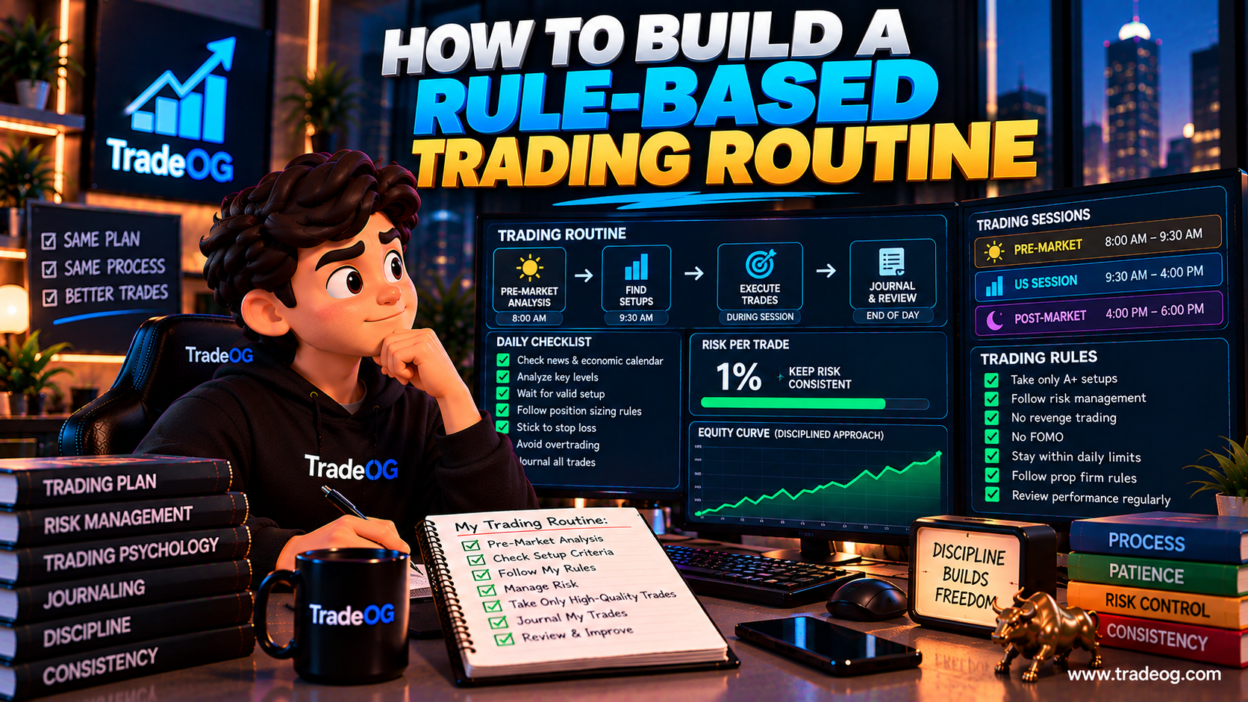
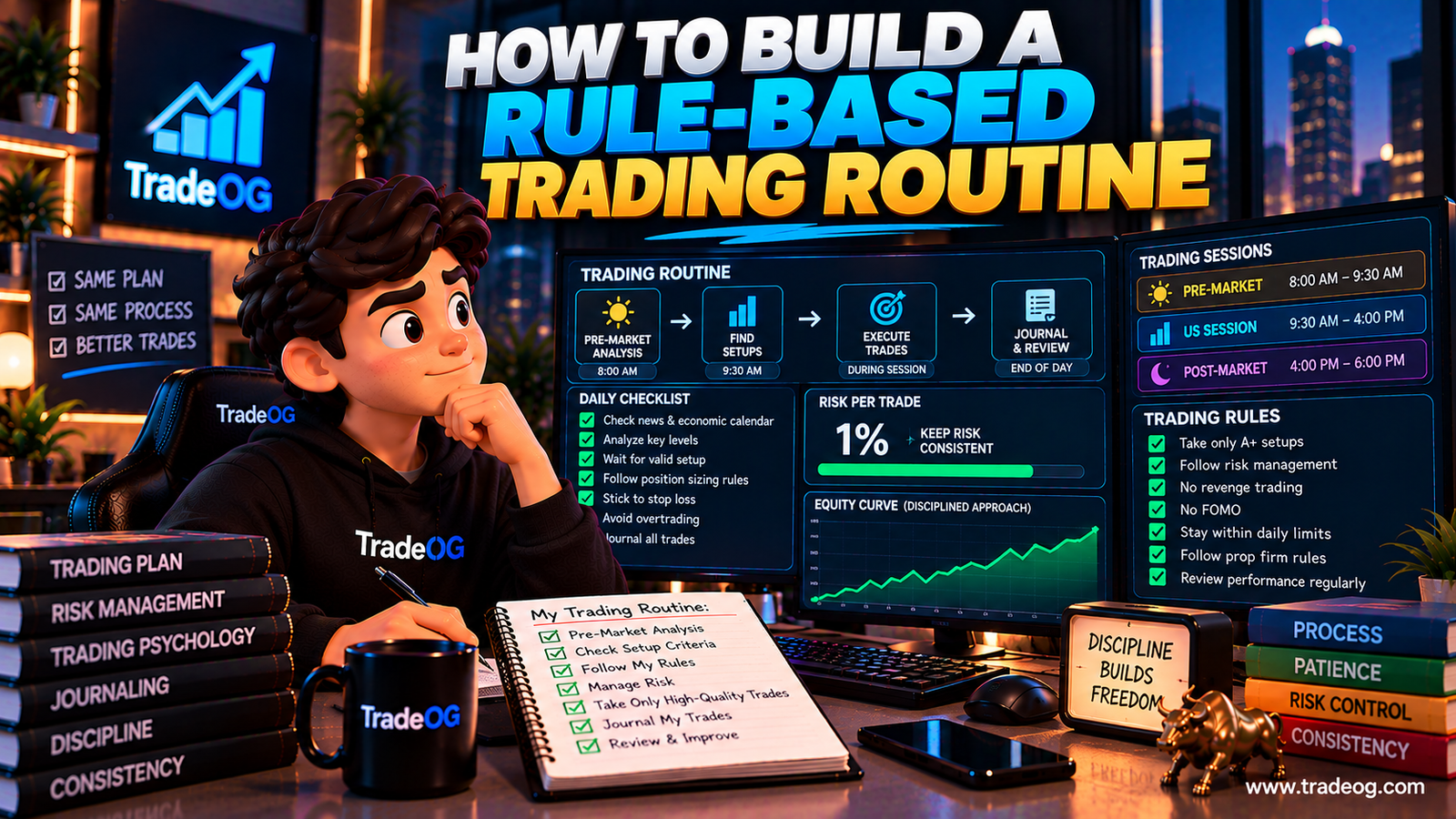
Trading becomes difficult when every decision has to be invented in real time.
Which market should I trade? Should I enter now? How much should I risk? Should I move the stop? Should I take another setup? Should I keep trading after a loss? Should I increase size after a win?
If you answer all of those questions while watching a fast-moving market, emotions can easily become part of the decision-making process.
A rule-based trading routine solves part of that problem by moving important decisions from the heat of the market into a structured process that can be prepared, tested and reviewed.
CME Group describes a trading plan as a working business plan for trading and identifies five core components: objectives, methodology, risk management, trading strategies and a trader log. CME also emphasizes defining risk before trading and using position size and stops that fit the trader’s risk parameters. CME Group — Building a Trade Plan and CME Group — Position and Risk Management.
FTMO Academy similarly structures a trading plan around goals, markets, methodology, entry and exit criteria, position sizing, money management, routine, journaling and performance review. FTMO Academy — Developing a Trading Plan.
This guide shows how to turn those principles into a practical daily and weekly routine for futures and prop firm traders.
What Is a Rule-Based Trading Routine?
A rule-based trading routine is a repeatable sequence of actions that defines what you do:
- before the market;
- when a setup appears;
- before entering a trade;
- while a position is open;
- after a trade closes;
- at the end of the session;
- during weekly performance reviews.
The objective is not to make trading completely mechanical.
The objective is to make the important decisions consistent, observable and reviewable.
For example, instead of:
“I will trade when the market looks good.”
a rule-based routine might say:
“I trade only my predefined setup during my selected session, after the required confirmation, with position size calculated from the predefined risk limit.”
That statement can be tested. “The market looks good” cannot.
Why a Routine Matters for Prop Traders
Prop firm trading adds constraints that make consistency especially important.
Depending on the firm and account model, traders may have profit targets, maximum-loss rules, daily loss limits, position limits, consistency requirements, news restrictions or other conditions.
For example, Topstep’s current Responsible Trading guidance tells traders to define risk before trading, start each day with a plan, avoid FOMO and revenge trading, and step away when emotions are high. Topstep — What Is Responsible Trading?
The exact rules vary, but the psychological principle is broadly useful:
The account rules should be translated into daily behaviours.
Instead of merely knowing that a maximum loss exists, your routine should tell you what risk you will take long before the account reaches that boundary.
Rule 1: Define the Purpose of Your Trading Session
Before opening your charts, know what the session is supposed to accomplish.
A good objective is process-based:
- trade only predefined setups;
- respect the risk limit;
- avoid unplanned instruments;
- journal every executed trade;
- stop when the personal session rule is reached.
A poor objective is:
“Make $500 today no matter what.”
A monetary target can be part of a broader plan, but it should not become a reason to force trades when the market does not provide valid opportunities.
Rule 2: Choose Your Markets Before the Session
Do not decide what to trade after the first large candle appears.
Create a defined market list.
For a futures trader, that could include:
- ES or MES;
- NQ or MNQ;
- YM or MYM;
- RTY or M2K;
- another specific contract that has been tested.
The exact instruments should depend on your strategy, account rules and risk model.
CME notes that different futures contracts have different volatility and tick-value characteristics, meaning market selection itself is part of risk management. CME Group — Position and Risk Management.
A limited watchlist also reduces decision fatigue.
Rule 3: Define Your Trading Session
Specify when you are allowed to trade.
For example:
| Session Rule | Example |
|---|---|
| Preparation | 30–60 minutes before trading |
| Primary session | Predefined market window |
| Late-session rule | No new trades after a defined cutoff |
| Review | Immediately after trading ends |
The times should be based on your strategy rather than copied from another trader.
If your backtest shows that your setup performs only during a particular window, trading outside that window introduces a variable that was not part of the original system.
Rule 4: Create a Pre-Market Checklist
Your pre-market checklist should be short enough to use every day.
A practical version can include:
- Check the current account balance/equity.
- Check remaining drawdown.
- Check applicable prop-firm rules.
- Review scheduled economic events.
- Mark major technical levels.
- Identify market structure or directional context.
- Define permitted setups.
- Define maximum risk for the session.
- Confirm maximum position size.
- Write down conditions that would make you stop.
Topstep’s current responsible-trading guidance specifically recommends starting the day with a plan and defining risk before clicking into trades. Topstep — Responsible Trading.
Rule 5: Define Your Setup in Observable Terms
A trading setup should be described using conditions that another person could understand.
For example, instead of:
“Buy when momentum looks strong.”
define:
- market must be above a specified reference level;
- price must form the required pattern;
- confirmation candle must close according to the strategy;
- entry must occur inside the predefined zone;
- stop must be placed at the invalidation level;
- risk must remain below the predefined maximum.
The more observable the rule, the easier it is to journal and backtest.
Rule 6: Separate Market Analysis From Trade Execution
This is one of the most useful routine improvements.
First analyze.
Then wait.
Then execute.
Do not continuously rewrite the plan while simultaneously trading.
A simple structure is:
- Context: What is the market doing?
- Levels: Where are the important areas?
- Scenarios: What would make you bullish, bearish or neutral?
- Setup: Which predefined pattern are you waiting for?
- Execution: What exactly triggers entry?
- Risk: Where is the stop and how large is the position?
Rule 7: Calculate Risk Before You Calculate Profit
Before entering, determine the maximum acceptable loss.
CME’s position-sizing guidance starts with two important inputs: where the stop will be placed and the dollar or percentage amount the trader is willing to risk. CME Group — Proper Position Size.
A basic futures formula is:
Risk per contract = Stop distance × Dollar value per point
Then:
Maximum contracts = Maximum planned dollar risk ÷ Risk per contract
Always apply the applicable contract and prop-firm limits after calculating the risk-based size.
Rule 8: Predefine the Stop Before Entry
The stop should not be invented after the trade begins moving against you.
Define the invalidation level before entering.
A good routine asks:
- Where is the setup invalidated?
- How far is that level from entry?
- What is the dollar risk?
- Does the resulting size fit my risk limit?
CME states that stops should be placed at logical levels that indicate when the trader’s directional thesis is wrong rather than at random locations. CME Group — Proper Position Size.
Rule 9: Use a Position-Size Formula
Do not decide contract quantity based on how confident you feel.
A rule-based routine might use:
Position size = maximum dollar risk ÷ (stop distance × point value)
For example, if a hypothetical trade allows $200 of risk and the calculated risk per contract is $80:
$200 ÷ $80 = 2.5 contracts
Because futures contracts are discrete, the trader cannot simply trade 2.5 contracts. The actual size must be rounded down to a permitted whole-contract quantity that stays within the risk budget.
The exact risk amount should come from the trader’s plan, not from a universal percentage.
Rule 10: Define a Maximum Daily Loss Before Trading
Your personal daily loss limit should generally be below the account’s outer loss boundary.
CME’s risk-management education recommends defining maximum trade loss and maximum day loss as part of a trading plan. CME Group — Risk Management and Your Trade Plan.
Some prop programs also provide formal daily loss mechanisms. For example, Topstep’s current Daily Loss Limit can flatten positions and prevent new trades for the remainder of the session when triggered on applicable accounts. Topstep — Daily Loss Limit.
Do not confuse a firm’s maximum permitted loss with the amount you should plan to lose.
Rule 11: Define a Maximum Number of Trades
A trade-count limit is not mandatory for every strategy, but it can be useful for traders who tend to overtrade.
For example:
- maximum 3 trades per session;
- maximum 2 consecutive losses;
- after the limit, stop and review.
The exact limits should be based on your data.
A trade-count rule should not force you to take trades merely because you have trades remaining.
Rule 12: Build a No-Trade Rule
A professional routine needs rules for not trading.
Examples:
- no valid setup;
- market condition outside the tested strategy;
- personal daily loss limit reached;
- maximum consecutive-loss threshold reached;
- emotional state is interfering with execution;
- platform or data problems;
- trade would violate the current account rules.
“No trade” should be a valid outcome of the system.
Rule 13: Create a News and Event Check
Economic events can change volatility and execution conditions.
Your routine should specify whether major scheduled events are:
- tradable;
- tradable only after a waiting period;
- not tradable;
- dependent on the specific prop firm’s rules.
Never assume that another trader’s news policy applies to your account.
For example, prop firms can publish account-specific restrictions around economic releases. Always check the current official rules before trading a news event.
Rule 14: Use Scenario Planning
Instead of predicting exactly what the market will do, create a small number of scenarios.
Scenario A — Bullish
If price reaches the predefined level and confirmation appears, execute the long setup.
Scenario B — Bearish
If the opposite condition appears, execute the short setup.
Scenario C — No setup
If neither condition occurs, remain flat.
This prevents the brain from searching for a trade simply because the market is moving.
Rule 15: Define the Entry Trigger Precisely
Write down the exact event that turns an observation into a trade.
Examples can include:
- candle close beyond a level;
- break-and-retest confirmation;
- specific moving-average relationship;
- volume condition;
- market-structure break;
- predefined pullback zone.
The actual rule depends on the strategy.
The important point is that “I felt momentum” should not be the only entry criterion.
Rule 16: Define the Exit Before You Enter
A routine should answer:
- where the trade is invalidated;
- where profits may be taken;
- whether partial exits are allowed;
- whether trailing is allowed;
- what happens if the setup stalls;
- what happens near the session close.
FTMO Academy’s trading-plan guidance similarly treats entry criteria, exit criteria, stop-loss levels, profit targets and position sizing as components of a complete methodology. FTMO Academy — Developing a Trading Plan.
Rule 17: Do Not Move the Stop Without a Rule
Moving a stop can be part of a legitimate strategy if it is predefined.
Moving it because you do not want to take the loss is a different behaviour.
Write down exactly when a stop may change.
For example:
- after price reaches +1R;
- after a specific structure forms;
- only when the trailing condition activates.
If there is no rule, the default should be to leave the original risk structure intact.
Rule 18: Define What Happens After a Win
Winning trades can create overconfidence.
Your routine should therefore specify what happens after a winner.
For example:
- return to the normal position-size calculation;
- do not increase size simply because the last trade won;
- wait for the next valid setup;
- do not take an immediate “bonus trade.”
The previous result should not automatically determine the next trade’s risk.
Rule 19: Define What Happens After a Loss
Losses can create revenge trading.
A rule-based response might be:
- record the loss;
- check whether the process was followed;
- wait for the next valid setup;
- keep normal size;
- stop if the predefined loss rule is reached.
Topstep’s current responsible-trading guidance specifically warns against FOMO and revenge trading and recommends stepping away when emotions are high. Topstep — Responsible Trading.
Rule 20: Create a “Missed Trade” Rule
Every trader misses setups.
Your routine should define what happens next.
A practical rule:
If the planned entry is missed, do not chase the move unless the strategy has a predefined re-entry condition.
This single rule can prevent many FOMO trades.
Rule 21: Create a Post-Trade Checklist
Immediately after closing a trade, record:
- instrument;
- setup type;
- entry;
- stop;
- target;
- position size;
- planned risk;
- actual result;
- R-multiple;
- market condition;
- rule adherence;
- emotional state;
- screenshot.
Do not write an essay after every trade.
A structured five-minute entry is usually more sustainable than a detailed journal that you abandon after a week.
Rule 22: Use a Simple Trade Classification
Classify each trade as:
| Label | Meaning |
|---|---|
| A — Valid | All rules followed |
| B — Minor deviation | Small process error |
| C — Major deviation | Entry/risk/exit rule violated |
| FOMO | Chased the move |
| Revenge | Entered to recover a previous loss |
| No trade | Setup did not qualify |
Over time, you can compare P&L by classification.
Rule 23: Review the Routine Daily
At the end of the session, ask:
- Did I follow my setup rules?
- Did I follow my risk rules?
- Did I trade only during the planned session?
- Did I take any FOMO trades?
- Did I revenge trade?
- Did I increase size without a rule?
- Did I stop when I was supposed to?
- What was the most important deviation?
Then choose one improvement for the next session.
Do not try to fix ten things simultaneously.
Rule 24: Build a Weekly Review
The daily review is for execution.
The weekly review is for the system.
Track:
- number of trades;
- win rate;
- average win;
- average loss;
- expectancy;
- average R;
- maximum consecutive losses;
- maximum drawdown;
- rule-violation rate;
- performance by setup;
- performance by instrument;
- performance by session.
This separation prevents you from changing the strategy because of one emotional trading day.
Rule 25: Separate Strategy Review From Psychology Review
When results are poor, ask two different questions.
Strategy question: Did the tested setup perform differently from its historical characteristics?
Execution question: Did I actually execute the strategy correctly?
These are not the same.
A strategy can lose while being executed perfectly.
A strategy can also make money while being executed badly.
Your routine should track both.
Rule 26: Use a Daily Risk Dashboard
Before the session, display the numbers that matter.
| Metric | Example |
|---|---|
| Account equity | $50,000 |
| Remaining drawdown | $2,000 |
| Planned risk/trade | $150 |
| Personal daily loss limit | $450 |
| Maximum contracts | Risk-calculated |
| Maximum trades | 3 |
These are illustrative numbers, not universal recommendations.
The benefit is that risk becomes visible before the first trade.
Rule 27: Use Alerts Instead of Constant Chart Watching
If your platform supports price alerts, use them for important levels.
Instead of watching every candle and feeling pressure to participate, let the market come to your predefined area.
This can reduce:
- impulsive entries;
- boredom trades;
- constant chart manipulation;
- FOMO after small price movements.
The exact tools vary by platform.
Rule 28: Reduce Decision Fatigue
Decision fatigue occurs when the trader makes too many small decisions throughout the session.
A rule-based routine reduces the number of decisions by deciding in advance:
- what to trade;
- when to trade;
- what setup qualifies;
- how much to risk;
- where the trade is invalidated;
- when to stop.
The remaining decision becomes simpler:
Does this trade meet the rules?
Rule 29: Keep Your Trading Environment Consistent
Your routine should also cover the environment.
Before trading, check:
- internet connection;
- platform connection;
- data feed;
- chart templates;
- order-entry settings;
- economic calendar;
- correct trading account.
Execution mistakes are sometimes operational rather than analytical.
Rule 30: Create an Emergency Procedure
Every trader should know what to do if something unexpected happens.
For example:
- platform freezes;
- order does not fill as expected;
- connection drops;
- data becomes unreliable;
- an unexpected market event occurs.
Write down the appropriate operational response and the relevant broker or prop-firm support procedure.
Do not invent a response while a position is moving rapidly.
Rule 31: Make Your Routine Short Enough to Survive
A routine with 50 mandatory steps may look impressive but become unusable.
The best routine is one you can follow on a normal trading day.
A compact routine could be:
- Check rules and risk.
- Check news/events.
- Mark key levels.
- Define scenarios.
- Wait for setup.
- Calculate position size.
- Execute.
- Manage according to rules.
- Journal.
- Review.
That is enough to create structure without turning preparation into another form of procrastination.
Rule 32: Build a Pre-Market, Live-Market and Post-Market Routine
| Phase | Actions |
|---|---|
| Pre-market | Rules, risk, news, levels, scenarios |
| Live market | Wait, qualify, size, execute, manage |
| Post-market | Journal, screenshots, classify, review |
| Weekly | Statistics, strategy review, process improvement |
This creates a complete loop rather than treating trading as only the moment of entry.
Rule 33: Build Rules Around Behaviour, Not Just Indicators
A trading plan should contain behavioural rules too.
For example:
- no revenge trades;
- no doubling size after a loss;
- no increasing size simply after a win;
- no chasing missed entries;
- no trading outside the permitted session;
- no moving stops without a predefined rule.
These rules can be just as important as the technical entry conditions.
Rule 34: Define What Counts as a Rule Violation
If “rule violation” is vague, traders will interpret it differently each day.
Write explicit definitions.
For example:
| Behaviour | Violation? |
|---|---|
| Valid setup loses -1R | No |
| Valid setup with planned stop | No |
| Entry outside setup zone | Yes |
| Position size above calculated limit | Yes |
| Stop moved without rule | Yes |
| Missed setup and no chase | No |
| No trade because no setup | No |
This makes your journal much more objective.
Rule 35: Do Not Optimize Your Routine Every Day
Changing the routine constantly can create the same problem as changing a trading strategy constantly.
Give a new routine enough time to produce useful observations.
At the end of a review period, ask:
- Which rule was difficult to follow?
- Which rule produced useful information?
- Which rule was unnecessary?
- Which behaviour repeatedly caused problems?
Then make a controlled revision.
Rule 36: Use a Rule Hierarchy
Not every rule has the same importance.
Create three levels.
Tier 1 — Account protection
- maximum loss;
- position-size limit;
- personal daily stop;
- mandatory stop.
Tier 2 — Strategy rules
- setup criteria;
- entry trigger;
- exit logic;
- session.
Tier 3 — Optimization rules
- preferred entry timing;
- optional filters;
- secondary confirmation.
This hierarchy makes decisions easier when two rules appear to conflict.
Rule 37: Build a “One Trade at a Time” Mental Model
Do not let the previous trade dictate the next one.
After a win:
Reset.
After a loss:
Reset.
The next trade must independently qualify.
This prevents winning streaks from creating overconfidence and losing streaks from creating revenge trading.
Rule 38: Measure Process Consistency
Create a process score.
For example, score each day on:
- setup adherence;
- risk adherence;
- session adherence;
- stop adherence;
- FOMO control;
- journal completion.
A trader might have a profitable day with a poor process score.
That is a warning.
Another day might have a negative P&L but an excellent process score.
That is useful data rather than automatic evidence of failure.
Rule 39: Review Your Routine Against Real Results
After 30–50 trades, review whether the routine is producing measurable changes.
Compare:
| Metric | Before Routine | After Routine |
|---|---|---|
| Rule violations | Example: 18% | Example: 7% |
| FOMO trades | Example: 9 | Example: 3 |
| Average risk | Variable | More consistent |
| Overtrading | Frequent | Less frequent |
| Journal completion | 60% | 95% |
These numbers are illustrative. The point is to measure whether the routine actually changes behaviour.
Rule 40: Know When the Routine Needs a Break
A routine should support trading, not become another source of stress.
If preparation becomes so complicated that you spend more time preparing than analyzing the strategy, simplify it.
Keep the critical rules and remove unnecessary steps.
A Complete Rule-Based Trading Routine Example
60–30 Minutes Before Trading
- Check account status.
- Review applicable prop-firm rules.
- Check economic events.
- Open the predefined watchlist.
- Mark key levels.
- Define market scenarios.
15 Minutes Before Trading
- Confirm session conditions.
- Review setup criteria.
- Confirm risk per trade.
- Confirm personal daily loss limit.
- Confirm maximum position size.
During Trading
- Wait for the setup.
- Calculate risk.
- Place the trade.
- Do not improvise the stop.
- Do not chase.
- Do not increase size because of the previous result.
- Journal the trade.
After the Trade
- Record P&L.
- Record R.
- Capture screenshot.
- Classify the trade.
- Record rule adherence.
End of Session
- Calculate daily result.
- Review rule violations.
- Review emotional decisions.
- Identify one improvement.
- Close the trading platform if the plan says the session is finished.
Rule-Based Routine for a Prop Firm Challenge
For a prop firm challenge, add these fields to the routine:
| Challenge Variable | Routine Check |
|---|---|
| Profit target | Know current progress, but do not force daily trades |
| Maximum loss | Know the current threshold |
| Daily loss limit | Know whether it applies and how it is calculated |
| Position limit | Stay within current contract rules |
| Consistency rule | Track if the account has one |
| News restrictions | Check current official rules |
| Session rules | Know permitted trading hours |
| Drawdown model | Understand whether it is trailing, EOD or another method |
These details vary by firm, so your routine should contain the exact values for your own account rather than generic numbers.
How to Turn the Routine Into a One-Page Checklist
Your final routine can fit on one page.
Before Market
- ☐ Account/rules checked
- ☐ News checked
- ☐ Key levels marked
- ☐ Setup selected
- ☐ Risk defined
- ☐ Daily stop defined
Before Entry
- ☐ Setup qualifies
- ☐ Entry trigger confirmed
- ☐ Stop defined
- ☐ Position size calculated
- ☐ Risk within limit
- ☐ No FOMO/revenge motive
After Entry
- ☐ Follow management rules
- ☐ Do not widen stop without a rule
- ☐ Do not increase size impulsively
- ☐ Record result
End of Day
- ☐ Daily P&L recorded
- ☐ R-multiple recorded
- ☐ Rule violations counted
- ☐ Screenshots saved
- ☐ One improvement identified
Common Mistakes When Building a Trading Routine
Making it too complicated
A routine with dozens of unnecessary indicators and checks can become impossible to follow consistently.
Copying another trader’s routine
Your routine should match your strategy, session, instrument and account constraints.
Ignoring no-trade conditions
A routine that only explains when to trade is incomplete.
Using risk limits that exist only in your head
Write them down.
Changing rules after every loss
Separate daily execution review from longer-term strategy testing.
Focusing only on P&L
Track process metrics as well.
Not reviewing execution
Two traders can use the same setup but produce different results because of entry, sizing and management differences.
How Long Does It Take to Build a Trading Routine?
The routine itself can be written in one session.
The more important part is testing whether you can follow it consistently.
Start with a small number of rules and track them for a meaningful sample of trades.
Then refine.
Do not try to create the perfect routine on day one.
The Difference Between a Strategy and a Routine
A strategy tells you what trade to take.
A routine tells you how you behave around the strategy.
For example:
| Strategy | Routine |
|---|---|
| Buy breakout above level | Mark level before session |
| Stop below structure | Calculate risk before entry |
| Target 2R | Define exit before trade |
| Trade NQ | Confirm contract size and risk |
| Use 15-minute chart | Do not change timeframe impulsively |
You need both.
Final Takeaway
A rule-based trading routine turns trading from a sequence of emotional decisions into a repeatable process.
The routine should answer the important questions before they become urgent:
- What will I trade?
- When will I trade?
- What setup qualifies?
- How much will I risk?
- Where am I wrong?
- When will I stop?
- What will I do after a win?
- What will I do after a loss?
- How will I review the session?
CME’s trading-plan framework, risk-management education and position-sizing guidance all point toward the same basic structure: define objectives, methodology, risk, strategies and logging before relying on real-time decisions. CME Group — Building a Trade Plan.
For prop traders, the routine should also translate the firm’s current rules into practical daily checks. Topstep’s current responsible-trading guidance, for example, emphasizes defining risk before trading, having a plan, avoiding FOMO and revenge trading, and reviewing and refining the process. Topstep — Responsible Trading.
The goal is not to eliminate uncertainty. That is impossible.
The goal is to make your behaviour predictable even when the market is unpredictable.
Build the rules before the session. Follow them during the session. Review them after the session. Improve them only when the data supports a change.
FAQs
What is a rule-based trading routine?
It is a repeatable process that defines what a trader does before, during and after a trading session, including market selection, setup criteria, risk, position sizing, execution, stopping rules and journaling.
Why is a trading routine important for prop firm traders?
Prop firm accounts can have specific drawdown, loss, position, consistency or trading-session rules. A routine converts those account constraints into actions that can be checked before and during trading.
What should I do before the market opens?
Check the current account rules, review scheduled events, mark important levels, define scenarios, review setups, establish risk limits and decide which markets you are allowed to trade.
How much should I risk per trade?
There is no universal percentage suitable for every trader or account. Use a risk level supported by your strategy testing, account constraints and personal risk plan, then calculate position size from the stop distance and contract value.
Should I have a maximum number of trades per day?
A trade-count limit can be useful if you have a history of overtrading, but it is not necessary for every strategy. If you use one, base it on your data and use it as a stopping or discipline mechanism rather than a quota.
Should I trade after a loss?
Only if the next setup independently qualifies and your plan allows it. The previous loss should not be a reason to increase size or force a recovery trade.
Should I increase size after a winning trade?
Not solely because the previous trade won. Keep the predefined risk model unless your strategy contains a tested rule for changing position size.
What should I journal after each trade?
Record the setup, entry, stop, target, position size, planned risk, result, R-multiple, market condition, rule adherence and a chart screenshot. Keep the journal simple enough to maintain consistently.
How often should I review my trading routine?
Do a short process review after each session and a deeper statistical review periodically, such as weekly or after a meaningful sample of trades. Avoid changing rules after every individual result.
Can a rule-based routine guarantee profitable trading?
No. A routine cannot create a market edge by itself. It can, however, make execution more consistent and help separate strategy performance from avoidable behavioural and risk-management errors.
TradeOG note: Futures specifications, prop firm rules, drawdown calculations, position limits, daily loss rules and permitted trading practices can vary by firm, account type and product and can change over time. Always verify the current official rules for your specific account before trading.