

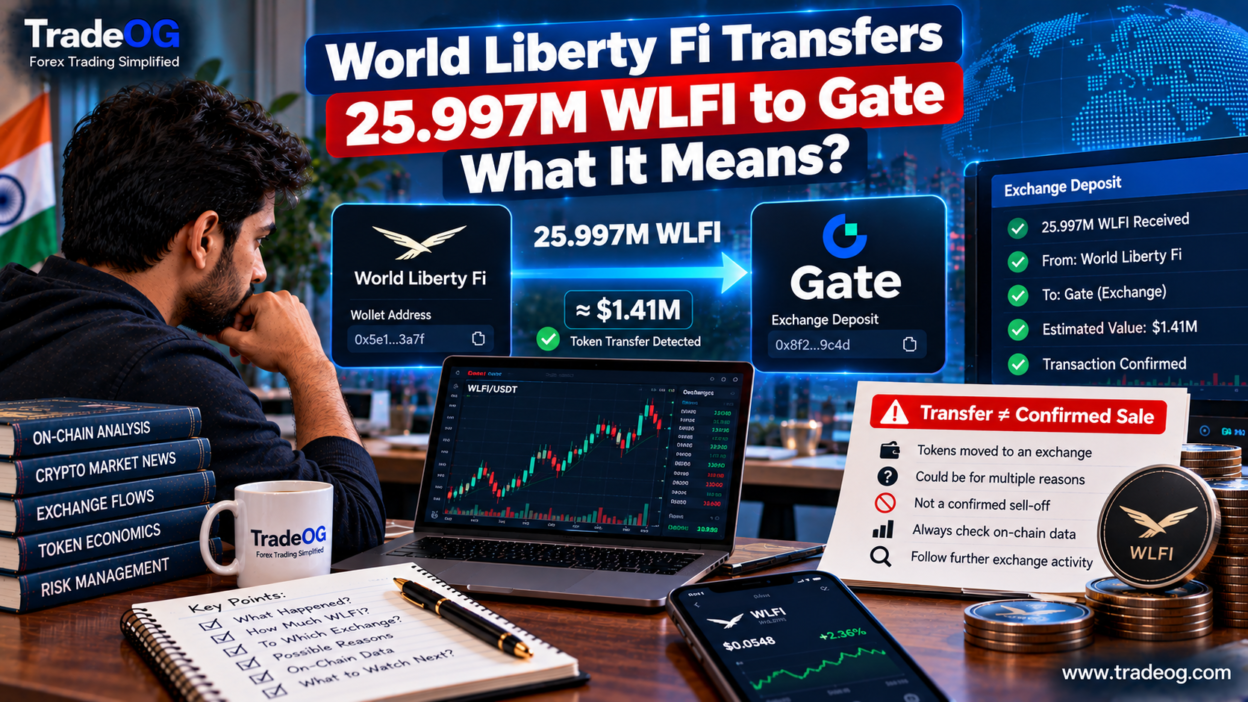
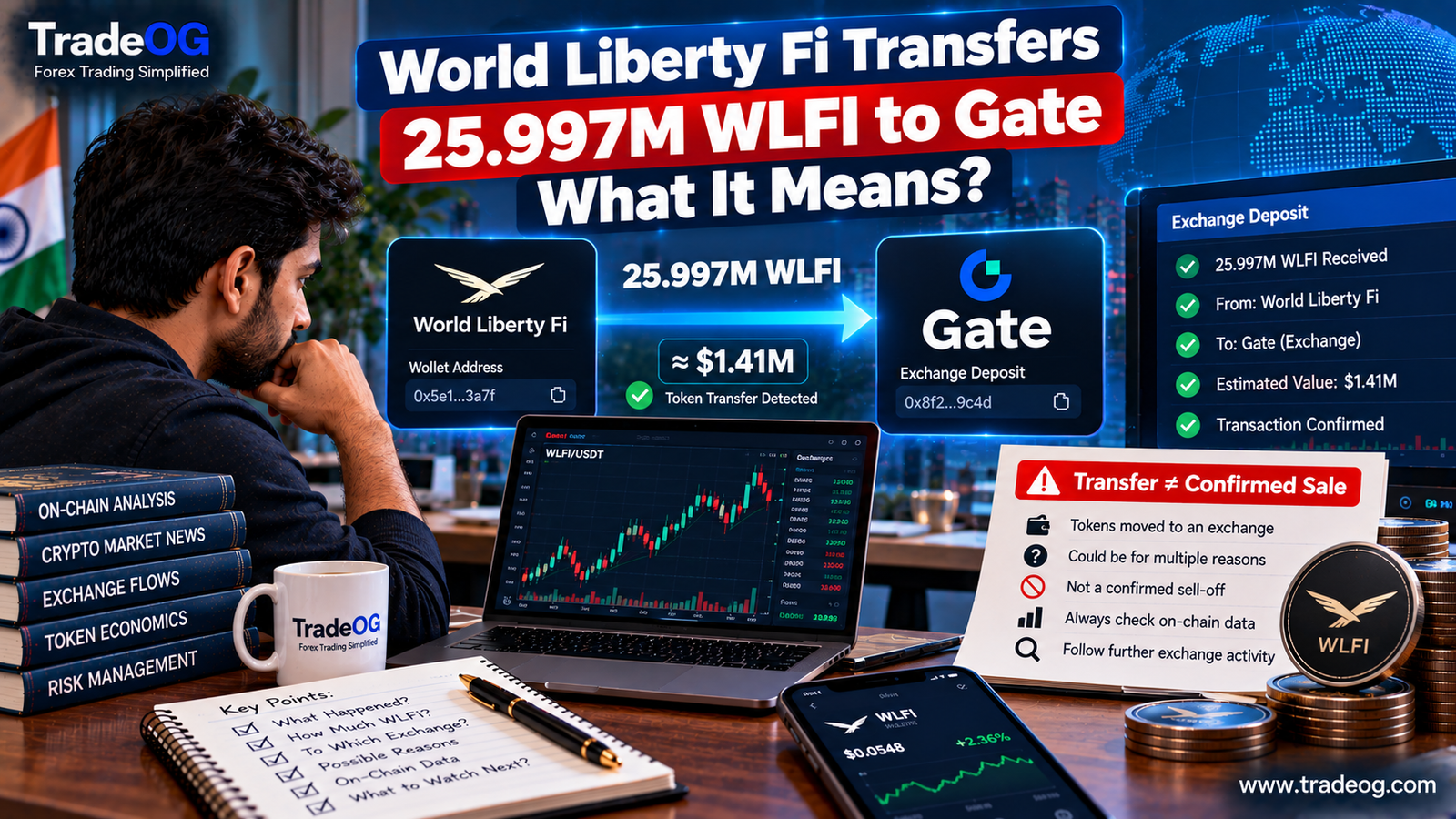
A wallet identified as belonging to World Liberty Fi has transferred approximately 25.997 million WLFI tokens to the Gate cryptocurrency exchange, in a transaction valued at roughly $1.41 million at the time of the transfer.
The movement was reported on October 4, 2026, based on blockchain-tracking data cited by Gate and other crypto-news sources. The transfer is notable because sending a large amount of a token to a centralised exchange can increase speculation about potential selling, liquidity management or another planned transaction.
However, there is an important distinction: the transfer to Gate does not prove that the WLFI tokens were sold. The available reporting confirms the wallet-to-exchange movement, not a completed sale.
What Happened to WLFI?
According to data cited by Gate, a wallet marked as belonging to World Liberty Fi moved approximately 25.997 million WLFI to Gate. The tokens were valued at approximately $1.41 million when the transfer was reported.
| Detail | Reported Information |
|---|---|
| Token | WLFI |
| Entity/wallet | World Liberty Fi-marked wallet |
| Destination | Gate exchange |
| Amount | 25.997 million WLFI |
| Reported value | Approximately $1.41 million |
| Date reported | October 4, 2026 |
| Confirmed sale? | No |
Does the Transfer Mean World Liberty Financial Is Selling WLFI?
Not necessarily.
This is the most important point when interpreting on-chain exchange deposits.
A token can be moved to a centralised exchange for several reasons:
- Potential sale or partial sale
- Liquidity management
- Market-making activity
- Exchange custody
- Operational transfers
- Trading or hedging
- Other treasury or ecosystem activities
Without evidence of a completed trade, it is more accurate to describe the event as an exchange deposit or transfer rather than a confirmed sale.
Both Pluang and Gate’s reporting make this distinction clear: the transfer itself does not establish that the tokens were sold.
Why Does Sending WLFI to Gate Matter?
Crypto traders often watch transfers to centralised exchanges because exchanges provide a venue where tokens can potentially be traded against other assets.
That means a large exchange deposit can become a market-watch signal.
It does not automatically mean the price will fall. The market impact depends on what happens after the deposit.
For example:
- If the tokens are sold into the market, selling pressure could increase.
- If the tokens remain untouched, the immediate market impact may be limited.
- If the tokens are used for liquidity or another operational purpose, the interpretation can be different.
Therefore, traders should watch the destination wallet and subsequent transactions instead of treating the initial transfer as proof of a bearish event.
How Much Is 25.997 Million WLFI Worth?
The reported value was approximately $1.41 million at the time of the transfer. That figure is an estimated market value, not necessarily the amount eventually realised if the tokens are sold.
The actual proceeds from any future sale would depend on:
- WLFI market price
- Order size
- Available liquidity
- Execution price
- Trading fees
- Slippage
A large market order can execute at multiple prices, meaning the headline value of tokens entering an exchange should not automatically be treated as the expected cash proceeds.
WLFI Is Now Tradable
World Liberty Financial’s own website states that WLFI became tradable following a governance vote. The project describes WLFI as its governance token and says tokens can be traded after being unlocked.
The project’s published materials describe WLFI as a governance token rather than a conventional equity instrument. Its gold paper states that holding WLFI provides governance utility and does not provide a right to dividends or other distributions.
Why Traders Are Watching WLFI Wallet Movements
Large wallet movements can provide useful information about potential supply entering exchange markets.
But on-chain analysis works best when multiple signals are combined.
Traders can monitor:
- Exchange deposits
- Exchange withdrawals
- Wallet balances
- Large transfers between labelled wallets
- Trading volume
- Order-book liquidity
- Price reaction after the transfer
- Follow-up transactions
A single wallet transfer is usually not enough to establish a complete market narrative.
What Should WLFI Holders Watch Next?
The next transactions may be more informative than the initial transfer.
1. Does WLFI move from the Gate deposit address?
If the tokens are transferred again, the destination can provide additional context about what is happening.
2. Does trading volume increase?
A major increase in volume around the transfer could indicate that the market is reacting to the additional exchange liquidity.
3. Does the WLFI price react?
A price decline by itself does not prove that the 25.997 million tokens were sold. Traders should look for transaction-level evidence.
4. Are additional WLFI tokens moved?
Repeated transfers from related wallets can provide more context than one isolated transaction.
WLFI Exchange Transfers vs Confirmed Selling
| Event | What It Proves |
|---|---|
| Wallet → exchange | Tokens were deposited at an exchange |
| Exchange deposit + matching trade | Evidence of an executed sale/trade |
| Exchange withdrawal | Tokens left the exchange |
| Large wallet movement | Asset movement, but purpose may be unknown |
This distinction matters because crypto headlines sometimes turn an exchange deposit into a statement that a whale “sold” tokens before an actual sale is confirmed.
Could This Create Selling Pressure?
Potentially, but it is not confirmed by the transfer alone.
If a substantial portion of the 25.997 million WLFI is sold on the open market, additional supply could affect price, particularly if market liquidity is insufficient to absorb the orders without significant slippage.
But if the tokens remain on the exchange or are used for another purpose, the immediate price impact could be very different.
What Does This Mean for WLFI Investors?
For investors, the main lesson is to separate on-chain evidence from interpretation.
The on-chain event is straightforward: a wallet associated with World Liberty Fi moved approximately 25.997 million WLFI to Gate.
The interpretation is less certain: the reason for the transfer and whether the tokens were subsequently sold are separate questions.
That distinction becomes especially important when the market is volatile and social-media commentary moves faster than blockchain evidence.
World Liberty Financial and WLFI Background
World Liberty Financial describes WLFI as a governance token for its protocol. Its published gold paper states that the token’s utility is governance and that WLFI does not provide holders with a right to dividends or other distributions.
The project’s website also currently lists integrations and exchange-related ecosystem partners including Gate, Binance, Coinbase, Kraken and others.
WLFI has a fixed initial supply of 100 billion tokens, according to the project’s published documentation.
Why Exchange Wallet Data Can Be Useful
Blockchain transactions are publicly observable, which allows traders and researchers to monitor significant movements without relying entirely on company announcements.
However, wallet labels are not always perfect and a transfer does not reveal the complete business purpose behind a transaction.
For that reason, responsible on-chain analysis should use language such as:
“A wallet associated with the project transferred tokens to an exchange.”
rather than automatically saying:
“The project sold the tokens.”
unless an actual executed trade has been identified.
What Traders Should Avoid
- Assuming every exchange deposit means a dump
- Assuming the entire transferred amount was sold
- Using the transfer value as confirmed realised proceeds
- Ignoring liquidity and slippage
- Trading solely because of one wallet transaction
- Confusing an on-chain transfer with a completed market trade
Frequently Asked Questions
Did World Liberty Financial sell 25.997 million WLFI?
The reported event confirms a transfer of approximately 25.997 million WLFI to Gate, but the available reporting does not confirm that the tokens were sold.
How much was the WLFI transfer worth?
The transfer was valued at approximately $1.41 million when reported.
Why would a project send WLFI to an exchange?
Possible reasons include trading, liquidity management, market-making, custody or other operational purposes. The specific purpose of this transfer has not been established by the available reporting.
Is WLFI currently tradable?
World Liberty Financial’s website states that WLFI became tradable following a governance vote.
Does a large WLFI exchange deposit mean the price will fall?
Not necessarily. A deposit can create potential selling capacity, but the actual market impact depends on whether the tokens are sold, the size and execution of any orders, and available liquidity.
Should traders sell WLFI because of this transfer?
A single wallet transfer is not sufficient evidence for an investment decision. Traders should verify subsequent transactions, market volume, liquidity and price behaviour rather than treating the transfer as a confirmed sale signal.
Final Takeaway
A wallet associated with World Liberty Fi transferred approximately 25.997 million WLFI to Gate, worth about $1.41 million at the time of the reported transaction.
The important part is what the evidence does not show: the transfer alone does not confirm that the tokens were sold.
For traders, the sensible approach is to monitor what happens next — whether the tokens are traded, moved again, withdrawn, or simply remain at the exchange.
Exchange deposit ≠ confirmed sale. That distinction is essential when interpreting whale and project-wallet activity.
Disclaimer: This article is for informational and educational purposes only and is not investment, financial or legal advice. Cryptocurrency markets are highly volatile. Verify on-chain transactions and official project information before making trading or investment decisions.