
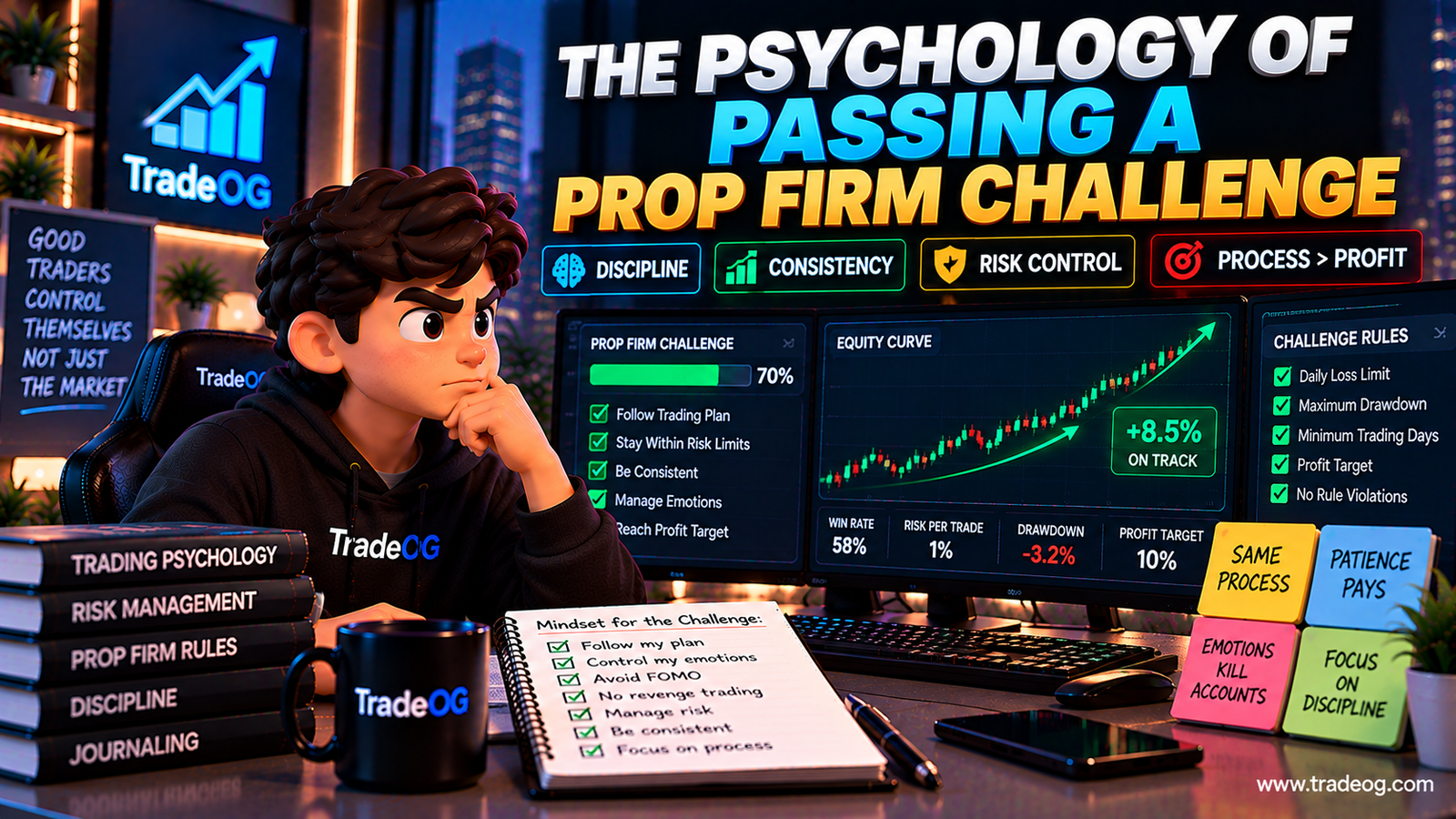
Passing a prop firm challenge is often described as a trading problem: find a strategy, hit the profit target and stay below the drawdown limit.
In practice, the psychological side can be just as important as the strategy itself.
A trader can have a profitable setup and still struggle because the challenge creates a different decision-making environment. The account has a target, a loss threshold, a time or consistency requirement in some programs, and the emotional pressure of knowing that one oversized trade can undo several sessions of progress.
That pressure can change behaviour.
A trader who normally follows a plan may start taking marginal setups. A trader who normally risks one unit may increase size after a loss. Someone who usually waits for confirmation may chase a breakout because the profit target feels far away.
Current prop-firm guidance reflects this problem. FTMO’s recent material on the mental game of its Challenge discusses pressure around the target and highlights revenge trading, FOMO and moving stops as common psychological traps. Topstep’s current Responsible Trading guidance similarly emphasizes defining risk before trading, following a plan, avoiding FOMO and revenge trading, and using personal limits rather than relying only on the account’s outer loss limit. FTMO — The Mental Game of the FTMO Challenge and Topstep — What Is Responsible Trading?
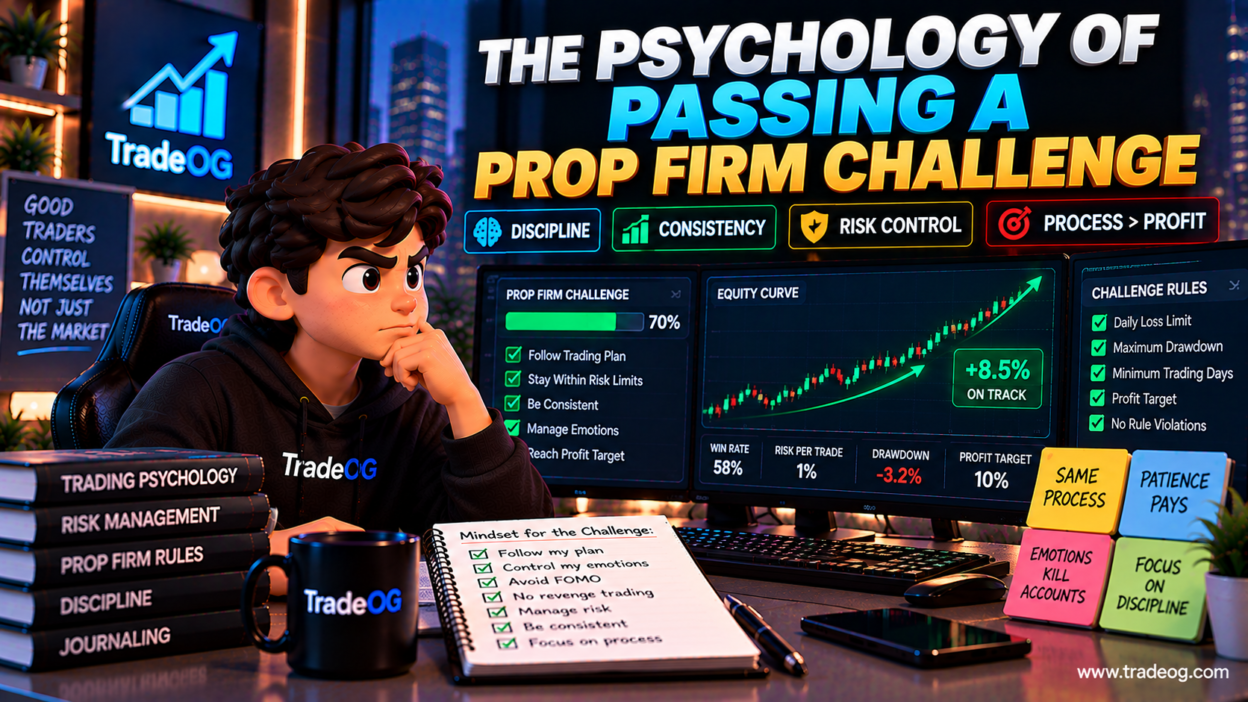
This article explains the psychology of passing a prop firm challenge, why traders sabotage otherwise workable strategies, how to manage pressure, and how to build a challenge process around discipline, consistency and controlled risk rather than urgency.
What Makes a Prop Firm Challenge Psychologically Different?
A normal trading account and a prop firm evaluation can use the same markets and technical setups, but the decision environment can feel very different.
A challenge usually has defined objectives and account constraints. The exact rules vary by firm and account type.
For example, Topstep’s current Trading Combine has a Profit Target, a Consistency Target and a Maximum Loss Limit. Its current rules also specify maximum position sizes, while emphasizing that traders are not required to use the maximum available size. Topstep — Trading Combine Parameters
FTMO’s current objectives also vary by product and challenge type. Its current 1-Step rules, for example, include a Best Day Rule in addition to other trading objectives. FTMO — Trading Objectives
These constraints create a psychological conflict:
The trader wants to maximize progress, while the account requires controlled behaviour.
That is why passing is not simply about finding trades that can make money. The trader must also avoid decisions that create disproportionate downside.
The Core Psychological Shift: Stop Trying to “Pass” Every Day
One of the biggest mental mistakes is treating every trading session as if it must move the account materially closer to the target.
A trader sees:
Profit target: $5,000
and thinks:
“I need to make $500 today.”
That number can become a daily quota even when the market is offering no valid setup.
The trader then starts searching for trades rather than waiting for trades.
A healthier process is:
“My job today is to execute my tested setup within my risk limits. The account target is an outcome, not an hourly requirement.”
FTMO’s current psychology material makes a similar distinction between focusing on the process and becoming obsessed with the target. FTMO — The Mental Game of the FTMO Challenge
1. Understand That the Profit Target Is Not a Trading Signal
A profit target tells you how much the account needs to gain under the applicable rules.
It does not tell you:
- when to enter;
- what instrument to trade;
- how many contracts to use;
- how many trades to take;
- when the market will trend;
- when volatility will expand.
Yet traders often let the target influence all of those decisions.
For example:
“I am $1,500 short, so I need a bigger trade.”
That is a psychological calculation, not a market calculation.
The market does not know how far you are from your challenge target.
2. Replace the “Pass or Fail” Mindset With a Process Mindset
Binary thinking can create unnecessary pressure:
“I must pass this challenge.”
That thought can turn every trade into a referendum on your ability.
A process mindset changes the objective:
- Follow the setup.
- Respect position size.
- Place the planned stop.
- Accept the predefined risk.
- Record the trade.
- Stop when the personal limit is reached.
Now a losing trade can still be considered a correctly executed trade.
That does not make the loss profitable. It means the trader is evaluating the quality of the decision separately from the random outcome of an individual trade.
3. Why Traders Rush After a Slow Start
Imagine the first five sessions produce:
- Day 1: +$150
- Day 2: +$0
- Day 3: -$100
- Day 4: +$200
- Day 5: +$50
The account is progressing, but the trader feels that progress is too slow.
That feeling can create urgency.
The trader may then:
- increase size;
- trade more frequently;
- switch instruments;
- lower entry standards;
- trade during unfamiliar sessions.
The irony is that trying to accelerate the challenge can increase the probability of a large drawdown event.
FTMO’s recent risk-and-psychology guidance explicitly emphasizes controlled risk, predefined stops and avoiding emotional deviations from the plan. FTMO — Risk Management and Psychology in Practice
4. Learn to Tolerate Boredom
Passing a challenge can involve long periods in which there is no valid setup.
That is psychologically difficult because the trader paid for access to the challenge and may feel pressure to “use” it.
But a market does not owe you a trade.
Sometimes the correct decision is:
No trade.
Boredom becomes dangerous when the trader interprets inactivity as failure.
A useful journal metric is:
Number of trades taken when no valid setup existed.
That number should ideally be zero.
5. Control the Urge to Recover Losses Immediately
A losing trade can create a strong desire to restore the previous account balance.
The thought may be:
“I only need one good trade to get it back.”
That thought is dangerous because it makes the next trade responsible for repairing the previous one.
The next trade should have no obligation to recover anything.
It should only meet the current setup and risk criteria.
FTMO’s recent challenge guidance specifically identifies revenge trading as a psychological trap, while its current “5 Rules” article warns against increasing position size to recover losses. FTMO — 5 Rules to Stop Breaching Your Challenge
6. Avoid FOMO When the Account Is Behind Target
FOMO is not limited to seeing a fast-moving chart.
It can also come from seeing your challenge progress move too slowly.
For example:
“Everyone else is making money today. I need to catch this move.”
The result can be a late entry.
A late entry often changes the original risk-to-reward structure because the price has already moved away from the planned zone.
Ask three questions before entering:
- Would I take this trade if I were already at the profit target?
- Was this entry defined before the move started?
- Am I entering because of a setup or because I feel behind?
If the answer to the third question is “because I feel behind,” pause.
7. Don’t Let a Winning Streak Create Overconfidence
The psychological challenge is not only dealing with losses.
Winning can create its own problems.
After several winners, a trader may think:
- “I have figured out the market.”
- “I can increase size.”
- “I can take one more trade.”
- “This setup is almost guaranteed.”
Topstep’s current responsible-trading guidance specifically says maximum position size is a tool rather than a default setting and encourages traders to build balances gradually rather than habitually maxing out size. Topstep — What Is Responsible Trading?
A winning streak should increase confidence in a properly executed process, not automatically increase exposure.
8. Your Challenge Is Not an Emergency
Urgency is one of the most destructive psychological states in challenge trading.
Urgency says:
“I have to make money now.”
Discipline says:
“I will trade only when my conditions exist.”
These statements lead to completely different behaviour.
The market rewards neither urgency nor patience automatically. But urgency can cause traders to break their own rules more frequently.
9. Build a Personal Daily Stop Before the Firm’s Limit
A challenge’s maximum loss is generally an account-level boundary, not a suggestion for how much you should intentionally lose in one session.
Topstep’s current Responsible Trading guidance explicitly recommends defining risk before trading and setting personal loss limits rather than treating the Maximum Loss Limit as a stop loss. It also encourages traders to step away when emotions are high. Topstep — What Is Responsible Trading?
A personal limit might be defined by:
- maximum dollar loss;
- maximum R loss;
- maximum consecutive losses;
- maximum number of trades;
- specific psychological conditions.
The exact threshold should come from your own tested plan and the current account rules.
10. Understand the Difference Between Account Size and Risk Capacity
A prop challenge might advertise a $50,000, $100,000 or $150,000 account size.
That number should not be interpreted as the amount you can freely risk.
The practical risk variables include:
- maximum loss;
- daily loss limit where applicable;
- trailing or end-of-day drawdown;
- position limits;
- instrument restrictions;
- consistency requirements;
- news restrictions or session rules where applicable.
Topstep’s current Trading Combine documentation, for example, defines the Maximum Loss Limit and position-size limits while separately describing its Profit Target and Consistency Target. Topstep — Trading Combine Parameters
The psychological benefit of understanding this distinction is important: you stop thinking of the headline account size as a reason to trade larger.
11. Think in Risk Units, Not Dollars to the Target
Suppose your predefined risk is $100 per trade.
Instead of thinking:
“I need another $1,000.”
think:
“My next valid trade risks 1R.”
That keeps the focus on the process.
If your strategy historically produces average winners of +2R and average losses of -1R, the target becomes a statistical journey rather than a daily emotional requirement.
12. Don’t Increase Risk Because the Target Is Close
This is one of the most common psychological traps.
Suppose a hypothetical challenge requires $5,000 of profit.
The trader is at $4,600.
They think:
“Only $400 left. I can make that quickly.”
They double size.
The next trade loses $800.
Now the trader is not only farther from the target; they may also be under greater psychological pressure.
Being close to the target does not make the next trade higher probability.
13. Don’t Increase Risk Because You Are Far From the Target Either
The opposite trap is equally important.
At the beginning of a challenge, the trader sees a large distance to the target and decides:
“I need to start aggressively.”
That can create unnecessary exposure before the trader has built any cushion.
The target distance is not a justification for larger risk.
14. The Psychological Importance of a Written Trading Plan
A written plan reduces the number of decisions that must be made under pressure.
It should define:
- markets;
- sessions;
- setups;
- entry conditions;
- stop conditions;
- target logic;
- position-size formula;
- maximum daily risk;
- maximum number of trades;
- conditions for stopping;
- conditions for changing the strategy.
CME’s trade-plan education emphasizes objectives, methodology, risk management, trading strategies and maintaining a trader log. CME Group — Building a Trade Plan
The purpose is not bureaucracy. The purpose is to create a reference point when emotions become louder than the plan.
15. Define What a “Good Trade” Means
If the only definition of a good trade is “a trade that makes money,” psychology becomes unstable.
A better definition is:
A good trade is one that follows the plan and respects the predefined risk.
It can still lose.
Similarly, a profitable trade can be a bad process decision if it involved:
- oversizing;
- moving the stop;
- breaking an entry rule;
- trading outside the permitted conditions.
This distinction protects traders from reinforcing bad behaviour simply because it happened to make money.
16. Accept That Losses Are Part of the Distribution
No strategy produces only winning trades.
A trader who expects every setup to work will interpret normal losses as evidence that something is wrong.
That creates emotional reactions.
A trader who understands the historical distribution can say:
“This loss is unpleasant, but it is within the range I have already tested.”
That mindset makes it easier to keep position size consistent.
17. Understand Your Maximum Consecutive Losses
Before starting a challenge, review your strategy’s historical losing streaks.
Track:
- average losing streak;
- maximum losing streak;
- losses in R;
- losses by setup;
- losses by session;
- losses by market regime.
If your strategy has historically experienced six consecutive losses, then a sequence of three losses should not automatically trigger a complete strategy rewrite.
Instead, it should trigger a process review.
18. Don’t Change the Strategy During Emotional Pressure
A challenge can create a dangerous feedback loop:
Loss → doubt → strategy change → unfamiliar execution → loss → more doubt.
The trader never gives the original system enough consistent data to evaluate it.
If a strategy needs modification, write down the proposed change and test it separately.
Do not redesign the system from the emotional state created by the last trade.
19. Use a Pre-Trade Psychological Check
Before each trade, ask:
- Is the setup valid?
- Is the risk predefined?
- Is the position size calculated?
- Is this trade independent of the previous trade?
- Am I trying to recover a loss?
- Am I trying to accelerate the challenge?
- Am I afraid of missing the move?
- Would I still take this trade if the account were already at the target?
That last question is particularly useful.
If the answer changes because of the challenge target, the target may be influencing the decision.
20. Learn to Walk Away After a Strong Emotional Event
Trading immediately after a major emotional event can reduce decision quality.
Examples include:
- a large unexpected loss;
- a large unexpected win;
- a missed trade;
- a sudden rule violation;
- a rapid market reversal;
- a technology or execution problem.
Topstep’s current Responsible Trading guidance specifically recommends taking a short break when emotions are high. Topstep — What Is Responsible Trading?
The exact break length can be part of your own plan.
21. The Psychology of Missing a Trade
Missing a valid setup can feel like losing money even though no money was lost.
This is a major source of FOMO.
The trader watches the market move without them and thinks:
“I should have taken it.”
That thought can lead to a late entry.
The better interpretation is:
A missed trade is a missed opportunity, not a realized loss.
There will be another setup if the strategy is designed to operate across many opportunities.
22. The Psychology of Being Up on the Day
Winning days create another psychological decision:
“Should I keep trading?”
Some traders give back a good day because they continue after reaching their own profit objective.
Topstep’s current Responsible Trading guidance recommends setting a realistic personal profit target and stepping away after reaching it, while also offering platform tools to help traders lock in gains. Topstep — What Is Responsible Trading?
This does not mean every trader must stop at the same profit number. It means the decision should be predefined rather than made impulsively after a winning streak.
23. The Psychology of Being Down on the Day
Being down creates a different temptation:
“I have to finish green.”
That mindset can turn a normal losing day into an overtrading day.
A trader may take setups that would normally be rejected simply because the account is below the morning balance.
The better question is:
“Is the next setup valid?”
Not:
“Can this trade get me back to breakeven?”
24. Avoid Comparing Your Challenge With Other Traders
Social media can distort the perception of what normal challenge progress looks like.
You may see:
- large one-day profits;
- challenge passes;
- multiple funded accounts;
- screenshots of large payouts.
You usually do not see the complete distribution of attempts, losses, resets, rule violations and unsuccessful periods behind those posts.
Your trading plan should therefore be based on your own tested statistics rather than another trader’s highlight reel.
25. Don’t Let a Countdown Control Your Decisions
If a particular challenge has a time limit or subscription cycle, the remaining time can create urgency.
The psychological danger is obvious:
“I have three days left, so I need to make it happen.”
That thought can turn the final days into the highest-risk period of the evaluation.
Not every prop program uses the same timing rules. Some current programs have no fixed evaluation time under certain account models, while others have specific cycles or subscription structures.
Always check the current rules of the exact account rather than assuming every challenge has the same deadline.
26. Use “Process Score” Instead of Only P&L
Create a daily scorecard.
| Process Area | Score |
|---|---|
| Followed setup rules | Yes / No |
| Position size followed plan | Yes / No |
| Stops respected | Yes / No |
| No FOMO entries | Yes / No |
| No revenge trades | Yes / No |
| Daily limit respected | Yes / No |
| Journal completed | Yes / No |
A day can therefore be:
+1.2R with excellent process
or:
-0.8R with excellent process.
Both can be valuable data points.
27. Build a “Do Nothing” Trigger
One of the most useful psychological tools is knowing when not to trade.
Create explicit conditions such as:
- personal daily loss reached;
- three consecutive losses;
- major emotional reaction;
- platform instability;
- market condition outside tested strategy;
- no valid setup during the planned session.
When a trigger occurs, the default action is not “find another trade.”
The default action is stop and review.
28. Don’t Use the Maximum Position Size Because It Is Available
A prop firm’s maximum position size is a ceiling, not a recommendation.
Topstep’s current Trading Combine documentation explicitly says traders are never required to trade the maximum number of contracts and that fewer contracts are allowed. Topstep — Trading Combine Parameters
This distinction is psychologically important.
Availability does not equal suitability.
29. Consistency Can Be a Psychological Constraint
Some programs include consistency-related objectives.
Topstep’s current Trading Combine uses a Consistency Target in which the best trading day must stay below 55% of the Profit Target to avoid increasing the target. FTMO’s current 1-Step process has a Best Day Rule with a different calculation. Topstep — Consistency and FTMO — Trading Objectives
These rules can change how a trader thinks about large winning days.
Instead of always wanting the biggest possible single-day result, a trader may need to understand how the program defines consistency and how that affects the path to completion.
Always use the current rules for the exact account.
30. Passing Requires Emotional Stability, Not Emotional Suppression
Traders will still feel:
- fear;
- excitement;
- frustration;
- greed;
- disappointment;
- urgency.
The objective is not to become emotionless.
The objective is to prevent an emotion from changing the trading decision without a valid rule-based reason.
You can feel nervous and still follow your stop.
You can feel excited and still use normal position size.
You can feel frustrated and still stop at your daily limit.
That is practical emotional control.
31. The Psychology of Risk Before Reward
A common challenge mindset asks:
“How much can I make today?”
A more useful question is:
“How much am I prepared to lose if this setup fails?”
Topstep’s current responsible-trading guidance explicitly frames risk definition as something that should happen before trading, while FTMO’s risk-management education similarly emphasizes predefined risk and stops. Topstep — Responsible Trading and FTMO — Risk Management and Psychology
This changes the emotional structure of the trade.
32. Don’t Confuse Activity With Progress
More trades do not automatically mean more progress.
A trader can take 20 trades and make less progress than another trader who takes five high-quality setups.
Track:
- valid setups taken;
- invalid setups taken;
- average trade quality;
- average R;
- rule violations;
- time spent trading.
If activity increases while process quality decreases, the trader is moving in the wrong direction even if the account temporarily rises.
33. Use a Pre-Challenge Psychological Preparation Routine
Before starting a challenge, write down:
- why you are trading the challenge;
- what your strategy does;
- what conditions invalidate a setup;
- your normal position size;
- your maximum personal daily loss;
- your maximum consecutive-loss rule;
- your stop-trading conditions;
- what you will do after a large win;
- what you will do after a large loss;
- what would make you pause the challenge.
This is more useful than writing a motivational statement alone.
The objective is to create specific responses for predictable emotional situations.
34. Create a “If This Happens, I Do This” Plan
| Situation | Predefined Response |
|---|---|
| One normal loss | Continue only if the next setup qualifies |
| Several consecutive losses | Review and apply personal stop rule |
| Large unexpected win | Return to normal size |
| Missed trade | Do not chase |
| Target nearly reached | Keep normal risk |
| Account below plan | Do not increase size to recover |
| Emotional tilt | Step away and reassess |
| No setup | No trade |
The value of this table is that the decision is made before the emotion appears.
35. Review the Challenge Like a Business Process
At the end of each session, review:
- What worked?
- What failed?
- Which rules were followed?
- Which rules were broken?
- Was risk consistent?
- Did market conditions match the strategy?
- What should be tested rather than immediately changed?
Keep the review factual.
Instead of writing:
“I traded badly today.”
write:
“I took two trades outside the defined session and increased size by 50% after the first loss.”
The second statement creates something you can correct.
36. What Passing Psychology Looks Like in Practice
A psychologically controlled challenge session might look boring:
- Trader reviews the plan.
- Trader waits for the setup.
- Trader calculates risk.
- Trader enters.
- Trader accepts the result.
- Trader records the trade.
- Trader waits again.
- Trader stops when the personal rule says to stop.
There may be no dramatic recovery trade.
No all-in moment.
No attempt to finish the target in one afternoon.
That is precisely the point.
37. The Psychological Trap of “Almost Passing”
Being close to the target can create more pressure than being far away.
The trader can see the finish line.
That can cause:
- larger positions;
- more frequent entries;
- shorter holding periods;
- lower-quality setups;
- profit-protection behaviour.
Remember:
Close to the target does not mean close to certainty.
The next trade is still subject to the same market uncertainty as the previous trade.
38. The Psychological Trap of a Large Winning Day
A large winning day can create its own challenge.
The trader may think:
“I can finish this quickly.”
But some programs have consistency or best-day requirements that can make an unusually large day relevant to the path toward completion.
Topstep’s current Consistency Target and FTMO’s current Best Day Rule illustrate why traders should understand the specific program’s completion mechanics instead of assuming that the largest possible daily profit is always the simplest route. Topstep — Consistency and FTMO — Trading Objectives
39. The Psychology of Patience
Patience is not sitting at the screen hoping for a trade.
It is the ability to wait without changing your criteria because nothing has happened yet.
A patient trader can watch a market move 50 points without entering because their setup did not appear.
An impatient trader enters simply because the market is moving.
That difference can be decisive during an evaluation.
40. The Psychology of Consistency
Consistency does not mean every trade has the same outcome.
It means the decision process remains recognizable across trades.
For example:
- similar risk calculation;
- similar setup criteria;
- similar execution process;
- similar stopping rules;
- similar journaling.
Outcomes will naturally vary.
The process should vary much less.
41. A 10-Question Challenge Mindset Test
Before a session, answer yes or no:
- Do I know my maximum risk today?
- Do I know my maximum position size?
- Do I know which setups I am allowed to trade?
- Am I willing to finish the day with no trade?
- Will I keep the same size after a loss?
- Will I keep the same size after a win?
- Will I avoid chasing missed moves?
- Will I stop when my personal limit is reached?
- Will I accept that the challenge may take longer than expected?
- Will I judge today’s performance by process as well as P&L?
If several answers are “no,” the psychological preparation may need more work before trading.
42. What to Do After Failing a Challenge
A failed challenge should be treated as data, not simply as a personal verdict.
Review:
- maximum drawdown reached;
- largest daily loss;
- largest position;
- number of rule violations;
- FOMO trades;
- revenge trades;
- average risk;
- strategy expectancy;
- market conditions;
- psychological triggers.
Ask:
“What behaviour would I need to change before taking another evaluation?”
This is more useful than immediately purchasing another challenge to recover the previous fee.
43. Do Not Turn a Failed Challenge Into a Recovery Mission
After failure, the emotional temptation can be:
“I need to pass the next one to prove that I can do it.”
That can create even more pressure.
The next challenge should be a new evaluation under a revised process, not a revenge trade against the previous account.
44. The Psychology of Passing Is Mostly About Not Self-Sabotaging
There is no psychological trick that can guarantee a challenge pass.
But traders can reduce avoidable errors by controlling:
- risk;
- position size;
- trade frequency;
- FOMO;
- revenge trading;
- profit-target urgency;
- rule changes;
- emotional decision-making.
Topstep’s current Responsible Trading Program exists specifically around problems such as inconsistency, emotional tilt and lack of discipline, and its current guidance stresses that sustainable habits matter more than simply using maximum available size. Topstep — Responsible Trading Program
45. A Practical Daily Routine for a Prop Challenge
Before the session
- Check current account rules.
- Check remaining drawdown.
- Define personal daily loss limit.
- Define maximum position size.
- Review valid setups.
- Check scheduled market events.
- Write today’s process objective.
During the session
- Wait for the setup.
- Calculate risk before entry.
- Use planned size.
- Respect the stop.
- Avoid FOMO.
- Record meaningful deviations immediately.
After the session
- Record P&L.
- Record R-multiple.
- Count valid and invalid trades.
- Review emotional decisions.
- Review rule adherence.
- Identify one improvement.
46. Build a “Challenge Mode” Trading Plan
Your normal trading plan and your challenge plan can share the same strategy, but the challenge plan should explicitly account for the firm’s constraints.
| Component | Challenge Plan |
|---|---|
| Markets | Only permitted instruments |
| Setup | Predefined criteria |
| Risk | Fixed or rule-based |
| Position size | Calculated before entry |
| Daily stop | Personal limit below account boundary |
| Trade limit | Predefined if useful |
| FOMO rule | No late entries outside plan |
| Revenge rule | No size increase to recover |
| Profit rule | Protect gains according to plan |
| Review | Daily journal + periodic statistical review |
47. The Best Psychological Metric: Rule Adherence
One of the most useful challenge metrics is not win rate.
It is:
What percentage of trades followed the plan?
For example:
- 40 trades taken;
- 36 followed the plan;
- 4 contained rule violations.
Rule adherence = 90%.
That number tells you something different from the win rate.
A strategy can have a 55% win rate but poor rule adherence, making it difficult to know whether the strategy or the execution is responsible for the results.
48. Don’t Try to Feel Confident Before Every Trade
Some traders wait for certainty before entering.
Certainty is not available.
A better objective is:
“I am comfortable taking the predefined risk because the setup meets my rules.”
This removes the requirement to predict the next candle correctly.
49. Passing Is Not the Same as Winning Every Trade
A challenge can be completed while experiencing losing trades.
That is important psychologically.
If a trader believes that passing requires constant winning, every loss becomes a crisis.
If the trader understands that the process can contain losses while remaining within its risk parameters, individual losses become easier to handle.
50. Final Takeaway: Process Over Pressure
The psychology of passing a prop firm challenge is not about becoming fearless or predicting the market perfectly.
It is about building a decision process that remains stable when the account is:
- below the target;
- close to the target;
- on a winning streak;
- on a losing streak;
- flat for several sessions;
- under pressure from time or consistency rules.
The strongest psychological framework is simple:
Know your rules. Define risk before the trade. Keep position size controlled. Accept losses. Do not chase missed opportunities. Do not increase risk to recover. Do not let the profit target dictate entries. Review your process regularly.
Current guidance from FTMO and Topstep repeatedly emphasizes versions of these same principles: risk should be defined before trading, emotions should not override the plan, and sustainable consistency matters more than forcing quick results. FTMO — The Mental Game of the FTMO Challenge and Topstep — The Funded Trader Mindset
There is no universal psychological formula that guarantees a pass. The exact rules also vary between prop firms and account models. But one principle is broadly useful:
Do not let the desire to pass the challenge become the reason you stop trading your plan.
FAQs
What is the most important psychological skill for passing a prop firm challenge?
Consistent execution under pressure. A trader needs to follow the predefined setup and risk rules even when the account is behind target, near target, after a loss or after a large win.
Why do traders fail prop firm challenges psychologically?
Common behavioural problems include revenge trading, FOMO, oversizing, moving stops, overtrading, chasing the profit target and ignoring personal loss limits. These behaviours can turn normal trading variance into avoidable account damage.
Should I focus on the profit target every day?
No. The profit target is an account objective, not a daily trading signal. A daily target can create pressure to trade when no valid setup exists. Focus on executing your tested process.
Should I increase my position size to pass faster?
Increasing size solely because you are behind the target or close to passing changes the risk profile of the challenge. Position size should follow a predefined risk model and the current account rules.
How do I handle a losing streak during a challenge?
Separate valid strategy losses from process errors. Review the setup quality, risk, execution and market conditions. Follow your predefined stopping rule rather than increasing size to recover losses.
How do I handle a winning streak?
Return to the same risk and position-sizing rules unless your strategy has a tested rule for increasing size. Winning trades can create overconfidence and make traders take unnecessary additional risk.
What should I do if I am very close to the profit target?
Continue applying the same process unless the firm’s rules require a different approach. Being close to the target does not make the next trade more predictable.
Should I stop trading after reaching my own profit target for the day?
If your written plan includes a daily profit stop, follow it. A personal profit target can help prevent giving back gains through unnecessary additional trades. The appropriate threshold depends on your strategy and account rules.
Can psychology matter more than strategy?
Strategy and psychology interact. A strategy with no sustainable edge cannot be rescued by mindset, while a potentially useful strategy can be undermined by poor execution, oversizing or emotional decisions.
How should I prepare mentally before starting a challenge?
Write down your setup rules, risk limits, position-sizing formula, stopping conditions, FOMO rule, revenge-trading rule and response to large wins or losses before the challenge begins.
TradeOG note: Prop firm rules, profit targets, drawdown calculations, consistency requirements, position limits and permitted trading practices vary by firm, account type and product and can change over time. Always verify the current official rules for your specific account before trading.