

Most traders entering a prop firm evaluation obsess over two numbers: the Profit Target (8% to 10%) and the Maximum Drawdown (8% to 10%). They assume that as long as they hit the target without touching the drawdown floor, their payout is mathematically guaranteed.
Then comes payout day.
Instead of an automated bank or crypto transfer, an email lands from the compliance department: “Your payout has been placed on hold due to a breach of Section 7.4 of our Trading Policies.”
Prop firms do not operate like traditional retail brokerages. Underneath the headline drawdown limits lies an intricate network of automated compliance filters, algorithmic trade scanners, and anti-arbitrage protocols. Violating these secondary restrictions does not always blow your account immediately—often, you are allowed to trade for weeks, only to have your profits voided when you request a withdrawal.
Here is an exhaustive, institutional breakdown of the six trading restrictions prop firm traders routinely miss, how the broker’s compliance server detects them, and how to keep your execution 100% compliant.
1. Prop Firm Trading Restrictions: Minimum Trade Duration Rules
Related: prop firm trading restrictions and prop firm rule changes.
If your strategy involves aggressive scalping, this is the restriction most likely to invalidate your earnings:
Why Prop Firms Restrict Fast Trades
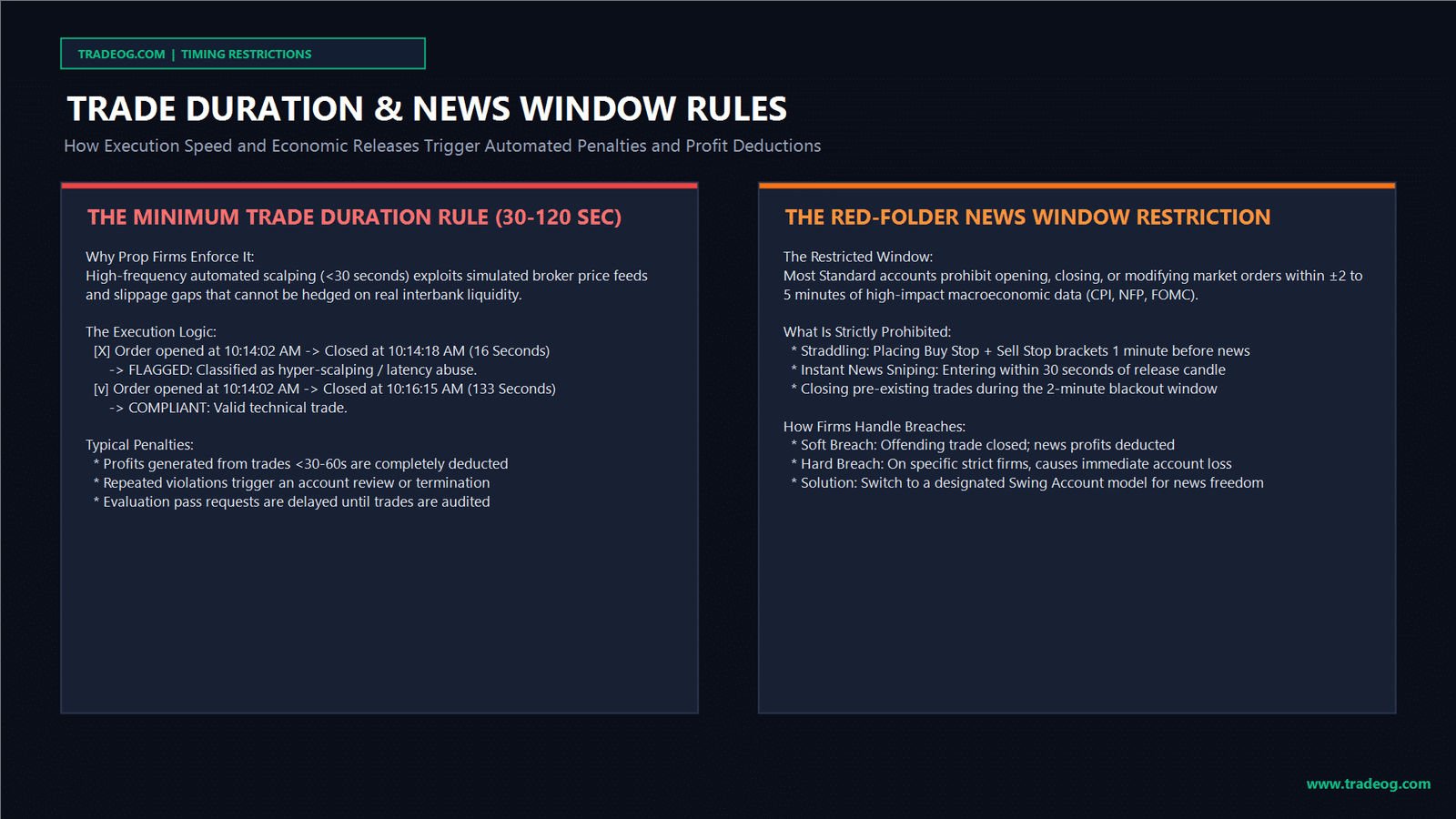
In simulated demo environments, orders are filled instantly at the displayed price. In real institutional markets, entering and exiting a massive 20-lot position in 8 seconds causes significant market impact, requotes, and execution slippage.
Traders who exploit demo feed latency or micro-second price gaps are categorized by prop risk engines as “Latency Arbitrage” or “Toxic Order Flow.” Because the firm cannot replicate or hedge these hyper-short trades on institutional liquidity providers (LPs), they enforce mandatory minimum hold times.
How the Rule Works in Practice
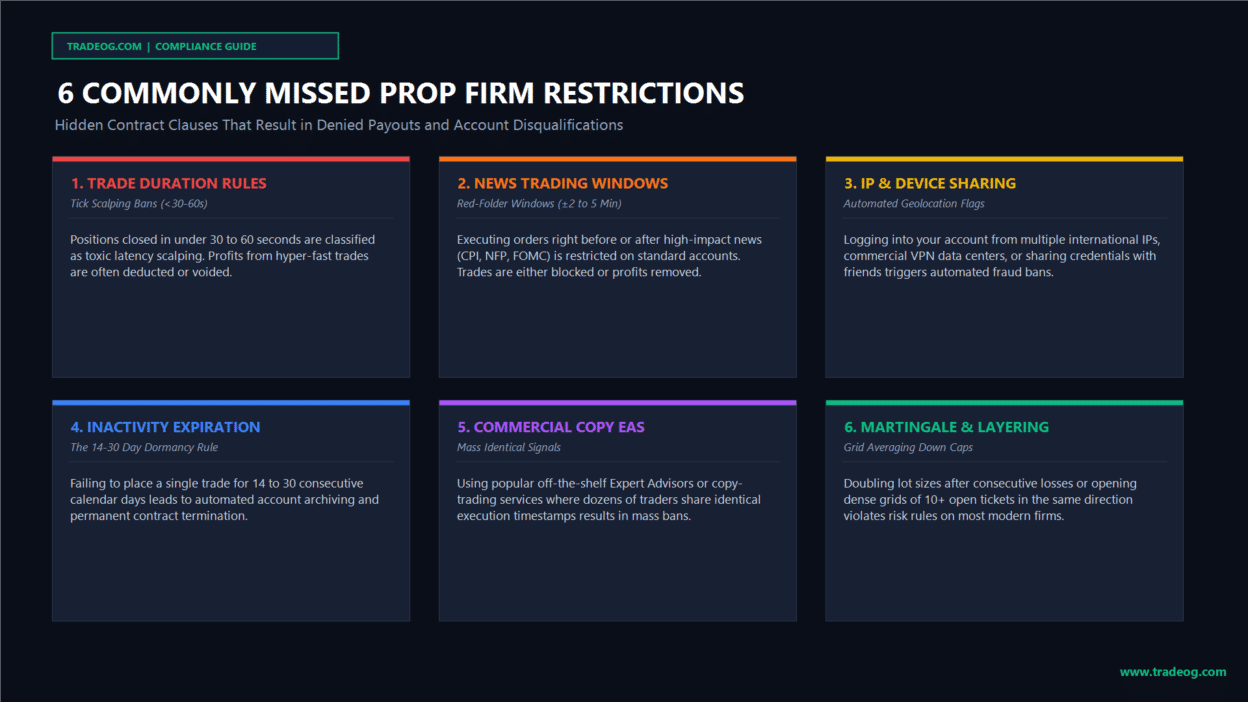
- The 30-Second Rule: Many CFD firms require positions to remain open for at least 30 to 60 seconds.
- The 2-Minute Rule: Specific futures and foreign exchange evaluations mandate a 120-second hold time for a trade to qualify as a valid performance execution.
- The Consequence: If you catch a sudden 15-pip spike and close your position in 18 seconds, the trade may show as a green win on your terminal. However, during the pre-payout audit, the risk script flags all tickets where
Close_Time - Open_Time < 30sand automatically deducts those gains from your balance.
2. Red-Folder News Trading Windows (The ±2 to 5-Minute Blackout)
Trading high-impact macroeconomic announcements—such as US Non-Farm Payrolls (NFP), Consumer Price Index (CPI), or FOMC interest rate releases—is strictly regulated across standard prop firm accounts:
| Trading Action | Standard / Regular Account Policy | Dedicated Swing Account Policy |
|---|---|---|
| Opening Orders (Market / Pending) | ❌ Prohibited within ±2 to 5 min of news | ✅ Permitted without restriction |
| Closing Existing Orders | ❌ Prohibited within ±2 to 5 min of news | ✅ Permitted at market price |
| Straddle / Bracket Orders | ⛔ Strictly Banned (Instant Breach) | ⛔ Banned (Considered toxic arbitrage) |
The “Straddle” Trap
Placing a Buy Stop and a Sell Stop 30 seconds before a CPI announcement hoping to catch whichever direction explodes is explicitly classified as gambling/arbitrage in prop agreements. If the news triggers execution, firms will either cancel the profits or issue an immediate hard breach.
Professional Solution: If your edge relies on macro events or multi-day swing holds, never purchase a Standard evaluation. Select a Swing Account model (like FTMO Swing or FundedNext Stellar) that explicitly waives news trading restrictions in exchange for lower leverage (1:30).
3. IP Address, Device Fingerprinting & Geolocation Flags
Prop firms monitor account security with the same rigor as online banks. Every time your platform connects, the server logs your IP address, Internet Service Provider (ISP), Autonomous System Number (ASN), and hardware device ID:

The 3 Dangerous Red Flags:
- Rapid IP Geolocation Hops: Logging in from London at 9:00 AM and placing an order from New York at 10:30 AM triggers an automated “Account Sharing / Account Management” flag.
- Commercial Data Center VPNs: Free or commercial VPN services (NordVPN, ExpressVPN) route your connection through shared data center servers. If another banned trader used that same VPN IP yesterday, your account is linked to fraud by association.
- Device Sharing / Account Management Rings: If you allow a friend or Telegram “account manager” to trade your challenge from their PC, the broker logs their machine’s MAC address. When that manager eventually blows someone else’s account, all accounts associated with their device are frozen simultaneously.
4. Commercial Copy-Trading & Mass Expert Advisors (EAs)
Many traders buy an automated trading bot on MQL5, Telegram, or Discord that claims to “pass prop firm challenges on auto-pilot.”
The Mass Correlation Detection Algorithm
Prop firm risk desks deploy correlation scanners across their entire trader database. If 300 different accounts open EUR/USD at 08:00:01 AM and close at 08:14:22 AM with identical stop and target parameters, the compliance algorithm flags the entire cluster as “Group / Mirror Trading.”
Prop firms do not fund retail traders who rely on mass public algorithms because the firm cannot hedge 300 identical positions simultaneously on live liquidity without creating catastrophic market slippage. Payouts for accounts running mass public EAs are routinely rejected.
5. Inactivity Clauses (The 14-to-30-Day Dormancy Trap)
Did you pass Phase 1 and decide to take a well-deserved month off before starting Phase 2? Or did you get funded and wait for market conditions to improve?
Check your contract’s Inactivity Clause. Most prop firms enforce a mandatory dormancy limit:
- If no trades are executed on the account for 14 consecutive calendar days (on select aggressive models) or 30 consecutive calendar days (standard), the account is automatically archived.
- Once archived, the account cannot be resumed, and your evaluation fee is forfeited.
6. Martingale, Grid Layering & Toxic Stacking
Prop firms want risk managers, not gamblers who double down on losing positions. Modern rulebooks explicitly define and prohibit two specific toxic sizing strategies:
A. Martingale
Increasing your lot size after a loss to recover previous deficits in a single trade (e.g., losing 1 lot, entering 2 lots, losing, entering 4 lots). While standard Martingale eventually hits maximum drawdown on its own, many firms ban the algorithm preemptively even if you remain above the drawdown floor.
B. Grid Layering / Ticket Stacking
Entering 10 to 20 separate micro-orders within a tight 3-pip range to bypass maximum lot-size restrictions or simulate a single massive position. Prop firms monitor aggregate ticket density and will restrict accounts that flood the server with layered executions during volatility spikes.
The Pre-Trade Compliance Audit Checklist
To ensure your hard-earned profits are fully approved on payout day, run this 5-point checklist before every trading session:

- Economic Calendar Audit: Check Forex Factory or your platform news feed for high-impact red-folder data in the next 15 minutes. Avoid opening or closing standard account positions during the buffer window.
- Hold-Time Confirmation: Confirm your strategy’s average hold time exceeds 60 seconds. Eliminate micro-second tick scalping.
- Dedicated Connection Verification: Trade from your home residential ISP or a dedicated private static VPS. Never log into funded accounts over public Wi-Fi or shared VPN endpoints.
- Lot Size Variance Band: Keep your position sizing stable within 0.8x to 1.3x of your rolling average to ensure compliance with profit and volume consistency rules.
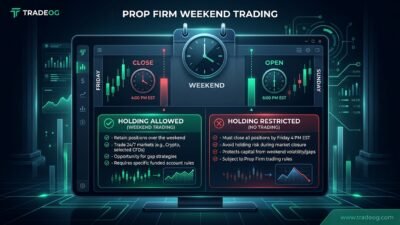
- Weekend Flattening Reminder: If trading on Friday, confirm your account allows weekend holding. If not, set an alarm for 4:15 PM EST to close all open positions before institutional spreads widen.
Frequently Asked Questions (FAQ)
Can I use trade copiers between my own prop firm accounts?
Yes, provided all accounts are registered under your exact same verified name and KYC documents. Prop firms permit local trade copying between accounts owned by the same individual. Copying trades from external third-party signals or master accounts owned by someone else is strictly prohibited.
What should I do if I accidentally close a trade in 15 seconds?
An isolated trade closed quickly due to an immediate stop-out or sudden news wick is rarely penalized. The rule targets systematic strategies where 50%+ of closed volume relies on sub-30-second scalping. If an accidental fast close occurs, leave it documented in your trading journal.
Do prop firms warn you before voiding profits for a rule violation?
Some firms issue a soft warning on the first procedural infraction (such as weekend holding or news trading). However, for commercial EA usage, IP sharing, or latency arbitrage, firms typically audit accounts during withdrawal review and void profits without prior notice.
Summary
Passing a prop firm evaluation is only half the battle. Keeping your funded account and securing regular, predictable payouts requires strict adherence to the secondary rulebook. Treat prop firm compliance with the same discipline you apply to technical chart analysis, respect execution boundaries, and ensure your trading flow remains clean, hedgeable, and professional.
[…] If you trade on an account with a 2-minute news restriction and execute a trade 90 seconds before NFP, you have violated your contract. At some firms, this results in a soft breach (all profits from that trade are stripped). At stricter firms, repeated execution inside news blackouts triggers full account termination—even if the trade was profitable and your drawdown was zero. Review these restrictions thoroughly in our guide on prop firm trading restrictions traders often miss. […]