

Forex prices do not always move smoothly from one visible quote to the next. In fast markets, you may see one quote at one level and the next quote noticeably higher or lower. This can look like the market has suddenly “skipped” prices.
So, why can forex prices jump between two consecutive quotes? The answer usually comes down to how fragmented FX pricing works, how much liquidity is available at different levels, how quickly liquidity providers reprice, and how aggressively the market is moving.
Understanding this matters because a sudden quote change can affect entries, exits, stop-loss orders and the amount of slippage you actually receive.
What Is a Forex Quote?
A forex quote normally shows two prices: the bid, which is the price available for selling, and the ask, which is the price available for buying. The difference between them is the bid-ask spread.
Unlike a single centralised exchange order book, spot FX is largely an over-the-counter market with pricing distributed across dealers, liquidity providers and trading venues. That structure means the price displayed to a trader can change quickly as available liquidity and executable quotes change. BIS describes the FX market as decentralised and fragmented, while CME educational material explains how retail FX/CFD pricing can be sourced through liquidity providers and aggregators. citeturn0search7turn0search0
Why Forex Prices Jump Between Consecutive Quotes
1. Liquidity can disappear at specific price levels
One of the simplest reasons is that there may not be enough executable liquidity between two quoted prices. Imagine a pair trading around 1.08208. If liquidity at nearby levels is thin and the next meaningful available prices are lower, the next quote can appear much farther away than the previous one.
This is closely related to how liquidity affects the price of a forex pair. When quote depth becomes thinner, relatively small changes in order flow can produce larger price changes.
2. Liquidity providers can reprice extremely quickly
FX quotes are continuously updated. Dealers and liquidity providers can change their bid and ask prices when they receive new information, manage inventory, respond to other market prices or detect rapidly changing order flow.
In a fast market, the next executable quote can therefore be materially different from the previous one. CME research on FX liquidity highlights the importance of quote speed, top-of-book spreads and available price points when assessing market quality and execution conditions. citeturn0search1turn0search3
3. Major economic news can trigger instant repricing
Central-bank decisions, inflation data, employment releases and unexpected geopolitical developments can change the market’s view of a currency in seconds.
When a major release arrives, liquidity providers may widen spreads, pull quotes, or rapidly update prices. The market can then move through several levels before your platform receives the next stable quote.
This is one reason forex price consolidation before a major breakout can be important to understand: compressed activity can be followed by a sharp repricing once new information or aggressive order flow enters the market.
4. Bid and ask prices can move independently
Traders sometimes look at a single chart price and assume it represents one universal market price. In practice, your buy and sell executions depend on different sides of the quote.
A market can therefore appear to jump differently depending on whether you are looking at the bid, ask or a chart convention such as mid-price. This becomes particularly relevant when spreads widen during volatile conditions.
5. The market can move faster than a retail chart can visually represent
A chart may display one bar containing a large amount of information, while the underlying quote stream may have changed many times during that bar. In a high-speed market, the screen may simply show the most recently received price.
That does not necessarily mean there was literally no trading or quoting activity between the two displayed levels. It can mean that the visible quotes available to your platform changed faster than the chart gives you visual detail.
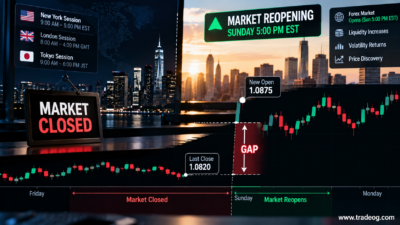
Is a Quote Jump the Same as a Forex Market Gap?
Not always. A jump between two consecutive displayed quotes is not automatically the same thing as a traditional market gap.
A classic gap is generally discussed in relation to a period where the market reopens at a materially different price after a closure or interruption. A rapid quote jump during an active session can instead reflect fast repricing, thin liquidity, changing spreads or the replacement of one executable quote with another.
That distinction matters when analysing charts because a visual gap does not always imply the same underlying market structure.
How Slippage Is Connected to Quote Jumps
Slippage occurs when your order is executed at a different price from the one you expected. When quotes change very quickly, the price you saw when sending an order may no longer be available by the time the broker attempts execution.
This is why slippage can increase when market volatility is extremely high. Faster price changes, wider spreads and changing liquidity can make precise execution more difficult. CME also notes that retail FX/CFD execution is different from a centralised exchange order book and that quote and execution mechanics can materially affect order outcomes. citeturn0search0
Why Stop-Loss Orders Can Be Filled Away From Your Planned Price
A stop-loss is an instruction to manage risk, but it does not guarantee that the market will always execute at the exact stop level.
Suppose you place a stop at 1.08180 and the next executable quote when the stop is triggered is 1.08145. Your trade could be filled around that available price rather than at 1.08180, depending on the broker’s execution model and market conditions.
This is a practical reason to study why a currency pair can break support and immediately reverse. A fast move through a level can create a very different execution experience from what the static chart level suggests.
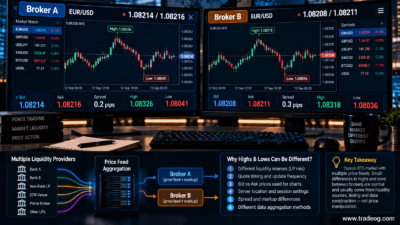
Why Different Forex Brokers Can Show Different Prices
It is normal for two brokers to display slightly different prices, especially during fast markets. Each broker may have different liquidity providers, aggregation methods, spreads, execution policies and quote-update speeds.
Because spot FX is decentralised rather than controlled by one universal central order book, traders should not assume every broker must show an identical tick at every instant. BIS research describes this fragmented structure, while exchange-traded FX futures provide a more centralised and transparent market structure for comparison. citeturn0search7turn0search8
What Market Depth Tells You
Market depth is useful because it gives traders a better idea of how much liquidity may exist around the current price. The deeper the available liquidity, the more capacity the market may have to absorb buying and selling without large immediate price changes.
For a practical explanation, see what forex market depth is and whether it matters. Depth is not a perfect prediction tool, but it can help explain why two periods with similar trading volume can produce very different short-term price behaviour.
Can Forex Prices Jump Without Major News?
Yes. A major headline is not required for a sudden move.
Price can jump because of changing liquidity, large orders, dealer inventory adjustments, market-session transitions, correlated market moves, or a sudden repricing in another asset that affects currency demand.
This is why a forex pair can move even when there is no major news. News is one driver of price, but it is not the only driver.
When Are Quote Jumps More Likely?
Quote jumps are generally more noticeable during periods of elevated volatility or weaker available liquidity. They can occur around major data releases, central-bank announcements, session transitions, market opens and periods when several markets reprice at the same time.
At the same time, high volatility does not automatically mean poor liquidity in every situation. Market liquidity is dynamic, and measures such as spreads, quote activity and market depth can change throughout the trading day. citeturn0search14turn0search15
How Traders Should Handle Sudden Quote Jumps
The best response is not to try to predict every tick. Instead, understand the execution environment and size positions accordingly.
- Do not assume the next quote must be close to the previous quote.
- Expect execution conditions to change around major news.
- Understand whether your broker uses spread-based or other quote mechanics relevant to your order type.
- Keep position size small enough that unexpected slippage does not create disproportionate account risk.
- Review actual fills, spreads and slippage in your trading journal instead of judging execution only from the chart.
These practices become especially important when trading short-term strategies where a small difference in entry or exit price can materially change the risk-to-reward profile.
Because FX pricing is fragmented, traders may also notice that two brokers can show different forex highs and lows. Price feeds, liquidity sources, bid-ask spreads and timing can all contribute.
Final Takeaway
Forex prices can jump between two consecutive quotes because the FX market is continuously repricing across a fragmented liquidity network. When nearby liquidity becomes thinner, spreads change, providers reprice or volatility accelerates, the next available quote can be noticeably different from the previous one.
For traders, the key lesson is simple: the price visible on the screen is not a promise that the next executable price will be nearby. Understanding liquidity, market depth, spreads and execution can make sudden forex price jumps much easier to interpret and manage.
Frequently Asked Questions
Why do forex prices jump between quotes?
They can jump when liquidity changes, providers reprice quickly, spreads widen, or aggressive order flow moves the market faster than the displayed quote sequence suggests.
Can forex prices skip price levels?
Yes. A trader may not receive an executable quote at every intermediate level, particularly when liquidity is thin or the market is moving rapidly.
Does a sudden quote jump always mean a market gap?
No. An intraday quote jump can result from rapid repricing or changing liquidity and does not necessarily represent a traditional gap after a market closure.
Why can stop-loss execution differ from the stop price?
Because the stop can trigger when the market reaches the relevant level, while the actual fill may depend on the next available executable quote and prevailing liquidity.
Why do two brokers sometimes show different forex prices?
Different brokers can source prices from different liquidity providers and use different aggregation, spread and execution arrangements, so their displayed quotes can vary.