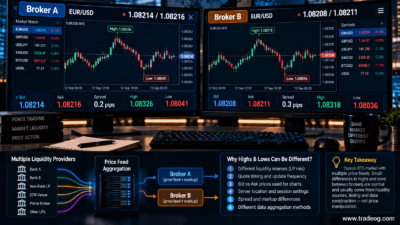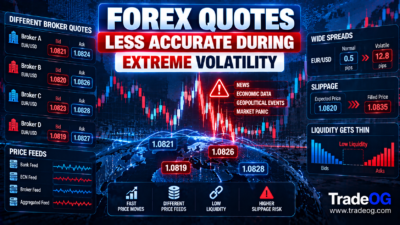


When traders look at a forex price on their platform, it can feel as if the market itself is producing one single stream of prices. In reality, the foreign exchange market is a network of banks, non-bank liquidity providers, dealers, venues and technology platforms that continuously exchange and distribute prices.
This is where liquidity providers become important. They help supply executable bid and ask prices to the market, and their pricing decisions can influence spreads, available liquidity, execution quality and short-term price behaviour.
What Is a Forex Liquidity Provider?
A forex liquidity provider, or LP, is a financial institution or trading firm that supplies buy and sell prices to other market participants. Traditionally, major banks played the dominant role, but the modern FX market also includes non-bank liquidity providers and principal trading firms.
The global FX market is decentralised and fragmented rather than operating through one central spot exchange. The BIS notes that customers can access multiple dealers and non-bank liquidity providers through different trading venues and liquidity aggregation systems.
How Liquidity Providers Affect Forex Prices
1. They provide bid and ask quotes
The most direct role of a liquidity provider is supplying prices at which market participants can potentially buy or sell.
For example, an LP might stream EUR/USD around:
- Bid: 1.08214
- Ask: 1.08216
The difference between these two prices is the spread. If several competitive providers quote the pair, an aggregator or broker may be able to compare their prices and use the best available combination of bid and ask prices.
2. They influence the available spread
When multiple liquidity providers compete aggressively for order flow, spreads can become tighter. When liquidity providers face more risk or market uncertainty, they may quote wider spreads.
Research from the BIS shows that constraints on dealer intermediation capacity can increase the cost of providing FX liquidity. In practical terms, the ability and willingness of liquidity providers to absorb risk matters for trading conditions.
3. They affect how much liquidity is available around the current price
Liquidity is not simply a yes-or-no condition. There can be different amounts of executable interest at different price levels.
If substantial liquidity is available close to the current market, incoming orders may be absorbed with relatively little price movement. If liquidity is thin, the same order imbalance can push the market through several price levels more quickly.
This is directly connected to how liquidity affects the price of a forex pair and to the concept of forex market depth.
4. They can change quotes when market risk changes
Liquidity providers are not required to maintain the same price indefinitely. They continuously manage inventory, market risk and information risk.
During a major news release or fast market move, an LP may change its prices rapidly, widen its spread or reduce the amount of liquidity it is willing to provide at a particular level.
This can help explain why forex prices can jump between consecutive quotes.
Where Do Forex Liquidity Providers Fit Into the Trading Chain?
A simplified retail execution chain can look like this:
Liquidity Providers → Liquidity Aggregator → Broker / Trading Platform → Trader
The exact architecture differs between brokers. Some firms may use multiple banks, non-bank providers, prime brokers, venues and internal liquidity pools. Modern FX execution is highly fragmented, and liquidity aggregation is used to combine access to multiple sources.
What Is a Liquidity Aggregator?
A liquidity aggregator collects prices from multiple liquidity sources and makes those prices available through a trading system.
Imagine five providers quoting EUR/USD:
| Provider | Bid | Ask |
|---|---|---|
| Bank A | 1.08214 | 1.08216 |
| Bank B | 1.08213 | 1.08216 |
| Prime Broker | 1.08212 | 1.08215 |
| Non-Bank LP | 1.08211 | 1.08217 |
| ECN Source | 1.08213 | 1.08215 |
An aggregation system can compare those streams and route or display the best available pricing according to its configuration and execution rules.
Why Liquidity Providers Do Not Always Quote the Same Price
There is no requirement for every liquidity provider to display exactly the same price at every instant.
Each provider has its own risk model, inventory, technology, client flow, hedging relationships and view of current market conditions. As a result, small differences between quotes are normal.
This is one reason two brokers can sometimes show slightly different forex prices, especially during fast markets.
How Liquidity Providers React to Major News
Major economic releases can change the value that institutions assign to a currency within seconds. Liquidity providers therefore have to manage a difficult balance: they want to continue providing competitive prices, but they also need to protect themselves from being repeatedly hit at stale prices.
During fast markets, quotes can change rapidly. Spreads may widen, quote sizes may change and the distance between available price levels may increase.
That is one reason slippage can increase when market volatility is extremely high.
Can Liquidity Providers Move the Forex Market?
It is better to say that liquidity providers can influence short-term pricing and liquidity conditions rather than assuming that one provider simply controls the market.
Large dealers and non-bank liquidity providers are part of a much larger network. Orders, hedging activity, internalisation, electronic venues and other liquidity sources interact continuously.
The BIS describes liquidity provision as increasingly distributed across dealers and non-bank actors, with fragmentation and electronic execution playing important roles in modern FX markets.
What Happens When a Liquidity Provider Pulls Back?
If one liquidity source reduces its pricing activity, other providers may still be available. But if several providers simultaneously reduce liquidity, market conditions can change much more noticeably.
Potential effects include:
- Wider bid-ask spreads
- Lower available liquidity
- Greater price impact from orders
- More visible price jumps
- Higher execution uncertainty
- Increased slippage
BIS research has found that tighter constraints on dealer intermediation can raise the cost of FX liquidity disproportionately.
Liquidity Providers and Forex Price Gaps
Liquidity providers also matter around market reopening. If the market has been closed and new information has changed expectations, providers may return with prices that differ materially from the previous available quotes.
This connects with why forex price gaps are more common around market reopening.
Liquidity Providers and Retail Traders
Retail traders normally do not interact with the global FX market in exactly the same way as a large institutional client. The broker determines the execution architecture through which the trader receives prices and sends orders.
That means traders should focus less on identifying a single “master liquidity provider” and more on understanding their broker’s overall execution model, spreads, liquidity sources, order handling and slippage behaviour.
How Traders Can Identify Poor Liquidity Conditions
Traders cannot see every part of the global FX liquidity network, but several practical signals can indicate changing conditions:
- Sudden spread widening
- Large changes between consecutive quotes
- Unexpected slippage
- Fast price movement with limited visible depth
- Abnormal execution times
- Sharp changes around economic announcements
- Thin conditions during less active trading periods
These signals are more useful when tracked over time rather than judged from one isolated trade.
Why Liquidity Matters More Than Trading Volume Alone
High trading volume does not automatically guarantee that every price level has deep liquidity. What matters for execution is how much liquidity is available, where it is available and how quickly providers are willing to replenish or change their quotes.
This is why market depth, bid-ask spreads and execution quality should be considered alongside volume when analysing forex market conditions.
When comparing charts from different brokers, it is also worth understanding why two brokers can show different forex highs and lows, especially around fast markets and changing spreads.
Final Takeaway
Liquidity providers affect forex prices by supplying bid and ask quotes, determining how much liquidity is available, competing on spreads and adjusting their pricing as market risk changes.
Modern FX liquidity is distributed across banks, dealers, non-bank liquidity providers, trading venues and aggregation systems. When these participants provide strong and competitive liquidity, trading can generally occur with tighter spreads and lower immediate price impact. When liquidity becomes constrained, spreads can widen and price movements can become more abrupt.
For retail traders, understanding this structure makes sudden price jumps, spread changes and slippage much easier to interpret. Instead of viewing every price movement as a mysterious action by “the market,” it is more useful to think about the network of participants supplying and consuming liquidity behind the quote on the screen.
Frequently Asked Questions
What does a forex liquidity provider do?
A liquidity provider supplies buy and sell prices and liquidity to other market participants, helping facilitate FX transactions.
Do liquidity providers control forex prices?
No single liquidity provider controls the global forex market. Pricing emerges from interaction among many dealers, non-bank providers, venues and market participants.
Why do forex spreads widen when liquidity falls?
When liquidity providers face greater risk or less competition for available liquidity, they may quote wider bid-ask spreads.
Can liquidity providers cause slippage?
Liquidity conditions can contribute to slippage because the price available when an order is executed may differ from the price visible when the order was submitted.
Why can different brokers show different forex prices?
Different brokers can use different liquidity sources, aggregators, spreads and execution arrangements, so their quotes can differ slightly.