

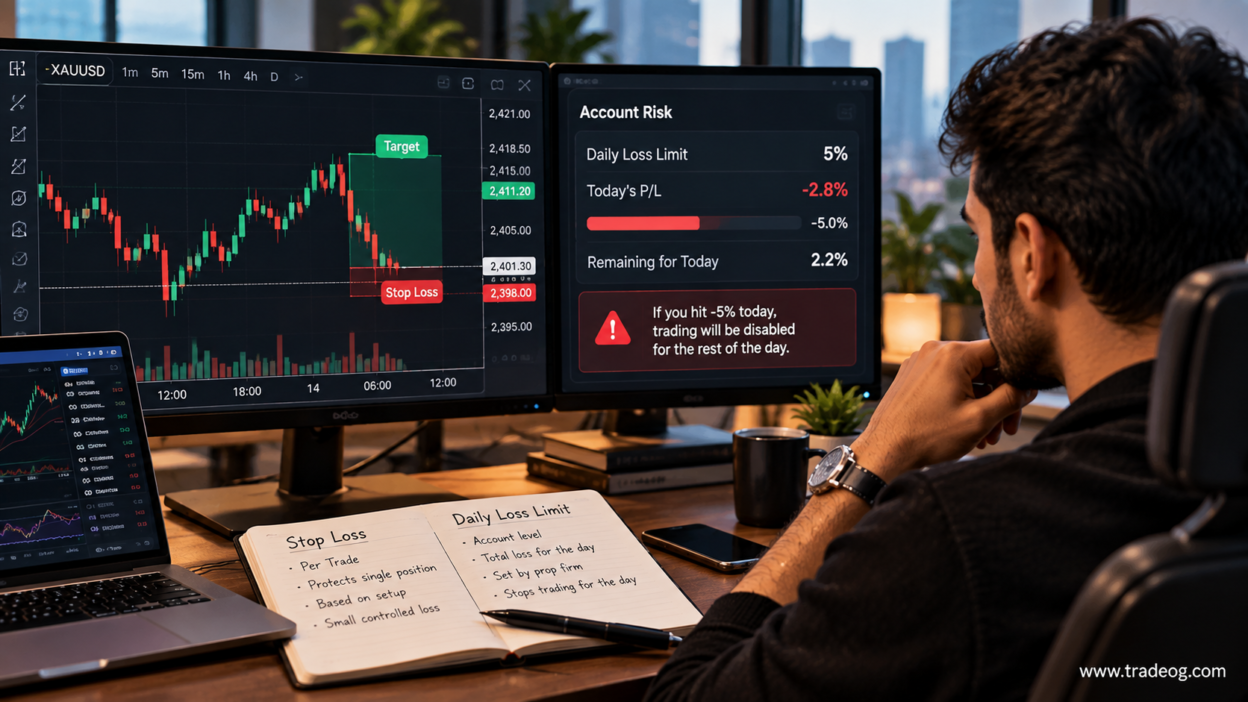
A trader once sent me a screenshot of his locked account dashboard in complete disbelief: “How did I breach my daily loss limit? Every single trade I took had a hard stop loss attached. I never risked more than 1% on any ticket. How is this even possible?”
The answer was simple, painful, and shared by thousands of liquidated traders every month: A Stop Loss protects an individual trade. A Daily Loss Limit protects the prop firm from you.
They are not interchangeable. They do not operate on the same time horizon, they are calculated by completely different software systems, and assuming your stop loss will automatically keep you inside your daily limit is the fastest way to lose a funded account.
If you want to rank among the 5% of traders who actually keep their accounts long enough to collect consistent payouts, you have to understand the operational gap between trade-level risk and account-level ceilings. Here is everything you need to know.
Daily Loss Limit vs Stop Loss: Understanding the Core Difference
Related: risk per trade and daily drawdown reset.
The easiest way to understand the difference between a Stop Loss and a Daily Loss Limit is through a driving analogy:
- Your Stop Loss is a seatbelt: It is a tactical, trade-level safety device you click into place before you accelerate. It is designed to cushion the impact if a single setup fails.
- The Daily Loss Limit is a concrete guardrail: It is a structural barrier built by the prop firm on the edge of a cliff. It doesn’t care whether your seatbelt was buckled or not; if your car collides with that guardrail at speed, the vehicle is totaled on impact.
A stop loss is an order you send to the broker’s matching engine. A daily loss limit is a contract rule monitored 24/7 by the prop firm’s risk management software.
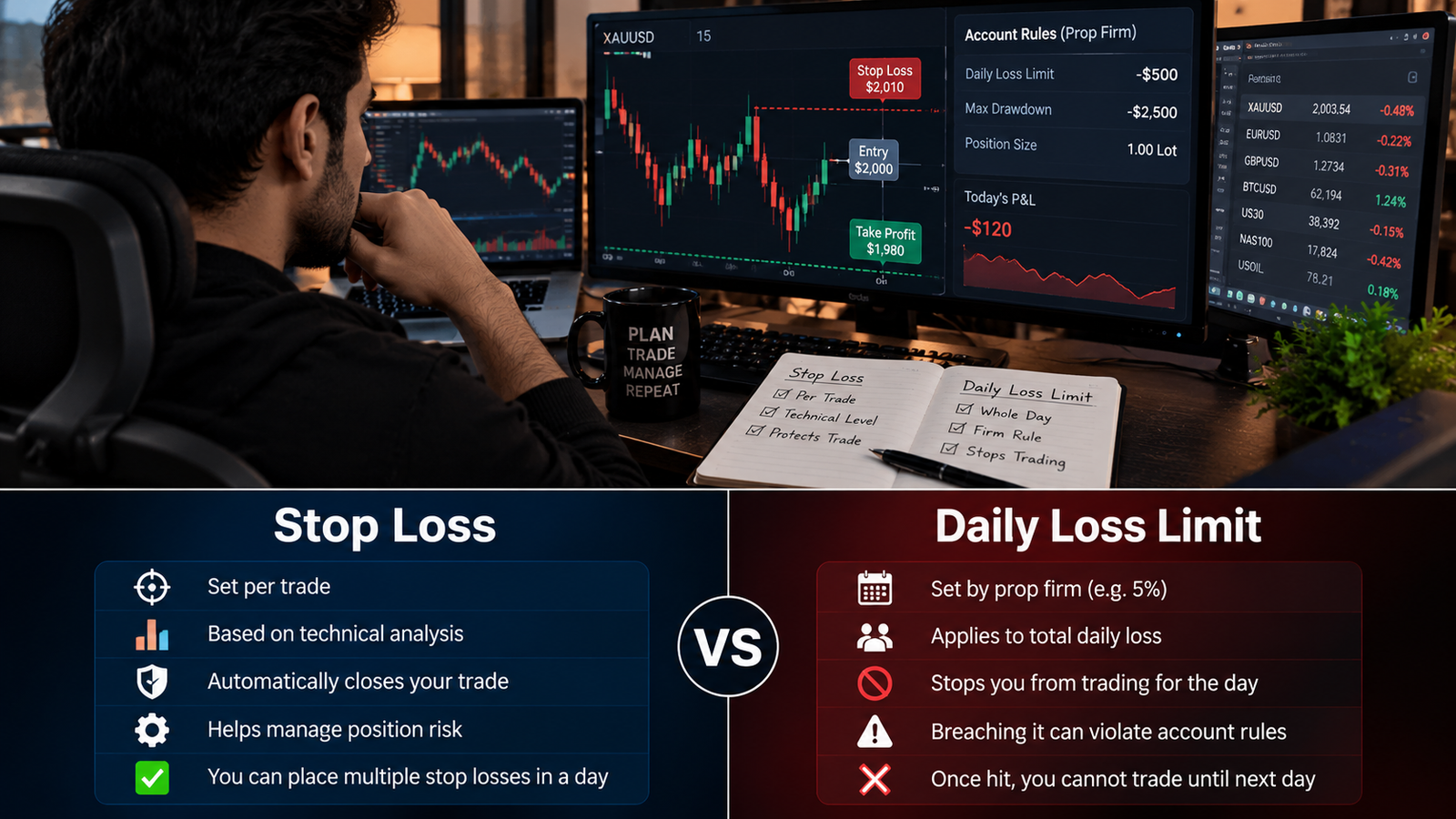
| Feature | Stop Loss (Micro Risk) | Daily Loss Limit (Macro Risk) |
|---|---|---|
| Primary Scope | Single position / ticket | Entire account balance & equity |
| Who Controls It? | You (the trader) | The prop firm’s automated risk engine |
| What It Tracks | Specific market price of an asset | Cumulative realized + floating P&L |
| Trigger Consequence | Closes the current trade at a defined loss | Locks account, closes all open trades, terminates contract |
| Slippage Exposure | Vulnerable to execution gaps and news spikes | Counts the final settled loss (including slippage) |
| Reset Mechanism | Resets with every new trade execution | Resets daily at the firm’s server close (e.g., 5 PM EST) |
4 Brutal Scenarios Where Having a Stop Loss Won’t Save Your Account
Most traders who blow their accounts didn’t “forget” their stop loss. They had stops on every trade. Here are the four exact real-world scenarios where trade-level stops fail to protect the daily limit:
1. The Correlated Basket Trap
You see a great setup to short the US Dollar. You enter three positions: short USD/JPY, long EUR/USD, and long GBP/USD. On each position, you set a disciplined stop loss risking exactly 1.5% of your account.
In your mind, you are managing risk because each trade has a stop. But in reality, you are holding 4.5% of aggregate risk on a single macro idea. A high-impact US CPI print surprises to the upside, the Dollar rockets 80 pips in four seconds, and all three stop losses hit almost simultaneously. Your daily loss limit was 4%. Your account was liquidated in 400 milliseconds.
2. The Floating Equity Mid-Candle Liquidation
This is the most common reason traders scream that their prop firm “cheated” them. Prop firms do not wait for you to close a trade to calculate daily loss; they monitor intraday floating equity tick-by-tick.
Suppose you have a 5% ($5,000) daily limit on a $100k account. You enter two trades. During an aggressive market swing, your open floating loss briefly dips to -$5,100 before rebounding 30 seconds later to close at +$800 profit.
Guess what? You are already disqualified. The moment your equity touched -$5,000 for even one millisecond, the firm’s liquidation script fired. The fact that your stop loss was placed further down or that the trade eventually became profitable is completely irrelevant.
3. Spread Expansion & Rollover Slippage
A stop loss is not a guaranteed price; it is a stop-market order. When the market reaches your stop level, your broker sells at the next available market price.
If you hold trades into the 5:00 PM EST session rollover or through major news announcements, market spreads widen drastically (EUR/USD spreads can widen from 0.2 pips to 6 pips in seconds). If you budgeted a $1,000 loss, execution slippage can easily push that to $1,400. If you were already nursing small earlier losses, that slippage gap will push you straight through your daily loss cap.
4. The Choppy Market Death by a Thousand Cuts
If your strategy risks 1% per trade and you take 5 disciplined trades on a day when your asset is stuck in a low-volume, whipsawing consolidation range, you can easily rack up five textbook losses in a row.
Each trade followed your rulebook. Each trade had a stop loss. But collectively, they consumed 5% of your account—triggering account closure before the lunch bell.
Why You Need a “Personal Circuit Breaker”
If you wait for the prop firm’s daily loss limit to stop you, you have already failed. A professional trader never allows the firm’s automated liquidation engine to be their stop mechanism.
To survive long-term, you must institute a Personal Daily Circuit Breaker that sits safely inside the firm’s official limit:
Personal Daily Limit = 50% of the Prop Firm's Daily LimitFor example, if your prop firm enforces a 5% Daily Loss Limit, your personal rulebook must state that your trading day ends permanently if you reach 2.0% to 2.5% in losses.
Why this rule saves accounts: That 2.5% buffer acts as an air cushion. It absorbs unexpected news slippage, commissions, and correlation mistakes. Most importantly, it gives you a clean psychological reset. You walk away with your account intact, ready to trade tomorrow with 75% of your drawdown buffer completely unharmed.
How to Mathematically Synchronize Your Stop Loss with Your Daily Limit
To ensure your stop loss never jeopardizes your daily limit, use this simple synchronization formula every morning before placing an order:
Maximum Risk Per Trade = Personal Daily Limit / Maximum Trades Planned for the SessionLet’s walk through an example on a $100,000 Funded Account:
- Firm’s Daily Limit: 4% ($4,000)
- Your Personal Daily Limit: 2% ($2,000)
- Max Setups Planned Today: 4 trades
- Max Allowed Risk Per Stop Loss: $2,000 / 4 = $500 (0.50% per trade)
Under this system, even if every single trade you take today hits its stop loss, your total loss is only $2,000. You are still a massive $2,000 away from the firm’s hard liquidation floor. You survived your worst possible day with zero risk of account termination.
Frequently Asked Questions (FAQ)
Can a guaranteed stop loss protect me from a daily loss limit breach?
Some retail brokers offer “Guaranteed Stop Losses” (often for a fee), but most prop firm trading platforms (Match-Trader, cTrader, MT4/MT5, DXtrade) use standard market orders. In prop trading, guaranteed stops are rare, meaning slippage during flash crashes or news spikes is entirely your responsibility.
Does the daily loss limit reset at midnight in my local timezone?
No! This is a dangerous mistake. The daily loss limit resets according to the prop firm’s server timezone (usually 5:00 PM EST / 00:00 UTC/CE(S)T). If you trade from Asia or Europe without knowing the firm’s exact server clock, your daily loss calculation could span across two different trading sessions without you realizing it.
Is it better to use mental stops or hard stops in prop firm accounts?
Always use hard stops. In prop trading, market volatility can wipe out a daily buffer in seconds. Mental stops are vulnerable to frozen internet connections, platform lag, and human hesitation. A hard stop placed directly on the server is your only line of defense against catastrophic market moves.
Final Word: Think in Systems, Not Tickets
Amateurs evaluate risk trade-by-trade. Professionals evaluate risk system-by-system.
Your stop loss is just one component of a broader risk architecture. It manages price levels on an individual chart, but your daily loss limit dictates whether you have a career as a funded trader tomorrow morning. Respect the difference, build a personal buffer, and never let a single bad session dictate the fate of your funded account.

[…] Understanding the interplay between these two constraints is paramount. A trader who confuses their trade-level stop loss with their daily loss limit will frequently breach their account long before reaching their overall drawdown threshold. For a technical analysis of this distinction, see our guide on daily loss limit vs stop loss mechanics. […]
[…] Furthermore, daily loss calculations factor in broker execution commissions, financing swap fees, and spread widening during session rollovers. To understand why stops fail to protect against daily limits, read our analysis on daily loss limit vs stop loss: why they are not the same. […]