

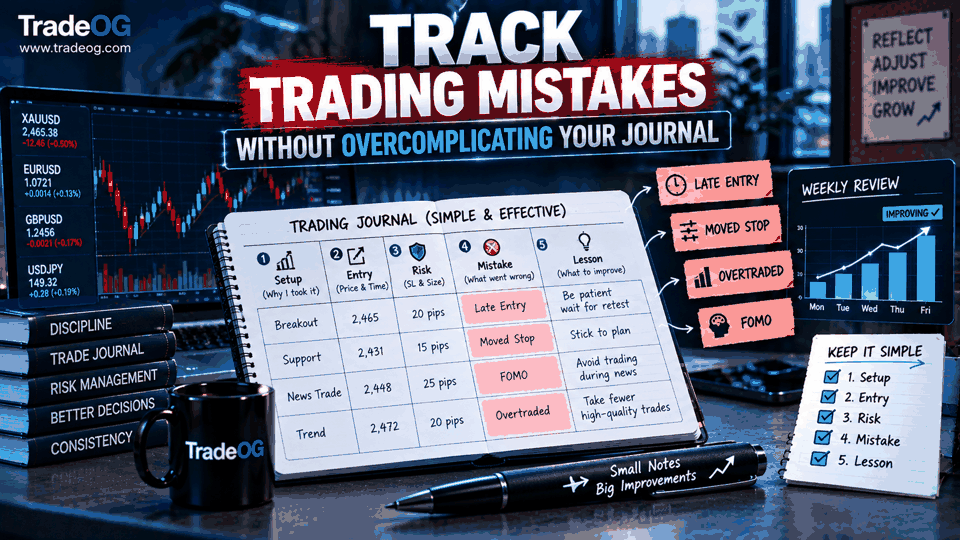
Most traders know they should keep a trading journal. The problem is that many journals become too complicated to maintain. After a few days, the trader is expected to record dozens of fields, screenshots, indicators, emotions, market conditions, news events, setup classifications and detailed notes. The result is predictable: the journal gets abandoned.
A useful trading journal does not need to look like a professional trading database. Its job is much simpler: help you identify what you did, what went wrong, why it happened and what you will change next time. The goal is not to document every second of a trade. The goal is to make repeated mistakes visible.
This guide explains a simple system for tracking trading mistakes without turning your journal into another full-time job. It works for forex, XAU/USD, futures, indices, stocks and prop firm trading.
Why Tracking Mistakes Matters More Than Recording Every Trade Detail
A broker or trading platform already records many objective facts: entry price, exit price, position size, time, commissions and profit or loss. A journal adds something the platform cannot fully capture: your decision-making process.
CME Group recommends maintaining a trade log so traders can review their history, understand why trades worked or failed and identify patterns in performance. Its guidance also suggests reviewing factors such as strategy performance, drawdowns, average trade duration and market conditions. CME Group’s trade-log guidance explains why record keeping is useful for identifying mistakes and successful behaviours.
The most valuable question is therefore not simply:
“Did I make money?”
It is:
“Did I execute the trade the way I intended to?”
A losing trade can be a good trade if you followed your plan and accepted the predefined risk. A profitable trade can be a bad trade if you ignored your rules and happened to get lucky.
The 5 Things You Actually Need to Record
You can build a useful mistake-tracking journal with just five core fields:
| Field | What to Record | Example |
|---|---|---|
| Setup | Why you entered | London breakout |
| Execution | Entry, stop and exit | Entered after confirmation |
| Risk | Planned risk | 0.5R |
| Mistake | What you did wrong | Moved stop farther away |
| Lesson | What you will change | Never widen the initial stop |
That is enough to start. You can add more fields later only if they help you discover a meaningful pattern.
Use a Mistake Code Instead of Writing a Long Explanation
One of the easiest ways to simplify a journal is to use a short list of mistake categories. Instead of writing a paragraph after every trade, select one or two codes.
| Mistake Code | Meaning | Typical Example |
|---|---|---|
| LE | Late Entry | Entered after most of the move had already happened |
| EE | Early Entry | Entered before confirmation |
| MS | Moved Stop | Widened the stop to avoid taking a loss |
| EP | Early Profit | Closed a valid winner too soon |
| OT | Overtrading | Took extra trades after the planned setup was gone |
| FOMO | Fear of Missing Out | Chased a fast move |
| REV | Revenge Trade | Entered mainly to recover a recent loss |
| NEWS | Ignored News Risk | Entered without checking a major scheduled release |
| SIZE | Oversized Position | Risked more than the trading plan allowed |
| PLAN | Plan Violation | Took a trade that did not meet the setup rules |
These codes turn your journal into something you can analyse quickly. After 50 or 100 trades, you can count how often each mistake occurred.
Separate Strategy Losses From Execution Mistakes
This is one of the most important improvements you can make to a trading journal.
Not every losing trade is a mistake.
Suppose your strategy has a valid setup, your entry follows the rules, your stop is placed correctly and the trade loses 1R. That may simply be a normal losing trade.
Now consider another trade where you entered late, doubled your position after the entry and moved your stop when price moved against you. If that trade loses 2R, the loss contains an execution problem.
| Trade Type | Result | Journal Classification |
|---|---|---|
| Valid setup + correct execution | -1R | Normal strategy loss |
| Valid setup + poor execution | -1.5R | Execution mistake |
| No valid setup + emotional entry | +1R | Profitable mistake |
| Valid setup + correct execution | +2R | Valid winner |
This prevents a common psychological error: believing that every losing trade means the strategy is broken.
Track Rule Violations, Not Just P&L
Profit and loss is important, but it can hide behavioural problems. A trader can make money while breaking rules, especially during a short winning streak.
Instead, track a simple Rule Violation Count.
For example:
- Moved stop: 2
- Entered without confirmation: 3
- Overtraded: 4
- Traded during restricted news: 1
- Oversized: 0
If overtrading appears eight times in a month, you have a much clearer improvement target than simply looking at the monthly P&L.
IG also recommends using a trading diary to record why a trade was taken, expected profit and risk, entry and exit points, market behaviour and the trader’s emotional state. Its performance guidance notes that a journal can be as simple as a book, spreadsheet or annotated chart, provided it is practical enough to maintain consistently. IG’s trading performance guidance provides further context.
The 60-Second Post-Trade Review
You do not need to spend 15 minutes writing after every trade. Try a one-minute review instead.
- Was the setup valid? Yes or No.
- Did I follow my entry rule? Yes or No.
- Did I follow my risk rule? Yes or No.
- Did I make a mistake? Select one code.
- What will I do differently? One sentence.
Example:
Result: -1R
Valid setup: Yes
Execution: Yes
Mistake: None
Lesson: Accept the planned loss and do not change the strategy because of one trade.
Another example:
Result: -1.8R
Valid setup: No
Execution: No
Mistake: FOMO + MS
Lesson: Do not chase an extended candle; stop remains fixed.
The second entry gives you a specific behavioural problem to work on.
Use One Screenshot, Not Ten
Charts are useful, but collecting screenshots of every timeframe can make a journal unnecessarily large.
For most traders, one screenshot is enough:
- Mark the entry.
- Mark the stop.
- Mark the target.
- Circle the point where the mistake happened.
- Add one short note.
For example, if the mistake was a late entry, mark the original breakout and the actual entry. You do not need screenshots of the 1-minute, 5-minute, 15-minute, hourly and daily charts unless your strategy genuinely depends on them.
Create a Weekly Mistake Review
The weekly review is where a simple journal becomes useful.
Do not review every trade in detail. Instead, count your mistakes.
| Metric | This Week | Goal |
|---|---|---|
| Total trades | 24 | — |
| Rule violations | 6 | Below 3 |
| FOMO trades | 2 | 0 |
| Moved stops | 1 | 0 |
| Overtrading | 3 | Below 1 |
| Valid losses | 7 | Accept them |
Now you have a practical conclusion: your biggest problem is not necessarily your strategy. It may be overtrading.
Find Your Top Three Repeated Mistakes
Do not try to fix ten behaviours simultaneously. Pick the three mistakes that occur most often or cost you the most money.
A useful ranking system is:
Frequency × Average Cost = Priority
Suppose you made:
- 5 late entries costing an average of 0.3R = 1.5R impact
- 2 moved-stop mistakes costing 1.2R each = 2.4R impact
- 8 overtrading mistakes costing 0.2R each = 1.6R impact
Your moved-stop behaviour deserves immediate attention even though it happened less frequently than overtrading.
Use R-Multiples to Make Mistakes Easier to Compare
R represents the amount you planned to risk on a trade. If your planned loss is $100, then 1R equals $100.
This allows you to compare mistakes across different account sizes and instruments.
For example:
- Trade A: -1R
- Trade B: -0.5R
- Trade C: -2R because the stop was moved
The third trade immediately stands out as a risk-management problem.
CME Group’s risk-management guidance emphasises defining maximum trade loss, maximum day loss and the amount of capital you are prepared to risk. CME Group’s risk-management framework provides a useful foundation for deciding which risk violations should be tracked.
Track Emotional Mistakes With a Simple Score
You do not need a long psychology questionnaire after every trade.
Use a simple 1–5 scale:
| Score | State |
|---|---|
| 1 | Calm and focused |
| 2 | Slightly uncertain |
| 3 | Emotionally distracted |
| 4 | Strong urge to act |
| 5 | Highly emotional / impulsive |
Then look for relationships. If most rule violations happen when your emotional score is 4 or 5, the solution may be a trading pause rather than a new strategy.
IG’s trading psychology material similarly highlights the value of recording emotional states and decision-making because these factors are not visible in normal account history. IG’s trading psychology guidance discusses how emotions can influence exits, risk-taking and subsequent decisions.
Do Not Turn Your Journal Into a Strategy Lab Every Night
One common mistake is changing the trading strategy after every losing trade.
A journal should help you identify repeated patterns, not encourage constant strategy changes.
Use a minimum sample size before changing a rule. For example, if a setup loses twice, that is usually not enough evidence to declare the setup invalid. If the same setup produces a meaningful pattern over dozens of trades, then it may deserve deeper testing.
Separate these questions:
- Was the strategy wrong?
- Was the execution wrong?
- Was the risk wrong?
- Was the trade outside the strategy?
This separation prevents emotional overreaction.
A Simple Trading Journal Template
You can copy this structure into Excel, Google Sheets, Notion or any journal application:
| Date | Market | Setup | Result | Mistake | Emotion | Lesson |
|---|---|---|---|---|---|---|
| 04 Oct | XAU/USD | Breakout | -1R | None | 2/5 | Valid loss; no change |
| 04 Oct | XAU/USD | Reversal | -1.5R | FOMO | 4/5 | Wait for confirmation |
| 05 Oct | NQ | Opening range | +2R | None | 1/5 | Followed plan |
| 05 Oct | EUR/USD | Breakout | -1.8R | MS | 5/5 | Never widen stop |
The Minimum Journal for Busy Traders
If you trade frequently, reduce the journal even further.
Record only:
- Market
- Setup
- Result in R
- Mistake code
- One lesson
That is enough to build a mistake database over time.
A five-column journal that you actually maintain is more valuable than a 30-column journal you abandon after one week.
How Prop Firm Traders Can Use Mistake Tracking
For prop firm traders, mistake tracking can be particularly useful because a behavioural mistake can have consequences beyond the individual trade.
Track violations such as:
- Approaching the daily loss limit
- Oversizing after a loss
- Revenge trading
- Trading outside permitted hours
- Ignoring news restrictions where applicable
- Moving stops to avoid closing a losing trade
- Taking too many correlated positions
Do not only record whether the account made money. Record whether your execution increased the probability of violating the account’s rules.
This creates a more useful performance metric: rule adherence.
How to Know Whether Your Journal Is Too Complicated
Your journal is probably too complicated if:
- You regularly skip entries.
- You spend more time formatting than analysing.
- You record fields you never review.
- You cannot explain your main mistake patterns in one minute.
- You change the template every week.
- You avoid journaling after a losing day.
The solution is not another productivity tool. Delete fields.
A 10-Minute Weekly Trading Review
At the end of each week, answer these seven questions:
- What was my most common mistake?
- What mistake cost the most R?
- Did I break my risk rules?
- Did I overtrade?
- Which setup had the best execution?
- What one behaviour should I eliminate next week?
- What one behaviour should I repeat?
Write one action for the following week.
That is much more actionable than writing a two-page review.
What You Should Not Track
Not every piece of information is useful. Unless your strategy specifically depends on it, you probably do not need to record:
- Every indicator value
- Every candle formation
- Every headline you read
- Every thought during the trade
- Multiple screenshots of the same setup
- Dozens of market statistics you never analyse
The journal should answer a practical question: What behaviour should I repeat or stop?
Trading Mistakes That Deserve Immediate Attention
Some mistakes are more dangerous than others because they directly increase risk.
| Mistake | Priority | Why |
|---|---|---|
| Moving stop farther away | Very High | Changes planned risk after entry |
| Oversizing | Very High | Can magnify normal market movement into a major loss |
| Revenge trading | High | Often creates a chain of emotional decisions |
| Overtrading | High | Adds unnecessary exposure and costs |
| Late entry | Medium | Can worsen entry quality and reward-to-risk |
| Early profit-taking | Medium | Can reduce average winner size |
| Normal strategy loss | Low | Not necessarily an execution error |
Risk management should remain separate from the desire to improve win rate. A trader can have a reasonable win rate and still perform poorly if losses are too large or risk rules are repeatedly violated.
Final Framework: The 5-Minute Trading Mistake Journal
If you want the simplest possible system, use this workflow:
- Before the trade: Write the setup and planned risk.
- After the trade: Record the result in R.
- Mark one mistake code: Only if a mistake occurred.
- Write one lesson: One sentence, not a paragraph.
- At the end of the week: Count the top three mistakes.
Then choose one behaviour to improve during the following week.
This approach is consistent with the broader principle behind professional trade logs: the value comes from reviewing decisions and identifying repeatable patterns, not from creating the longest possible record.
Frequently Asked Questions
How detailed should a trading journal be?
Start with the minimum information required to identify mistakes: setup, result, risk, mistake and lesson. Add fields only when they help answer a specific question.
Should I journal losing trades?
Yes. Losing trades often contain the clearest information about risk management and execution. But distinguish a normal strategy loss from a rule violation.
Should profitable trades be journaled?
Yes. A profitable trade can still contain a bad decision. Recording winners helps you identify behaviours worth repeating without confusing luck with good execution.
What is the biggest mistake traders should track?
Track the mistakes that either happen repeatedly or materially increase risk. Moving stops, oversizing, revenge trading and overtrading generally deserve more attention than a normal losing trade.
Can I use Excel or Google Sheets for a trading journal?
Absolutely. A spreadsheet is often enough. The best journal is the one you can update consistently and review objectively.
How often should I review my trading journal?
Do a quick review after each trade and a deeper review once a week. A monthly review can then identify longer-term patterns.
Should I track emotions?
Yes, but keep it simple. A 1–5 emotional score or a short label such as calm, uncertain, FOMO or frustrated is usually enough to identify behavioural patterns.
Conclusion
A trading journal should not become another complicated trading system. Its purpose is to make your decision-making visible.
Track the setup. Track the risk. Track the result. Identify the mistake. Write one lesson. Then review the pattern each week.
The objective is not to eliminate every losing trade. That is impossible. The objective is to eliminate avoidable mistakes while allowing normal strategy losses to remain part of the process.
When your journal becomes simple enough to maintain consistently, it becomes much easier to see the behaviours that are actually holding your trading back.