
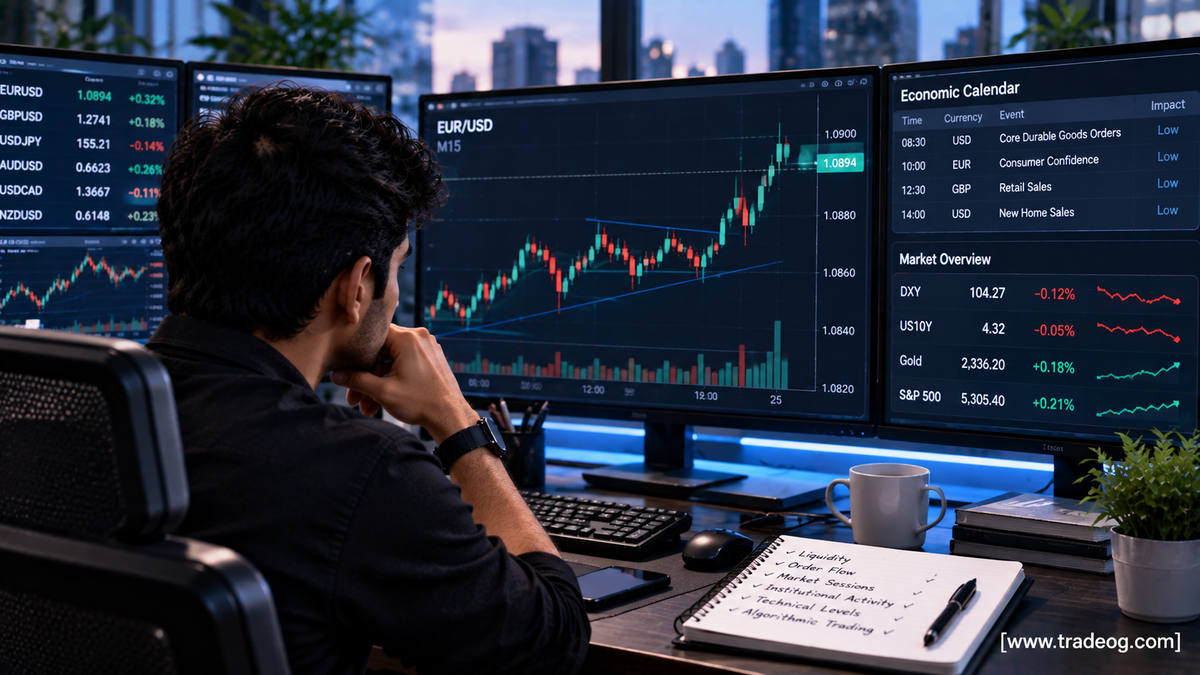
Have you ever opened a forex chart, checked the economic calendar, found no major announcement, and still watched EUR/USD, GBP/USD or USD/JPY move sharply? It can feel confusing because many beginners assume that every meaningful forex move must have a headline behind it.
The reality is different. Forex prices can move even when there is no obvious major news event because the market is constantly processing orders, liquidity, positioning, technical levels, cross-asset moves and changing expectations. News is only one source of information. In a decentralised over-the-counter market, prices can change simply because the balance between buyers and sellers changes.
The Bank for International Settlements (BIS) describes FX as a decentralised and fragmented market where trading takes place across dealers and multiple electronic venues. Research from the BIS also finds that order flow can contain information about future exchange rates.
Why Does a Forex Pair Move Without Major News?
A forex pair does not need a fresh CPI report, central-bank decision or employment number to move. A price changes whenever market participants are willing to transact at different prices.
For example, imagine EUR/USD is trading around 1.0850. There may be no major economic announcement, but if large buyers become more aggressive while available sell orders near 1.0850 are absorbed, the price can move to 1.0860, 1.0870 or higher.
Nothing dramatic appeared on the economic calendar. The market’s internal buying and selling pressure changed.
This is why checking only the news calendar is not enough to understand short-term forex price action.
1. Order Flow Can Move Forex Prices
One of the biggest reasons forex moves without visible news is order flow.
Order flow refers broadly to the actual buying and selling activity entering the market. Large banks, asset managers, corporations, hedge funds, exporters, importers, proprietary trading firms and other participants may need to exchange currencies for very different reasons.
A company may need USD to pay an overseas supplier. An investment fund may hedge foreign assets. A bank may rebalance its currency exposure. A leveraged fund may reduce a position. None of these transactions necessarily creates a headline for retail traders.
Yet collectively, these flows can affect prices.
BIS research has found that customer currency order flows can contain information about future exchange-rate movements. That does not mean every large order creates a trend, but it helps explain why price can react even when there is no obvious public announcement.
2. Liquidity Changes Throughout the Day
Forex liquidity is not constant. It changes by currency pair, trading session, market conditions and the number of active participants.
EUR/USD during an active London-New York overlap can behave very differently from EUR/USD during a quieter period. If fewer orders are available around the current price, relatively modest buying or selling can produce a larger price response.
This is especially important for short-term traders. A move that looks unusually large on a five-minute chart may not have been caused by a major fundamental shock. It may simply have happened during a period when the market had less depth.
For a deeper explanation of liquidity-related price behaviour, see our guide on what a liquidity grab in forex trading means.
3. The London and New York Sessions Can Change the Price
Another common reason for apparently unexplained movement is a change in market participation.
When a major trading session opens, new participants enter and existing positions may be adjusted. This can create fresh demand or supply without any new economic announcement.
For example, a pair may trade quietly during the Asian session and then start moving when London opens. Later, the New York session can add another wave of activity. The move may look like “random news” if you are only watching the chart, but the underlying explanation can simply be changing participation and liquidity.
This is one reason experienced intraday traders pay attention to session timing rather than treating every candle as an isolated event.
4. The Market Can React to Expectations, Not Headlines
Forex traders do not wait for official news before forming expectations.
Markets constantly price what participants believe will happen next. Traders may change positions because of recent economic data, comments from policymakers, bond-market movements, political developments, risk sentiment or changing forecasts.
Sometimes the information itself is not new. What changes is the market’s interpretation of it.
For example, suppose traders have become increasingly confident that a central bank will cut rates later in the year. The currency may weaken gradually over several sessions as positions adjust. On the day you notice the move, there may be no major announcement at all.
The move is still connected to information. It just did not arrive as a single headline at that exact moment.
5. Technical Levels Can Trigger Large Moves
A forex pair can also move because price reaches an important technical area.
Common examples include:
- Previous day high or low
- Weekly high or low
- Major support and resistance
- Round numbers such as 1.0800 or 1.1000
- Recent swing highs and lows
- Breakout levels
- Areas where many traders have placed stop-loss orders
Imagine EUR/USD has repeatedly struggled near 1.0900. When price approaches that level again, some traders may sell while others wait for a breakout. If enough orders are triggered, the pair can move rapidly through the level.
There may be no news at all. The market is simply responding to positioning around a price level.
This is why a technically important move should not automatically be labelled as manipulation or unexplained volatility.
6. Stop-Loss Orders Can Accelerate an Existing Move
Stop-loss orders are another reason a small move can suddenly become a large candle.
Suppose many traders are long EUR/USD and place protective stops below the same recent low. If price starts falling and reaches that area, those stops can be triggered. The resulting selling can add momentum to the decline.
That decline may then trigger additional stops or attract fresh sellers.
The process can create a chain reaction:
Initial selling → price reaches a key level → stop-losses trigger → additional selling → faster price movement.
Again, there does not have to be a major news release for this to happen.
7. Algorithms Can Move the Market Without a Retail News Headline
Modern FX trading is highly electronic. Banks, institutions and trading firms use automated systems to execute orders, manage risk and respond to changing market conditions.
BIS research notes that algorithmic trading and non-bank intermediation have become important parts of the modern FX market structure.
An algorithm does not need to wait for a headline saying “EUR/USD bullish.” It can respond to changes in price, liquidity, volatility, correlations, order flow or predefined execution conditions.
This can produce short bursts of movement that look mysterious to a retail trader who is only watching an economic calendar.
8. Another Market Can Move Your Forex Pair
Forex is closely connected with other financial markets.
A currency can react to:
- US Treasury yields
- Equity-market risk sentiment
- Commodity prices
- Gold
- Oil
- Credit-market conditions
- Volatility indices
- Another major currency pair
For example, USD/JPY can respond to changes in US Treasury yields even if there is no fresh USD/JPY-specific headline. AUD/USD can react to broader risk sentiment or commodity movements. CAD pairs can respond to oil-market developments.
The important lesson is that a forex chart should not always be analysed in isolation.
9. Positioning and Profit-Taking Can Reverse a Trend
Sometimes the reason a currency pair moves is simply that traders who already made money decide to close their positions.
Suppose EUR/USD has risen strongly for several days. There may be no bearish news, but traders who bought earlier may start taking profits. If enough participants do this at the same time, buying pressure falls and selling pressure increases.
The pair can then pull back even though the original bullish fundamental story has not changed.
This is particularly common after extended moves, major technical targets or periods of unusually strong momentum.
10. Low Volatility Can Suddenly Turn Into High Volatility
A quiet market can build up energy without producing obvious price movement.
When volatility is compressed, traders may place orders around a relatively narrow range. Once price breaks that range, pending orders, stop-losses and new momentum trades can combine to produce a larger move.
That breakout may happen during a completely ordinary calendar day.
So when a forex pair suddenly moves 30 or 40 pips without major news, ask what happened to the range, liquidity and positioning before assuming that there must be secret news behind it.
11. Why the Economic Calendar Can Look Empty
The economic calendar is useful, but it is not a complete map of everything that can move FX.
A calendar usually highlights scheduled macroeconomic releases. It cannot show every corporate currency transaction, portfolio rebalance, hedge adjustment, institutional order, technical stop, algorithmic trade or change in positioning happening across a decentralised global market.
BIS describes the FX market as fragmented across dealers and trading venues, with a substantial amount of trading taking place through dealer-customer relationships and internal liquidity pools.
That structure is one reason a retail trader can see price movement without seeing an obvious corresponding headline.
How Indian Forex Traders Should Analyse an Unexplained Move
If you are trading from India and see EUR/USD, GBP/USD or USD/JPY suddenly moving, do not immediately search social media for a dramatic explanation.
Use a simple checklist:
- Check the economic calendar: Look for scheduled data, speeches and events.
- Check the trading session: Did London or New York just become active?
- Check DXY: Is the US dollar moving broadly against several currencies?
- Check US yields: Are Treasury yields moving?
- Check major correlated assets: Look at equities, gold and commodities where relevant.
- Mark technical levels: Identify previous highs, lows, support, resistance and round numbers.
- Look for liquidity sweeps: Did price briefly take a prior high or low before reversing?
- Check spreads and execution: A fast move during thinner liquidity can produce different broker quotes and slippage.
For traders who are still learning execution costs, our guide to forex commissions versus spreads can help explain why the same market move can have a different practical impact depending on trading costs.
Example: EUR/USD Moves 35 Pips With No Major News
Imagine EUR/USD is trading at 1.0860 during a relatively quiet period. There is no major central-bank decision or employment report.
Price breaks above 1.0870, where several short positions have protective stops. Those stops create additional buying. At the same time, London participation increases and the dollar is weakening against several currencies.
EUR/USD reaches 1.0895.
A beginner may say, “There was no news, so why did EUR/USD rise?”
A better explanation is:
Changing liquidity + order flow + stop activation + broader USD weakness + technical breakout.
No single factor needed to be a headline. Several smaller forces can combine into one visible move.
Does Every Forex Move Have a Fundamental Reason?
Not necessarily in the way retail traders often imagine.
Over longer periods, macroeconomic fundamentals matter greatly. Interest rates, inflation, growth, trade flows, fiscal policy and central-bank expectations can influence currency valuations.
But on a five-minute or 15-minute chart, price can move because of short-term liquidity and positioning even when the underlying fundamental outlook has not changed.
This distinction is important. A short-term price movement does not automatically mean that the long-term fundamental story has reversed.
Should You Trade a Forex Pair Just Because It Is Moving?
No.
Unexpected movement can be an opportunity, but it can also be a warning. If you do not understand why volatility has increased, entering late can expose you to poor risk-to-reward conditions, wider spreads or rapid reversals.
This matters even more for leveraged accounts and prop-firm traders, where a relatively small adverse move can have a meaningful effect on account drawdown.
A better approach is to identify the cause of the movement category rather than searching for one magical headline:
- News-driven?
- Liquidity-driven?
- Technical breakout?
- Session-driven?
- Cross-asset-driven?
- Positioning-driven?
- Profit-taking?
Common Mistakes Traders Make When a Pair Moves Without News
1. Assuming the broker is manipulating the chart
Different liquidity sources and broker execution models can create small quote differences, but not every unexpected candle is broker manipulation.
2. Searching for news after the move
Traders sometimes search desperately for a headline to explain every candle. This can lead to hindsight bias.
3. Ignoring session timing
A move around a major market open can have a completely different explanation from a move during a quiet period.
4. Treating technical levels as irrelevant
Large pools of orders can exist around obvious highs, lows and round numbers even when the news calendar is empty.
5. Entering after the big candle
A sudden move can already have consumed much of its short-term momentum. Chasing it without a defined stop and invalidation level can create unnecessary risk.
Final Takeaway
Why does a forex pair move even when there is no major news? Because forex prices are driven by much more than scheduled economic announcements.
Order flow, liquidity, session changes, technical levels, stop-losses, algorithmic trading, cross-asset movements, expectations and profit-taking can all move a currency pair. In a decentralised OTC market, much of this activity is not visible as a headline on a retail economic calendar.
The best response to an unexplained move is therefore not to panic or invent a news story. Check the broader dollar, market session, liquidity, technical structure, correlated assets and positioning. Once you start looking at these factors together, many “random” forex moves become much easier to understand.
Risk disclaimer: Forex and leveraged trading involve substantial risk. This article is for educational purposes only and should not be treated as financial advice. Always verify market conditions, broker execution and applicable regulations before trading.