
Receiving a USDT trading payout in Trust Wallet can create a misleading sense that the entire payment process is finished. You may see the USDT balance in your wallet within minutes, while the INR equivalent is still nowhere near your bank account.
The reason is simple: USDT reaching Trust Wallet and money reaching your bank are two different settlement events. The first is a blockchain transfer into a self-custody wallet. The second normally requires an additional conversion and withdrawal route through a supported crypto or payment service, followed by its own verification, settlement and banking processes.
Trust Wallet describes itself as a self-custody wallet where users control their keys and can store, send, receive, buy, sell or swap supported assets. It does not turn a USDT balance into a bank deposit automatically. urlTrust Wallet’s USDT wallet informationhttps://trustwallet.com/usdt-wallet
This distinction matters especially for Indian traders receiving a prop-firm or other trading-related payout in USDT. The blockchain part can be complete while the INR off-ramp is still pending, unavailable, under review or subject to the rules of the provider and bank involved.
USDT in Trust Wallet Does Not Mean INR Has Been Sent
Consider a simple example. A trader receives a 1,000 USDT payout.
- The payer sends 1,000 USDT on the agreed blockchain network.
- The transaction is confirmed on-chain.
- Trust Wallet displays the 1,000 USDT.
- The trader still holds a crypto asset, not ₹1,000 worth of cash in a bank account.
- The trader must separately arrange an INR conversion and bank withdrawal through a supported route.
That final step is where many delays occur.
The blockchain does not have to be experiencing a problem simply because the bank has not received the money. In fact, the blockchain transaction can be fully confirmed while the later fiat transaction has not even started.
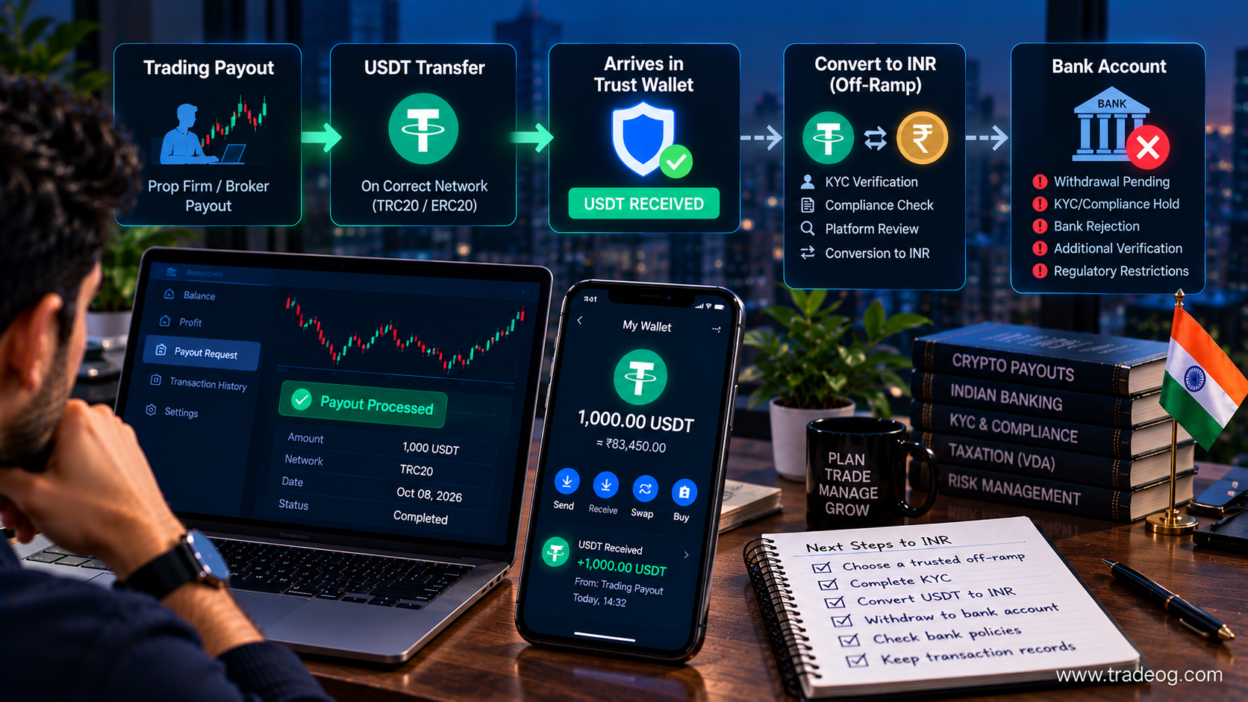
This is why it is useful to think of the process as a chain:
Trading payout → USDT transfer → Trust Wallet → off-ramp/conversion → INR settlement → bank account.
Each arrow represents a separate operational dependency.
Why a USDT Payout Can Reach Trust Wallet but Stop Before the Bank
1. Trust Wallet is the holding stage, not automatically the banking stage
A self-custody wallet primarily gives you control over the digital asset. When USDT arrives, the asset is available in your wallet according to the applicable blockchain transaction.
Trust Wallet’s terms explain that digital-asset transfers are processed through the applicable blockchain network and that Trust Wallet cannot cancel or modify a transaction after it has been initiated. urlTrust Wallet Terms of Servicehttps://trustwallet.com/terms-of-service
Therefore, a confirmed USDT balance tells you that the crypto transfer has reached the wallet. It does not tell you that an INR withdrawal has been approved or sent to your bank.
2. You still need a supported USDT-to-INR off-ramp
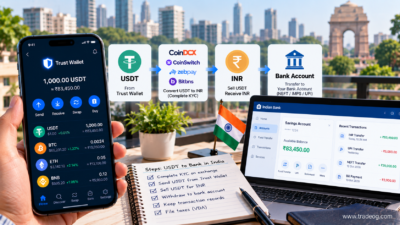
To move from USDT to rupees, you generally need a service that supports the relevant USDT network, accepts deposits from your wallet, allows the asset to be sold or converted into INR, and provides a bank withdrawal option for your account.
The exact process varies by provider. Some services may offer crypto-to-fiat features directly, while others require you to transfer USDT to a separate exchange or off-ramp first.
That is why TradeOG’s guide on Trust Wallet to INR should be treated as the next-stage companion to this article: the wallet receipt and INR withdrawal are separate parts of the workflow.
3. The receiving platform may not support the network you used
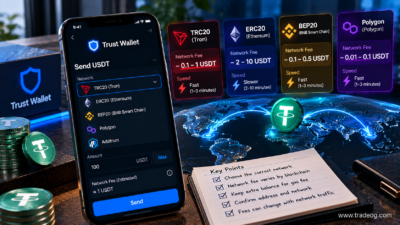
USDT exists on multiple blockchain networks. A platform may accept USDT but support only particular networks for deposits.
For example, if your wallet contains USDT on TRON and the receiving platform only provides an Ethereum deposit route for that transaction, you cannot assume that the two are interchangeable.
The network must match the receiving platform’s instructions for that specific deposit. TradeOG’s guide on TRC20 vs ERC20 USDT explains why this matters.
A network mismatch can create a much more serious problem than an ordinary bank-processing delay. Before moving funds, verify the token, network and receiving address together.
4. KYC or compliance checks can delay the INR stage
A crypto platform or payment provider may need to verify the customer’s identity, source of funds, transaction history or other information before allowing a fiat withdrawal.
This does not necessarily mean that something is wrong with the USDT transaction. The blockchain only confirms the digital-asset transfer. The off-ramp provider has its own customer and transaction controls.
A large or unusual transaction may therefore require additional review even though the USDT arrived successfully.
5. The bank receives INR, not your original USDT transaction
This distinction is easy to overlook.
Your bank normally does not receive the blockchain transaction that delivered USDT to Trust Wallet. It receives a later fiat payment after the USDT has been converted and the withdrawal has been processed by the relevant provider.
So there can be several different timestamps:
| Stage | What it means |
|---|---|
| Payout approved | The payer has approved or initiated the payout. |
| Blockchain transaction confirmed | USDT has been transferred on the selected blockchain. |
| Wallet balance updated | Trust Wallet displays the received USDT. |
| Deposit credited by off-ramp | The receiving platform has accepted the USDT deposit. |
| USDT sold/converted | The asset has been exchanged for INR or another fiat balance. |
| INR withdrawal initiated | The provider has started the bank payout. |
| Bank credited | The final INR amount appears in the bank account. |
Only the last event means the money has actually reached the bank.
A 1,000 USDT Example
Suppose an Indian trader receives 1,000 USDT from a trading-related payout.
The payer sends 1,000 USDT to the trader’s Trust Wallet address on the correct network. The transaction confirms and the wallet displays 1,000 USDT.
At this point, the trader may think:
“My payout has arrived, so why is my bank balance unchanged?”
Because the transaction has completed only the crypto leg.
The trader still needs to:
- Choose a supported off-ramp or crypto platform.
- Confirm that it supports the exact USDT network.
- Complete any required account verification.
- Transfer the USDT from Trust Wallet.
- Wait for the platform to credit the deposit.
- Sell or convert USDT into INR if required.
- Review the quoted rate, spread and applicable fees.
- Request an INR withdrawal to the linked bank account.
- Wait for the bank-side settlement.
There can therefore be multiple independent delays even though the original payout was successfully delivered to the wallet.
Check These Five Things Before Assuming Your Bank Is the Problem
1. Check the blockchain transaction hash
Start with the on-chain transaction, not the bank statement.
If the transaction hash confirms that the correct USDT amount reached your wallet address on the intended network, the original payout transfer may already be complete.
If the transaction is pending, failed or sent to an incorrect address, the problem is earlier in the chain.
2. Confirm the USDT network
Open the token details in Trust Wallet and identify the network associated with the USDT you received. Then compare it with the deposit network shown by the service you intend to use for INR conversion.
Do not select a network simply because the address looks familiar. Different networks can use similar-looking address formats, while the receiving platform may require a particular chain.
If you are unsure, stop before sending the funds. A wrong-network transfer can create recovery problems and may not be reversible.
See TradeOG’s detailed guide: What Happens If You Send USDT to the Wrong Network From Trust Wallet?
3. Check whether the off-ramp credited your deposit
After sending USDT from Trust Wallet, there is another transaction to verify. The receiving platform must detect the blockchain transaction and credit the deposit to your account.
A blockchain confirmation does not automatically guarantee instant platform credit.
Keep the transaction hash, amount, network and destination address available if support asks you to prove the transfer.
4. Check whether INR conversion actually happened
Some users confuse a crypto deposit with a fiat withdrawal.
If your platform still shows 1,000 USDT as a crypto balance, you have not yet completed the conversion stage. If it shows an INR balance, then the next question is whether the bank withdrawal has been initiated.
These are different states and should be checked separately.
5. Check the bank withdrawal status
If the platform shows the USDT as converted and the INR withdrawal as processed, look for the provider’s withdrawal reference, expected settlement information and any message requesting additional verification.
If the provider has not actually initiated the INR payment, contacting the bank first may not solve the issue.
Common Reasons the INR Withdrawal Can Be Delayed
- KYC is incomplete: the off-ramp may not permit withdrawals until identity verification is completed.
- Transaction review: the provider may review a particular deposit or withdrawal before releasing funds.
- Source-of-funds questions: a trading-related payout may require supporting records.
- Network mismatch: the USDT deposit may not have been sent using the network required by the receiving platform.
- Incorrect bank details: the linked account information may be incomplete or incorrect.
- Bank-side processing: the provider may have initiated the payment but the bank has not credited it yet.
- Withdrawal limits: account-level or transaction-level limits can affect the amount that can be withdrawn.
- Provider availability: crypto-to-INR services and supported payment methods can change.
- Fees and conversion spreads: the INR amount received can be lower than a simple USDT × displayed exchange-rate calculation.
For a broader explanation of payout deductions, see Why the Amount Received Can Differ From the Payout Amount.
Why a Bank May Ask Questions About a USDT-Related Payment
An important point for Indian traders is that the banking stage is separate from the blockchain stage.
A bank may have its own requirements for transactions, account activity and documentation. If a crypto platform converts USDT into INR and sends a bank transfer, the bank sees the resulting fiat transaction rather than the original blockchain event.
For larger or unusual transactions, it is sensible to maintain a clear record showing:
- the original payout statement;
- the payout amount and date;
- the blockchain transaction hash;
- the wallet address used;
- the network used;
- the USDT deposit record on the off-ramp;
- the conversion or sale record;
- the INR withdrawal record;
- the final bank credit.
This creates an audit trail connecting the original payout to the final bank transaction.
What About Tax in India?
Do not assume that moving USDT to your bank is the only tax event that matters.
Indian tax treatment can depend on the nature of the underlying income and on whether a transaction constitutes a transfer of a Virtual Digital Asset. The Income Tax Department’s current materials continue to provide specific reporting fields for income arising from transfer of VDAs, including Schedule VDA in the income-tax return framework.
At the same time, you should not automatically describe every USDT trading payout as a simple 30% VDA gain. The tax character of the underlying trading or prop-firm income and the later transfer of the digital asset are separate questions that can require professional tax advice.
For that reason, keep the complete transaction trail instead of relying only on the final bank credit.
Does Receiving USDT Make the Underlying Forex Activity Legal?
No.
The payment method and the legality of the underlying activity are separate questions.
The Reserve Bank of India has warned residents about unauthorised electronic trading platforms offering forex trading and has stated that resident persons can undertake forex transactions only with authorised persons and for permitted purposes under FEMA.
Receiving a payout in USDT through a self-custody wallet does not itself establish that the underlying forex activity is authorised in India.
Likewise, using a crypto wallet does not automatically remove applicable tax, foreign-exchange, banking or compliance considerations.
What You Should Do If USDT Is in Trust Wallet but the Bank Payment Is Missing
- Do not panic or send the USDT again. First establish which stage has actually failed.
- Verify the blockchain transaction. Confirm amount, network, recipient address and confirmation status.
- Check the wallet balance. Make sure you are looking at the correct USDT token and network.
- Confirm the off-ramp network. Do not transfer until the receiving platform explicitly supports the same network.
- Use a small test transfer where practical. This can reduce the risk of a large network or address error.
- Check deposit credit. A confirmed blockchain transaction can still require platform-side processing.
- Complete KYC or requested verification. Do not ignore legitimate verification requests.
- Confirm the INR conversion. Make sure the USDT has actually been sold or converted.
- Check the INR withdrawal reference. If the provider says the bank transfer has been sent, keep its reference.
- Contact the correct party. If the blockchain transfer is missing, investigate the crypto transaction. If INR withdrawal is processed but the bank has not credited it, contact the off-ramp and bank with the transaction reference.
What You Should Never Do
- Never share your Trust Wallet recovery phrase or private key with anyone claiming to be support.
- Never send additional USDT to a stranger promising to “unlock” or “release” a pending withdrawal.
- Never assume a screenshot proves that a bank transfer was completed.
- Never use a receiving network that differs from the network explicitly supported by the destination platform.
- Never delete transaction records because the wallet balance already looks correct.
- Never assume that a successful USDT transfer proves the underlying trading activity complies with Indian regulations.
USDT Payout to Bank: The Correct Mental Model
The easiest way to understand the problem is to separate the transaction into three layers.
Layer 1 — Blockchain: Did the USDT reach your wallet on the correct network?
Layer 2 — Off-ramp: Did a supported platform receive the USDT, complete any required checks and convert it into INR?
Layer 3 — Banking: Did the INR withdrawal actually leave the platform and get credited to the bank account?
If Layer 1 is complete but Layer 2 has not started, the bank cannot be expected to show the money.
If Layer 2 is complete but Layer 3 is pending, the issue is no longer a Trust Wallet problem.
This three-layer model can save a lot of time when troubleshooting a missing payout.
Quick Checklist for Indian Traders
| Question | What to verify |
|---|---|
| Did the payout leave the payer? | Payout status and payout reference |
| Did USDT arrive? | Blockchain hash and wallet balance |
| Is the network correct? | USDT chain on both sender and receiver |
| Did the off-ramp credit the deposit? | Deposit history and blockchain confirmation |
| Was USDT converted to INR? | Trade/sale/conversion record |
| Was INR withdrawal initiated? | Withdrawal status and reference |
| Did the bank receive INR? | Bank statement or transaction history |
Frequently Asked Questions
Why is my USDT visible in Trust Wallet but not in my bank?
Because the wallet receipt and bank withdrawal are separate stages. USDT must generally be converted into INR through a supported off-ramp before a bank can receive the resulting fiat payment.
Does Trust Wallet automatically send USDT to my bank?
No. Trust Wallet is a self-custody wallet. Its supported buy, sell and swap features can depend on available providers, assets, jurisdictions and current service availability. The presence of USDT in the wallet does not mean an INR bank transfer has been initiated.
Can a USDT transaction be confirmed while my bank withdrawal is pending?
Yes. The blockchain transaction can be confirmed long before the separate INR conversion and banking stages are completed.
What if my USDT reached Trust Wallet but my exchange or off-ramp has not credited it?
First verify the transaction hash, network, destination address and confirmation status. Then compare the transaction with the receiving platform’s deposit requirements. If all details match, use the platform’s official support process and provide the transaction hash.
Can a bank reject the INR payment even if the USDT transfer was successful?
Potentially, yes. The bank transaction is a separate fiat payment and can be subject to the provider’s and bank’s own verification, processing and account requirements.
Should I send the USDT again if the bank payment has not arrived?
No. First identify which stage is pending. Sending another transaction without understanding the problem can create a second, unnecessary transfer and increase your risk.
Final Takeaway
A USDT trading payout arriving in Trust Wallet does not mean the payout has reached your Indian bank account. It means the blockchain portion of the payment has reached your self-custody wallet.
The remaining path can involve a supported off-ramp, network compatibility, KYC, transaction review, USDT-to-INR conversion, withdrawal processing and bank settlement. Each stage can have its own status and delay.
If you are troubleshooting a missing payout, do not start by asking only, “Why hasn’t my bank received it?” Start by asking exactly where the transaction stopped: blockchain, off-ramp or bank.
For the complete preceding steps, see How to Move USDT From a Prop Firm to Trust Wallet, and for the next step, see Trust Wallet to INR: How Indian Traders Can Convert USDT to Rupees.
Disclaimer
Disclaimer: TradeOG provides educational and informational content only. Nothing in this article should be treated as financial, investment, legal, tax, banking, regulatory or professional advice. Indian forex rules, crypto/VDA taxation, exchange availability, payment-provider policies and blockchain support can change. Receiving USDT does not by itself establish that an underlying forex or prop-firm activity is authorised in India. Always verify the applicable RBI/FEMA rules, tax treatment, provider terms and network details, and consult a qualified professional for your specific circumstances.