

If you are new to forex trading, one of the first terms you will see is lot size. You may hear traders say “I entered 1 lot,” “I trade 0.10 lot,” or “I only use 0.01 lot.” But what does that actually mean?
In simple terms, a lot is a standard way of measuring the size of a forex position. It tells you how many units of the base currency you are controlling. The larger the lot size, the larger the exposure—and usually the larger the profit or loss for the same price movement.
This guide explains what 1 lot means in forex trading, how standard, mini, micro and nano lots work, how lot size affects pip value, how to calculate position size from your risk, and why beginners should never choose a lot size simply because it “looks small” on the trading platform.
What Is 1 Lot in Forex Trading?
In the commonly used forex convention, 1 standard lot = 100,000 units of the base currency.
For example, in EUR/USD, the base currency is EUR. Therefore:
- 1.00 lot EUR/USD = 100,000 euros of notional base-currency exposure
- 0.10 lot = 10,000 euros
- 0.01 lot = 1,000 euros
This does not mean you necessarily need the full 100,000 euros sitting in your account to open 1 lot on a leveraged trading product. Margin and leverage may reduce the cash required to open the position. But the underlying market exposure is still based on the position’s notional size.
That distinction is extremely important: margin is not the same thing as position size.
Lot Size Explained in One Simple Table
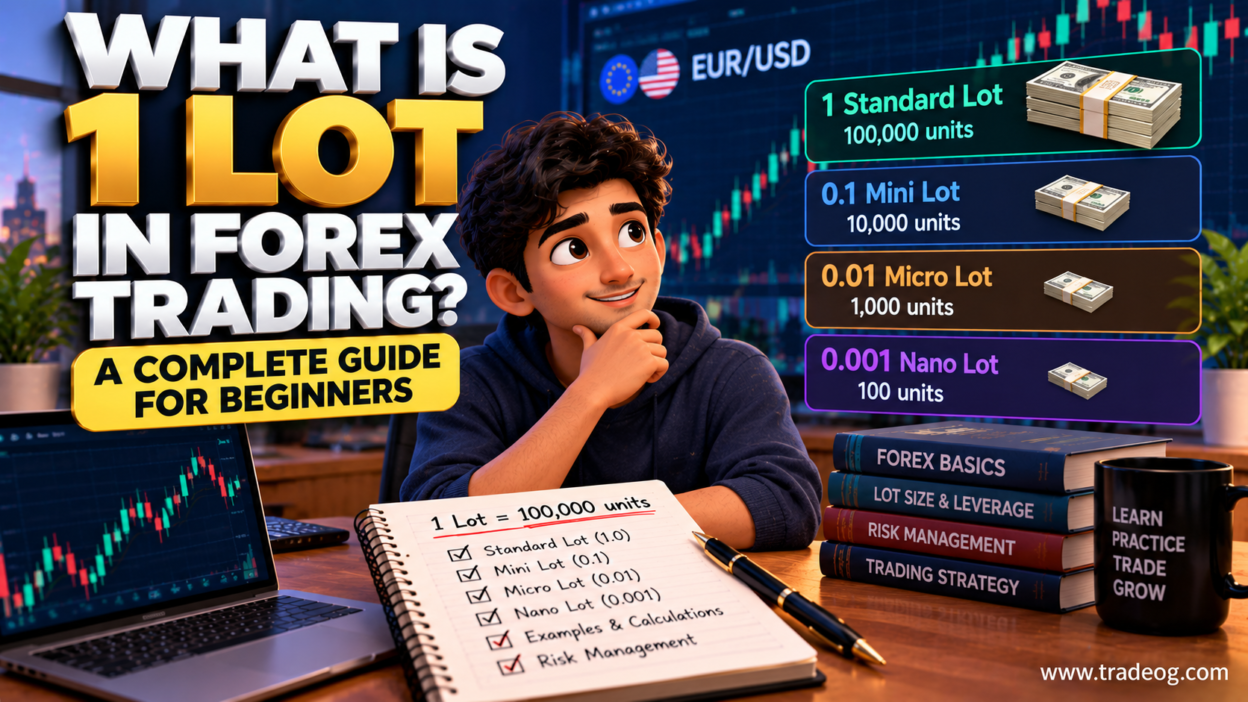
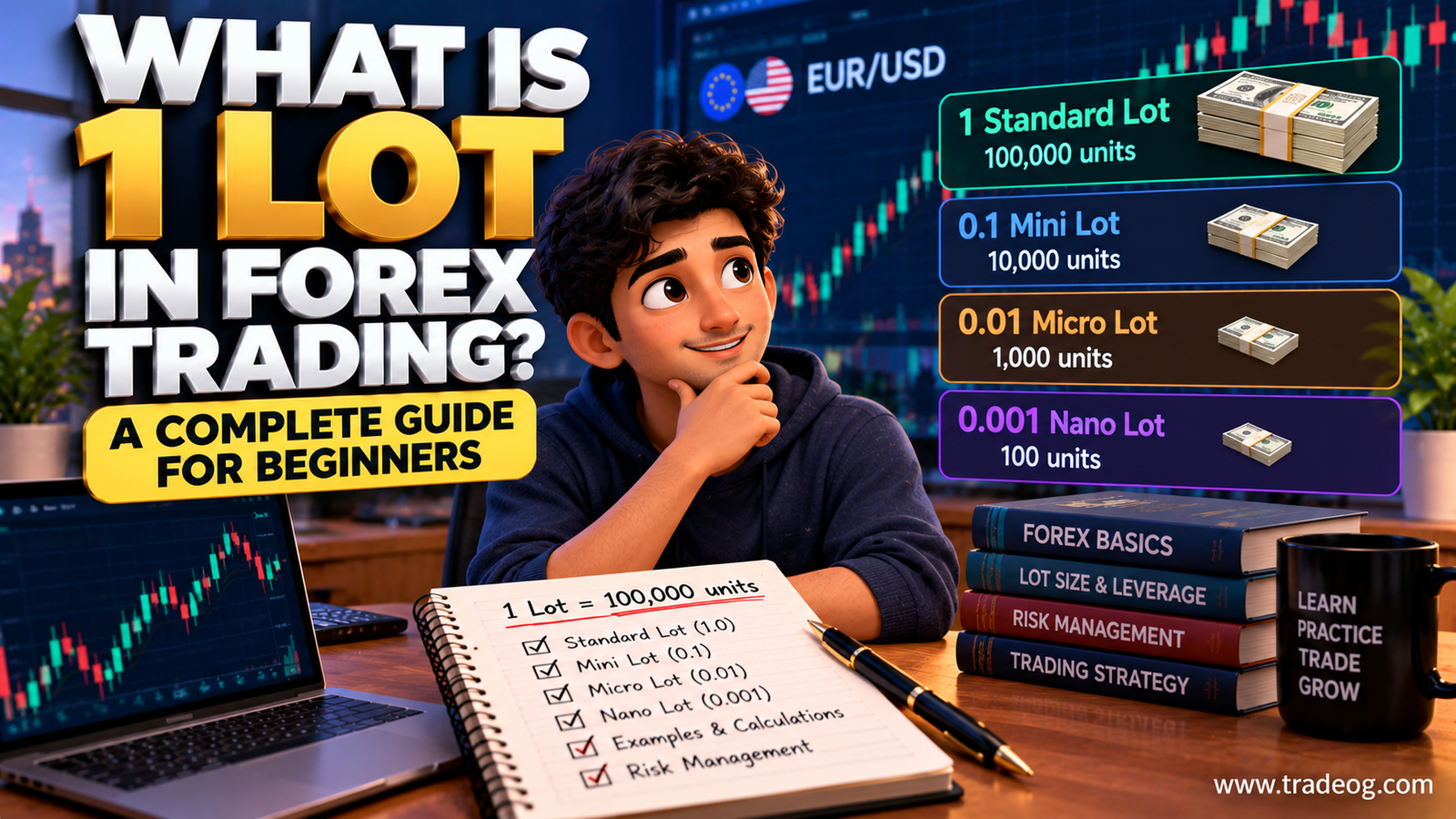
| Lot Type | Common Size | Units |
|---|---|---|
| Standard lot | 1.00 | 100,000 |
| Mini lot | 0.10 | 10,000 |
| Micro lot | 0.01 | 1,000 |
| Nano lot | 0.001 | 100 |
These are common industry conventions. Your broker or trading product may use different minimum sizes, contract specifications or naming conventions, so always check the exact specification before trading.
Why Is 1 Lot Equal to 100,000 Units?
The standard-lot convention makes it easier to describe position sizes consistently across the forex market. Instead of repeatedly writing large currency quantities, traders can say “one lot,” “half a lot,” or “0.10 lot.”
For example, if you buy 50,000 EUR against USD, you could describe the position as 0.50 lot EUR/USD under the standard convention.
Lot size is therefore a position-sizing language. It does not tell you whether a trade is good or bad. It only tells you how large the position is.
Standard Lot vs Mini Lot vs Micro Lot
1 Standard Lot
A standard lot is commonly 100,000 units of the base currency. It is a large position for a small retail account because even ordinary market movements can create significant monetary changes.
0.10 Lot: Mini Lot
A mini lot is commonly 10,000 units. It is one-tenth of a standard lot.
0.01 Lot: Micro Lot
A micro lot is commonly 1,000 units. It is one-hundredth of a standard lot.
0.001 Lot: Nano Lot
A nano lot is commonly 100 units. Not every broker supports nano lots.
The important relationship is:
1.00 lot = 10 × 0.10 lot = 100 × 0.01 lot = 1,000 × 0.001 lot
What Does 0.01 Lot Mean?
Beginners often ask this because 0.01 is one of the smallest commonly available forex trade sizes.
Under the standard convention:
0.01 lot = 1,000 units of the base currency.
So if you trade EUR/USD at 0.01 lot, your notional position is 1,000 euros, subject to the exact contract specification.
However, do not conclude that 0.01 lot is automatically “safe.” The correct position size depends on your account size, stop-loss distance, currency pair, contract value and the amount you are willing to risk.
What Does 0.10 Lot Mean?
0.10 lot = 10,000 units under the standard convention.
Because 0.10 lot is ten times larger than 0.01 lot, the monetary impact of the same price movement is also approximately ten times larger, assuming the same instrument and contract conditions.
This is why moving from 0.01 to 0.10 lot is not a small adjustment. It represents a tenfold increase in position size.
What Does 1.00 Lot Mean?
1.00 lot = 100,000 units under the standard forex convention.
For EUR/USD, this means 100,000 euros of base-currency notional exposure. For GBP/USD, it means 100,000 pounds of base-currency exposure.
The currency involved in the base position changes with the pair, but the standard lot convention remains 100,000 base-currency units.
How Does Lot Size Affect Profit and Loss?
Lot size directly affects how much money you gain or lose when the market moves.
If everything else remains equal, doubling your lot size approximately doubles the monetary effect of a given price movement. Cutting your lot size in half approximately cuts that effect in half.
For example, suppose a simplified position gains ₹100 from a particular price movement at 0.01 lot. If the same trade were taken at 0.02 lot under identical conditions, the gross price-movement result would be approximately ₹200.
The actual result can differ because of spread, commission, conversion rates, financing and the specific contract.
What Is Pip Value?
A pip is a commonly used unit for measuring price movement in many forex pairs. Pip value tells you approximately how much one pip is worth for your particular position size.
Lot size and pip value are closely connected.
For many major currency pairs where USD is the quote currency, a commonly used approximation is:
- 1.00 lot: about $10 per pip
- 0.10 lot: about $1 per pip
- 0.01 lot: about $0.10 per pip
This is a useful educational shortcut for pairs such as EUR/USD, but it is not universal. Pip value changes depending on the currency pair, exchange rate, account currency and contract specification.
Example: 1 Lot EUR/USD
Imagine EUR/USD is trading at 1.1000 and you hold 1 standard lot.
Using the common approximation for a USD-quoted major pair, one pip is approximately $10 for 1 lot.
If EUR/USD moves 20 pips in your favour:
20 pips × $10 ≈ $200
If it moves 20 pips against you:
20 pips × $10 ≈ -$200
This is before spread, commission, financing and other costs.
Example: 0.01 Lot EUR/USD
At 0.01 lot, the same common approximation gives roughly $0.10 per pip.
A 20-pip move would therefore be approximately:
20 × $0.10 = $2
This illustrates why smaller lot sizes can make it easier for beginners to keep individual trade risk smaller.
Lot Size and Leverage Are Not the Same
This is one of the biggest beginner misunderstandings.
Lot size tells you how large your position is.
Leverage tells you how much market exposure you can control relative to the margin required.
For example, a trader may have a relatively small account and still open a large position because the broker provides leverage. That does not make the position small. It simply means less cash may be required as margin to open it.
Leverage can therefore make large positions accessible—but it does not make them less risky.
Lot Size vs Margin
Consider a simplified example. Suppose a position has a notional value of $100,000 and the applicable margin requirement means $1,000 is required to support the position.
The $1,000 is the margin requirement in this example. It does not mean the position is only worth $1,000.
The position still has $100,000 of notional exposure.
This is why beginners should never say, “I only used ₹X margin, so my risk is ₹X.” Your actual risk depends on the position size and how far the market can move before your exit.
How to Calculate the Correct Lot Size
The safest way to choose a lot size is to start with your maximum acceptable loss, not with the lot number you want to trade.
A simplified position-sizing process is:
- Decide how much money you are willing to risk.
- Choose the logical stop-loss distance.
- Calculate the monetary value of that stop distance for one unit or one lot.
- Divide your allowed risk by the loss that one lot would produce at the stop.
- Round the result down to a trade size supported by your broker or exchange.
In simplified form:
Position Size = Maximum Risk ÷ Risk per Unit
The exact calculation becomes more involved when the account currency differs from the quote currency or when the instrument is not a standard forex pair.
Example: Choosing Lot Size From Risk
Suppose you have a ₹50,000 trading account and decide, purely as an example, that you do not want to risk more than ₹500 on one trade.
Your stop loss is 25 pips away.
If your selected pair and account conditions mean that 0.01 lot would lose approximately ₹20 for a 25-pip stop, then:
₹500 ÷ ₹20 = 25
That would mean 25 × 0.01 lot = 0.25 lot under this simplified assumption.
But this example is deliberately simplified. Before placing a real trade, you must use the actual pip value, conversion rate, spread and contract specification. Never copy the 0.25-lot answer into another currency pair without recalculating it.
Why Stop-Loss Distance Changes Your Lot Size
Suppose you want to risk ₹500.
If your stop is very close, you may technically be able to use a larger position while keeping the same planned loss. If your stop is farther away, your position size needs to be smaller to maintain the same monetary risk.
That means there is no universal “best lot size.”
The same trader might reasonably use 0.10 lot on one setup and 0.03 lot on another because the stop-loss distances are different.
Can I Trade 1 Lot With a ₹10,000 Account?
A broker may technically allow a trader to open a large position with a small account if sufficient leverage and margin are available. That does not mean doing so is sensible.
A 1-lot position can create a large monetary change from a relatively small market movement. With a ₹10,000 account, even a modest adverse move could represent a very large percentage of the account.
The correct question is not:
“Can my broker allow 1 lot?”
It is:
“If my stop loss is hit, will the resulting loss be acceptable for my account?”
What Lot Size Should a Beginner Use?
There is no universal beginner lot size. A trader with a ₹20,000 account and a trader with a ₹5 lakh account should not automatically use the same position size.
For a beginner, a better approach is to:
- start with a small position;
- know the monetary value of the stop loss;
- keep risk consistent;
- avoid using maximum leverage;
- practise on demo first where available; and
- increase size only after gaining experience and maintaining a tested process.
Does 1 Lot Mean the Same Thing for Gold?
No. This is extremely important for traders who move between forex and gold.
In traditional forex, the common standard-lot convention is 100,000 units of the base currency. But XAU/USD is a gold product, and the contract size depends on the broker, exchange or financial product.
Therefore, you should never assume:
“1 lot EUR/USD = 1 lot XAU/USD.”
They can have completely different contract specifications and monetary values per price movement.
Before trading gold, check the exact contract size, tick value, minimum volume, margin and trading conditions.
Does 1 Lot Mean the Same Thing for Indices and CFDs?
No. “Lot” is often used as a convenient volume label across different trading products, but the underlying contract can be completely different.
For an index, commodity or CFD, one lot may represent a particular number of units, barrels, ounces, contracts or a fixed monetary exposure depending on the provider.
Always read the instrument specification rather than assuming that forex lot conventions apply everywhere.
Forex Lot Size Calculator: What You Need
A good lot-size calculator generally needs:
- account balance;
- account currency;
- currency pair;
- risk percentage or maximum cash risk;
- entry price;
- stop-loss price;
- pip or tick value; and
- contract specification.
A calculator is useful, but it should support your understanding rather than replace it. If you do not know what the calculator is calculating, you can still make a serious sizing mistake.
Common Lot Size Mistakes Beginners Make
- Choosing 1 lot because it sounds professional: Lot size is not a measure of skill.
- Using the maximum leverage available: Available leverage is not a recommendation.
- Ignoring stop-loss distance: The same lot size can create very different risk depending on the stop.
- Confusing margin with risk: Margin is not your maximum possible loss.
- Using the same lot size on every instrument: Contract specifications differ.
- Ignoring account currency: Pip values may need conversion.
- Increasing lot size after a loss: This can turn a normal losing streak into major account damage.
- Copying another trader’s lot size: Their account balance and risk tolerance may be completely different.
- Moving the stop to support a large position: Position size should fit the trade idea, not the other way around.
- Forgetting trading costs: Spread, commission, financing and slippage can increase the actual loss.
Lot Size and Risk-Reward Ratio
Lot size does not determine whether a trade has a good risk-reward ratio. Your entry, stop and target determine the price-based risk and reward, while lot size determines how much money that price movement represents.
For example, a setup might have a 20-pip stop and a 40-pip target, giving a 1:2 price-based risk-reward relationship. Changing from 0.01 lot to 0.10 lot does not change that ratio. It changes the money gained or lost if the stop or target is reached.
Lot Size and Account Growth
Beginners often increase their lot size after a few winning trades. This can create a false feeling of skill because a larger position makes profits appear faster.
A more disciplined approach is to review performance over a meaningful number of trades and adjust position size according to a defined risk plan and account size.
Growing the account by taking uncontrolled position-size risk is not the same as building a sustainable trading process.
Lot Size for Indian Forex Traders
Indian traders should first identify the exact product they are trading. Currency derivatives available through Indian exchanges can have their own contract specifications, lot sizes, expiry rules and margin requirements.
Do not assume that a standard 100,000-unit retail forex lot applies to every currency product available in India.
Also verify the intermediary, trading venue and applicable RBI, SEBI and exchange rules before depositing funds or trading a product. The fact that an international platform displays a particular lot size does not by itself establish that the product or arrangement is permitted for an Indian resident.
1 Lot vs 0.1 Lot vs 0.01 Lot
| Position Size | Common Forex Units | Relative Size |
|---|---|---|
| 1.00 lot | 100,000 | 100% |
| 0.50 lot | 50,000 | 50% |
| 0.20 lot | 20,000 | 20% |
| 0.10 lot | 10,000 | 10% |
| 0.05 lot | 5,000 | 5% |
| 0.01 lot | 1,000 | 1% |
This table shows the relationship between volume and units under the standard convention. It does not mean that 0.01 lot represents 1% account risk. Account risk depends on your balance, entry, stop distance, pip value and costs.
Frequently Asked Questions
How much is 1 lot in forex?
A standard forex lot is commonly 100,000 units of the base currency. The exact contract specification should always be checked with your broker or trading venue.
How much is 0.01 lot?
Under the standard convention, 0.01 lot equals 1,000 units of the base currency.
How much is 0.10 lot?
Under the standard convention, 0.10 lot equals 10,000 units of the base currency.
How much is 1 lot in EUR/USD?
One standard lot of EUR/USD represents 100,000 euros of base-currency notional exposure. The exact margin and monetary profit or loss depend on the price movement, account currency, contract and trading costs.
How much money do I need for 1 lot?
There is no single answer because margin depends on the instrument, price, leverage and broker or exchange rules. More importantly, the amount you need as margin is not the same as the amount you could lose.
Is 0.01 lot safe?
0.01 lot is smaller than 0.10 or 1.00 lot, but it is not automatically safe. Risk depends on the instrument, stop distance, pip value, account size and costs.
What lot size is best for a $100 account?
There is no universal answer. Calculate the position size from the maximum amount you are willing to lose and the stop-loss distance. Also check whether your broker’s minimum position size makes that risk level practical.
Does lot size affect leverage?
Lot size determines position exposure, while leverage affects the margin needed to control that exposure. They are related but not the same thing.
Does 1 lot always mean 100,000 units?
No. The 100,000-unit convention applies to a standard forex lot. Gold, indices, commodities, futures and CFDs can have completely different contract specifications.
Can I change my lot size after opening a trade?
You generally cannot change the size of an already-open position without modifying the position through additional orders or partial closing. Any adjustment should be understood before execution because it changes exposure and risk.
Final Thoughts
Understanding what 1 lot means in forex trading is one of the foundations of responsible position sizing.
Remember the simple relationship: under the common forex convention, 1.00 lot = 100,000 units, 0.10 lot = 10,000 units, and 0.01 lot = 1,000 units.
But the most important lesson is that lot size should never be selected in isolation. Your account balance, stop-loss distance, pip value, contract specification, leverage and maximum acceptable loss all matter.
Do not ask only, “How many lots can I trade?” Ask, “How much can I lose if this trade reaches my stop?” That question leads to much better risk management.
Disclaimer: This article is for educational and informational purposes only and is not financial, investment, legal or tax advice. Forex and leveraged trading products involve substantial risk of loss. Contract sizes, margin, pip values, trading hours and regulations vary by instrument and provider. Verify the exact product specification before trading.