

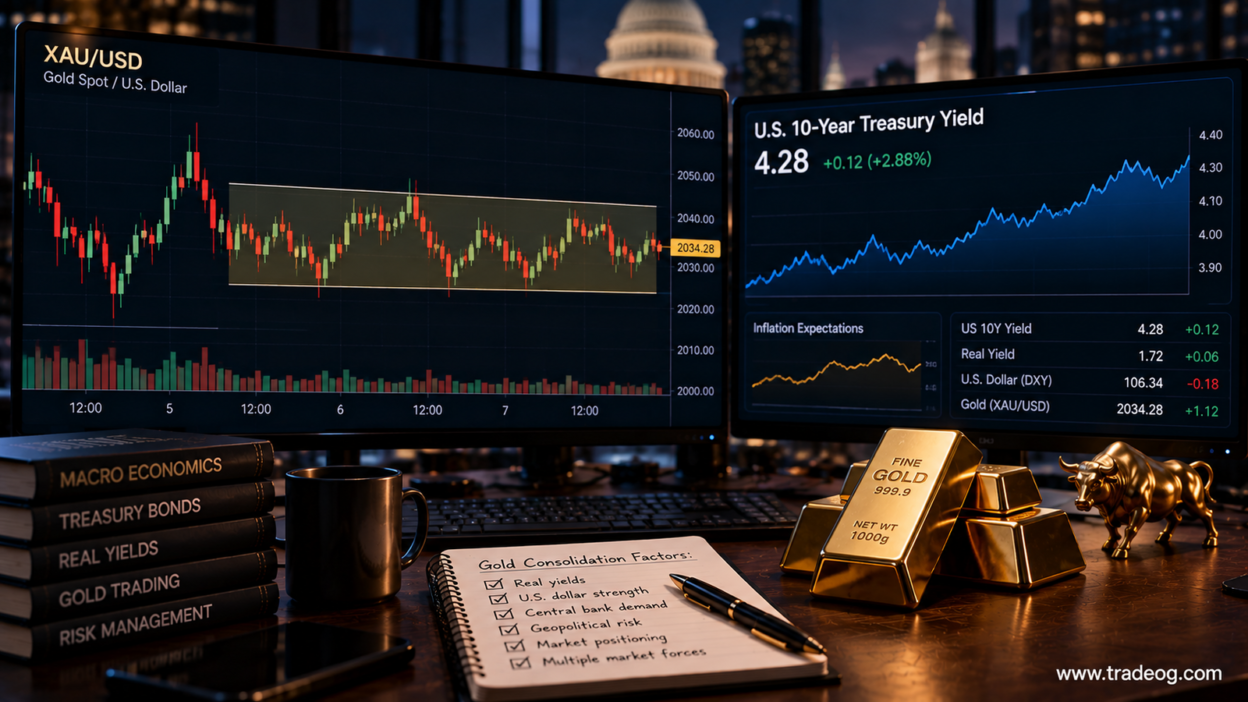
Gold can print a fresh high and still fail to accelerate higher. For XAU/USD traders, that situation is easy to misread: a new high looks bullish, but the move can stall because the breakout has not attracted enough fresh buying, the macro backdrop is mixed, or the market is simply taking profit after reaching an obvious liquidity level.
This matters because a new high is a price event, not proof of strong follow-through. Gold can briefly trade above a previous high, trigger breakout orders and stop losses, and then spend the next several candles consolidating or retracing. The World Gold Council notes that gold’s performance is influenced by risk, opportunity cost, the US dollar, momentum and investor positioning rather than by one variable alone. World Gold Council’s 2026 Gold Mid-Year Outlook
What Does “New High Without Follow-Through” Mean?
Suppose XAU/USD has a previous high at $4,150. Price pushes through it and prints $4,165, but the next several candles fail to extend the move. Instead, gold trades between $4,150 and $4,165, repeatedly testing the breakout area.
That is a new high without strong follow-through.
Follow-through means buyers continue accepting higher prices after the breakout. You normally want to see some combination of:
- higher highs and higher lows after the breakout;
- strong candle closes above the previous high;
- continued participation rather than an immediate fade;
- support developing above the old resistance;
- a catalyst that continues to favour gold.
Without those signals, the first move above resistance may be an extension of the existing trend, a liquidity event, or simply a temporary price discovery attempt.
1. Gold Can Reach a New High Because of Liquidity, Not Fresh Demand
Obvious highs contain orders. Breakout traders place buy stops above resistance, while short sellers often place protective stops above recent highs. When price reaches that area, those orders can create a rapid upward push.
That does not necessarily mean a large group of new investors has decided that gold should be materially higher.
For example, if gold has repeatedly failed near the same resistance, a move above it can activate clustered orders. Once those orders are filled, the immediate buying pressure can disappear. Price may then consolidate because the market needs a new catalyst to attract another wave of demand.
This is one reason a new high should be evaluated together with the liquidity sweep concept, rather than treated as an automatic buy signal.
2. Profit-Taking Can Appear Exactly at the New High
A market can be bullish and still sell off temporarily.
Imagine traders who bought XAU/USD several sessions earlier. When gold reaches a fresh high, that level can become an obvious place to lock in profits. If enough existing longs reduce exposure at the same time that breakout buyers enter, the two flows can partially cancel each other.
The result can look strange:
- gold makes a new high;
- the candle initially looks strong;
- buyers fail to extend the move;
- price moves sideways or pulls back;
- the broader bullish structure remains intact.
This is not automatically bearish. It can simply mean the market is absorbing supply from profitable positions before deciding whether another leg higher is justified.
3. A New High Does Not Mean the Macro Catalyst Is Still Getting Stronger
Gold is influenced by several macro variables at once. The World Gold Council identifies opportunity cost, risk, momentum and economic conditions as important drivers, while its 2026 outlook highlights the roles of real yields, monetary-policy expectations, the US dollar, investment demand and central-bank buying. World Gold Council’s 2026 outlook and mid-year analysis
This creates an important distinction: the reason gold reached the new high may already be priced in.
For example, gold could rally because traders expect lower rates. If that expectation is already reflected in price, the market may need an additional improvement in the rate outlook to continue rising.
Similarly, a geopolitical headline may produce a fast safe-haven rally. If the headline does not worsen, traders may stop chasing the move even though gold remains elevated.
4. Treasury Yields Can Limit Follow-Through
Gold does not pay interest, so changes in real yields can affect its relative attractiveness. When real yields rise, the opportunity cost of holding gold can increase. When yields fall, gold can become more attractive relative to interest-bearing assets.
But the relationship is not mechanical. Gold can sometimes remain strong while yields rise if other forces, such as geopolitical risk, central-bank demand or diversification flows, are powerful enough.
That is why traders should not use “yields up = gold down” as a standalone rule. The better question is whether the move in yields is strong enough to change the balance of forces behind XAU/USD.
Recent 2026 market action illustrates this point: gold has shown resilience even during periods of elevated Treasury yields because structural demand and geopolitical uncertainty have continued to matter. Reuters gold market coverage and World Gold Council market commentary
5. The US Dollar Can Offset a Gold Breakout
Gold is priced in US dollars, so a strengthening dollar can create a headwind for XAU/USD. A weak dollar, on the other hand, can make gold more attractive in dollar terms.
This creates situations where gold makes a new high but the dollar simultaneously begins strengthening. The initial gold breakout may continue because of momentum, but the dollar move can prevent aggressive follow-through.
For an intraday trader, the useful observation is not simply whether DXY is rising or falling. Watch whether the dollar move is accelerating at the same time that XAU/USD is trying to break higher.
6. Gold May Be Waiting for the Next Catalyst
Markets often move ahead of information. Once traders position for an expected event, price can reach a new high before the event itself occurs.
Then the market pauses.
For gold, important catalysts can include US inflation data, employment reports, Federal Reserve communication, Treasury-yield moves, geopolitical developments and major shifts in risk sentiment.
If the new high occurs before the catalyst, traders may be reluctant to chase the breakout. That can produce a tight consolidation just below or above the new high.
The key lesson is simple: lack of immediate continuation does not automatically invalidate the breakout. It may mean the market is waiting for information that can justify the next repricing.
7. The Breakout May Be Technically Extended
Sometimes the reason is much simpler: gold has already moved too far too quickly.
After a strong impulse, short-term traders may have already entered. Momentum indicators can become stretched, price can move far away from short-term averages, and the distance between the entry zone and logical stop-loss placement can become unattractive.
In that situation, buyers may still control the broader trend but have less incentive to buy aggressively at the new high.
This is where a trader should distinguish between trend strength and entry quality. A strong trend does not mean every new high is a good place to enter.
8. The New High May Be a Liquidity Test
One of the most important patterns in gold is a quick move through an obvious high followed by rejection.
Consider this sequence:
- Gold approaches a widely watched resistance level.
- Price pushes above the previous high.
- Breakout buyers enter and short stops are triggered.
- Price fails to attract sustained buying.
- XAU/USD returns toward the old resistance.
If price closes back below the previous high and continues lower, the breakout deserves much more caution. This is different from a healthy breakout that holds above resistance and builds a new support zone.
TradeOG’s guide on identifying false breakouts is useful for understanding this distinction.
9. High Liquidity Does Not Guarantee Follow-Through
Gold can experience strong liquidity during major trading-session overlaps while still failing to trend.
Liquidity determines how efficiently orders can be executed; it does not tell you which direction price must take. A liquid market can move sharply upward, absorb buying, and then consolidate.
This is particularly relevant around the London-New York overlap. TradeOG’s recent analysis of XAU/USD liquidity during the London-New York overlap explains why deeper participation can coexist with fast price movement and sudden reversals.
10. How Indian Traders Can Read a New Gold High
For traders watching XAU/USD from India, the first question should not be “Gold made a new high, should I buy?” Instead, use a confirmation sequence.
Check 1: Did the candle close above the old high?
A wick above resistance is weaker evidence than a decisive close above it.
Check 2: Did the next candle hold the breakout?
If price immediately falls back below the old high, the breakout is less convincing.
Check 3: Is there a higher low?
A higher low above the previous resistance suggests that the market may be converting resistance into support.
Check 4: What are Treasury yields doing?
A sharp rise in real yields can make sustained upside harder, while falling yields can provide a supportive backdrop.
Check 5: What is DXY doing?
A sudden dollar rally can create a headwind for XAU/USD.
Check 6: Is there a fresh catalyst?
If there is no new information supporting higher prices, consolidation after a new high is perfectly normal.
New High vs Strong Breakout: What Is the Difference?
| Condition | New High Only | Stronger Follow-Through |
|---|---|---|
| Price above old high | Yes | Yes |
| Strong close | Not always | Usually |
| Retest holds | Unconfirmed | More likely |
| Higher low above breakout | Not yet | Preferred |
| Fresh catalyst | May be absent | Often present |
| Risk of false breakout | Higher | Lower, but never zero |
What Traders Should Avoid
- Buying simply because a record or swing high was printed. The first move can be liquidity-driven.
- Ignoring the closing price. A wick and a sustained breakout are different events.
- Using a very tight stop directly under the breakout candle. Gold can retest obvious levels before continuing.
- Ignoring macro conditions. Dollar and Treasury-yield moves can change the quality of a breakout.
- Assuming consolidation means reversal. A pause can be absorption rather than distribution.
- Chasing an extended candle. Waiting for structure can improve the risk-to-reward profile.
A Simple XAU/USD Follow-Through Checklist
Before treating a new gold high as a high-confidence breakout, ask:
- Did XAU/USD close above the previous high?
- Did price hold above that level on the next test?
- Has a higher low formed?
- Is the dollar supportive or becoming a headwind?
- Are real yields helping or limiting gold?
- Is there a fresh fundamental catalyst?
- Is the move occurring during a liquid session?
- Is the breakout already extended relative to the recent range?
If several answers are negative, the new high may be more of a price discovery attempt than a clean continuation setup.
Final Takeaway
Gold can make a new high without strong follow-through because breaking a previous high does not automatically create new sustained demand. The move may be driven by stop orders, breakout positioning, short covering, profit-taking or an already-priced-in catalyst.
The stronger signal comes after the new high: does XAU/USD hold above the old resistance, build a higher low, attract fresh participation and receive support from the broader macro backdrop?
The World Gold Council’s 2026 research reinforces the broader point: gold’s direction reflects a combination of risk, momentum, opportunity cost, the dollar, investor demand and central-bank activity. World Gold Council’s 2026 research
For traders, therefore, the new high is the first piece of information—not the confirmation. Wait to see what price does after the breakout.
FAQs
Why does gold make a new high and then stop rising?
Profit-taking, exhausted short covering, limited new buying, mixed macro signals and a lack of fresh catalysts can all cause gold to consolidate after making a new high.
Is a new high in XAU/USD always bullish?
No. A new high is bullish in isolation, but a failed breakout can become a reversal signal if price quickly falls back below the previous resistance.
What confirms a gold breakout?
A sustained close above resistance, a successful retest, a higher low and continued participation provide stronger confirmation than a single wick above the previous high.
Should Indian traders buy immediately after gold makes a new high?
Not automatically. It is generally better to evaluate the breakout structure, session liquidity, dollar, Treasury yields and the distance to a logical stop before entering.

[…] article on why gold can make a new high without strong follow-through covers the opposite problem: a fresh high can still fail if the market cannot maintain […]