Trading is often described as a battle between buyers and sellers, but there is another battle happening inside the trader’s mind: the battle to make good decisions repeatedly.
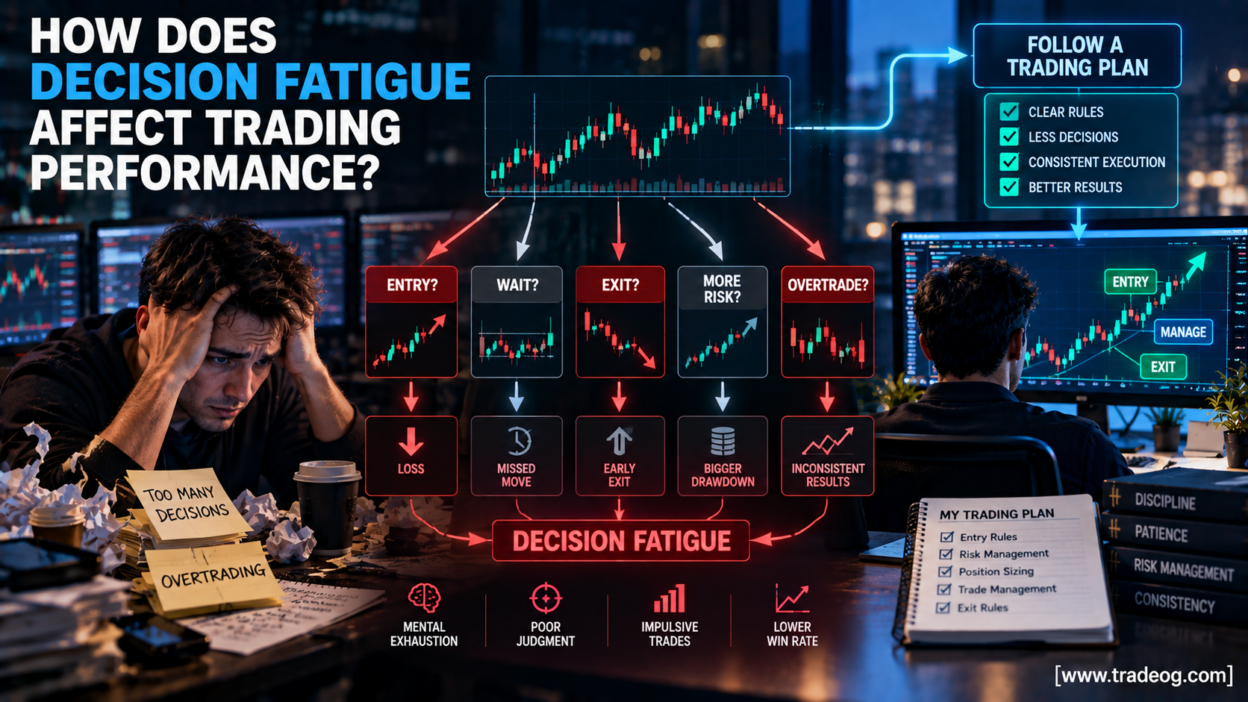
Every trading session can involve dozens of decisions. Should you enter? Should you wait? Should you move the stop? Should you take profit? Is the setup still valid? Should you trade again after a loss?
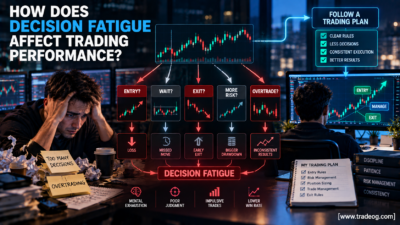
When these decisions accumulate, decision fatigue can affect trading performance. A trader may start the day with a clear plan and strong discipline, then gradually become more impulsive, less selective and more willing to break the rules.
Decision fatigue does not mean a trader has suddenly forgotten how to trade. It means the quality of decision-making can deteriorate after prolonged mental effort and repeated choices.
What Is Decision Fatigue in Trading?
Decision fatigue is the decline in decision quality that can occur after making many decisions over a period of time. In trading, this can happen because the trader is continuously evaluating price, news, technical setups, risk, open positions and possible outcomes.
The effect can be subtle. A trader may not feel exhausted, yet still start making decisions that would have been rejected earlier in the session.
For example, the first setup of the day may be taken only when all five trading conditions are present. After several hours of watching the market, the trader may begin entering when only three conditions are present.
The market has not necessarily changed. The trader’s decision threshold has changed.
Why Trading Creates So Many Decisions
Unlike many activities where decisions happen at fixed intervals, markets continuously generate new information.
A trader may have to process:
- price movement;
- market structure;
- support and resistance;
- volatility;
- economic news;
- open positions;
- unrealised profit or loss;
- entry opportunities;
- position size; and
- risk limits.
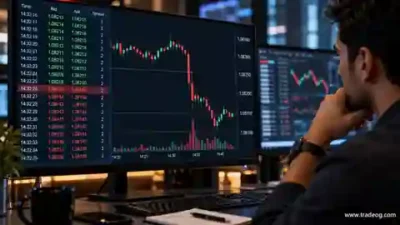
When a trader watches every price fluctuation, the number of perceived decisions can increase dramatically.
This is one reason constant chart monitoring can become counterproductive. TradeOG covers this in Why Does Watching Every Tick Make Short-Term Trading More Difficult?.
How Decision Fatigue Can Lead to Overtrading
Overtrading is one of the most common consequences of poor decision control.
At the beginning of a session, a trader may wait patiently for a high-quality setup. Later, after watching the market for hours, a smaller movement may suddenly appear attractive.
The trader tells themselves:
“It is not a perfect setup, but it looks good enough.”
That phrase can be a warning sign.
One weak trade may not matter much, but repeated low-quality decisions can significantly change the day’s results. Overtrading also increases spreads, commissions and the number of opportunities for execution errors.
Decision Fatigue Can Reduce Setup Selectivity
A profitable strategy often depends on selectivity. Not every market movement deserves a trade.
Decision fatigue can gradually lower the standard for what qualifies as a valid setup.
| Early in Session | After Many Decisions |
|---|---|
| Waits for confirmation | Enters before confirmation |
| Uses planned position size | Changes size emotionally |
| Accepts missed trades | Chases moves |
| Follows stop rules | Moves stops impulsively |
| Stops after daily limit | Looks for “one more trade” |
The key issue is consistency. A strategy cannot be evaluated properly if the rules change according to the trader’s mental state.
Why Losses Can Make Decision Fatigue Worse
A losing trade can require significant emotional processing. The trader may start questioning the strategy, looking for another setup or trying to recover the loss quickly.
After several losses, the number of decisions can increase because the trader starts analysing every possible opportunity.
This can create a dangerous cycle:
- A trade loses.
- The trader wants to recover the loss.
- More setups are considered.
- Entry standards become less strict.
- More trades are taken.
- Another loss creates more emotional pressure.
The problem is no longer just the original losing trade. The trader’s response to it becomes part of the risk.
Why Winning Streaks Can Also Create Poor Decisions
Decision fatigue is not limited to losing sessions.
A trader who has won several trades may become overconfident. They may begin believing that the next setup is also likely to work and increase position size or enter trades that do not meet the original criteria.
In both winning and losing streaks, emotional changes can influence decision quality.
The goal is to keep the process stable regardless of the previous trade.
How Decision Fatigue Affects Risk Management
Risk management is particularly vulnerable because it requires discipline even when emotions are high.
A fatigued trader may:
- increase position size;
- move a stop loss farther away;
- remove a stop entirely;
- take profit too early;
- hold a losing position because of hope;
- risk more after a loss; or
- ignore a daily drawdown limit.
These behaviours can transform a controlled strategy into an uncontrolled one.
For traders working under strict drawdown rules, the consequences can be particularly serious because one emotionally driven decision can consume a large part of the permitted risk.
Decision Fatigue and Short-Term Trading
Short-term trading can create more opportunities for decision fatigue because positions are opened and closed frequently.
A scalper might make dozens of decisions during a single session. Even when each decision is small, the cumulative mental workload can become substantial.
This is why a short-term trader should not confuse more activity with better performance.
A strategy with fewer, higher-quality decisions can sometimes be easier to execute consistently than one that requires constant intervention.
How Watching Every Tick Adds to Decision Fatigue
Tick-by-tick monitoring creates a continuous stream of information.
Price moves slightly higher: decision.
Price moves slightly lower: decision.
Spread changes: decision.
A candle becomes smaller: decision.
A trader sees another pair moving: possible decision.
Most of these observations do not require action. But when the trader feels that every movement deserves a response, mental fatigue can accumulate quickly.
This is why reducing unnecessary decisions can be more useful than trying to process every available piece of market information.
Decision Fatigue Can Cause Revenge Trading
Revenge trading is the attempt to recover losses through additional trading rather than following the original plan.
Decision fatigue can make revenge trading easier because the trader’s ability to pause and evaluate the situation objectively may already be weakened.
The trader stops asking, “Is this a valid setup?” and starts asking, “Can this trade recover my loss?”
Those are completely different questions.
Why a Daily Trade Limit Can Help
A daily trade limit reduces the number of decisions a trader is allowed to make.
For example, if a strategy allows a maximum of three trades per session, the trader does not need to decide whether to take the tenth opportunity of the day.
The rule has already answered the question.
This is an important principle of trading-system design: good rules should remove decisions rather than create more decisions.
Predefined Rules Reduce Mental Load
Consider the difference between these two approaches.
Discretionary approach: “I will decide when the market looks good.”
Rule-based approach: “I enter only when trend, structure, confirmation and risk conditions are all present.”
The second approach reduces the number of decisions that need to be made in real time.
It does not guarantee profitability, but it can improve consistency by reducing unnecessary discretion.
Use Checklists Before Entering a Trade
A trading checklist can convert a complicated decision into a sequence of simple yes-or-no questions.
For example:
- Is the market in the required condition?
- Is the setup present?
- Has confirmation occurred?
- Is the entry level acceptable?
- Is the stop-loss level defined?
- Is the position size within the risk limit?
- Is major scheduled news about to occur?
- Does the expected reward justify the risk?
If the required conditions are not present, there is no need for a long internal debate. The answer is simply “no trade.”
How Breaks Can Protect Decision Quality
Taking a break is not the same as giving up on a trading session. It is a way of reducing continuous cognitive load.
After a sequence of trades, a trader can step away from the chart and return only when the next predefined setup appears.
This can also reduce emotional carry-over from the previous trade.
Separate Analysis From Execution
One useful technique is to do as much analysis as possible before the active trading period.
For example, before the session begins, identify:
- important support and resistance;
- higher-timeframe direction;
- key liquidity levels;
- major economic events;
- potential entry zones; and
- maximum daily risk.
During the session, the trader then waits for predefined conditions instead of rebuilding the entire analysis after every price movement.
Do Not Let the Previous Trade Decide the Next Trade
A winning trade should not automatically increase confidence in the next setup. A losing trade should not automatically make the next setup more attractive.
Each trade should be evaluated according to the same criteria.
This is especially important for systematic traders because a strategy’s historical expectancy assumes that its rules are applied consistently.
Decision Fatigue and High Win-Rate Strategies
A high win rate can create another psychological problem: traders may become uncomfortable with losing trades.
If a strategy normally wins frequently, one loss may feel like something that needs to be immediately corrected. The trader may take another setup too quickly or increase risk.
But a strategy’s win rate does not remove variance. Even a historically strong system will experience losing trades.
TradeOG explains the broader relationship between win rate and profitability in Why Can a High Win Rate Strategy Still Lose Money?.
How Decision Fatigue Can Affect Prop Firm Traders
Prop firm traders often operate under strict daily loss and maximum drawdown rules. That environment makes decision discipline especially important.
A trader may start with a good setup, take a normal loss and then spend the rest of the session trying to recover it. The additional trades can increase exposure while reducing decision quality.
A predefined daily loss limit, maximum number of trades and mandatory break after consecutive losses can reduce the opportunity for this behaviour.
Signs You May Be Experiencing Decision Fatigue
- You take setups that you would normally reject.
- You repeatedly change your stop-loss.
- You increase position size without a strategy-based reason.
- You feel the need to trade because the market is moving.
- You keep reopening charts after closing a position.
- You struggle to accept a missed opportunity.
- You take trades to recover previous losses.
- You make different decisions late in the session than early in the session.
- You feel mentally drained after a high number of trades.
These signs do not prove that decision fatigue is the only cause, but they can indicate that your process contains too many discretionary decisions.
How to Reduce Decision Fatigue in Trading
1. Create a fixed trading window
Instead of watching markets all day, define the sessions you actually trade. This reduces unnecessary exposure to market noise.
2. Limit the number of trades
Set a maximum number of trades per session or day and stop once the limit is reached.
3. Predefine risk
Determine maximum risk per trade and maximum daily loss before the session starts.
4. Use alerts
Set alerts around important levels so you do not need to stare continuously at the chart.
5. Use a checklist
A checklist reduces the number of decisions that must be invented in real time.
6. Take structured breaks
Step away after a defined number of trades or after an emotionally difficult trade.
7. Keep a trading journal
Record not only the trade result but also whether you followed your rules. This helps identify patterns of decision deterioration.
8. Stop when your process deteriorates
If you notice repeated rule-breaking, continuing to trade may create more damage than benefit. Protecting capital includes protecting decision quality.
Practical Example: A Gold Trader During a Volatile Session
Imagine a trader is trading XAU/USD during the US session. The trader has a strategy that normally allows a maximum of three high-quality setups.
The first trade wins. The second trade loses. The trader then watches gold for another two hours waiting for the next opportunity.
After seeing dozens of price movements, the trader takes a fourth trade even though the setup does not meet all conditions. A sudden reversal produces another loss.
The problem was not necessarily the strategy. The trader exceeded the original decision framework because prolonged monitoring and the desire for another opportunity changed the behaviour.
A predefined three-trade limit would have removed that decision entirely.
Decision Fatigue vs Trading Psychology
Decision fatigue is closely related to trading psychology, but they are not exactly the same.
Trading psychology covers emotions, beliefs, confidence, fear, greed and behavioural patterns. Decision fatigue focuses more specifically on how repeated decision-making can reduce the quality or consistency of later decisions.
Both can influence execution, which is why a strong strategy still requires a strong process.
The Goal Is Not to Make More Decisions
Many new traders assume that professional trading means constantly analysing the market.
In reality, experienced execution often involves waiting.
The trader’s job is not to react to everything. It is to identify situations where the probability and risk profile meet the strategy’s requirements.
Everything else can be ignored.
Final Takeaway
Decision fatigue can affect trading performance by gradually reducing patience, selectivity and risk discipline. It can contribute to overtrading, impulsive entries, revenge trading, position-size changes, premature exits and rule-breaking.
The solution is not simply to become mentally tougher. A better approach is to design the trading process so that fewer unnecessary decisions are required.
Use predefined entry criteria, fixed risk limits, trade limits, alerts, checklists and structured breaks. The fewer decisions you need to improvise in the heat of the market, the easier it becomes to execute the strategy consistently.
Frequently Asked Questions
What is decision fatigue in trading?
Decision fatigue is the decline in decision quality or consistency that can occur after making many decisions. In trading, it can lead to weaker setup selection, impulsive entries and poor risk management.
Can decision fatigue cause overtrading?
Yes. As traders become mentally tired, they may lower their standards for what qualifies as a trade and take more marginal setups.
How can traders prevent decision fatigue?
Useful methods include fixed trading hours, checklists, daily trade limits, predefined risk, alerts, structured breaks and a consistent trading plan.
Does decision fatigue affect profitable traders?
Yes. Profitability does not make a trader immune to mental fatigue. In fact, a winning streak can sometimes encourage overconfidence and additional discretionary decisions.
Why is decision fatigue dangerous for prop firm traders?
Prop firm accounts often have strict drawdown and daily-loss restrictions. A few poor decisions after mental fatigue can therefore have a disproportionately large impact on account survival.