

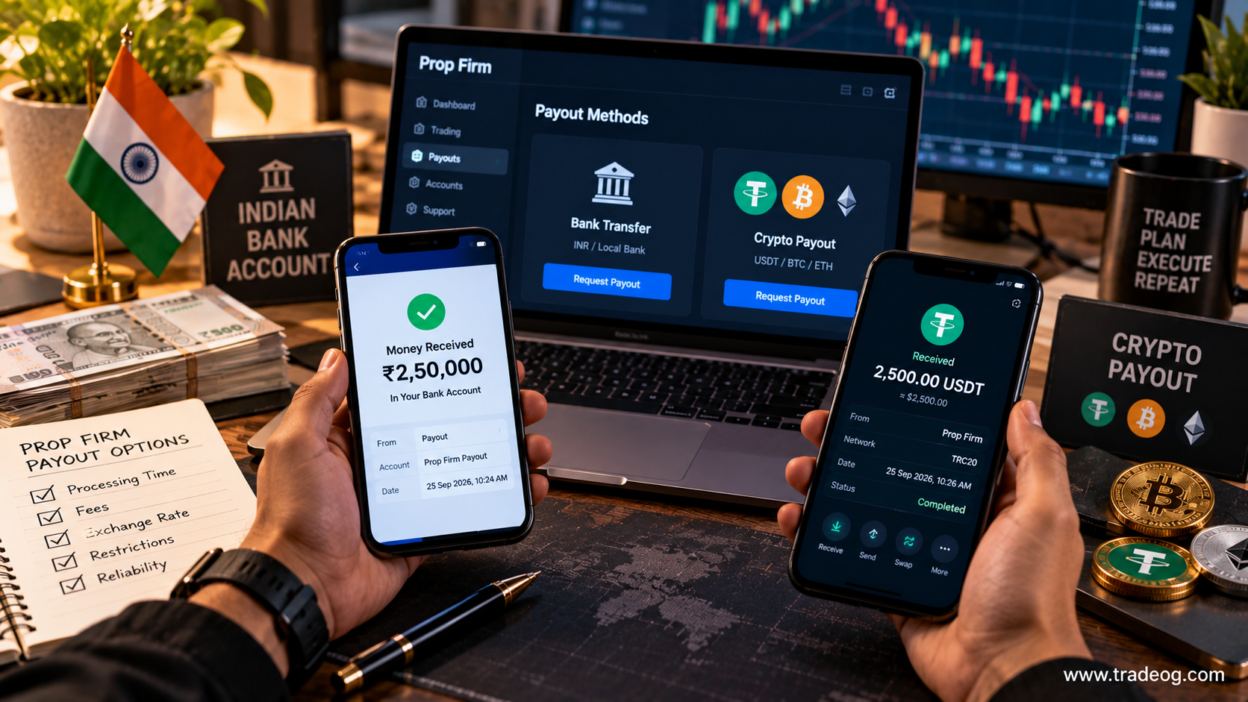
Getting a prop firm payout into an Indian bank account looks simple: request the payout, wait for processing, and receive INR. In practice, the flow can involve payout verification, an overseas payment provider or bank, currency conversion, your Indian bank’s inward-remittance checks, and tax records.
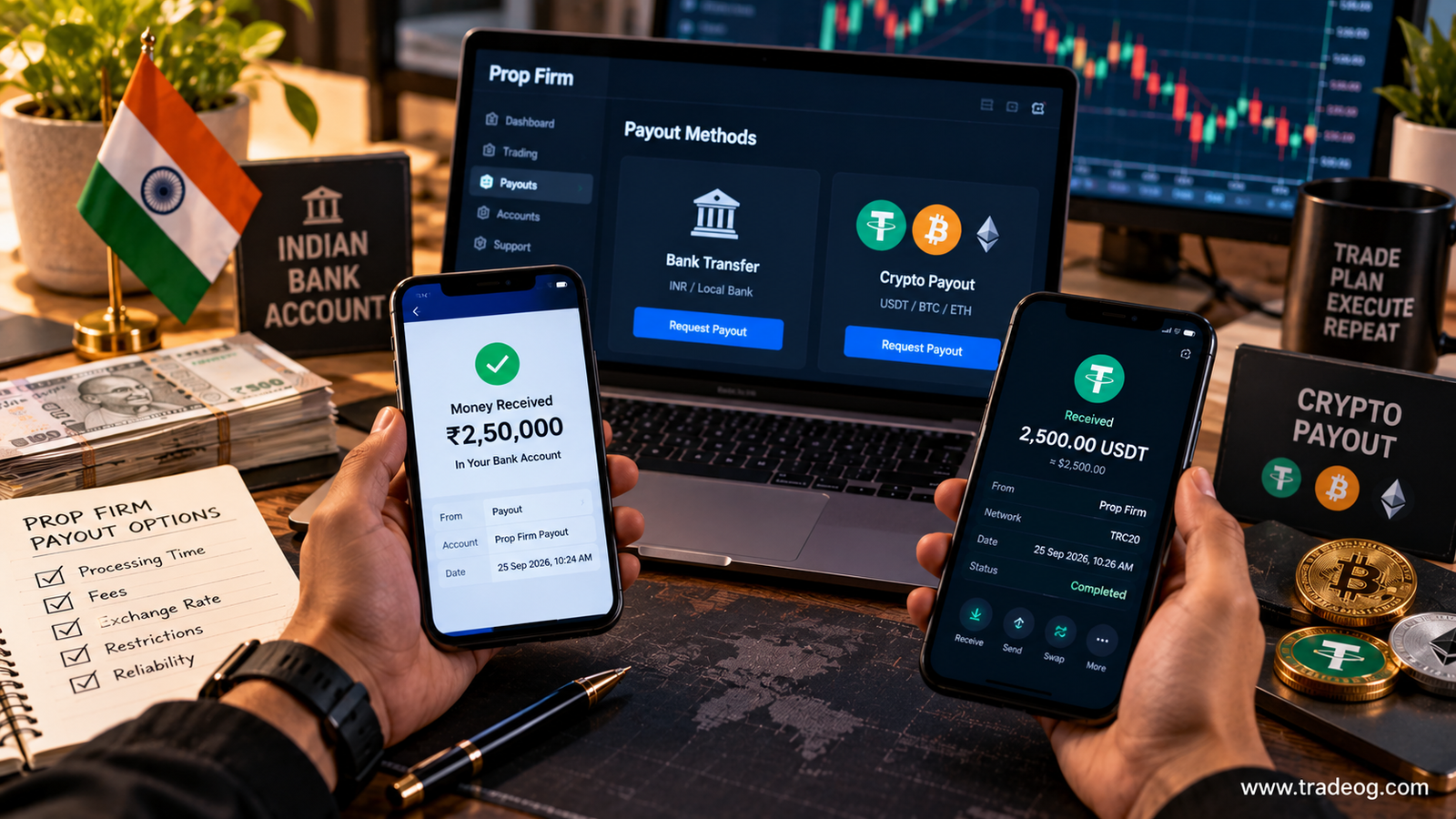
This guide explains the process in simple language for Indian traders. The exact steps can differ by prop firm, payout provider, bank, currency and the legal nature of the payment, so treat the bank’s instructions and your prop firm’s current payout terms as the final operational reference.
Quick Overview: Prop Firm Payout to an Indian Bank Account
- Complete the prop firm’s payout eligibility requirements.
- Submit the payout request and complete identity/payment verification.
- Select an available bank-transfer or payment-provider method.
- Provide your Indian bank details exactly as requested.
- The overseas payer/payment provider processes the transfer.
- Your Indian bank receives the foreign inward remittance and may run KYC/AML and source-of-funds checks.
- The amount is converted to INR where applicable and credited to your account after applicable charges.
- Keep the payout statement, payment confirmation, bank credit advice and supporting records for tax/compliance purposes.
Step 1: Check Whether Your Prop Firm Supports Bank Payouts to India
Before requesting a payout, check the prop firm’s current payout page. Some firms offer direct bank transfer, while others route payouts through third-party payment providers, e-wallets, card-like products or cryptocurrency.
Do not assume that a payment method available to a trader in another country will also be available to an Indian resident. Availability can depend on the provider, country, currency, KYC status and the firm’s current rules.
Step 2: Complete the Payout Verification
Most established payout systems can require identity or account verification before releasing funds. Depending on the provider, you may be asked for your legal name, address, identity document, bank information or other verification details.
Your payout account name should generally match your identity and bank details. A mismatch between the prop firm profile, payment provider and bank account can create delays or additional questions.
Step 3: Choose the Bank-Transfer Route
If direct bank transfer is available, enter the Indian bank details exactly as required. Typical information can include your account holder name, bank name, account number and IFSC. International transfers can also require SWIFT/BIC or other beneficiary information depending on the payment route.
Some prop firms do not send the money directly from their own bank account. They may use a payment processor or another financial intermediary. In that situation, the sender name shown in your bank statement may not exactly match the prop firm’s brand name.
Step 4: Understand Foreign Inward Remittance
When money arrives in India from overseas through the banking system, the receiving bank may treat it as a foreign inward remittance. RBI material shows that banks and authorised dealers use transaction-purpose information for foreign-exchange reporting, and KYC-compliant accounts are relevant to direct-to-account foreign inward remittances.
That means a bank may ask you what the payment represents, who sent it, the country of origin, or for supporting documents. The purpose should be described accurately. Do not select a purpose code simply because someone online says it is the easiest one.
Step 5: Keep the Payout Documents Ready
If your bank asks for clarification, useful documents can include:
- Prop firm payout statement or dashboard screenshot/PDF.
- Payout approval or payment confirmation email.
- Payment provider transaction receipt.
- Bank credit advice or foreign inward remittance advice, if issued.
- Agreement or terms showing the commercial relationship with the payer, where available.
- Identity/KYC documents requested by the bank.
- Your own payout and tax records showing the amount and date received.
RBI documentation on foreign-exchange transactions demonstrates that inward remittances can carry transaction and purpose information through the banking system. Your bank may therefore request information before or after credit depending on the payment route.
Step 6: What Is FIRC/FIRA and Do You Always Need It?
Indian traders often search for “FIRC” when receiving overseas money. A foreign inward remittance may generate a bank-issued remittance advice or other documentary record, but the exact document name, availability and format depend on the bank and payment channel.
Do not assume that every prop firm payout automatically produces a traditional FIRC in the same format. Ask your bank what inward-remittance document it can issue for the particular transaction and retain it if you need it for accounting or tax records.
Step 7: Currency Conversion — USD to INR
If the payout is denominated in USD or another foreign currency, the amount ultimately credited in INR depends on the conversion rate applied by the bank or payment provider and the applicable fees or spread.
For example, suppose a trader is approved for a hypothetical $1,000 payout. The INR credit will not necessarily equal $1,000 multiplied by the exchange rate visible on Google at the time. The actual settlement can depend on the provider’s conversion rate, bank rate, intermediary charges and timing.
For tax records, keep the original foreign-currency amount, transaction date and the INR amount actually credited, along with the relevant bank/payment statement. If your tax computation requires a specific exchange-rate convention, discuss the conversion method with your CA rather than using an arbitrary rate.
Step 8: Why Can a Prop Firm Payout Be Delayed?
A delay does not automatically mean that the payout has failed. Common operational reasons include:
- Prop firm payout review is still pending.
- KYC or payment-provider verification is incomplete.
- Bank details are incorrect.
- Sender or beneficiary information requires review.
- The receiving bank requests source-of-funds or purpose information.
- Intermediary-bank processing takes additional time.
- Weekend or bank-holiday timing affects settlement.
- Currency conversion or compliance checks are pending.
If a bank contacts you, respond with the actual transaction information and supporting documents. Avoid describing a payment as something different from what it really is merely to make the credit process easier.
Step 9: Does Receiving a Prop Firm Payout Make It Tax-Free?
No. Receiving the money into a bank account is only the payment step. Taxability is a separate question.
For an Indian resident, foreign-source income and the correct head of income can require careful analysis based on the contractual arrangement, residential status, nature of the activity and applicable tax law. A prop firm payout should not automatically be labelled “salary”, “capital gains”, “forex profit” or “crypto income” without examining the actual transaction.
The Income Tax Department’s guidance also distinguishes between returns such as ITR-2 and returns applicable where income includes profits and gains from business or profession. For example, its AY 2026-27 ITR-2 guidance states that ITR-2 is not for individuals whose total income includes profits and gains from business or profession.
For a detailed discussion of Indian taxation of prop firm payouts, see our guide: Prop Firm Payout Tax in India 2026.
Step 10: What About USDT or Crypto Payouts?
A USDT payout is operationally different from a direct bank transfer. The funds may first reach a crypto wallet or exchange before being converted and transferred to an Indian bank account.
Do not automatically assume that every prop firm payout received in USDT is taxed in exactly the same way as income from transferring a virtual digital asset. The tax treatment can depend on the underlying income and subsequent VDA transaction. Keep separate records for the original payout, wallet transaction, conversion/sale and INR bank credit.
TradeOG also covers the differences between crypto and bank-transfer payout routes in Crypto vs Bank Transfer for Prop Firm Payouts.
Step 11: Will the Bank Deduct Tax When the Payout Arrives?
Do not assume that the absence of a tax deduction means the income is tax-free, and do not assume that every bank credit automatically has TDS deducted.
TDS and final income-tax liability are different concepts. The correct treatment depends on the nature of the payment, payer, intermediary and applicable tax provisions. Maintain your records and have a CA determine whether any tax, advance tax, reporting or withholding obligation applies to your situation.
Step 12: How to Record a ₹1,25,000 Hypothetical Payout
Imagine a prop firm approves a payout equivalent to ₹1,25,000 after conversion and the amount reaches your Indian bank account.
| Record | What to keep |
|---|---|
| Prop firm | Payout approval and statement |
| Payment provider | Transaction ID and payment receipt |
| Foreign currency | Original amount and currency |
| Conversion | Exchange rate and conversion details, where available |
| Indian bank | Credit entry and remittance advice, if issued |
| Tax file | Income calculation and supporting documents |
This creates an audit trail from payout approval to bank credit. It is much safer than relying only on the final bank statement.
Common Mistakes Indian Traders Should Avoid
- Using another person’s bank account for a payout without checking the prop firm and payment provider rules.
- Entering an incorrect beneficiary name or bank detail.
- Deleting payout emails and transaction receipts after receiving money.
- Choosing an inaccurate purpose description or purpose code.
- Assuming “foreign remittance” automatically means “tax-free”.
- Mixing prop firm payouts with unrelated crypto transactions in your records.
- Using a random exchange rate for tax calculations without checking the applicable method.
- Ignoring a bank’s request for source-of-funds documentation.
- Assuming that a payout provider’s availability in another country guarantees availability in India.
Bank Transfer vs Payment Provider vs USDT
| Route | Typical Flow | Records to Keep |
|---|---|---|
| Direct bank transfer | Prop firm/provider → Indian bank | Payout statement, transfer reference, bank credit |
| Payment provider | Prop firm → provider → Indian bank | Provider receipt, conversion details, bank credit |
| USDT/crypto | Prop firm/provider → wallet → exchange/conversion → Indian bank | Blockchain transaction, exchange statement, conversion and bank records |
What If the Indian Bank Asks “What Is This Payment For?”
Answer truthfully and provide the documents requested. A useful response should explain the actual relationship and payment, for example that the funds are a payout received under a contractual arrangement with an overseas prop-trading company, if that accurately describes your case.
Purpose codes are used by authorised dealers for foreign-exchange reporting. RBI’s purpose-code material includes multiple categories for inward services and other receipts, so there is no universal “prop firm payout code” that every trader should blindly select. If your bank asks you to choose or confirm a purpose code, use the code that matches the actual nature of the transaction as determined with the bank or your professional adviser.
Simple Checklist Before Requesting Your First Payout
- ✔ Your prop firm account name matches your identity.
- ✔ Your payout method is currently available to Indian residents.
- ✔ Your bank account is KYC compliant.
- ✔ Your account details are correct.
- ✔ You have saved the prop firm payout terms.
- ✔ You know which payment provider will process the transfer.
- ✔ You can document the source of funds.
- ✔ You have a system for recording the foreign-currency amount and INR credit.
- ✔ You understand that tax reporting is separate from receiving the bank credit.
Frequently Asked Questions
Can a prop firm payout be sent directly to an Indian bank account?
Yes, where the prop firm or its payment provider supports an Indian bank-transfer route. Availability and requirements vary by firm and provider.
Can my bank ask for proof of the payout?
Yes. A receiving bank can request transaction, KYC, source-of-funds or purpose information depending on the payment and its compliance process.
Do I need an FIRC for every prop firm payout?
Not necessarily in the same format for every payment route. Ask your bank what remittance advice or certificate is available for your specific inward remittance and keep the relevant document.
Is a prop firm payout automatically tax-free because it comes from abroad?
No. The source of the payment does not by itself determine whether the income is taxable in India.
What if the payout is received in USDT?
Keep the original payout record and all subsequent wallet, exchange, conversion and bank records. The tax treatment of the underlying payout and any later VDA transaction should be analysed separately.
How long does a bank payout take?
There is no single guaranteed timeline. Processing can depend on the prop firm, payment provider, intermediary banks, KYC checks, currency conversion and the receiving bank.
Final Takeaway
The safest way to think about a prop firm payout to an Indian bank account is as a complete transaction trail: payout approval → verification → payment provider/foreign transfer → Indian bank inward remittance → INR conversion/credit → record keeping → tax reporting.
For another practical guide, see Prop Firm Payout Verification Explained Step by Step.
Do not focus only on the moment the money appears in your account. Save the documents that explain where the money came from, why it was paid, how it was converted and how much was finally credited. If your bank or CA asks for clarification, a clean documentary trail makes the process much easier.
Important: This article is for general educational information and is not legal, tax, FEMA or banking advice. Prop firm contracts and payment routes vary. Indian tax and foreign-exchange rules can change, so verify the current position with your bank, the relevant regulator and a qualified Chartered Accountant before relying on a specific treatment.