

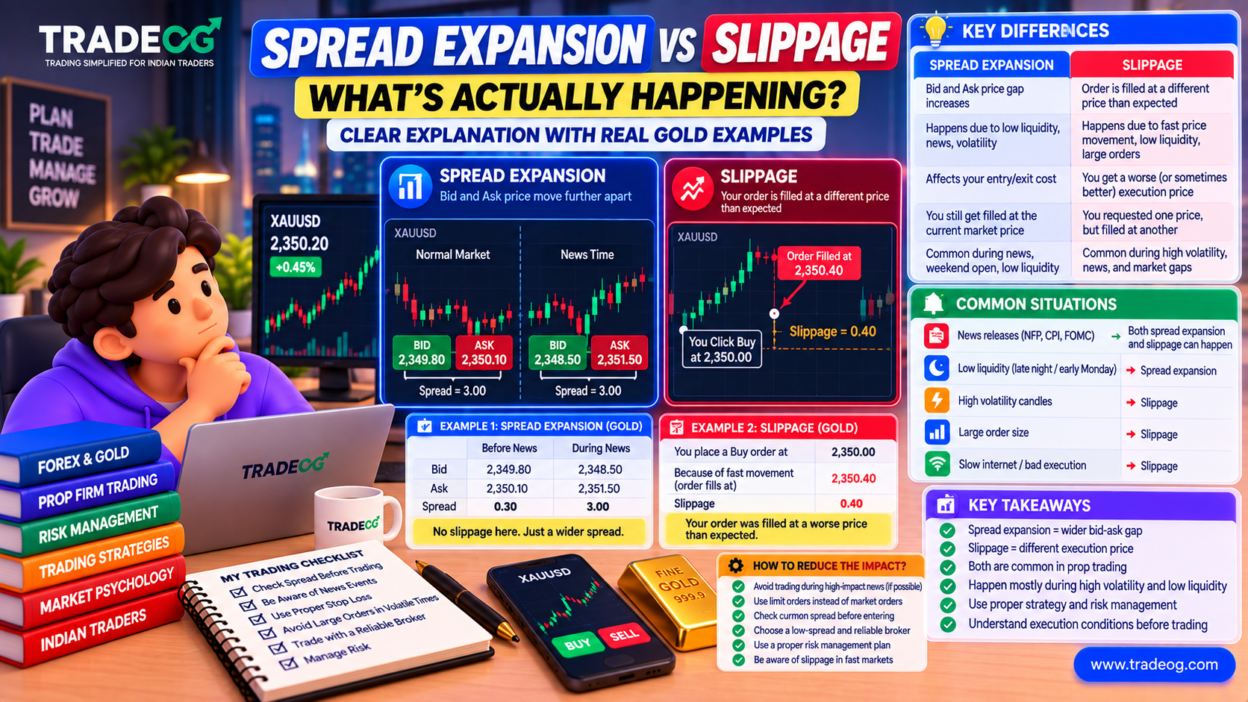
Slippage is a normal part of trading, but for prop firm traders it can have an important consequence: a stop-loss may fill at a worse price than expected, pushing realized or floating losses beyond a firm’s daily loss or maximum loss threshold.
The key point is that slippage itself is not necessarily a rule violation. The problem occurs when the resulting account equity, balance, or loss calculation crosses a firm’s breach threshold. The exact treatment depends on the prop firm’s current rules and account type.

What Is Slippage in Trading?
Slippage is the difference between the price a trader expects when an order is triggered and the price at which the order is actually filled. It can be positive or negative.
Topstep explains that slippage can occur when there is insufficient market depth, especially during economic releases, high volatility, illiquid periods, market opens and closes, or gaps.
FundedNext similarly describes slippage as a normal market occurrence caused by volatility, liquidity conditions and gaps.
Can Slippage Directly Breach a Prop Firm Account?
Yes, it can contribute to a breach. The important distinction is between the cause and the rule.
For example, suppose your account has a $2,000 maximum permitted loss and you place a stop designed to limit a trade to approximately $1,850. If a fast market causes the stop to fill $250 worse than expected, the final loss could exceed $2,000. If the firm’s breach calculation includes that loss, the account can cross the threshold.
FTMO specifically warns that a stop-loss does not guarantee execution at the predefined price. In its example, insufficient liquidity can cause a worse fill and potentially result in a loss-limit breach.
Why Stop-Loss Orders Do Not Guarantee Your Maximum Loss
A stop-loss is designed to trigger when a specified market level is reached. In many execution environments, the triggered order is then filled at the next available price.
That means a stop at 1.1000 does not necessarily mean the trade will close at exactly 1.1000. During a rapid move, the available price may be materially different.
FTMO also explains that market rollovers, spread widening, major news releases, volatility, low liquidity and weekend gaps can increase slippage risk.
Three Ways Slippage Can Trigger a Breach
1. Slippage pushes realized loss beyond the daily limit
Imagine a trader has only $200 of daily loss capacity remaining. A position approaches its stop and the trader expects a $150 loss. A fast move produces a $230 realized loss instead. If the firm’s daily loss calculation includes that trade, the account can cross the permitted threshold.
FundedNext’s current documentation states that its daily-loss calculation can include running and closed losses and that exceeding the applicable threshold constitutes a violation.
2. Floating loss crosses the threshold before the stop fills
A trader does not always have to wait for a position to close. Some firms monitor equity or floating P&L in real time.
FundedNext’s current loss-limit documentation says floating losses can count toward its applicable limits. Its futures guidance also states that a floating loss reaching the maximum loss limit during a live trade can breach the account immediately.
This is why a trader can sometimes see an account breach even though the final stop execution appears to have occurred shortly afterward.
3. Slippage occurs during a platform-generated liquidation
Some risk systems monitor the account and generate a liquidation order after a threshold is crossed. That liquidation order still has to execute.
Topstep explains that its risk tools monitor unrealized P&L, detect a threshold crossing and generate an order that is then sent to the exchange. In fast markets, the actual fill can differ from the threshold price.
FTMO Futures similarly states that risk rules are monitored in real time and positions are automatically liquidated when a rule is breached.
News Trading and Slippage Risk
High-impact economic releases can create extremely fast price changes and temporarily reduce available liquidity. This can increase the distance between the intended stop price and the actual execution price.
FundedNext notes that slippage can occur during high-impact news and says it generally does not adjust such executions except in cases of total execution failure, subject to its stated conditions.
For prop traders, this creates an important risk-management issue: placing a stop exactly at the account’s remaining loss limit leaves little room for adverse execution.
Spread Widening Can Look Like Slippage
Traders should also distinguish between actual execution slippage and spread-related effects. Around market rollovers or volatile events, the bid-ask spread can widen significantly.
FTMO notes that spread widening can affect stop-loss execution, particularly during low-liquidity periods.
For instruments quoted using bid and ask prices, a trader can therefore see a position reach a stop condition even when the chart’s visible price appears to be close to the intended level.
Example: How Slippage Can Cause a Breach
Consider a hypothetical $50,000 prop account with a $2,500 maximum loss threshold.
- Current account equity: $48,100
- Remaining loss capacity: $600
- Planned trade risk: $450
- Expected stop loss: $450
- Actual loss after slippage: $680
- Resulting equity: $47,420
If $47,500 is the account’s breach threshold, the $680 loss would take the account below that threshold. The trader may have used a stop correctly, but the stop did not guarantee the exact execution price.
This example is illustrative only. Each firm’s calculation method can differ.
Does a Prop Firm Reverse a Breach Caused by Slippage?
There is no universal rule that a slippage-related breach will be reversed.
FundedNext’s current CFD terms state that its recorded platform data, logs and system time are used to determine P&L, drawdown, breaches and compliance, and that simulated conditions can include differences in execution speed and slippage. The terms also provide a process for reporting a suspected technical incident.
FTMO says its slippage can be positive or negative and attributes execution differences to technical and market conditions rather than hidden additional slippage.
Therefore, traders should not assume that an ordinary market slippage event automatically qualifies as a technical error or grounds for a rule exception.
How to Reduce Slippage-Related Breach Risk
Keep a buffer below the firm’s loss limit
Do not size a trade so that your planned stop sits almost exactly on the maximum amount you are allowed to lose. A buffer provides some room for adverse execution.
Reduce position size during extreme volatility
Smaller positions reduce the dollar impact of a given price movement. This does not eliminate slippage, but it can reduce the chance that one execution materially damages the account.
Understand the firm’s calculation method
Check whether the firm measures daily loss using balance, equity, floating P&L, closed P&L, commissions, swaps or another combination. FundedNext, for example, explicitly discusses running and closed losses and floating losses in its published loss-limit documentation.
Know the firm’s trading-day reset time
A daily loss limit is usually tied to a firm’s defined trading day. A trade opened before the reset can therefore interact with the next day’s calculation differently from what a trader expects. Always check the firm’s stated server or trading-day time.
Review execution around news and low-liquidity periods
Major economic releases, market opens, closes, rollovers and gaps can increase execution uncertainty. If your strategy trades these periods, account for the additional execution risk in position sizing.
What Traders Should Check in Prop Firm Rules
- Does the firm calculate limits using balance, equity, or both?
- Are floating losses included?
- Are commissions and other trading costs included?
- Can slippage cause the account to cross a hard loss threshold?
- Are news trades restricted?
- Are overnight or weekend positions allowed?
- What happens if a stop gaps through the intended price?
- How are suspected platform or execution errors reviewed?
- What timestamp and platform data determine a breach?
- Is there a specific support process for disputed executions?
Slippage vs. a Trading Rule Violation
These should not be treated as the same thing.
Slippage is an execution outcome. It can occur naturally in fast or illiquid markets.
A rule breach occurs when the resulting account state crosses a prohibited threshold or the trader violates another condition in the firm’s rules.
A trader can therefore experience normal slippage and still breach an account if the resulting loss exceeds the applicable limit.
Final Takeaway
Slippage can cause a prop firm account breach when the worse-than-expected execution pushes realized or floating losses beyond the firm’s permitted threshold. The risk is particularly important during news releases, market gaps, low liquidity, spread widening and fast price movements.
The practical lesson is simple: never treat your stop-loss price as a guaranteed maximum dollar loss. Build an execution buffer into your risk plan, understand how the specific prop firm calculates its limits, and verify the current rules before trading.
Important: Prop firm rules change and can differ by account type. Always check the current official terms for the exact program you are trading.