
Receiving a foreign payment into an Indian bank account does not always mean the money will be credited immediately. Sometimes the bank asks for additional information before it processes or releases the payment.
For a trader, this can be confusing. You may already see the payout as completed on a prop firm, broker or payment-provider dashboard, yet your bank may ask what the payment is for, who sent it, why you are receiving it, or for supporting documents.
That request does not automatically mean that something is wrong with the payment. Banks have customer due-diligence, transaction-monitoring and cross-border payment requirements, and they may need enough information to understand and trace a foreign transaction.
For Indian traders, the practical question is not simply “Why is my bank asking questions?” It is what information does the bank need, why does it need it, and what should I provide?
Why Can a Bank Ask Questions About a Foreign Payment?
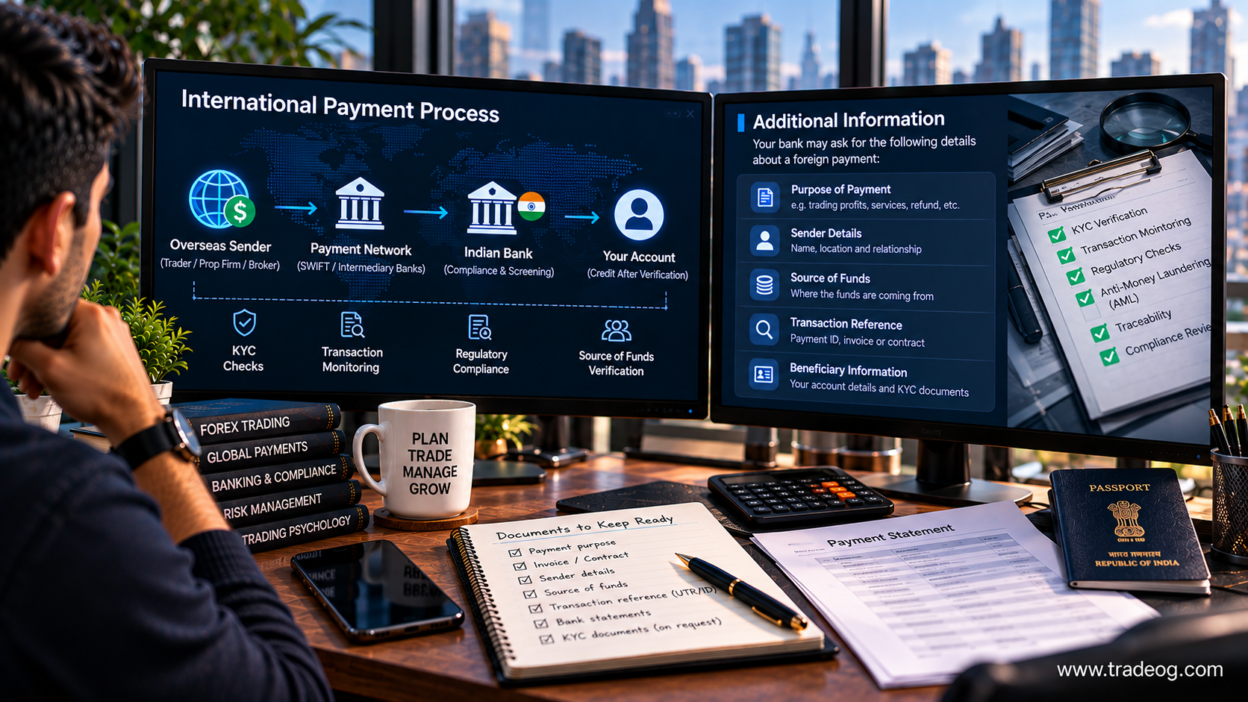
Cross-border payments contain more information and processing stages than many domestic transfers. The payment can involve an overseas sender, payment institution, correspondent bank, SWIFT or another payment network, and an Indian receiving bank.
RBI’s KYC framework requires banks to conduct ongoing due diligence and monitor transactions against the customer’s profile and expected activity. Banks are specifically expected to pay attention to large, complex or unusual transactions and patterns that do not have an apparent legitimate purpose. citeturn0search17turn0search18
For cross-border wire transfers, RBI’s KYC framework also requires accurate originator and beneficiary information to accompany the transaction, including names and relevant account or traceability information. citeturn0search20
As a result, a bank may contact you when the payment needs more context before it can be processed.
What Information Might Your Bank Ask For?
The exact request varies by bank, payment method, amount, currency and transaction profile. Common requests can include:
| Information | Why it may be requested |
|---|---|
| Purpose of payment | To understand the economic reason for the incoming transfer. |
| Sender name and country | To identify the remitter and payment origin. |
| Source of funds | To establish where the money originated. |
| Transaction reference | To trace the payment through the banking chain. |
| Invoice, contract or payout statement | To support the stated purpose when documentation is required. |
| KYC or identity information | To satisfy customer or beneficiary verification requirements. |
| Payment-provider details | To explain why the name of the remitter may differ from the platform you know. |
A request for information is therefore not necessarily a rejection. It can simply mean the bank needs additional information before deciding how the transaction should be processed.
Why a Prop Firm Payout Can Trigger Additional Questions
Prop firm payouts can be less straightforward than a salary payment from a familiar domestic employer.
The name appearing on your bank statement may belong to a payment processor, financial institution or other entity rather than the brand name you see on the prop firm’s website.
The bank may therefore need to understand the relationship between:
- the prop firm or trading platform;
- the payment provider;
- the actual remitter shown on the transfer; and
- you as the beneficiary.
This is one reason it is useful to keep your payout confirmation, transaction reference and supporting documentation.
TradeOG’s related guide on why a prop firm payout can show as completed before reaching your bank explains another important distinction: a platform’s “completed” status does not necessarily mean the receiving bank has credited the funds.
Why Banks Care About the Purpose of the Payment
The payment purpose helps a bank understand what the transaction represents.
For example, an incoming transfer could represent a salary, invoice settlement, refund, family remittance, investment-related transaction, business income, professional services or another legitimate payment category. The appropriate documentation and regulatory treatment can differ between these situations.
That is why answering a bank’s question with a vague description such as “trading money” may not always provide enough context.
Give the bank an accurate description that matches the underlying transaction and the documentation you have. Do not invent a purpose simply because you think a different description will make the payment easier to process.
Why Source of Funds May Be Requested
Source of funds means where the money being received came from. In a cross-border transaction, the bank may want to establish the origin of the funds and understand whether the transaction is consistent with your account profile.
RBI’s transaction-monitoring framework expects banks to consider factors such as the customer’s background, source of funds, type of transactions and other risk indicators when assessing unusual or higher-risk activity. citeturn0search17turn0search19
For a trader, useful supporting records can include the payout statement, payment confirmation, platform account statement, contract or other legitimate documentation that accurately explains the payment.
The exact documents required should come from your bank because requirements vary by transaction.
Why a Large Payment May Receive More Attention
There is no universal rule that every large foreign payment will be questioned. However, transaction size is one factor banks can consider when monitoring activity.
RBI guidance specifically tells banks to pay attention to unusually large, complex or unusual transactions and transactions that do not have an apparent economic or lawful purpose. citeturn0search17turn0search18
This means a payment that is significantly different from the normal activity in an account may attract additional review.
For example, a trader who normally receives small domestic credits may receive a large international payment that is completely legitimate but still outside the account’s historical pattern. The bank may ask questions simply because it needs additional context.
Why Your Bank May Ask About the Sender
Sometimes the name of the sender does not match the name of the company you expected.
This can happen when a prop firm or broker uses a third-party payment provider or banking partner. The bank sees the actual remitter information attached to the payment, not necessarily the brand name displayed on the trading website.
If this happens, provide the relationship accurately. For example, if your payout was initiated by a trading company but transmitted by its payment provider, explain that relationship and provide the available payout confirmation.
Do not claim that a payment came directly from an entity if the payment record shows a different sender.
Why a Bank May Ask for a Transaction Reference
A transaction reference helps the bank locate the payment inside its systems or communicate with another institution in the payment chain.
For an international payment, useful identifiers may include a bank reference, UTR, SWIFT-related reference or another transaction ID, depending on the payment route.
If your prop firm or payment provider gives you a reference number, keep it until the money is successfully credited and the transaction is reconciled.
This becomes especially important if the payment is delayed, returned or placed under review.
What Documents Should Indian Traders Keep?
You do not need to send every document you have to the bank unless requested. But maintaining an organized record makes it easier to respond when a bank asks for clarification.
A practical record can include:
- Prop firm or broker payout confirmation
- Payment-provider confirmation
- Transaction reference
- Account statement showing the payment
- Relevant contract or agreement
- Invoice or other supporting document where applicable
- Identity/KYC documents if the bank requests them
- Correspondence explaining the transaction
Keep the documents genuine and consistent with the actual transaction.
What If the Bank Asks for an Invoice?
Do not create a fake invoice simply because the bank requested documentation.
If the transaction does not arise from an invoice-based commercial sale, tell the bank the true nature of the payment and ask what alternative supporting document it accepts.
A payout statement, agreement, payment confirmation or other record may be more appropriate depending on the nature of the transaction.
The important principle is that the documentation should describe the real transaction rather than manufacture a different one.
Could the Bank Hold the Payment?
Yes, a bank may delay processing while it obtains information or completes the checks applicable to the transaction.
This is different from saying that every request for information means the payment is suspicious or has been rejected.
RBI’s framework distinguishes ongoing monitoring and enhanced due diligence based on risk. It also requires banks to obtain information necessary to perform appropriate KYC measures in relevant circumstances. citeturn0search18turn0search19
If the bank has specifically asked for documents, respond through the bank’s official channel and ask what is still outstanding.
What If You Do Not Provide the Requested Information?
The consequences depend on the transaction and the information being requested.
If the bank cannot complete the required KYC or due-diligence process, it may be unable to process or credit the transaction. RBI guidance for authorised persons handling remittances also states that where appropriate KYC measures cannot be applied because required information is not furnished or the customer does not cooperate, the transaction should not be undertaken. citeturn0search19
Therefore, ignoring a bank’s request is generally not a good strategy. If you believe the request is unclear or excessive, ask the bank to specify exactly which document or information is required and why it is needed for the transaction.
Foreign Payment Information Request vs Payment Rejection
| Status | What it can mean | What you should do |
|---|---|---|
| Additional information requested | Bank needs more context or documents. | Provide accurate information through the official channel. |
| Payment pending | Processing may not be complete. | Ask which stage is pending. |
| Payment held for review | Additional checks may be underway. | Respond to the bank’s request and keep the reference. |
| Payment rejected | Bank could not process the transaction. | Ask for the stated reason and next step. |
| Payment returned | Funds have been sent back through the payment chain. | Coordinate with the sender/payment provider. |
Why the Same Foreign Payment May Be Treated Differently by Different Banks
Two Indian traders can receive similar international payments and experience different levels of review.
Banks use their own systems, customer profiles, risk controls, transaction histories and operational processes. The payment route can also differ depending on the sender, currency and intermediary institutions.
One trader may receive an automatic credit while another may receive a request for supporting information.
This does not by itself prove that either transaction is wrong.
How Indian Traders Should Respond to a Bank Information Request
- Read the request carefully. Identify exactly what the bank is asking for.
- Confirm the communication is genuine. Use your bank’s official app, website, branch or verified contact channel if you are unsure.
- Identify the transaction. Note the amount, currency, sender, date and transaction reference.
- Explain the purpose accurately. Use the real economic reason for the payment.
- Provide supporting records. Send only genuine documents relevant to the request.
- Keep copies of what you submit. Record the date and method of submission.
- Ask what happens next. Find out whether the payment is pending, under review or ready for credit.
Do not send sensitive banking credentials, OTPs, PINs or passwords to someone simply because they claim to be calling from a bank. A legitimate verification request should not require you to disclose your online-banking password or OTP to a caller.
How This Can Affect Prop Firm Payout Timing
A prop firm can complete its internal payout process while the receiving bank is still performing its own checks.
The overall timeline can therefore look like:
Prop firm approval → payment provider → international payment network → intermediary bank → Indian bank review → account credit.
TradeOG’s article on why international trading payments can take longer on bank holidays explains another reason the last stage can take longer than the sender’s processing estimate.
Likewise, if the payment contains incorrect beneficiary details, it may be rejected or returned rather than simply credited. See what happens when a prop firm sends a payment with incorrect bank details.
What If the Bank Says the Payment Purpose Is Unclear?
Ask the bank what evidence would help it understand the transaction.
For example, the bank may want to see a payout confirmation showing the sender, amount and payment date. It may also ask for information about the relationship between the sender and beneficiary.
Give a factual explanation and use terminology that accurately describes the underlying transaction. If you are uncertain about the regulatory classification or tax treatment of the income, consult a qualified professional rather than guessing.
Does an Information Request Mean You Have Done Something Wrong?
Not necessarily.
Additional information requests can arise from normal transaction monitoring, incomplete payment information, differences between sender and platform names, unusual transaction size, a new payment pattern or the need to satisfy documentation requirements.
RBI’s framework explicitly expects banks to monitor transactions and understand whether activity is consistent with the customer’s profile. citeturn0search17
The sensible response is therefore to treat the request as a documentation and verification step unless the bank tells you that the transaction has been rejected or another specific issue exists.
Final Takeaway
Your bank may ask for additional information about a foreign payment because it needs to identify the sender, understand the payment purpose, verify beneficiary information, establish the source of funds, trace the transaction or complete applicable KYC and transaction-monitoring checks.
For Indian traders receiving money from a prop firm, broker or overseas payment provider, the most useful records are usually the payout confirmation, transaction reference, sender information and genuine documents that explain the underlying payment.
Do not panic when a bank asks questions, but do not ignore the request either. Respond through an official bank channel, provide accurate information, keep your records consistent and ask what stage the payment is currently at.
The key distinction is simple: an information request is not automatically a payment rejection. It often means the bank needs more context before it can complete the transaction.
FAQs
Why is my bank asking where a foreign payment came from?
The bank may need to identify the remitter and understand the source and purpose of the transaction as part of KYC and transaction-monitoring processes.
Why does my bank want proof of a prop firm payout?
The bank may need supporting information to understand the relationship between the sender, payment provider and beneficiary and to document the purpose of the incoming payment.
Can a bank ask for an invoice for a foreign payment?
It can request supporting documentation, but the appropriate document depends on the actual nature of the payment. If there is no genuine invoice, do not create one; ask the bank what alternative evidence it accepts.
Can a foreign payment be delayed because the bank asks for documents?
Yes. If the bank needs information before it can complete its checks, crediting may take longer.
Should I provide the requested information?
If the request is genuine, respond with accurate information and genuine supporting documents through the bank’s official channel. If the request is unclear, ask the bank to specify what is required.