

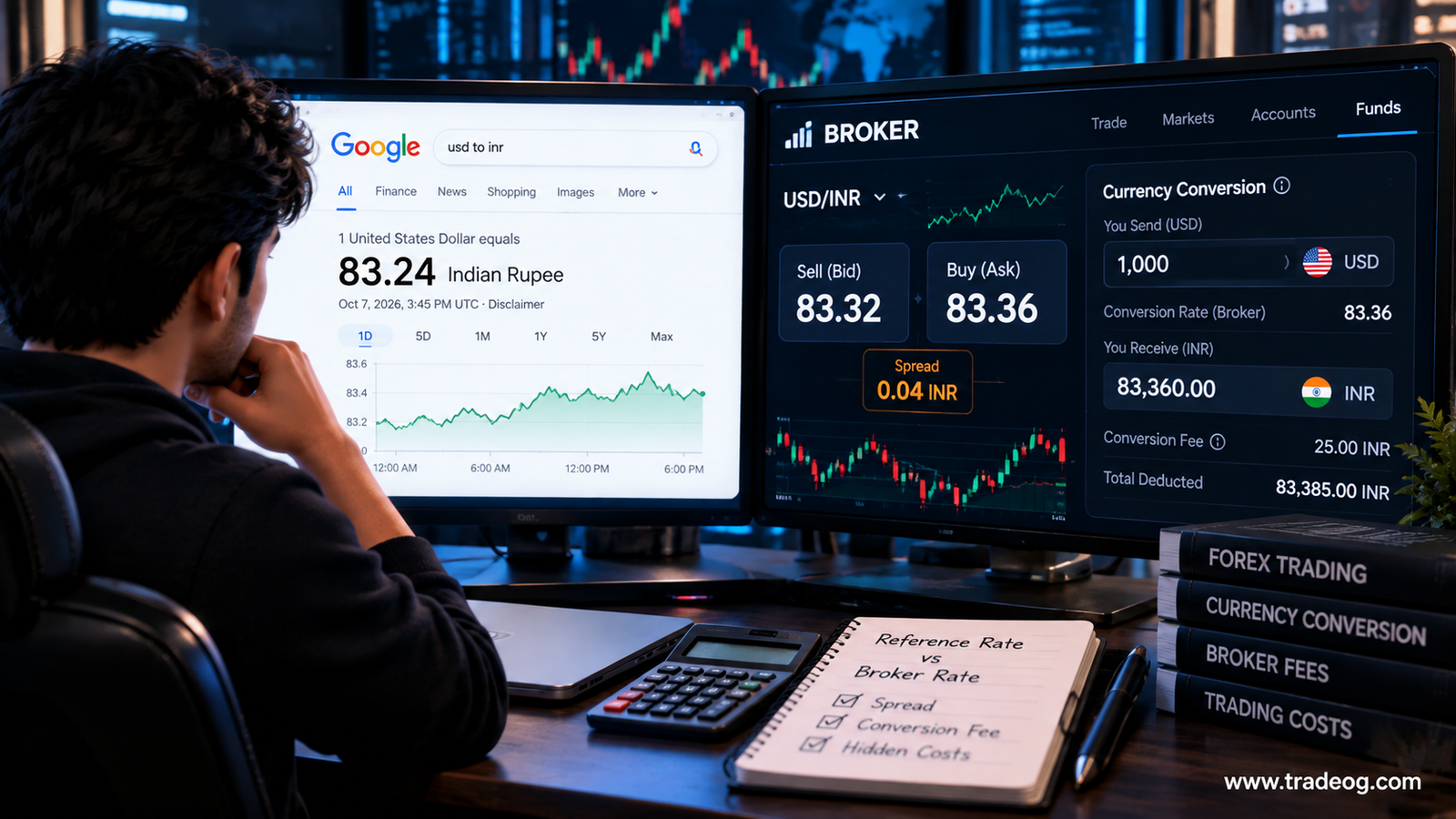
Have you ever checked an exchange rate on Google, opened your broker account, and noticed a different number? It can be confusing when Google shows one USD-to-INR rate while your broker, trading platform, card provider, or withdrawal screen uses another.
The important thing is that these two numbers are not necessarily supposed to be identical. Google can display a reference exchange rate based on financial data feeds, while a broker may use a tradable quote, a bid or ask price, a conversion rate from a payment provider, or a rate that includes a spread or other margin. The exact method depends on the broker and the transaction.
Google’s Exchange Rate Is Usually a Reference, Not Your Guaranteed Transaction Rate
When you search for a currency conversion on Google, the number you see is useful for checking the general market level. Google Finance itself says its currency data comes from various providers and also warns that it cannot guarantee the accuracy of displayed exchange rates. In other words, the number is a reference point, not a promise that a broker or bank will execute your transaction at exactly that rate.
That distinction matters for traders. A live trading quote is built for execution, while a public converter is mainly designed to help people understand the approximate value of one currency in another.
1. Your Broker May Be Showing a Bid or Ask Rate
One of the simplest reasons for a difference is the bid-ask spread.
The Bid is the price at which the market or dealer is willing to buy, while the Ask is the price at which it is willing to sell. The difference between the two is the spread, which is one of the normal costs of trading currencies.
For example, imagine a simplified USD/INR quote:
| Quote | Illustrative Rate |
|---|---|
| Bid | ₹83.90 |
| Ask | ₹84.10 |
| Midpoint | ₹84.00 |
A public converter may show something close to ₹84.00, while the rate relevant to your actual transaction could be nearer ₹83.90 or ₹84.10 depending on what you are doing. These numbers are only an example; actual USD/INR pricing changes continuously.
2. Brokers Can Add a Spread or Markup
A broker does not necessarily have to give you the same rate you see on a public reference screen. The provider can recover some of its costs through a spread or markup.
For example, suppose a market reference rate is ₹84.00 per US dollar. A provider could quote ₹83.70 when converting dollars into rupees or ₹84.30 when selling dollars to a customer. The difference may effectively represent the provider’s margin, alongside any separately disclosed fee.
For retail traders, this is especially important when withdrawing funds, depositing money, paying a foreign currency fee, or converting a trading balance into INR. The headline exchange rate is only one part of the total transaction cost.
3. Different Data Providers Use Different Feeds
There is no requirement for every financial website, broker, bank and payment service to display the exact same tick at the exact same millisecond.
Google Finance says its financial data is supplied by various data providers and feeds. A broker may receive prices through liquidity providers, banks, market makers, or other financial counterparties. Another platform may use a different aggregation process.
During calm markets, these differences can look tiny. During fast markets, the difference can become more noticeable because currency prices can move quickly and providers may update their quotes at slightly different times.
4. Your Broker Rate May Be Based on a Different Time
Timing matters more than many traders realise.
Imagine Google displayed USD/INR at ₹84.00 at 10:00:00, but your broker processed a conversion several seconds later after the market moved to ₹84.12. The two numbers can differ even though neither system is necessarily wrong.
This becomes even more relevant around major economic releases, sudden risk-off moves, central-bank announcements, and other events that can cause rapid changes in currency markets.
5. Trading Prices and Conversion Prices Are Not the Same Thing
This is one of the most common sources of confusion.
A broker may offer a trading quote for a forex instrument, but when you transfer or withdraw money, a separate conversion process may be used. The conversion can be handled by the broker itself, a banking partner, a payment processor, or another financial institution.
As a result, you may see one rate on a trading platform and another rate on the withdrawal page. The two numbers serve different purposes.
6. Currency Conversion Fees May Be Built Into the Rate
Some providers disclose a conversion fee as a separate charge. Others may incorporate some or all of their margin into the exchange rate they offer.
That means comparing only the displayed rate can give you an incomplete picture. You should compare the final amount you receive after every fee, spread, and conversion adjustment.
For example:
| Item | Illustrative Value |
|---|---|
| Amount to convert | $1,000 |
| Google reference rate | ₹84.00 |
| Reference value | ₹84,000 |
| Provider’s effective rate | ₹83.50 |
| Converted amount | ₹83,500 |
The ₹500 difference is not necessarily a mysterious error. It could reflect a spread, fee, rate timing difference, or a combination of these factors.
7. Your Broker May Have Its Own Pricing Policy
Different brokers can use different pricing models. Some may quote tighter spreads in normal conditions and widen them when liquidity drops. Others may add a commission, mark up the conversion rate, or use a partner’s rate for deposits and withdrawals.
There is no single universal broker exchange-rate formula. That is why the terms, pricing page, account agreement, withdrawal policy, or fee schedule for your specific provider matter more than a generic comparison with Google.
Why This Matters for Indian Forex Traders
For an Indian trader, small conversion differences can become meaningful when a large amount is being converted into INR.
Suppose you withdraw $5,000. A difference of ₹0.50 per dollar changes the converted amount by ₹2,500. A ₹1.00 difference changes it by ₹5,000.
That does not automatically mean the broker is overcharging. The key question is what rate was used, when it was fixed, whether the rate includes a spread or markup, and whether any additional fee was charged.
This is also why traders should keep records of withdrawal confirmations, bank credits, payment-provider statements, and the exchange rate shown at the time of conversion.
How to Check Whether Your Broker’s Rate Is Reasonable
Step 1: Record the Reference Rate
Before starting the transaction, note the Google rate or another independent reference rate and the exact time.
Step 2: Check the Broker’s Rate
Write down the rate actually offered by the broker or payment provider. Do not rely on memory or a screenshot taken much later.
Step 3: Check the Fee Schedule
Look for conversion fees, withdrawal fees, processing charges, minimum charges, and any statement about currency conversion or exchange-rate margins.
Step 4: Calculate the Effective Rate
Divide the amount you ultimately receive in INR by the foreign-currency amount converted. That gives you the effective rate after the practical impact of the transaction.
Step 5: Compare Providers Using Net Amount
Do not choose a provider just because its displayed exchange rate looks better. Compare the final INR amount after every cost.
What About Google, Reuters, Banks and Trading Platforms?
It is normal to see small differences across data sources because they can use different feeds, update frequencies, timestamps, market conventions, and pricing methodologies.
Google itself notes that financial data can be delayed depending on the exchange or data provider. That makes a public reference quote useful for orientation, but not a substitute for the actual executable or settlement rate used by your provider.
Reuters, a bank, a broker and a consumer currency converter can therefore show slightly different numbers without one of them necessarily being fraudulent.
When Should You Be Concerned?
A difference by itself is not proof of a problem. You should investigate when the difference is consistently large, the provider does not clearly explain its conversion method, the final amount is materially lower than expected, or the terms disclose charges that were not clearly communicated to you.
For larger withdrawals, ask the provider a simple question: What exact exchange rate will be used, at what time is it fixed, and what fees or markup are included?
A transparent answer makes the transaction much easier to evaluate.
Google Rate vs Broker Rate: Which One Should You Trust?
Use Google as a reference benchmark. Use your broker’s confirmed rate as the figure that determines your actual transaction.
If the transaction is a forex trade, the tradable quote on the broker’s platform is what determines execution. If the transaction is a withdrawal or currency conversion, the rate and fees specified by the broker, bank, or payment provider determine how much money you actually receive.
These are different jobs, so the numbers do not have to match exactly.
Final Takeaway
Your broker can use a different exchange rate than Google because the two services may use different data feeds, bid-ask prices, timestamps, conversion methods, spreads, markups, or fee structures. Google provides a useful market reference, but the rate that matters for your money is the actual rate applied to your transaction.
For Indian traders, the best habit is simple: record the reference rate, check the provider’s conversion rate, read the fee schedule, calculate the effective INR rate, and compare the final amount received. That approach tells you far more than looking at two headline exchange rates and assuming one must be wrong.
Frequently Asked Questions
Why is my broker’s USD/INR rate different from Google?
Your broker may use a different data feed, a bid or ask price, a different timestamp, or a conversion rate that includes a spread or markup.
Is Google’s exchange rate the exact rate I should receive?
No. Google is useful as a reference, but the final rate used by your broker, bank, or payment provider can be different.
Can a broker make money from the exchange-rate difference?
Yes. Depending on the provider and product, a spread, markup, commission, or other disclosed charge may be part of the provider’s revenue model.
Why did my withdrawal convert at a different rate?
A withdrawal may use a separate payment or banking conversion process rather than the trading quote displayed on your platform. Timing and processing rules can also change the applied rate.
How can I calculate my real exchange rate?
Divide the final INR amount received by the original foreign-currency amount converted. Then compare that effective rate with an independent market reference for the same time.
Trading and currency markets involve risk. Exchange rates can change rapidly, and this article is for educational information rather than financial advice.


[…] Your actual withdrawal can be affected by the provider’s spread, pricing feed, conversion policy and timing. TradeOG explains this in more detail in Why Does Your Broker Use a Different Exchange Rate Than Google?. […]
[…] TradeOG explains this in Why Does Your Broker Use a Different Exchange Rate Than Google?. […]