
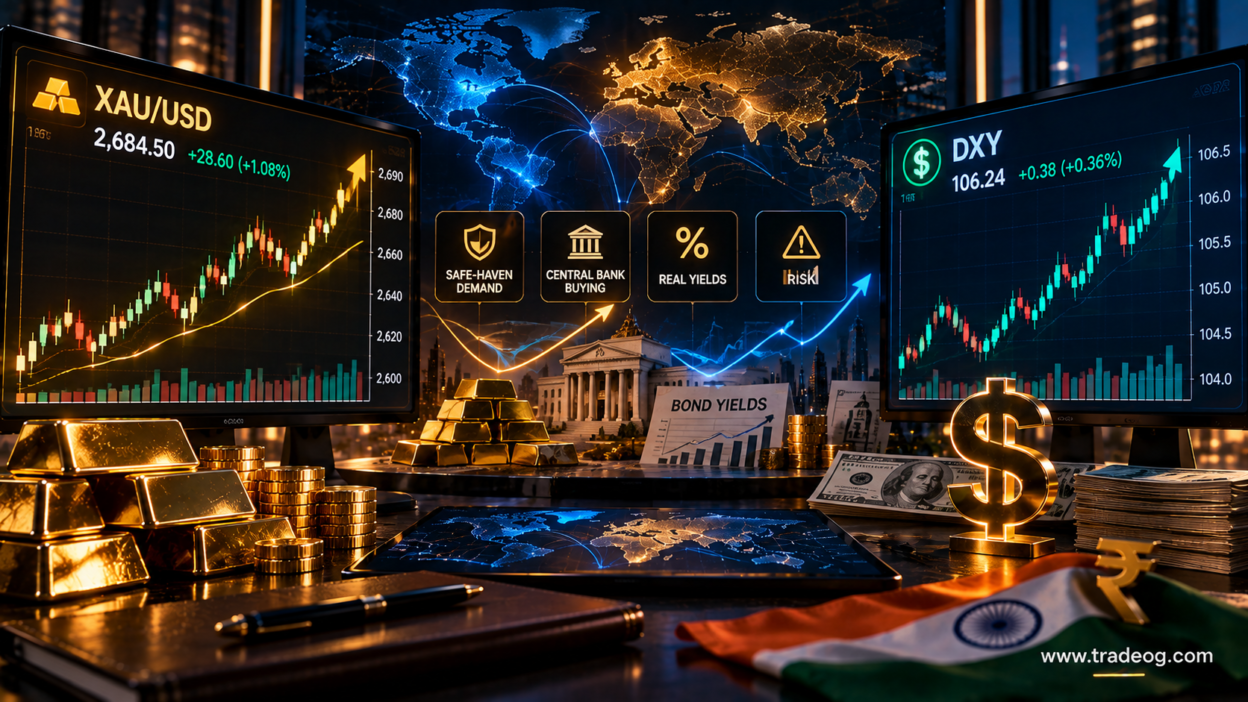
Quick answer: Yes. Gold can sometimes rise while the US dollar also rises because DXY is only one of several forces driving XAU/USD. A stronger dollar normally creates a headwind for dollar-priced gold, but that relationship can be overwhelmed by safe-haven demand, geopolitical risk, central-bank buying, falling real yields, expectations of future monetary easing, strong investment flows or concerns about US fiscal and financial stability.
This is why the simple rule “DXY up = gold down” works often enough to be useful, but not often enough to be treated as a trading law. The World Gold Council’s 2026 research makes the same broader point: gold responds to the interaction of opportunity cost, risk and uncertainty, economic conditions and momentum. The dollar matters, but it is not the only determinant.
Why Gold and the Dollar Usually Move in Opposite Directions
Gold is quoted internationally in US dollars. When the dollar appreciates against other major currencies, gold becomes more expensive in those currencies if the USD gold price does not fall. That can reduce some non-US demand and create downward pressure on XAU/USD.
There is also an opportunity-cost channel. When a stronger dollar is accompanied by higher US interest rates and higher real yields, interest-bearing assets can become more attractive relative to gold, which does not pay a coupon.
That creates the familiar relationship:
USD ↑ + real yields ↑ → gold headwind
But there is an important detail: the dollar can rise for reasons that are not necessarily bearish for gold.
The Key Reason Gold Can Rise With DXY
The dollar and gold are not competing for the same source of demand at all times. During a market shock, investors can want both.
The dollar can benefit from liquidity demand because investors want highly liquid US-dollar assets. Gold can benefit because investors want a store of value, portfolio diversification and protection from uncertainty.
That means a risk event can produce:
| Market | Possible reaction | Why |
|---|---|---|
| DXY | Rises | Demand for dollar liquidity and safe assets |
| Gold | Rises | Safe-haven and diversification demand |
| US Treasury yields | Falls or becomes volatile | Growth/risk concerns |
| Equities | Falls | Risk reduction |
In this environment, the dollar-gold relationship can temporarily break down.
1. Safe-Haven Demand Can Overpower Dollar Pressure
This is one of the clearest explanations.
Suppose geopolitical tensions suddenly increase. Investors become worried about war, trade disruption, financial instability or a major economic shock.
Two things can happen simultaneously:
- Investors increase demand for US dollars and dollar liquidity.
- Investors increase demand for gold as a defensive asset.
Gold does not need the dollar to weaken in order to attract buyers. If the demand for protection is strong enough, XAU/USD can rise despite a stronger DXY.
The World Gold Council’s 2026 outlook has repeatedly highlighted risk and uncertainty as important contributors to gold performance, alongside currency and rate effects.
2. Falling Real Yields Can Support Gold Even With a Strong Dollar
This is probably the most important relationship for advanced XAU/USD analysis.
A nominal Treasury yield can rise while the market’s inflation expectations rise even faster. In that situation, the real yield can fall despite higher nominal yields.
Because gold is particularly sensitive to its opportunity cost, real yields can sometimes tell you more than the direction of DXY alone.
For example:
| Factor | Move | Typical gold implication |
|---|---|---|
| DXY | Higher | Negative |
| 10-year nominal yield | Higher | Potentially negative |
| Inflation expectations | Higher faster | Can offset yield pressure |
| Real yield | Lower | Positive |
| Risk premium | Higher | Positive |
The combined result can be a rising gold price even while the dollar is appreciating.
For a deeper explanation, see What Is Real Yield and Why Does It Matter for Gold Traders?.
3. The Dollar Can Rise Because Other Currencies Are Weak
DXY is a relative currency index. This distinction is critical.
A rising DXY does not necessarily mean the US economy is becoming dramatically stronger or that global investors suddenly prefer dollars over every other asset. It can simply mean that the euro, yen, pound or other currencies are weakening faster.
Imagine a global political shock that damages European growth expectations. EUR/USD falls sharply. Because the euro has a large weight in the Dollar Index, DXY rises.
At the same time, investors buy gold because of the same geopolitical uncertainty.
Result:
EUR/USD ↓ → DXY ↑
while simultaneously:
Risk uncertainty ↑ → Gold ↑
This is one reason why looking only at DXY can produce an incomplete gold signal.
4. Central Bank Gold Buying Can Override Currency Signals
Gold demand is not generated only by short-term futures traders and retail investors.
Central banks can buy gold for reserve diversification, strategic reasons and portfolio resilience. This demand can be relatively insensitive to short-term movements in the US dollar.
The World Gold Council reported significant central-bank gold purchases during Q2 2026 and expects central banks to remain important buyers through the rest of the year.
That creates an important structural distinction:
- Short-term traders may sell gold because DXY rises.
- Longer-term official-sector buyers may continue accumulating gold.
- Investment flows can then absorb the selling and push price higher.
When several demand channels point in the same direction, the normal dollar-gold inverse relationship can weaken.
5. Gold Can Rise Because Investors Fear the Dollar Itself
This sounds contradictory, but it is possible.
The dollar can strengthen in the short term because investors want liquidity while simultaneously increasing their longer-term concerns about US fiscal policy, debt sustainability, sanctions, reserve diversification or financial-system risks.
In such a situation, the dollar can be strong on a short-term liquidity basis while gold benefits from longer-term diversification demand.
The World Gold Council has noted that diversification away from US assets and concerns around the international role of the dollar can become supportive factors for gold.
6. Momentum and Positioning Can Push Gold Higher
Markets do not move only because of economic formulas.
Once gold develops a strong trend, systematic funds, ETFs, futures traders, options desks and other participants can reinforce the move.
A rising gold market can attract additional buying even when one macro variable, such as DXY, is moving in the opposite direction.
The World Gold Council’s 2026 research specifically identified momentum, ETF flows, futures flows and options activity as important contributors during some periods.
This creates a useful rule for traders:
Macro relationships explain the environment; positioning and momentum can explain the actual move.
7. Inflation Can Create a Gold-Dollar Paradox
Inflation is another reason the relationship can become confusing.
Imagine US inflation expectations rise sharply. The market expects higher inflation, causing the dollar to strengthen because investors expect US rates to remain elevated. At the same time, investors increase demand for gold as an inflation hedge.
The result can be:
DXY ↑ + Gold ↑
Whether the gold rally survives depends heavily on what happens to real yields and growth expectations next.
The World Gold Council’s 2026 research stresses that inflation by itself does not guarantee a gold rally. Gold’s reaction depends on how inflation changes real rates, the dollar, growth expectations and other sources of demand.
8. Gold Is a Global Asset, Not Just a US Asset
This point is often overlooked by retail traders.
Gold is purchased by investors, central banks, institutions, jewellery consumers and traders across many regions. The US dollar and US interest rates are important, but they are not the entire global gold market.
The World Gold Council’s 2026 mid-year outlook highlighted the increasing importance of Asian markets in gold price discovery and noted that US rates and the dollar are important but not the sole determinants of gold’s direction.
That matters for Indian traders because Asian demand can influence the market while US macro traders are focused on a completely different set of signals.
Gold Rising While DXY Rises: Four Common Market Scenarios
Scenario 1: Geopolitical shock
DXY: Up
Gold: Up
Yields: Down or volatile
Equities: Down
Interpretation: investors want both dollar liquidity and safe-haven protection.
Scenario 2: Inflation shock
DXY: Up
Gold: Up initially
Yields: Up
Real yields: Depends on inflation expectations
Interpretation: gold can rise if inflation and risk demand overpower the increase in opportunity cost.
Scenario 3: Strong US growth
DXY: Up
Gold: Usually under pressure
Real yields: Up
Equities: Strong
Interpretation: this is a more traditional dollar-positive and gold-negative environment.
Scenario 4: Global currency stress
DXY: Up
Gold: Up
Risk: High
Interpretation: DXY is benefiting from relative currency weakness and liquidity demand while gold is benefiting from diversification and protection demand.
Why DXY Alone Is Not Enough for XAU/USD
If you trade XAU/USD, watching DXY is useful, but the better dashboard includes several markets.
| Market | What to ask | Why it matters |
|---|---|---|
| DXY | Is the dollar strengthening? | Measures broad USD pressure |
| US 10Y yield | Are nominal yields rising? | Measures rate pressure |
| US real yields | Is gold’s opportunity cost rising? | Important gold driver |
| VIX / risk indicators | Is fear increasing? | Safe-haven demand |
| Equities | Are investors reducing risk? | Risk regime |
| USD/INR | Is the rupee weakening? | Important for Indian gold exposure |
| XAU/USD | What is price actually doing? | Final trading confirmation |
This prevents a common mistake: seeing DXY green on the screen and immediately assuming XAU/USD must fall.
What Does It Mean When Gold and DXY Rise Together Intraday?
Intraday moves can be even more misleading than daily correlations.
Suppose a major headline hits the market. DXY jumps because traders seek liquidity, while gold also jumps because the headline increases geopolitical uncertainty.
The first five or ten minutes can show both markets rising together.
Later, Treasury yields may move sharply. The market then reassesses the event and gold can either continue higher or reverse.
This is why chasing the first gold candle after a major headline can be dangerous. Give the market time to reveal which transmission channel is winning.
For more on fast XAU/USD moves, see Gold Volatility Explained: Why XAU/USD Can Move So Fast.
How Indian Traders Should Interpret a Strong Dollar and Rising Gold
Indian traders need one additional layer: USD/INR.
International gold is quoted in dollars, while Indian gold prices are ultimately influenced by the exchange rate between the rupee and dollar.
If the dollar strengthens against the rupee at the same time that global gold rises, the INR value of gold can receive a double boost.
For example, an illustrative situation might look like this:
| Variable | Move | Possible Indian impact |
|---|---|---|
| XAU/USD | +1.0% | Positive |
| USD/INR | +0.7% | Positive for INR gold |
| DXY | +0.4% | Dollar strength confirmed |
| Real yields | Stable | Limited gold headwind |
The exact local price response depends on market structure, taxes, import-related factors, contract specifications and the instrument being traded, but the directional principle is important.
The World Gold Council has specifically highlighted the currency-hedging role of gold for Indian portfolios and noted that rupee depreciation can amplify domestic gold returns.
For more detail, read USD/INR and Gold Correlation: Is There a Connection?.
How to Trade the Situation Without Fighting the Macro
Do not use “DXY up and gold up” as an automatic buy signal. Instead, identify the reason behind the divergence.
Step 1: Check what caused DXY to rise
Was it strong US data? European weakness? A geopolitical shock? A liquidity event? Rate expectations?
Step 2: Check real yields
If DXY is rising but real yields are falling, gold may have a stronger fundamental reason to remain supported.
Step 3: Check risk sentiment
If equities are selling off and geopolitical risk is increasing, safe-haven demand may be overpowering the currency effect.
Step 4: Check gold’s price structure
Look for a confirmed breakout, higher high/higher low structure, rejection from support or continuation after a successful retest. Macro context should support a technical setup rather than replace it.
Step 5: Reduce risk during conflicting signals
When DXY and gold rise together, the market is telling you that multiple forces are competing. That can produce fast reversals. Lower position size can be more sensible than trying to predict which force wins.
Example: Why Gold Can Rally With a Stronger Dollar
Consider this illustrative scenario.
| Market driver | Move | Interpretation |
|---|---|---|
| DXY | +0.8% | Dollar liquidity demand |
| Gold | +1.5% | Safe-haven buying |
| US 10Y yield | -15 bps | Growth/risk concerns |
| Real yields | Lower | Gold opportunity cost falls |
| Equities | -2% | Risk-off environment |
At first glance, DXY and gold appear to be breaking their normal relationship. But there is no contradiction. The dollar is benefiting from liquidity demand while gold is benefiting from falling real yields and safe-haven demand.
The correct conclusion is not “the dollar no longer matters.” It is that another gold driver has temporarily become more powerful.
When Should a Rising DXY Make You More Bearish on Gold?
A stronger dollar becomes a more convincing bearish gold signal when several factors confirm it.
- DXY is breaking higher from a meaningful technical range.
- US real yields are also rising.
- Nominal Treasury yields are rising because of stronger growth or tighter policy expectations.
- Equities are stable or risk appetite is improving.
- Gold fails to hold important support levels.
- Gold ETF or futures positioning shows signs of liquidation.
When these factors align, the probability that dollar strength is genuinely pressuring gold becomes stronger.
For background on the broader dollar-gold relationship, read How US Dollar Strength Affects Gold Prices for Indian Traders.
When Should a Rising DXY Not Scare You Away From Gold?
A rising DXY deserves less weight when:
- Real yields are falling.
- Geopolitical risk is increasing sharply.
- Equities are experiencing a major risk-off move.
- Central-bank gold demand remains strong.
- Gold is showing strong technical momentum.
- ETF, futures or options flows are strongly supportive.
- The dollar is rising mainly because another major currency is weakening.
In these situations, DXY may be a poor standalone timing signal.
Gold-Dollar Correlation Can Change by Market Regime
One of the biggest mistakes in macro trading is assuming that a historical relationship is permanent.
Correlation changes because the dominant market driver changes.
During a normal growth environment, rising US yields and a stronger dollar may create a clear headwind for gold.
During a financial shock, the same dollar strength can coexist with aggressive gold buying.
During an inflation shock, gold may depend more heavily on what happens to real yields than on DXY itself.
During a strong gold momentum regime, investor flows can temporarily overwhelm traditional macro relationships.
The World Gold Council’s 2026 research reflects this multi-factor framework, grouping gold drivers into economic expansion, risk and uncertainty, opportunity cost and momentum rather than treating the dollar as a single master variable.
Common Mistakes Traders Make
Mistake 1: “DXY green means sell gold”
DXY is context, not an automatic trade signal.
Mistake 2: Ignoring real yields
Nominal yields and DXY can move together while real yields tell a different story.
Mistake 3: Ignoring geopolitical risk
Safe-haven demand can overwhelm the normal inverse relationship.
Mistake 4: Assuming correlation means causation
Gold and the dollar can both respond to a third variable such as risk, growth expectations or a geopolitical event.
Mistake 5: Ignoring Indian currency effects
For INR-based traders, USD/INR can materially change the local gold picture.
Gold and Dollar Checklist for Indian XAU/USD Traders
- Check DXY direction.
- Ask why DXY is moving.
- Check US 10-year Treasury yields.
- Check real yields.
- Watch geopolitical and financial-stability risk.
- Check equity-market risk sentiment.
- Watch gold ETF and positioning information when available.
- For Indian exposure, monitor USD/INR.
- Confirm the move with XAU/USD price action.
- Reduce position size when macro signals conflict.
Frequently Asked Questions
Can gold rise when the US dollar rises?
Yes. Gold can rise alongside DXY when safe-haven demand, falling real yields, central-bank buying, investment flows or other forces outweigh the negative effect of a stronger dollar.
Why does gold sometimes rise with DXY?
The dollar and gold can both benefit from uncertainty, but for different reasons. The dollar can attract liquidity demand while gold attracts safe-haven and diversification demand.
Does a strong DXY always mean gold will fall?
No. A strong DXY is generally a headwind for dollar-priced gold, but it is not a guaranteed sell signal. The reason for dollar strength and the direction of real yields matter.
What is more important for gold, DXY or real yields?
Neither should be treated as permanently dominant. Both matter, and their importance changes by regime. Real yields are particularly useful for understanding gold’s opportunity cost, while DXY captures broad currency pressure.
Why is this especially important for Indian gold traders?
Indian traders have an additional currency channel because domestic gold values are affected by the rupee-dollar exchange rate. A weaker rupee can amplify the local impact of a rising international gold price.
Should I buy XAU/USD when DXY and gold rise together?
Not automatically. First identify the catalyst, check real yields and risk sentiment, and then wait for price-action confirmation. A divergence between DXY and gold can persist, but it can also reverse quickly.
Final Takeaway
Gold can rise while the US dollar rises because the dollar is only one piece of the gold-pricing puzzle.
The normal relationship is still useful: all else equal, a stronger dollar tends to create pressure on dollar-priced gold. But markets rarely move with “all else equal.” Safe-haven demand, geopolitical risk, falling real yields, central-bank purchases, inflation expectations, investment flows and momentum can all become stronger forces.
For Indian XAU/USD traders, the best framework is therefore:
DXY + real yields + Treasury yields + risk sentiment + gold flows + USD/INR + XAU/USD price action.
When those markets tell the same story, the signal is stronger. When DXY and gold rise together, do not assume the market is “wrong.” Instead, find out which underlying force is overpowering the usual dollar-gold relationship.
Sources and Further Reading
- World Gold Council: Gold Mid-Year Outlook 2026
- World Gold Council: Gold Market Commentary — When the Dollar Turns on Itself
- World Gold Council: Gold Market Commentary — Hiking Up a Volcano
- World Gold Council: Why Gold in 2026 — An Anchor for Indian Portfolios
Related TradeOG Guides
- How US Dollar Strength Affects Gold Prices for Indian Traders
- What Is Real Yield and Why Does It Matter for Gold Traders?
- Gold and US Treasury Yields: Understanding the Relationship
- USD/INR and Gold Correlation: Is There a Connection?
- Gold Volatility Explained: Why XAU/USD Can Move So Fast
Risk disclaimer: This article is for educational and informational purposes only. Trading gold, forex and other leveraged products involves substantial risk and may not be suitable for every trader. Correlations can change, macro relationships can break down, and past market behaviour does not guarantee future results. Always verify current market, broker, exchange and regulatory information before making trading decisions.