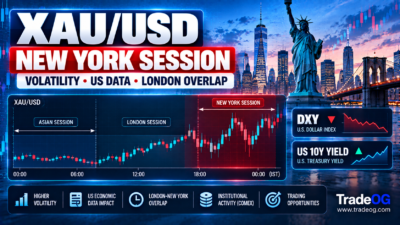

XAU/USD does not behave the same way throughout the trading day. During Asian hours, gold often develops a different market structure from the faster London and New York sessions: liquidity is generally lighter, volatility is often lower, ranges can stay compressed, and regional flows from Japan, China, Singapore and other Asian markets can influence price discovery.
For Indian traders, this makes the Asian session particularly interesting because much of it occurs during daytime IST. Instead of assuming that “Asian session = no movement,” it is more useful to understand what the market is actually doing: building a range, reacting to regional information, establishing reference levels and preparing liquidity for later European activity.
There is no single exchange-defined XAU/USD Asian session because spot gold is an over-the-counter global market. The World Gold Council identifies London OTC, US futures and Shanghai as the three major global gold trading centres, while Asian markets have become increasingly important to price discovery. CME gold futures also trade electronically across global hours, meaning the session boundaries used by retail platforms are conventions rather than hard market closures.
XAU/USD Asian Session: Quick Answer
| Factor | Typical Asian-Session Behaviour | What Traders Should Expect |
|---|---|---|
| Volatility | Generally lower than London/New York | More consolidation and smaller intraday ranges |
| Liquidity | Lower overall than major Western overlaps | Breakouts can need confirmation |
| Price structure | Often range-oriented | Asian high/low can become important reference levels |
| Regional influence | Japan, China and wider Asia | Local data, currencies and gold demand can matter |
| News risk | Usually lower than US-news hours | But BOJ, China and geopolitical headlines can create sharp moves |
| Best use | Range analysis and preparation | Build levels for London rather than forcing trades |
What Is the Asian Session for XAU/USD?
In practical trading terms, the broader Asian session covers the period when Sydney, Tokyo, Shanghai, Hong Kong and other regional financial centres are active before Europe becomes the dominant liquidity centre.
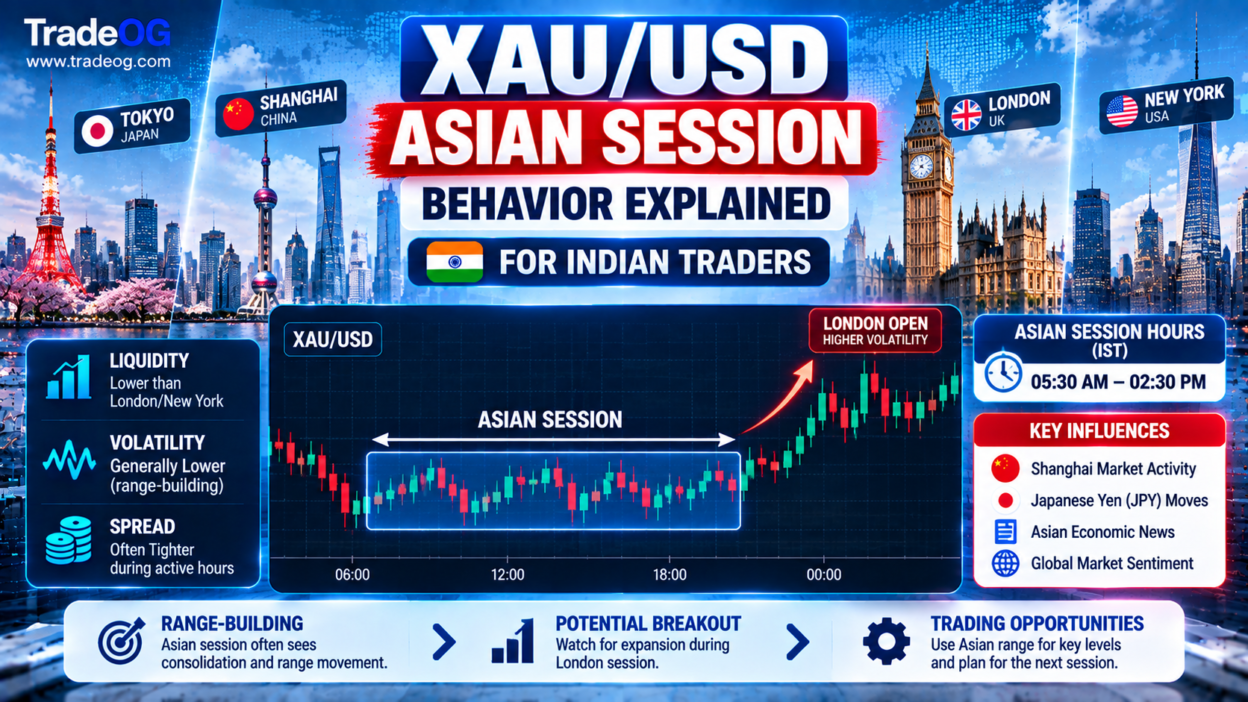
For an Indian trader, a useful working window is approximately 5:30 AM to 2:30 PM IST, with the Tokyo core roughly around 5:30 AM to 11:30 AM IST. Exact boundaries vary by broker, market convention and daylight-saving treatment in other regions.
The Shanghai Gold Exchange is particularly relevant because China is one of the world’s most important gold markets. The World Gold Council notes that Shanghai is a major global gold trading centre and that Asian participation in COMEX gold has also grown.
Therefore, the Asian session should not be viewed simply as a “quiet period.” It is a period in which important regional participants are active, even though the overall market structure can be less aggressive than the London-New York overlap.
Why Does XAU/USD Behave Differently in Asia?
The main reason is who is trading and how much liquidity is available.
Gold is a global asset, but market participation changes as financial centres open and close. During the Asian session, London and New York institutional flow is not yet dominating the market. That can reduce the depth available for large speculative orders and make price more likely to consolidate around recent reference levels.
The World Gold Council estimates that London remains the largest wholesale gold market, while Shanghai and the US futures market are also major centres. This helps explain why XAU/USD can develop a different character before London liquidity arrives.
Lower liquidity does not mean price cannot move. It means that the probability distribution of price movement changes. A headline, large regional order or sudden currency move can have a larger effect when fewer participants are simultaneously providing liquidity.
Asian Session Usually Means Range-Building
One of the most recognizable XAU/USD Asian-session behaviours is consolidation.
After the New York session closes or slows down, gold may begin oscillating between a relatively narrow high and low. Instead of producing a sustained directional trend, price can repeatedly test the edges of the range and return toward the middle.
This creates three useful reference points:
- Asian session high
- Asian session low
- Asian session midpoint
These levels can later become important when London liquidity enters the market. A London move through the Asian high or low can signal that the market is transitioning from consolidation to expansion, but the breakout itself still requires confirmation.
Asian High and Low: Why They Matter
The Asian high and low are not magical support and resistance levels. Their importance comes from the orders and attention that can accumulate around visible session boundaries.
Imagine XAU/USD spends several hours between $4,620 and $4,635. Traders can clearly identify the range. When London begins, a sharp move above $4,635 can attract breakout buyers, trigger stops from short positions and reveal whether additional liquidity is entering the market.
The opposite can happen below $4,620.
However, a break does not guarantee continuation. London can initially trade through an Asian extreme and then reverse. This is why it is better to treat the Asian range as a liquidity and market-structure reference rather than an automatic breakout strategy.
What Usually Happens to XAU/USD Volatility in Asia?
Asian gold trading is generally less volatile than the major London and New York windows, although there is considerable variation from day to day.
Research and market guides consistently describe Asian hours as a comparatively lower-liquidity period for XAU/USD. That tends to produce smaller ranges outside major regional catalysts. The later London-New York overlap generally brings much deeper participation and larger directional moves.
But averages can be misleading. A Bank of Japan surprise, Chinese economic release, geopolitical headline or major overnight repricing can make the Asian session extremely volatile.
Recent market behaviour also demonstrates that large gold moves can begin during Asian hours. A September 2026 gold selloff, for example, was reported as having a significant portion of its decline occur during Asian trading, illustrating that “Asian session = low volatility” is a tendency rather than a rule.
Liquidity During the Asian Session
Liquidity is one of the most important concepts for understanding Asian-session gold behaviour.
When fewer major participants are actively quoting prices, the market can become more sensitive to individual orders. Retail traders may also see broker spreads change according to the liquidity environment.
That creates an important distinction:
Lower volatility does not automatically mean lower trading risk.
A narrow range combined with a wider spread or sudden price jump can make a short-term strategy less attractive. This is particularly important for scalpers who depend on small price movements.
Why Gold Can Still Move Strongly During Asian Hours
Several catalysts can interrupt the normal range-building behaviour.
1. China-Related Gold Demand
China is one of the world’s most important gold markets, and the Shanghai Gold Exchange is a major physical gold trading venue. Regional demand and local market conditions can therefore influence international gold pricing.
2. Japanese Monetary Policy
Bank of Japan decisions, Japanese inflation data and major JPY moves can affect the US dollar and global risk sentiment. Because gold is priced in dollars, large currency moves can transmit into XAU/USD.
3. Chinese Economic Data
Chinese manufacturing, growth and inflation data can influence expectations for commodity demand and broader risk sentiment. Silver and industrial commodities may react directly, while gold can respond through broader macro positioning.
4. Geopolitical Headlines
Geopolitical news does not wait for London to open. If a major development occurs while Asia is active, gold can move rapidly because safe-haven demand can dominate normal session behaviour.
5. A Strong New York Close
Asia sometimes continues a trend established during New York rather than reversing it. If the previous US session produced a major breakout, assuming that Asia must form a tight range can be dangerous.
Tokyo vs Shanghai: Are They the Same?
No. Tokyo and Shanghai represent different sources of regional activity.
| Market | Potential Influence on Gold | What Indian Traders Can Watch |
|---|---|---|
| Tokyo / Japan | JPY, BOJ policy, local macro data, risk sentiment | USD/JPY and BOJ headlines |
| Shanghai | Physical gold demand and Chinese market activity | Chinese data and regional gold pricing |
| Hong Kong / Singapore | Regional financial flows and trading activity | Regional risk sentiment and liquidity |
| India / MCX | Local precious-metals demand and INR effects | USD/INR and MCX Gold context |
The World Gold Council lists Shanghai, India, Japan, Singapore and Hong Kong among important secondary or regional gold markets, while Shanghai itself is one of the three major global gold trading centres.
XAU/USD Asian Session and the US Dollar
Because XAU/USD is quoted in dollars, Asian-session gold traders should monitor DXY and major dollar pairs.
A simplified relationship is:
Stronger USD → potential pressure on XAU/USD
Weaker USD → potential support for XAU/USD
But the relationship is not mechanical. Gold can rise with the dollar when safe-haven demand or another macro factor is stronger than the currency effect.
For Indian traders, USD/INR is also relevant when evaluating the local-currency impact of global gold prices. TradeOG’s XAU/USD vs USD/INR guide explains this relationship in detail.
Asian Session and Treasury Yields
US Treasury yields remain important even when the US market itself is closed.
Global bond futures and macro expectations continue to change around the clock. A sharp repricing in Treasury yields can influence the dollar and gold before London opens.
For gold traders, the most useful relationship is often between US real yields, DXY and XAU/USD. Higher real yields can increase the opportunity cost of holding non-yielding gold, while falling real yields can provide support.
Read TradeOG’s Gold and US Treasury Yields guide for a deeper explanation.
Asian Session Trading Strategy: Range Framework
A simple framework is to define the Asian range first and trade only when price behaviour provides confirmation.
- Mark the Asian session high.
- Mark the Asian session low.
- Measure the range size.
- Check whether the previous New York session was trending or consolidating.
- Monitor major Asian economic events.
- Wait for London liquidity before assuming a breakout has real follow-through.
The important idea is that the Asian range can become a map for the next session. It does not have to be traded directly.
Should You Scalp XAU/USD During the Asian Session?
It depends on your execution costs and strategy.
Scalpers need frequent opportunities, tight execution and predictable spreads. A quieter market can reduce the number of clean setups. If the broker spread consumes a meaningful percentage of the expected profit target, the strategy may have negative expectancy even if the chart looks technically attractive.
For that reason, many traders may find it more useful to use Asian hours for market preparation rather than aggressive scalping.
That means identifying:
- Overnight high and low
- Previous-day high and low
- Key support and resistance
- Asian consolidation range
- Major macro catalysts
- Potential London breakout levels
Asian Session for Swing Traders
Swing traders can use Asian-session behaviour as context rather than an entry window.
For example, if gold has rallied strongly in New York and then consolidates above a major breakout level during Asia, the Asian range can reveal whether the market is accepting the new price area or losing momentum.
Conversely, if gold falls sharply and then fails to recover during Asian hours, the inability to reclaim key levels can become useful context for the next major liquidity window.
Asian Session for Prop Firm Traders
Prop-firm traders should pay particular attention to the relationship between position size and volatility.
A narrow Asian range can tempt traders to use oversized positions because the stop appears close. That can be dangerous. A sudden regional headline or London expansion can move XAU/USD far beyond the Asian range.
A better approach is to define risk in monetary terms first:
Maximum Risk = Account Equity × Risk Percentage
Then calculate position size from the stop distance and instrument specification. Do not increase lot size simply because Asian candles appear small.
Asian Range Breakout: What to Look For
If XAU/USD breaks the Asian high or low, ask five questions before entering:
- Did the breakout occur during a meaningful liquidity increase?
- Is there a strong fundamental catalyst?
- Did the candle close beyond the range?
- Is DXY confirming the direction?
- Is Treasury-yield movement consistent with the gold move?
A breakout supported by several independent signals is generally more informative than a wick through the range followed by an immediate reversal.
Asian Session Fake Breakouts
False breaks are particularly important around visible session extremes.
Suppose gold trades inside a narrow Asian range. Price briefly pushes above the high, triggers breakout orders and then falls back inside the range. That can indicate rejection rather than genuine expansion.
The correct response is not to assume every Asian high is a stop-hunt. Instead, observe:
- Where price closes
- Whether volume/liquidity increases
- Whether London confirms the direction
- Whether the dollar supports the move
- Whether the move follows a fundamental catalyst
Best Time to Watch XAU/USD From India
There is no single “best” time for every strategy.
| Approx. IST Window | Typical Gold Character | Useful For |
|---|---|---|
| 05:30–08:00 | Early Asian activity; often quieter | Opening range and overnight context |
| 08:00–11:30 | Tokyo core; regional activity | Range analysis and regional catalysts |
| 11:30–14:30 | Broader Asia; transition toward Europe | Preparing for London |
| 12:30–21:30 | London becomes increasingly important | Directional expansion and breakouts |
| 17:30–02:30 | New York influence increases | US data and major volatility |
These are practical reference windows, not guaranteed broker-session boundaries. London and New York times shift against IST during their daylight-saving periods, while India does not observe daylight saving.
For a broader session comparison, see TradeOG’s Gold Trading Sessions in IST guide.
What Makes the Asian Session Different From London?
The biggest difference is the depth and composition of liquidity.
London is historically the centre of wholesale gold trading, while Asia contains major physical and financial participants. When London opens, a larger pool of global speculative liquidity becomes active, which can produce stronger directional expansion.
Therefore, the same technical level can behave differently at different times. A resistance level that rejects price three times during Asia may break quickly once London liquidity arrives.
What Makes the Asian Session Different From New York?
New York brings major US macro releases, COMEX activity and the strongest overlap with London.
That makes the US session especially important for XAU/USD traders watching CPI, PCE, NFP, FOMC decisions, Treasury yields and the US dollar.
Asian trading is usually more about building the map; London and New York are more likely to determine whether that map becomes a major directional move.
Common Mistakes in Asian-Session Gold Trading
1. Assuming Asia Cannot Trend
It can. Regional news, geopolitical events and strong overnight momentum can create substantial trends.
2. Trading Every Asian Breakout
A low-liquidity breakout without confirmation can quickly reverse.
3. Ignoring the Previous New York Session
The previous session can determine whether Asia consolidates or continues an existing trend.
4. Using Oversized Positions
Small candles do not guarantee small future risk. Gold can expand rapidly when liquidity changes.
5. Ignoring Spread Conditions
Always check the actual XAU/USD spread on your broker during the hours you trade.
6. Forgetting Regional News
BOJ decisions, Chinese data and geopolitical headlines can invalidate a range-based assumption.
7. Treating Session Times as Exact
Different brokers use different server times and session labels. Build your analysis from the actual chart timestamp rather than blindly copying a generic session indicator.
A Practical Asian Session Checklist for Indian Traders
Before trading XAU/USD during Asian hours, check:
- What happened during the previous New York session?
- Where are the previous-day high and low?
- What is the Asian session high and low?
- Is gold trending or consolidating?
- What is DXY doing?
- What are US Treasury yields doing?
- Are Japanese or Chinese data releases scheduled?
- Is there a geopolitical catalyst?
- What is the current broker spread?
- How much account risk is acceptable if the range breaks suddenly?
Example: A Normal Asian Range
Imagine XAU/USD closes New York near $4,650 after a strong rally. During Asia, gold trades between $4,642 and $4,660 for several hours.
The market has created a clear range.
Instead of immediately buying every move toward $4,660, a trader can wait for evidence that the market is actually breaking out. If London opens and price closes decisively above $4,660 while DXY weakens and Treasury yields fall, the breakout has more macro confirmation.
If price briefly trades above $4,660 and immediately returns below it, the event may be better interpreted as rejection.
Example: When Asian Gold Becomes Volatile
Now assume a major geopolitical announcement occurs during Asian hours.
Gold suddenly breaks the previous day’s high, volatility increases and safe-haven demand dominates the dollar and rates relationship.
Trying to fade the move simply because “Asia normally ranges” would be poor reasoning. The market regime has changed.
The correct framework is always session tendency + current catalyst + price structure + risk management.
Does Asian Session Behaviour Predict London?
It can provide useful context, but it does not reliably predict the London direction by itself.
The Asian range can identify liquidity pools and important levels. London may break the range in either direction. A bullish Asian session does not guarantee a bullish London session, and a bearish Asian session does not guarantee a bearish New York session.
Use the Asian session as a reference map, not a directional prophecy.
FAQs
Is XAU/USD volatile during the Asian session?
Usually volatility is lower than during the major London-New York overlap, but the Asian session can become highly volatile around regional economic data, BOJ decisions, geopolitical headlines or strong overnight repricing.
What time is the Asian session for gold in India?
A practical broader window is roughly 5:30 AM to 2:30 PM IST, with Tokyo’s core hours beginning around 5:30 AM IST. Exact session definitions vary by broker and market convention.
Is the Asian session good for XAU/USD scalping?
It can work for a strategy designed for lower volatility and the actual broker’s spread, but fewer large moves and changing liquidity can make aggressive scalping less attractive than during major Western overlaps.
Why does gold often range during Asia?
Asian hours generally have less global speculative liquidity than the London-New York overlap, so gold can spend more time consolidating. This is a tendency, not a rule.
Should I trade the Asian session high and low?
You can use them as reference levels, but do not assume every break will continue. Wait for price confirmation, liquidity expansion and, when relevant, macro confirmation.
Does Shanghai affect XAU/USD?
Yes, Asian gold markets can influence global pricing. Shanghai is one of the world’s major gold trading centres, and Chinese physical demand is an important component of the global gold market.
Is Asian-session gold suitable for prop firms?
It can be, provided the instrument is permitted and your position size reflects the possibility of sudden volatility expansion. Never use the smaller Asian range as a reason to take excessive leverage.
Final Takeaway
XAU/USD Asian session behaviour is best understood as a lower-liquidity, often range-building phase rather than a dead market. Tokyo, Shanghai and other Asian centres contribute meaningful gold-market activity, while regional currencies, Chinese demand, Japanese policy and geopolitical events can create exceptions.
For Indian traders, the biggest advantage is the ability to use Asian hours to build a market map: mark the range, identify important highs and lows, monitor DXY and Treasury yields, check regional news and prepare for the liquidity expansion that can arrive with London.
The goal is not to force a trade because the market is open. The goal is to understand when XAU/USD is likely to be quiet, what can make it move, and how the Asian range can help frame the next major session.