

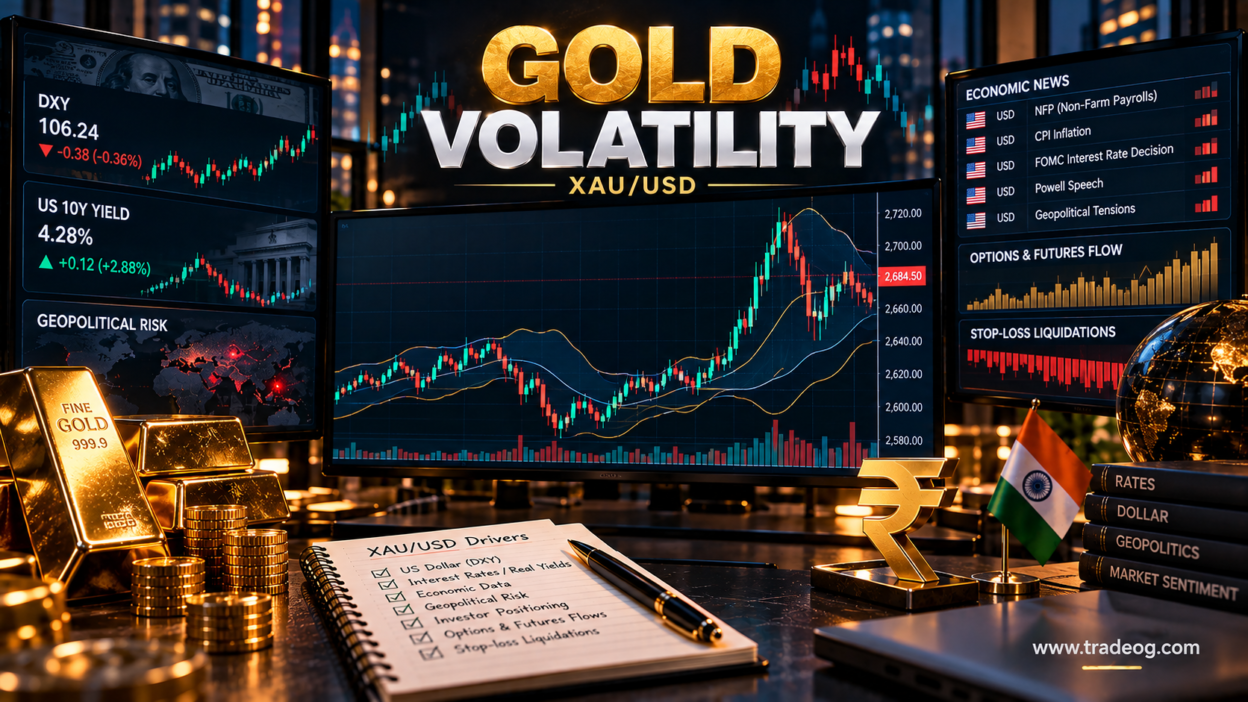
Gold volatility is one of the biggest reasons XAU/USD attracts short-term traders—and one of the biggest reasons it can punish them. Gold can spend hours moving calmly and then cover a large price range in minutes when interest-rate expectations, the US dollar, economic data, geopolitical risk or market positioning suddenly changes.
For Indian traders, the effect can feel even more significant because XAU/USD is quoted in US dollars while the value of a trade, deposit or withdrawal may ultimately be viewed in INR. A fast move in international gold can therefore create a large change in both opportunity and risk.
And there is an important point many beginners miss: gold does not need a major headline to become volatile. Position unwinding, stop-loss orders, options activity, futures positioning and changes in liquidity can accelerate a move even after the original catalyst has already occurred.
Quick answer:
XAU/USD can move very fast because gold reacts simultaneously to US interest-rate expectations, Treasury yields, the US dollar, inflation, economic data, geopolitical risk, investor positioning, options and futures flows, and changes in liquidity. When several of these forces point in the same direction, volatility can expand rapidly. The solution is not to predict every spike—it is to reduce position size, understand the catalyst and manage stop-loss risk before entering.
What Is Gold Volatility?
Gold volatility describes how much and how quickly the price of gold changes over a particular period.
There are several ways traders think about volatility:
- Realised volatility: how much gold has actually moved over a historical period.
- Implied volatility: the market’s forward-looking estimate of expected movement derived from options pricing.
- Intraday range: the distance between a session’s high and low.
- Average True Range (ATR): a technical measure used to estimate typical price movement over a selected number of candles.
The World Gold Council maintains historical gold-volatility data across daily, weekly and monthly frequencies. Its September 2026 data shows why volatility is worth monitoring as a separate market variable rather than simply looking at the gold price.
Why Is XAU/USD So Volatile?
XAU/USD sits at the intersection of several major global markets.
Gold is simultaneously influenced by:
- US monetary policy
- US Treasury yields
- Real interest rates
- US dollar movements
- Inflation expectations
- Economic growth expectations
- Geopolitical risk
- Central-bank demand
- ETF flows
- Futures and options positioning
- Technical levels and stop orders
- Liquidity conditions
That combination makes gold particularly responsive when financial markets are repricing several expectations at once.
Recent World Gold Council analysis describes gold’s 2026 volatility as unusually high and identifies changing rate expectations, bond yields, US dollar strength, investor position unwinding and stop-loss orders among the factors behind sharp moves.
1. US Interest Rates Can Move Gold Quickly
The Federal Reserve is one of the most important macro influences on XAU/USD.
Gold does not pay a conventional coupon or interest rate. Therefore, the opportunity cost of holding gold changes as the return available from interest-bearing assets changes.
When markets expect lower interest rates, gold can become relatively more attractive. When markets suddenly expect higher rates, gold can come under pressure.
But traders should avoid turning this into a simple rule such as:
“Fed cuts = gold always rises.”
Markets trade expectations, not headlines.
If a rate cut was already fully priced in, the actual decision may produce little reaction. Conversely, a change in the Fed’s guidance can cause a major gold move even if the current policy rate itself remains unchanged.
2. US Treasury Yields Affect Gold’s Opportunity Cost
Bond yields are one of the most useful variables to watch alongside XAU/USD.
When yields rise sharply, interest-bearing assets can become relatively more attractive compared with a non-yielding asset such as gold. When yields fall, the opportunity cost of holding gold can decrease.
Real yields can be particularly useful because they attempt to account for inflation expectations.
TradeOG has already covered this relationship in What Is Real Yield and Why Does It Matter for Gold Traders?.
The relationship is not mechanical, however. Gold can rise even while yields are elevated if another force—such as geopolitical risk, strong central-bank demand or investor positioning—is powerful enough to dominate.
The World Gold Council’s 2026 research makes this point clearly: risk, foreign exchange and momentum have all contributed materially to gold’s recent variability, while rates have not explained every move.
3. The US Dollar Is a Major XAU/USD Driver
Gold is globally quoted in US dollars, so changes in the dollar can have a significant effect on XAU/USD.
All else equal, a stronger dollar can create downward pressure on dollar-priced gold, while a weaker dollar can support it.
But again, “stronger dollar = gold always falls” is too simplistic.
During a major risk event, investors can seek both US dollars and gold at the same time. This is one reason correlations can temporarily break down.
For a deeper explanation, see How US Dollar Strength Affects Gold Prices for Indian Traders.
4. Economic Data Can Trigger Sudden XAU/USD Moves
Economic releases can change interest-rate expectations within seconds.
Important US releases for gold traders include:
- Consumer Price Index (CPI)
- Producer Price Index (PPI)
- Nonfarm Payrolls (NFP)
- Unemployment data
- Retail sales
- GDP
- PCE inflation
- ISM manufacturing and services data
- Consumer confidence indicators
The reason these reports matter is not simply that they contain economic information. Their importance comes from how they change expectations for growth, inflation and Federal Reserve policy.
Imagine CPI comes in significantly hotter than expected. Traders may immediately increase expectations for restrictive monetary policy. Treasury yields and the dollar can jump, while gold sells off.
But if the market had already positioned for an even hotter number, gold could react in the opposite direction after the release.
That is why the difference between actual, forecast and previous matters.
5. Federal Reserve Decisions Can Create Gold Volatility
FOMC meetings can produce large XAU/USD moves because traders are pricing more than the current interest-rate decision.
They also analyse:
- Forward guidance
- Economic projections
- Inflation language
- Growth expectations
- Labour-market commentary
- Future rate expectations
- Press-conference comments
A Fed decision can therefore produce several waves of volatility:
- The initial rate decision.
- The statement reaction.
- The projections reaction.
- The press conference.
- The subsequent repricing in yields and the dollar.
Gold traders who enter immediately before such events are effectively accepting event risk.
6. Geopolitical Risk Can Send Gold Into Fast-Moving Mode
Gold is widely treated as a defensive asset during periods of uncertainty.
When geopolitical tensions rise, investors can rapidly reassess risk across equities, bonds, currencies and commodities. Gold can attract demand as portfolios seek diversification or protection.
Recent 2026 World Gold Council research found geopolitical risk to be an important contributor to gold’s performance and volatility, particularly during periods of broader market stress.
However, the direction is not guaranteed.
A geopolitical shock can initially push gold higher, but if it simultaneously causes a sharp rise in inflation expectations, Treasury yields and the dollar, the eventual gold reaction can become much more complicated.
7. Positioning Can Make Gold Moves Much Larger
One of the most overlooked causes of rapid XAU/USD movement is positioning.
Suppose many traders are already long gold after a powerful rally. A new catalyst causes the price to break an important technical level.
The first sellers may simply be taking profit.
Then stop-loss orders from long positions are triggered.
Momentum traders may begin selling.
Other traders reduce leverage.
The result can be a much larger move than the original fundamental catalyst would suggest.
The World Gold Council specifically identified investor unwinding, stop-loss orders and positioning as factors that amplified gold’s 2026 volatility.
8. Stop-Loss Clusters Can Accelerate a Gold Move
Gold often reacts sharply around widely watched highs, lows, psychological numbers and technical levels.
Why?
Because many traders place risk-management orders in similar locations.
For example, imagine XAU/USD has repeatedly found support around a particular price zone. A large number of long traders may place stops just below it.
If the level breaks, those stops become market orders.
The selling can push price into the next liquidity zone, where additional stops may be triggered.
This creates a chain reaction.
That is why a seemingly small break can sometimes become a large candle.
9. Options and Futures Flows Can Amplify Volatility
Gold is a large global market with substantial futures and options activity.
Derivatives positioning can influence short-term price behaviour through hedging, profit-taking and position adjustments.
The World Gold Council noted that futures, options and ETF activity played a meaningful role in recent gold volatility, including during major moves in 2026.
Retail traders do not need to understand every institutional position to benefit from this information. The practical lesson is simpler:
A large gold move can be reinforced by positioning after the initial catalyst.
10. Liquidity Matters More Than Many Traders Realise
Volatility is not only about how much traders want to buy or sell. It is also about how much liquidity is available to absorb those orders.
When liquidity is deep, large orders can sometimes be absorbed with less price impact.
When liquidity becomes thinner, the same amount of aggressive buying or selling can move price more quickly.
The World Gold Council reported that gold’s bid-ask spreads have risen during the recent high-volatility environment, particularly noting that unusually high spikes can occur during off-market hours.
For retail traders, this means the time of day matters.
Why XAU/USD Can Move Faster During Certain Sessions
Gold trades across global financial centres, so its liquidity profile changes during the day.
European and US market activity can bring a significant increase in participation and macroeconomic information flow.
For Indian traders, this often means that the more active gold periods occur during the afternoon, evening and early night in IST, depending on the global session and seasonal daylight-saving changes.
Do not treat a session clock as a guarantee of volatility. Instead, use it as a framework for understanding when liquidity and news flow may increase.
Why Gold Moves So Fast During US News
Consider the sequence:
- A US economic release is published.
- Algorithmic systems process the data.
- Interest-rate expectations change.
- Treasury yields move.
- The US dollar moves.
- Gold reprices.
- Stops and leveraged positions are triggered.
- Momentum traders join the move.
That entire sequence can happen extremely quickly.
This is why XAU/USD candles around major releases can look dramatically larger than normal candles.
Gold Volatility and the US Dollar: What Traders Should Watch
A useful intraday dashboard for gold can contain:
| Market Variable | Why It Matters for XAU/USD |
|---|---|
| DXY / US dollar | Dollar strength can influence dollar-priced gold |
| US 10-year Treasury yield | Reflects changes in bond-market expectations |
| US real yields | Useful measure of gold’s opportunity cost |
| Economic calendar | Identifies potential volatility catalysts |
| VIX / risk sentiment | Provides broader risk context |
| Gold futures/options positioning | Can help explain amplified moves |
No single indicator should be treated as a guaranteed directional signal.
Why Gold Can Rise Even When Yields Rise
This is where many simplified gold strategies fail.
Gold often has an inverse relationship with real yields, but the relationship is not permanent or perfectly stable.
Gold can rise despite higher yields if:
- Geopolitical risk increases.
- Central-bank demand remains strong.
- ETF or investment demand accelerates.
- The dollar weakens sufficiently.
- Investors become concerned about fiscal or financial-system risks.
- Momentum and positioning overwhelm the rate effect.
The World Gold Council has noted that the traditional inverse relationship between gold and real rates has been counterbalanced by other forces in recent years, including investor and central-bank demand.
Why Gold Can Fall During a Geopolitical Crisis
This sounds contradictory, but it can happen.
During severe market stress, investors sometimes need cash or liquidity to meet margin requirements elsewhere. They may sell liquid assets—including gold—to raise cash.
Gold therefore cannot be treated as a guaranteed one-directional “war asset.”
The World Gold Council’s historical analysis notes that gold has sometimes been sold during major liquidity crises even when the underlying event would normally be considered supportive for defensive assets.
Gold Volatility and Indian Traders
Indian traders need to consider one additional layer: USD/INR.
International XAU/USD is quoted in US dollars per ounce. The INR value of gold is therefore affected not only by the international gold price but also by the rupee’s value against the dollar.
This creates an important distinction:
XAU/USD can fall while Indian gold prices do not fall by the same percentage.
If the rupee weakens against the dollar at the same time that international gold declines, part of the decline can be offset for Indian buyers.
For more detail, see USD/INR and Gold Correlation: Is There a Connection?.
How Gold Volatility Affects Indian XAU/USD Traders
Suppose an Indian trader has a USD-denominated trading account.
A sudden $20 move in gold can produce a much larger INR-equivalent P&L change than the trader expected if the position size is aggressive.
The correct response is not to predict the next $20 move.
The correct response is to calculate the position size before entering.
Use:
Risk = position size × price movement × contract value
The exact contract value depends on the broker or trading venue, so always use the specification for your instrument rather than assuming that every XAU/USD symbol has the same lot size.
Gold Volatility and Position Sizing
When volatility rises, fixed-lot trading can quietly increase account risk.
Imagine your normal XAU/USD stop is 2.0 dollars during a low-volatility environment. If the market’s typical intraday movement expands dramatically, that stop may become too close to normal noise.
You have two basic choices:
- Keep the stop distance and reduce position size.
- Keep the position size and accept substantially higher risk.
For disciplined risk management, reducing position size is usually the more controlled approach.
Do not widen the stop simply because the market is moving quickly unless the new stop is consistent with your tested strategy.
ATR Can Help Measure Gold Volatility
Average True Range (ATR) is one of the simplest ways to estimate recent market movement.
For example, if a 14-period ATR on your chosen timeframe increases substantially, it tells you that recent candles are covering more range.
ATR does not predict direction.
It answers a different question:
“How much has this market recently been moving?”
That can be useful when deciding whether your normal stop distance and position size are still appropriate.
Gold Volatility and Stop-Loss Placement
A stop-loss should be placed where your trade thesis is invalidated—not at an arbitrary distance simply because you want to risk a fixed number of dollars.
At the same time, volatility should influence the position size required to keep the monetary risk under control.
A practical framework is:
- Identify the technical invalidation level.
- Measure recent volatility.
- Calculate the distance to the stop.
- Determine the maximum rupee or account-currency risk.
- Reduce the position size until the risk fits your plan.
This is much safer than deciding the lot size first and forcing the stop around it.
Gold Volatility and Leverage
Leverage does not create volatility. It magnifies the account impact of volatility.
A $10 gold move is the same market movement whether your account uses low leverage or high leverage.
What changes is how much that movement affects your account relative to your capital.
This is why gold traders should monitor:
- Used margin
- Free margin
- Margin level
- Position size
- Stop-loss distance
- Maximum account risk
See Forex Leverage Explained for Indian Traders With Examples for a deeper explanation.
Gold Volatility vs Gold Price: They Are Not the Same Thing
A high gold price does not automatically mean high volatility.
Gold can trade at a record level while moving in a relatively narrow range.
Conversely, gold can trade at a lower price while producing enormous daily ranges.
Always separate:
- Price level: where gold is trading.
- Volatility: how quickly and how far gold is moving.
- Trend: the directional structure of the market.
A bullish market can be highly volatile. A bearish market can be highly volatile. A sideways market can also experience short volatility explosions around news.
Gold Volatility and Technical Breakouts
Technical breakouts can become much more powerful when they occur alongside a fundamental catalyst.
For example:
US data surprise → yields jump → DXY rises → XAU/USD breaks support → stops trigger → volatility expands.
Or the opposite:
Weak US data → yields fall → DXY weakens → XAU/USD breaks resistance → momentum buying accelerates.
This is why combining macro context with technical levels can be more informative than using either one in isolation.
Gold Volatility and Liquidity Sweeps
Gold traders often describe sharp moves through a previous high or low as a liquidity sweep.
The idea is that price moves into an area where orders are concentrated, triggers those orders and then either reverses or continues.
Not every wick is a liquidity sweep, and the concept should not be used as a reason to enter blindly.
When volatility is elevated, however, these rapid moves become more common because a larger amount of order flow is being processed in a shorter period.
How to Trade Gold When Volatility Is Extremely High
When XAU/USD becomes unusually volatile, traders should change their process—not chase the candles.
1. Reduce Position Size
If the expected range doubles, maintaining the same lot size can materially increase your risk.
2. Avoid Market Orders Into Explosive Candles
Entering after a huge candle can produce poor risk-reward because the stop may need to be far away.
3. Wait for Price to Stabilise
Let the first reaction develop before deciding whether a second opportunity exists.
4. Check the Economic Calendar
Know whether the move is happening immediately before or after a scheduled release.
5. Watch DXY and Yields
These can help determine whether the gold move has a broader macro driver.
6. Respect Your Daily Loss Limit
High volatility can turn a normal losing streak into a major account drawdown when traders increase size emotionally.
What Not to Do During a Gold Volatility Spike
- Do not double your lot size because candles look profitable.
- Do not move a stop farther away just to avoid being stopped out.
- Do not enter because everyone on social media is discussing the move.
- Do not assume every geopolitical headline means gold must rise.
- Do not ignore spreads and slippage.
- Do not trade through major news without understanding event risk.
- Do not revenge trade after a fast stop-out.
A Practical XAU/USD Volatility Checklist
| Question | What to Check |
|---|---|
| Is volatility expanding? | ATR, recent daily range, realised volatility |
| Is there a catalyst? | Economic calendar and geopolitical headlines |
| What is DXY doing? | Dollar direction and speed of movement |
| What are yields doing? | US Treasury and real-yield direction |
| Is price near a major level? | Previous high/low, support, resistance |
| Is positioning crowded? | Futures/options/ETF flow context where available |
| Is liquidity changing? | Session, spread and execution conditions |
| Can the trade survive the range? | Stop distance and position size |
Gold Volatility in 2026: What Recent Data Shows
The current environment is a useful reminder of why volatility deserves its own analysis.
The World Gold Council reported that gold volatility rose sharply during the beginning of 2026, reaching unusually high historical levels. Its analysis linked the large swings to changing Fed rate expectations, bond yields, dollar strength, position unwinding and stop-loss activity.
Its June 2026 mid-year outlook also reported that gold’s realised volatility had moved above 50% during the first-half volatility shock, before falling below 30% while remaining above its longer-term average.
Later 2026 commentary highlighted the continuing importance of ETF flows, futures activity, options and the US dollar in gold’s short-term performance.
The lesson is not that gold will remain permanently volatile. In fact, historical volatility spikes can mean-revert. The lesson is that traders should recognise when the market’s risk regime has changed.
Gold Volatility Does Not Always Mean a Trading Opportunity
This distinction is important.
Volatility creates movement, not necessarily edge.
A market moving $30 in an hour may look attractive to a trader, but if spreads widen, slippage increases and price whipsaws in both directions, the actual trading environment may be worse than a calmer market.
The best trading environment is the one where your strategy has a measurable advantage after costs—not necessarily the one with the biggest candles.
How Indian Traders Can Build a Gold Volatility Routine
A simple routine can make XAU/USD trading more systematic.
- Before the session: mark major daily and weekly levels.
- Check the calendar: identify CPI, NFP, FOMC and other major releases.
- Check DXY: note whether dollar momentum is strengthening or weakening.
- Check yields: watch the direction of US Treasury and real yields.
- Measure volatility: compare current ATR/range with recent sessions.
- Define risk: decide the maximum rupee amount you are willing to lose.
- Calculate size: choose the lot size after determining the stop distance.
- Wait for your setup: do not enter simply because gold is moving.
- Review: record whether volatility helped or hurt the trade.
Gold Volatility and Trading Journal Analysis
A trading journal can reveal whether your strategy actually performs well during high-volatility conditions.
Record:
- Time of entry
- Gold price
- ATR at entry
- News event, if any
- DXY direction
- Yield direction
- Position size
- Stop distance
- Slippage
- Result in R
After 50 or 100 trades, you may discover that your strategy works best in moderate volatility rather than extreme volatility.
That information is more valuable than simply assuming that “more movement is better.”
Final Takeaway: Why XAU/USD Can Move So Fast
Gold volatility is the result of multiple markets interacting at the same time.
US rates influence opportunity cost. Treasury yields change. The dollar moves. Economic data changes expectations. Geopolitical events alter risk sentiment. Investors adjust positions. Options and futures activity can amplify the move. Stop-loss orders turn price movement into additional order flow. Liquidity can change at the same time.
When several of these forces align, XAU/USD can move extremely quickly.
For traders, the goal should not be to predict every violent candle. The better objective is to recognise the volatility regime, understand the likely catalysts and size positions so that an unexpected move does not damage the trading account.
In gold trading, volatility is not the enemy. Unprepared risk is.
FAQs
Why is XAU/USD so volatile?
XAU/USD is influenced by US interest-rate expectations, Treasury yields, the US dollar, economic data, geopolitical risk, investor positioning, futures and options flows and liquidity. When several drivers change simultaneously, gold can move very quickly.
What makes gold move suddenly?
Major economic releases, Federal Reserve decisions, changes in bond yields, large dollar moves, geopolitical headlines, position unwinding and stop-loss cascades can all cause sudden XAU/USD movement.
Is gold more volatile than forex?
It depends on the period and instrument. Gold can experience much larger short-term percentage and dollar ranges than major currency pairs during risk events, but volatility varies over time.
What is the best indicator for gold volatility?
There is no single best indicator. ATR is useful for recent price range, while realised and implied volatility provide broader views of market movement and expectations.
How does the US dollar affect gold volatility?
Gold is priced in US dollars, so rapid changes in the dollar can influence XAU/USD. Dollar moves can also reflect changes in interest-rate expectations, making the two markets part of the same macro repricing process.
Do US interest rates affect XAU/USD?
Yes. Changes in expected interest rates can affect Treasury yields, real yields and the opportunity cost of holding gold. The relationship is important but not perfectly stable because other gold demand drivers can dominate.
Why does gold move so much during NFP?
NFP can change expectations about the US labour market, Federal Reserve policy, Treasury yields and the dollar. When those markets reprice quickly, XAU/USD can react within seconds.
Can gold fall during a war or geopolitical crisis?
Yes. Although geopolitical risk can support defensive demand for gold, severe market stress can also create liquidity needs and position unwinding. Gold is not guaranteed to rise during every geopolitical event.
How should I trade gold when volatility is high?
Consider reducing position size, checking the economic calendar, allowing enough room for normal price movement, avoiding impulsive entries after large candles and keeping the maximum account risk fixed.
How does volatility affect XAU/USD stop loss?
Higher volatility can make a very tight stop easier to hit through normal market noise. Instead of automatically widening the stop, traders can first identify the technically valid invalidation level and then reduce position size to keep monetary risk controlled.
Does high gold volatility mean gold will keep rising?
No. Volatility measures the size and speed of movement, not direction. Gold can be highly volatile during both rallies and selloffs.
How does USD/INR matter for Indian gold traders?
International XAU/USD is priced in dollars, so the rupee-dollar exchange rate can affect the INR value of gold. A weaker rupee can partly offset a decline in international dollar-denominated gold.
Related TradeOG Guides
- How US Dollar Strength Affects Gold Prices for Indian Traders
- What Is Real Yield and Why Does It Matter for Gold Traders?
- USD/INR and Gold Correlation: Is There a Connection?
- EUR/USD and Gold Correlation: What Traders Should Know
- Forex Leverage Explained for Indian Traders With Examples
- Pip Value Calculator Explained: How Indian Forex Traders Calculate Risk
Sources & Further Reading
World Gold Council — Gold Price Volatility Data
Historical gold volatility data and methodology
World Gold Council — Gold Volatility and 2026 Market Drivers
Analysis of the sharp increase in gold volatility and its drivers
World Gold Council — Gold Mid-Year Outlook 2026
2026 gold volatility, risk, FX, rates and momentum analysis
World Gold Council — Gold Market Commentary
Recent analysis of ETF, futures, options, dollar and gold-market flows
Risk Disclaimer: This article is for educational and informational purposes only and does not constitute financial, investment or trading advice. Gold and leveraged XAU/USD products can experience rapid price movements, spreads can widen and execution can differ from displayed prices during volatile conditions. Always determine position size from your maximum acceptable loss, understand the specifications of your trading venue and use appropriate risk management.