

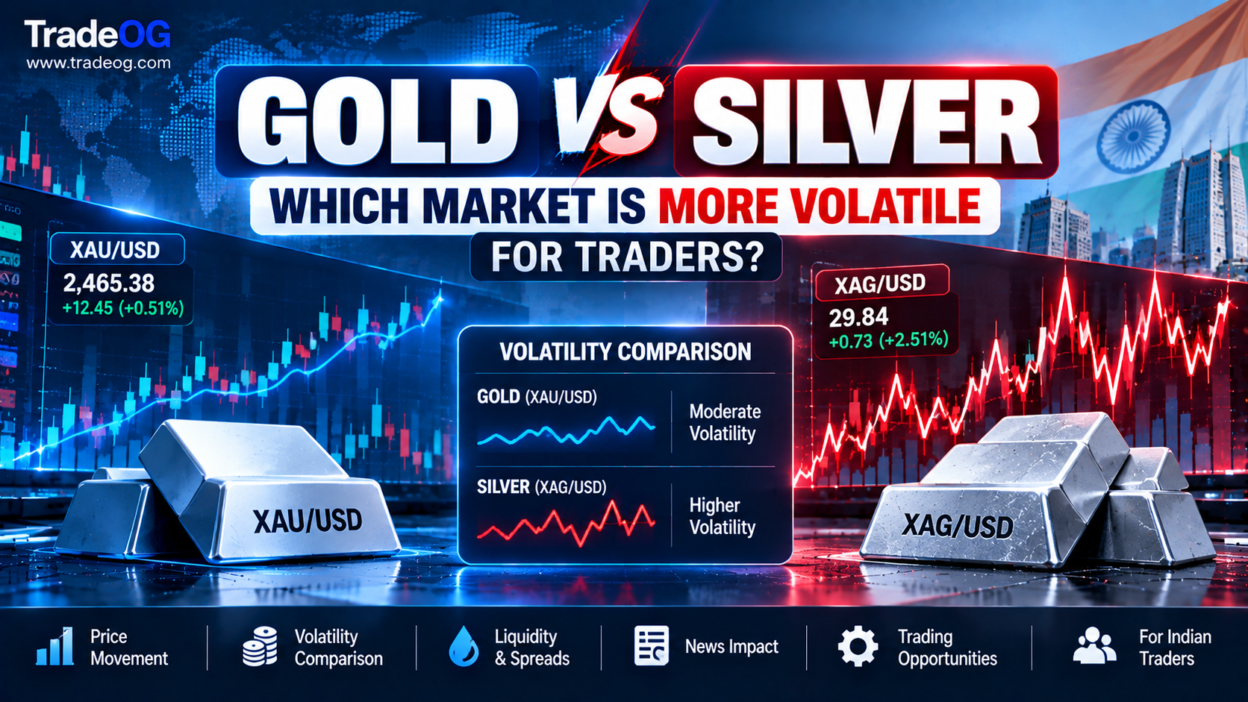
If you are comparing gold vs silver volatility, the short answer is clear: silver is generally the more volatile market. But volatility is only one part of the trading equation. Gold and silver respond to different combinations of monetary policy, investment demand, industrial demand, liquidity and risk sentiment.
That difference matters for traders. A silver position can move much faster in percentage terms than a similar gold position, creating larger potential gains but also larger drawdowns. Gold generally has deeper liquidity and tighter spreads, while silver behaves more like a high-beta version of gold and can react strongly to changes in industrial and commodity-market expectations.
In March 2026, the World Gold Council described silver as a higher-beta complement to gold, noting that silver’s volatility was roughly twice gold’s in its analysis. CME research likewise characterises silver as the higher-beta, more volatile precious metal.
Gold vs Silver Volatility: Quick Answer
| Factor | Gold | Silver |
|---|---|---|
| Typical volatility | Lower | Higher |
| Market liquidity | Deeper | Smaller |
| Typical spread environment | Tighter | Wider |
| Demand profile | Investment, central banks, jewellery and technology | Industrial, investment and jewellery |
| Economic sensitivity | More defensive | More cyclical |
| Price behaviour | Generally steadier | Higher beta and sharper swings |
| Risk per identical position size | Generally lower | Generally higher |
The comparison is about broad market behaviour, not a promise that gold will always be less volatile than silver. Gold itself can experience very large moves during geopolitical shocks, central-bank surprises and major changes in interest-rate expectations.
Why Is Silver More Volatile Than Gold?
There are several structural reasons.
1. Silver Has a Larger Industrial Component
Silver is both a precious metal and an important industrial commodity. Its demand is connected to areas such as electronics, solar technology, electrical applications and manufacturing.
That gives silver an additional economic cycle exposure that gold does not have to the same degree. When industrial-growth expectations improve, silver can receive a boost. When markets begin pricing weaker industrial activity, silver can come under pressure.
The World Gold Council’s 2026 research highlights this difference: gold has a more diversified demand base, while silver’s industrial-heavy demand makes it more cyclical.
2. Silver Has a Smaller Market
A smaller market can react more sharply when large flows enter or leave.
The World Gold Council found that gold trades more heavily than silver across ETFs, futures and OTC markets. Its February 2026 comparison estimated average daily futures activity of about US$55 billion for gold versus US$11 billion for silver over the preceding five years.
Lower market depth can amplify price movements, particularly during periods of stress.
3. Silver Has Higher Beta to Gold
Silver often amplifies gold’s directional moves. CME research calls silver the high-beta version of gold, while the World Gold Council’s 2026 analysis found silver’s long-term beta to gold clustered around 1.3.
In simple terms, when gold makes a meaningful move, silver can make a larger percentage move in the same direction. The relationship is not fixed, but it is useful when thinking about relative risk.
Gold Volatility: Why Gold Can Still Move Fast
Saying that silver is more volatile does not mean gold is a slow market.
Gold can experience significant price movements around:
- Federal Reserve decisions
- US inflation data
- US employment reports
- US Treasury-yield changes
- US dollar moves
- Geopolitical conflicts
- Central-bank buying expectations
- Large futures and ETF positioning changes
In 2026, gold itself experienced unusually high volatility. The World Gold Council reported that gold volatility moved above its historical upper quartile early in the year, with some of the large swings linked to changes in rate expectations, US dollar strength, geopolitical risk and position unwinding.
So the correct conclusion is not “gold is safe and does not move.” It is that silver generally requires a larger risk budget because its price fluctuations tend to be greater.
Silver Volatility: What Traders Need to Understand
Silver can be attractive to traders precisely because it moves. But that same characteristic creates execution and risk-management challenges.
A silver breakout can travel substantially farther than expected. A failed breakout can also reverse quickly. During thin liquidity or major macroeconomic events, spreads can widen and stop-loss execution can become less favourable.
CME notes that both gold and silver can become volatile around key economic releases, but silver has historically shown higher volatility than gold.
Gold vs Silver Spread and Liquidity
Volatility should not be analysed separately from liquidity.
Deep liquidity can make it easier for traders to enter and exit without paying as much through the bid-ask spread. Gold generally has the advantage here.
The World Gold Council’s March 2026 research estimated average intraday spreads of roughly 2 basis points for gold versus 9 basis points for silver over its measurement period, making silver’s spread more than four times wider in that comparison.
These are market-level historical estimates, not a guaranteed retail broker spread. Your actual XAU/USD or XAG/USD spread depends on your broker, account type, liquidity provider, session and market conditions.
Gold vs Silver During US Economic News
Both metals can react strongly to major US economic events because interest rates, real yields and the US dollar influence precious metals.
Important releases include:
- US CPI
- US PCE inflation
- Nonfarm Payrolls
- FOMC decisions
- US GDP
- Retail sales
- ISM manufacturing and services data
Gold often reacts first to changes in the dollar and real-rate expectations. Silver can then amplify the move because of its higher beta and industrial sensitivity.
Indian traders can use TradeOG’s Forex Economic Calendar guide to identify high-impact releases and convert them to IST.
Gold vs Silver During Risk-Off Markets
Gold and silver do not always behave the same way during market stress.
Gold has historically provided stronger defensive characteristics because investment and central-bank demand can support it when investors are looking for liquidity or protection.
Silver has a larger industrial component, so a severe economic slowdown can create additional pressure. It can therefore behave more like a cyclical asset during certain risk-off episodes.
The World Gold Council’s 2026 research found that gold has historically provided more consistent diversification during equity drawdowns, while silver has behaved more like a higher-beta satellite asset.
Gold vs Silver During a Bull Market
Silver can outperform gold during strong precious-metals or commodity rallies.
There are two reasons. First, its higher beta can amplify a broad metals move. Second, improving industrial-growth expectations can support silver demand in addition to investment demand.
But higher upside beta also means higher downside beta. The same leverage effect that makes silver attractive during a rally can make drawdowns considerably larger when sentiment reverses.
Gold vs Silver for Scalping
Scalpers care heavily about spread, execution speed, liquidity and short-term volatility.
Gold can be attractive because of its deep market and high global participation. Silver can offer larger intraday movement, but wider spreads and more abrupt price changes can make risk management harder.
If your strategy targets a small number of points, transaction costs matter enormously. A high-volatility market is not automatically better if the spread and execution costs consume the expected edge.
For Indian traders, the practical rule is simple: test the exact broker’s XAU/USD or XAG/USD spread during the hours you actually trade.
Gold vs Silver for Swing Trading
Swing traders can potentially use both markets, but the position-sizing framework should be different.
Because silver can move more aggressively, a swing position that uses the same nominal lot size as gold may carry significantly more percentage risk.
Instead of asking, “How many lots should I trade?”, ask:
- How much of my account am I willing to risk?
- How far away is the technical invalidation level?
- What is the recent average volatility?
- How much does the instrument move during major news?
- What is the broker’s margin requirement?
Gold vs Silver for Prop Firm Traders
Prop-firm traders need to be especially careful because daily loss limits and maximum drawdown rules can turn normal market volatility into a rule violation.
Silver’s higher volatility means a position can reach a predefined loss limit faster if the trader uses excessive size.
For example, a trader who normally risks a fixed dollar amount on gold should not automatically use the same lot size on silver. The position should be recalculated using the instrument’s point value, stop distance and expected volatility.
This is particularly important when trading around CPI, NFP or FOMC events.
Gold-Silver Ratio: An Important Metric
The gold-silver ratio measures how many ounces of silver are equivalent in price to one ounce of gold.
Conceptually:
Gold-Silver Ratio = Gold Price ÷ Silver Price
If gold trades at $5,000 per ounce and silver at $50 per ounce, the ratio is 100.
The ratio can help traders compare the relative valuation and momentum of the two metals, although it should not be treated as a standalone buy-or-sell signal.
CME research notes that the ratio often moves with changes in silver because silver tends to be the more volatile metal.
What Happens When Gold Rises 1%?
There is no fixed rule that silver must rise by a particular percentage whenever gold rises 1%.
However, silver’s higher beta means it has historically tended to amplify many gold moves. A simplified illustration could look like this:
| Gold Move | Illustrative Silver Reaction | Interpretation |
|---|---|---|
| +1% | More than +1% | Possible during strong risk-on metals momentum |
| 0% | Positive or negative | Silver has independent industrial drivers |
| -1% | Less than -1% | Possible during a broad metals selloff |
These are illustrations, not forecasts or guaranteed historical ratios. Actual performance depends on the market regime.
How Indian Traders Should Adjust Position Size
The most important practical difference is position sizing.
Suppose a trader normally risks ₹1,000 per trade. The trader should calculate the position size that would lose approximately ₹1,000 if the stop-loss is hit, rather than using the same lot size for every metal.
A simplified risk framework is:
Position Size = Maximum Monetary Risk ÷ (Stop Distance × Monetary Value Per Point)
The exact calculation depends on the broker, contract specification and instrument. Always verify the contract size and point value before trading.
Common Mistakes When Trading Silver
1. Using Gold Position Size on Silver
Silver can move substantially more, so copying a gold position size can create excessive risk.
2. Confusing Volatility With Opportunity
More movement does not automatically create a better trading setup. Volatility can increase both expected opportunity and expected loss.
3. Ignoring Spread
Silver’s wider spread can make frequent trading more expensive, particularly during thin liquidity.
4. Trading Major News Without a Risk Plan
CPI, NFP and FOMC events can create rapid price changes in both metals. Silver can amplify the move.
5. Assuming Gold and Silver Always Move Together
The metals have a positive long-term relationship, but their short-term drivers can diverge. Silver’s industrial exposure makes it more sensitive to economic-cycle expectations.
Which Is Better for Beginners: Gold or Silver?
For many beginners, gold can be easier to study because it has deeper liquidity, extensive market coverage and a relatively more stable volatility profile.
Silver may be more suitable after a trader understands position sizing, spread costs, stop placement and the impact of volatility.
Neither market should be considered automatically safe. Gold can produce very large moves, and silver can produce even larger percentage swings.
Gold vs Silver: Which Is More Volatile?
Silver is generally more volatile than gold. World Gold Council research published in March 2026 found silver’s volatility was roughly twice gold’s over its comparison period, while CME research has repeatedly characterised silver as the higher-beta metal.
For traders, that means silver can offer larger percentage opportunities but requires a smaller position for the same risk budget in many situations. Gold generally offers deeper liquidity and tighter spreads, which can make execution easier.
FAQs
Is silver more volatile than gold?
Yes. Silver has historically shown higher volatility than gold. The difference can become particularly large during strong commodity moves or periods of market stress.
Why does silver move more than gold?
Silver has a smaller market, greater industrial exposure and a higher beta to gold. These characteristics can amplify both rallies and declines.
Is gold safer than silver for traders?
Gold generally has lower volatility and deeper liquidity, but it is not risk-free. Leverage and position size determine much of a trader’s account-level risk.
Which is better for scalping, gold or silver?
It depends on the strategy and broker. Gold often has a liquidity and spread advantage, while silver may offer greater short-term movement. Test both with actual trading costs before choosing.
Does silver always follow gold?
No. Gold and silver often have a positive relationship, but silver has additional industrial and cyclical drivers that can cause it to outperform or underperform gold.
Should I use the same lot size for gold and silver?
No. Position size should be calculated from your maximum monetary risk, stop distance and instrument-specific point value. Identical lot sizes can produce very different risk.
Is silver good for prop firm trading?
Silver can be traded in prop environments where it is permitted, but its higher volatility requires careful position sizing because daily loss and maximum-drawdown limits can be reached quickly.
Final Takeaway
If your question is simply “Gold vs silver: which market is more volatile?”, silver wins.
Gold generally offers deeper liquidity, tighter spreads and a more defensive market structure. Silver is smaller, more industrially sensitive and higher beta, which can produce larger percentage moves in both directions.
For Indian traders, the practical lesson is not to avoid silver. It is to respect its volatility. Use smaller position sizes when necessary, calculate risk from the stop-loss rather than the lot size, monitor US macroeconomic releases and check actual broker spreads before trading.