
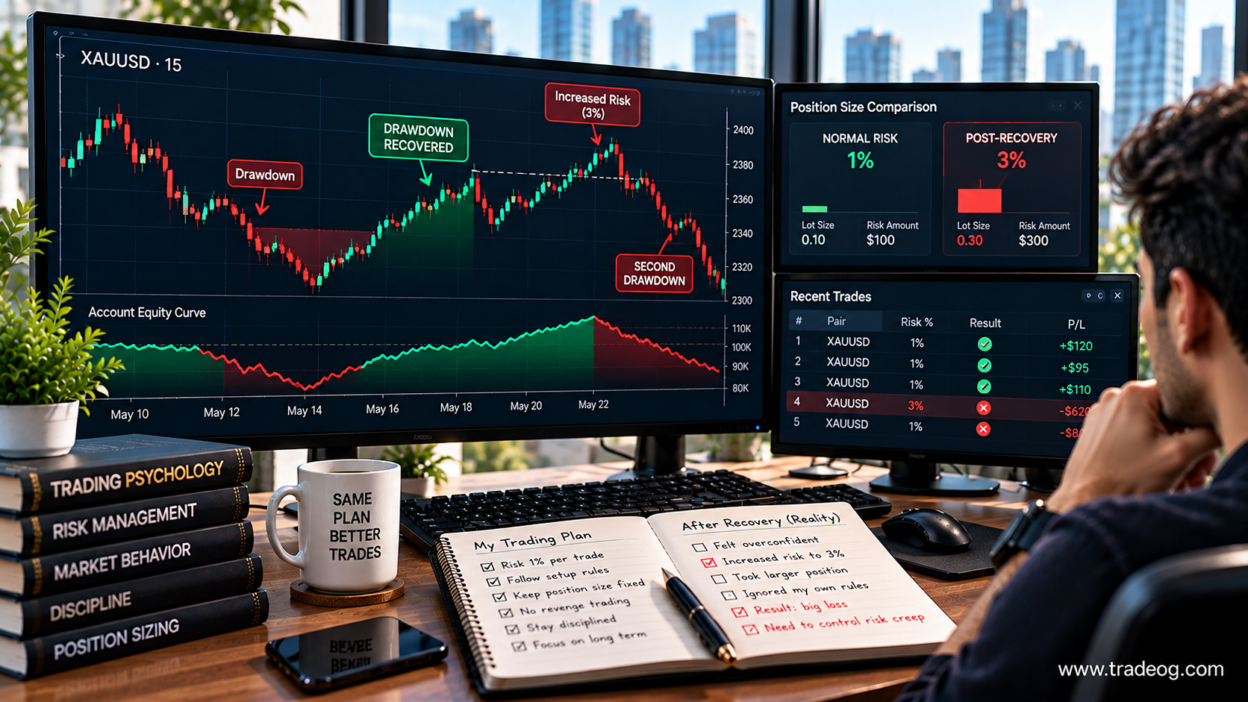
Recovering from a drawdown feels like a major victory. The account is back near its previous high, the losing period is behind you, and confidence starts returning. But for many traders, this is exactly when risk begins to increase again.
A trader who carefully controlled risk during the drawdown may suddenly increase position size after recovery. The logic sounds reasonable: “I have my losses back, so I can afford to take more risk now.”
That thinking can create a second drawdown.
Why traders take more risk after recovering from a drawdown is primarily a trading-psychology and risk-management problem. Recovery can change the trader’s perception of money, safety, skill and the urgency to make further gains. CME Group’s risk-management guidance emphasizes defining maximum trade loss, maximum daily loss, exposure and leverage before trading rather than making those decisions emotionally. CME Group’s risk-management guide provides a useful framework for this approach.
What Changes After a Drawdown Is Recovered?
Consider a simple example.
A trader starts with a $10,000 account and falls to $9,000. Over the next few weeks, disciplined trading brings the account back to $10,000.
Objectively, the trader has returned to the starting point.
Psychologically, however, the trader may feel that something different has happened:
- “I survived the drawdown.”
- “My confidence is back.”
- “The strategy is working again.”
- “I have room to take bigger trades.”
- “I don’t want to waste this momentum.”
The problem is that none of these feelings automatically justify increasing risk.
The account has recovered. The probability distribution of the next trade has not necessarily changed.
1. Recovery Creates a False Sense of Safety
During a drawdown, risk feels real. Every trade is evaluated carefully because another loss appears capable of making the situation worse.
After recovery, that pressure disappears.
The trader may begin to perceive the account as being “safe” again. This psychological safety can encourage larger positions, wider stops or more trades.
But an account at a new equity high is not immune to another drawdown.
CME’s risk-control material illustrates why fixed-percentage risk is useful during losing streaks: the amount at risk automatically falls as account equity falls, slowing the rate of account decay. The same principle works in reverse—returning to a normal risk percentage does not mean the trader should suddenly increase the percentage simply because recovery has occurred. citeturn0search0
2. Traders Start Treating the Recovered Money Differently
This is one of the most important psychological shifts.
Suppose the trader lost $1,000 and later made $1,000 back. The trader may mentally separate the account into two categories: “my original money” and “the money I recovered.”
The recovered amount can then feel easier to risk.
This is dangerous because money is fungible. A $10,000 account does not contain a special psychological label showing which dollars came from recovery trades.
If the trader risks 3% after recovery instead of the normal 1%, the market only sees the larger position.
3. The Trader Wants to Capitalize on Momentum
Recovery often comes with a sequence of successful trades. That creates a powerful temptation to keep pushing.
The trader sees:
Drawdown → recovery → winning trades → confidence → bigger opportunity.
The problem is that the recovery sequence may be mistaken for the beginning of a permanent improvement in trading performance.
Perhaps the market regime simply became more favorable. Perhaps volatility increased. Perhaps the trader happened to encounter several clean setups.
None of those conditions guarantees that the next trade deserves more capital.
4. The Trader Wants to Make Up for Lost Time
Recovering a drawdown can take days or weeks.
Once the account reaches breakeven, some traders feel that they have “lost” time and need to accelerate growth.
That produces a dangerous mental calculation:
“I spent three weeks recovering. Now I need to make three weeks of profit quickly.”
This turns recovery into a new performance target.
The trader may start taking marginal setups, increasing trade frequency or raising position size.
Instead of returning to normal trading, the trader begins trying to compensate for the emotional cost of the drawdown.
5. Risk Creep Happens Gradually
Risk escalation does not always happen as one dramatic decision.
It can look like this:
- Normal risk: 1%.
- After recovery: 1.25%.
- After two winners: 1.5%.
- After another winner: 2%.
- During a strong setup: 3%.
Every individual increase can feel small.
Collectively, the trader has changed the risk model.
This is why position size should be determined before the setup appears, not while the trader is excited about recent performance.
6. Recovery Can Be Mistaken for Proof That the Strategy Is Fixed
A drawdown may have several possible causes:
- normal statistical variation;
- a change in market regime;
- poor execution;
- excessive trading costs;
- strategy deterioration;
- temporary unfavorable conditions;
- discipline problems.
Recovering the account does not automatically tell you which explanation was correct.
A trader may therefore conclude, “The strategy is back,” when the sample is simply too small to know.
That false certainty can lead directly to larger risk.
7. The Trader Becomes Afraid of Losing the Recovery
There is another contradiction: traders can take more risk because they are both more confident and more afraid.
After recovering a drawdown, the trader may become protective of the new equity high.
That can lead to:
- taking larger positions to reach a target before a possible setback;
- moving stops to avoid seeing the account fall below the recovered level;
- closing winners too early;
- adding to positions that move against them;
- avoiding valid trades because they fear giving back the recovery.
CME’s trading-psychology material discusses how emotions surrounding gains and losses can interfere with rational judgment. citeturn0search1turn0search13
8. The Previous Drawdown Becomes a Psychological Benchmark
Once a trader has recovered from a 10% drawdown, the previous equity low becomes a reference point.
That can create a dangerous belief:
“I already survived a 10% drawdown, so another 3% or 4% isn’t a big deal.”
But drawdowns compound.
Two separate periods of elevated risk can eventually produce a much larger loss than expected.
CME’s educational material shows that recovery mathematics become increasingly difficult as losses become larger. A 20% loss requires a 25% gain to recover, while a 40% loss requires a 66.66% gain. citeturn0search0
9. The Trader Confuses Account Recovery With Strategy Recovery
These are two different things.
| Account Recovery | Strategy Recovery |
|---|---|
| Equity returns to a previous high | Performance data improves across a meaningful sample |
| May happen after a few strong trades | Requires repeated evidence |
| Measures money | Measures process and expectancy |
| Can be temporary | Should be evaluated across market conditions |
| Does not prove risk should increase | May eventually support a planned risk-model review |
A recovered account is therefore not proof that the strategy deserves more risk.
10. Bigger Risk Can Destroy the Evidence You Just Built
Imagine a trader normally risks 1% and uses a carefully tested strategy. The trader recovers from a 10% drawdown while following the plan.
Then the trader increases risk to 3% because confidence has returned.
If the next five trades lose, the resulting damage is not necessarily evidence that the original strategy failed.
The trader changed the experiment.
This is an important point for anyone maintaining a trading journal: a strategy’s results become harder to interpret when position sizing changes based on emotions.
Why Increasing Risk After Recovery Is Especially Dangerous
The mathematics can work against the trader.
Suppose a $10,000 account uses 1% risk per trade. A $100 loss is manageable within that framework.
If the trader later risks 3%, the same losing streak becomes much more damaging:
| Risk Per Trade | Five Consecutive Losses, Approx. | Capital Remaining |
|---|---|---|
| 1% | About 4.9% down | About $9,510 |
| 2% | About 9.6% down | About $9,039 |
| 3% | About 14.1% down | About $8,587 |
The exact result depends on how risk is calculated and whether the position size is fixed or equity-adjusted, but the principle is straightforward: larger risk makes the same losing sequence more expensive.
CME Group similarly emphasizes defining the amount of capital at risk before entering a trade and using explicit maximum-loss parameters. citeturn0search4turn0search8
How Traders Should Handle the First Trades After Recovery
Keep the Original Risk Model
If the strategy was tested at 1% risk, returning to the previous equity high does not create a reason to use 2% or 3%.
Do Not Create a New Profit Target
Once the drawdown is recovered, the goal should not suddenly become “make back the time I lost.” Return to the normal performance process.
Review the Drawdown Before Increasing Risk
Ask:
- Why did the drawdown occur?
- Were the trades executed according to plan?
- Did market conditions change?
- Did spreads, slippage or volatility change?
- Was the drawdown within the strategy’s historical expectations?
- Did the recovery happen because of valid setups or unusually favorable trades?
Separate Process Recovery From P&L Recovery
A trader should be more interested in whether discipline has recovered than whether the account has recovered.
That means tracking setup quality, execution, risk, trade frequency and adherence to rules.
A Practical Post-Drawdown Recovery Protocol
A simple protocol can prevent the emotional jump from recovery to risk escalation.
- Return to baseline risk. Use the predefined percentage or fixed risk amount.
- Review the drawdown. Identify whether it was normal variance or a process problem.
- Review the recovery. Check whether the profitable trades actually followed the system.
- Freeze position size. Do not increase risk simply because equity has recovered.
- Monitor the next 10–20 trades. Evaluate process consistency rather than trying to maximize returns.
- Change risk only by rule. Any increase should come from a tested, predefined risk model.
Drawdown Recovery for Prop Firm Traders
This issue is particularly important for prop firm traders because the trader may be operating inside a fixed drawdown limit.
After recovering, a trader can feel that there is now a “buffer” between the current balance and the account’s loss limit. That buffer can encourage larger positions.
But the buffer is not free risk.
A larger position can consume it quickly, especially in XAU/USD where volatility, spread changes and slippage can make short-term risk larger than the trader expects.
TradeOG’s article Why Traders Break Their Rules After a Series of Winning Trades covers the related psychological problem of increasing risk after positive performance. The same principle applies after recovering from a drawdown: recent P&L should not rewrite the risk rules.
For broader prop-firm psychology, see The Psychology of Passing a Prop Firm Challenge.
What Should Make You Increase Risk?
Risk should not increase because:
- you recovered your drawdown;
- you had several winning trades;
- you feel confident again;
- you want to make up for lost time;
- you think the market is easy;
- you have more distance from your drawdown limit.
A risk increase should only be considered when it is supported by a predefined and tested methodology, suitable account-level risk limits and evidence that the new risk level remains acceptable.
CME Group’s position and risk-management guidance similarly frames risk around account size, position sizing and an established plan rather than changing exposure emotionally. citeturn0search10
The Better Mindset After Recovering a Drawdown
Instead of saying:
“I recovered, so now I can take more risk.”
Use:
“I recovered because the process worked. My job is to keep executing that process.”
This mindset changes the objective from recovering money to preserving the behavior that produced the recovery.
A drawdown is not permission to gamble more aggressively once it ends. It is information about how your strategy, execution and psychology behave under pressure.
Final Takeaway
Traders often take more risk after recovering from a drawdown because recovery creates a psychological feeling of safety. Recent winning trades can increase confidence, recovered money can feel easier to risk, and the trader may want to accelerate growth after spending time repairing the account.
But the market does not recognize recovered money as special. The next trade still carries the same uncertainty.
The strongest response to a recovered drawdown is usually boring: return to the normal risk model, review what caused the drawdown, verify that the recovery came from valid trades, and continue executing the plan.
The objective is not simply to recover a drawdown once. It is to build a process that does not require increasingly aggressive risk to survive the next one.
FAQs
Why do traders increase risk after recovering a drawdown?
Recovery can create overconfidence, a sense of safety and a desire to accelerate account growth. Traders may also feel that recovered profits are easier to risk.
Should I increase position size after recovering losses?
Not simply because the account has recovered. Position size should remain tied to a predefined risk-management model unless a planned and tested change justifies an adjustment.
Is recovering a drawdown proof that my strategy is working?
No. A recovery is an account-level result. You should separately evaluate whether the recovery came from valid setups, consistent execution and a meaningful sample.
What should I do immediately after recovering a drawdown?
Return to baseline risk, review the cause of the drawdown, audit the recovery trades and avoid increasing position size based on confidence or recent profits.
Why is this important for XAU/USD traders?
XAU/USD can move rapidly, so increasing position size after recovery can magnify the effect of volatility, spread expansion and slippage. Keeping risk predefined is particularly important for short-term gold trading.