

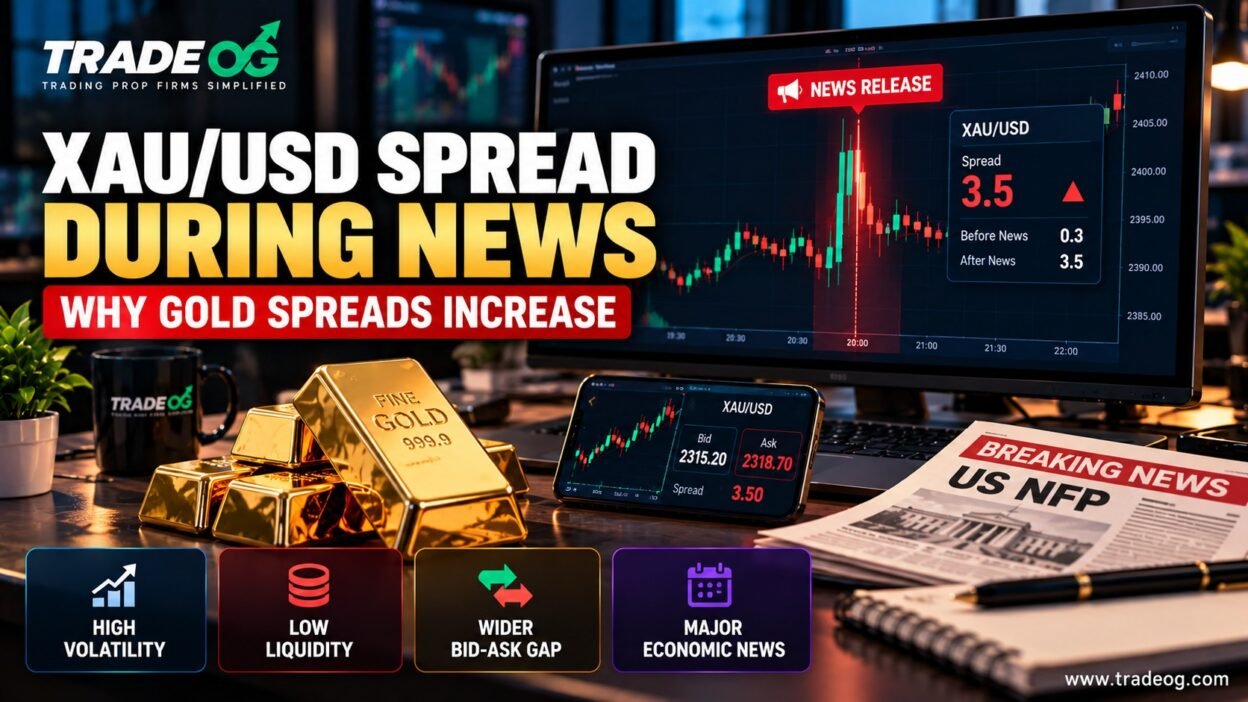
XAU/USD spread during news can change much faster than many gold traders expect. If you normally see a tight spread on your trading platform and suddenly notice a much larger gap between the Bid and Ask price around NFP, CPI, FOMC or another major U.S. release, that does not automatically mean your broker or prop firm is making an error.
The main reason is market conditions. Around major news, volatility can jump while available liquidity becomes thinner. Brokers and liquidity providers may therefore quote a wider Bid-Ask spread to reflect the higher risk of rapid price movement and changing market depth. IG explains that spreads can widen when markets become less liquid or when major economic data is released, while OANDA notes that volatility and changes in global liquidity can produce large spread increases after news announcements. citeturn0search0turn0search7
For Indian traders who trade XAU/USD, understanding this behaviour is important because a wider spread can affect entry cost, floating P&L, stop-loss distance, execution and even whether a trade temporarily appears closer to a prop firm drawdown limit.
What Is the XAU/USD Spread?
The spread is the difference between the Ask price and the Bid price. In simple terms, the Bid is the price used when selling, while the Ask is the price used when buying. The difference between the two is your quoted spread.
For example, imagine your platform shows:
| Quote | Price |
|---|---|
| Bid | 2315.20 |
| Ask | 2315.50 |
| Spread | 0.30 |
If the quote changes to:
| Quote | Price |
|---|---|
| Bid | 2315.20 |
| Ask | 2318.70 |
| Spread | 3.50 |
the spread has increased significantly. These numbers are illustrative examples, not a guaranteed normal or maximum XAU/USD spread. Actual spreads depend on the broker, liquidity provider, account type and market conditions.
Why Does Gold Spread Increase During News?
1. Volatility Rises Very Quickly
Major releases can move gold within seconds. NFP, CPI, FOMC decisions, U.S. interest-rate announcements and important inflation or employment data can produce rapid price changes.
When the market becomes harder to price, liquidity providers face greater execution risk. Wider quotes can therefore appear during the most volatile part of the release. IG also identifies volatility as a major factor that can widen Bid-Ask spreads. citeturn0search5
2. Liquidity Can Become Thinner
It may sound strange, but trading activity and usable liquidity are not exactly the same thing. A news release can attract huge attention while the available prices near the current market become less stable.
Some market participants wait for the announcement instead of providing normal liquidity immediately before it. As the available Bid and Ask prices move farther apart, the displayed spread can increase.
3. Liquidity Providers Face More Risk
A liquidity provider quoting a price during a quiet market has more time to manage an order. During a major announcement, the underlying price can move before that liquidity provider can fully hedge the exposure.
That is one reason spreads may be adjusted during major events. IG specifically notes that liquidity providers can widen spreads around important news to offset additional risk. citeturn0search6
4. Gold Reacts Strongly to U.S. Data
XAU/USD is heavily influenced by factors connected to the U.S. dollar, interest rates, inflation expectations and broader risk sentiment. A major U.S. economic release can therefore create a fast repricing in gold.
When price discovery becomes aggressive, the spread can expand at the same time as the candlestick becomes much larger.
Which News Events Can Cause XAU/USD Spreads to Widen?
There is no universal list or guaranteed spread response, but traders should pay particular attention to high-impact events such as:
- Non-Farm Payrolls (NFP)
- U.S. CPI inflation data
- FOMC interest-rate decisions
- Federal Reserve statements and press conferences
- U.S. GDP releases
- U.S. unemployment and employment data
- Major unexpected geopolitical or financial developments
The key point is not that every event will produce the same spread. The actual result depends on the market at that moment.
Simple Example: XAU/USD Spread Before and During NFP
Suppose an Indian trader is watching gold before an NFP release. On the platform, the spread is 0.30. The trader enters a position just before the announcement.
Seconds later, volatility increases and the displayed spread temporarily becomes 3.50.
| Market condition | Illustrative spread | What changes? |
|---|---|---|
| Quiet conditions | 0.30 | Tighter Bid-Ask difference |
| News approaching | Variable | Liquidity and quotes can change |
| Fast news move | 3.50 | Wider Bid-Ask difference |
| After volatility settles | May narrow again | Market conditions normalise |
Again, this is only a simplified example. Your broker may show completely different numbers. OANDA states that spreads are dynamic and can widen significantly around news announcements, market openings and closings, and periods of uncertainty. citeturn0search7
How a Wider Spread Can Affect Your Trade
Higher Entry Cost
A wider spread means a larger difference between the price at which you can buy and the price at which you can sell. If you enter during a very wide spread, the position can initially show a larger unrealised loss even before the underlying market moves against you.
Stop-Loss Can Be Triggered
This is one of the biggest concerns for short-term XAU/USD traders. Because Bid and Ask prices are different, a sudden spread expansion can affect the price used to trigger an order.
OANDA explains that stop-loss and take-profit orders are affected by Bid and Ask prices and that wider spreads during volatile markets can contribute to orders being triggered. citeturn0search7
Slippage Can Increase
A wider spread and fast price movement can occur together. Even if your stop-loss is placed at a specific level, the final execution price may differ when the market is moving rapidly. This is why a stop-loss should not be treated as a guarantee of an exact fill during extreme market conditions.
Prop Firm Drawdown Can Be Affected
If you are trading a funded account, a temporary spread expansion can matter because your account equity reflects the prices available on the platform. A position that looks comfortable during normal conditions can show a much larger floating loss when the Bid-Ask gap expands.
This is especially important for traders who use high leverage or very tight stop-losses on XAU/USD. For a broader risk framework, see our guide on prop firm risk management for Indian traders.
Why the Spread Can Widen Even Before the News
Many traders assume the spread only increases after the number is released. That is not always the case.
Liquidity conditions can change before a scheduled announcement because market participants know that a high-impact event is approaching. IG notes that liquidity can become lower before major announcements, which can contribute to wider spreads. citeturn0search6
That means a trader should not wait for the first huge candle to realise that trading conditions have changed. The spread shown on the platform is itself useful information.
Does XAU/USD Spread Always Stay Wide After News?
No. A spread increase is a market-condition event, not a fixed rule that says the spread must remain wide for a particular amount of time.
Once volatility and liquidity conditions improve, spreads can narrow again. The timing is not identical for every broker, instrument or event. IG notes that spreads can move back toward normal conditions after major events, but traders should monitor their own platform rather than assume a specific recovery time. citeturn0search8
How Indian Traders Can Check the Spread Before Entering
- Open the XAU/USD quote. Check the live Bid and Ask instead of looking only at the chart.
- Calculate the difference. Ask minus Bid gives the quoted spread in the instrument’s price units.
- Check the economic calendar. Look for NFP, CPI, FOMC and other high-impact U.S. events.
- Compare the current spread with normal conditions. Your own platform history is more useful than a generic number found online.
- Reduce unnecessary exposure. If the spread is unusually wide, consider whether the setup still makes sense.
- Check your prop firm’s news rules. Some firms restrict trading around major announcements, and the exact restrictions vary.
Should You Trade Gold During NFP, CPI or FOMC?
This is not simply a question of whether gold will go up or down. The trading environment itself changes.
Before taking a news trade, check three separate things: the prop firm’s rules, the current spread and the expected volatility. A strategy that works during normal XAU/USD conditions may behave very differently when the spread expands and price moves several dollars within seconds.
If you are specifically checking whether news trading is permitted, read our guide Can Indians Trade Gold During US News Releases? You can also review our detailed guide on trading gold during NFP with a prop firm.
Common Mistakes to Avoid
- Assuming the spread shown during normal hours will remain the same during news.
- Using an extremely tight stop without considering spread expansion.
- Entering a trade immediately before a high-impact release without checking the live quote.
- Confusing spread widening with a broker necessarily manipulating price.
- Using a generic “normal XAU/USD spread” as a guarantee for your broker.
- Ignoring prop firm restrictions on news trading.
- Using excessive leverage because the normal spread looks small.
Final Takeaway
XAU/USD spreads increase during major news because market conditions can change extremely quickly. Higher volatility, thinner or less stable liquidity, rapid repricing and increased execution risk can all contribute to a wider Bid-Ask difference. Major brokers explicitly describe news releases and changing liquidity as conditions that can widen variable spreads. citeturn0search0turn0search7
For Indian gold traders, the practical lesson is simple: check the live spread before entering, know your prop firm’s news rules, avoid assuming a fixed spread, and size your position for volatile conditions. A good XAU/USD setup is not only about predicting direction; execution conditions matter too.

[…] For more on spread behaviour, see our guide to XAU/USD spread during news and why gold spreads increase. […]
[…] For a detailed explanation of this issue, see our guide on XAU/USD spread during news. […]
[…] If you want to understand how this affects gold execution, read our detailed guide on XAU/USD spread during news. […]
[…] This is particularly important around major economic releases. We have covered the same issue from a gold-trading perspective in XAU/USD spread during news. […]