

Every week, thousands of retail traders browse prop firm comparison sites and ask the exact same two questions: “Which firm has the cheapest challenge fee?” and “Which one offers a 90% or 100% profit split?”
Choosing a prop firm based solely on price and advertised profit split is the single most reliable way to waste your evaluation capital.
A 90% profit split is mathematically worthless if the firm’s trailing drawdown algorithm liquidates your account on normal market retracements before you ever reach a payout. A $150 discount code means nothing if broker spread markups and slippage during session rollovers eat through your daily loss allowance.
If you want to treat funded trading as a serious business rather than an expensive hobby, you must look beneath marketing headlines. Here is the institutional due diligence framework used by professional funded traders to evaluate, audit, and compare prop firms before paying a single dollar in evaluation fees.
The Rookie Trap vs. The Professional Audit
The gap between traders who fail five evaluations in a row and traders who take home consistent monthly withdrawals comes down to what they audit before buying:
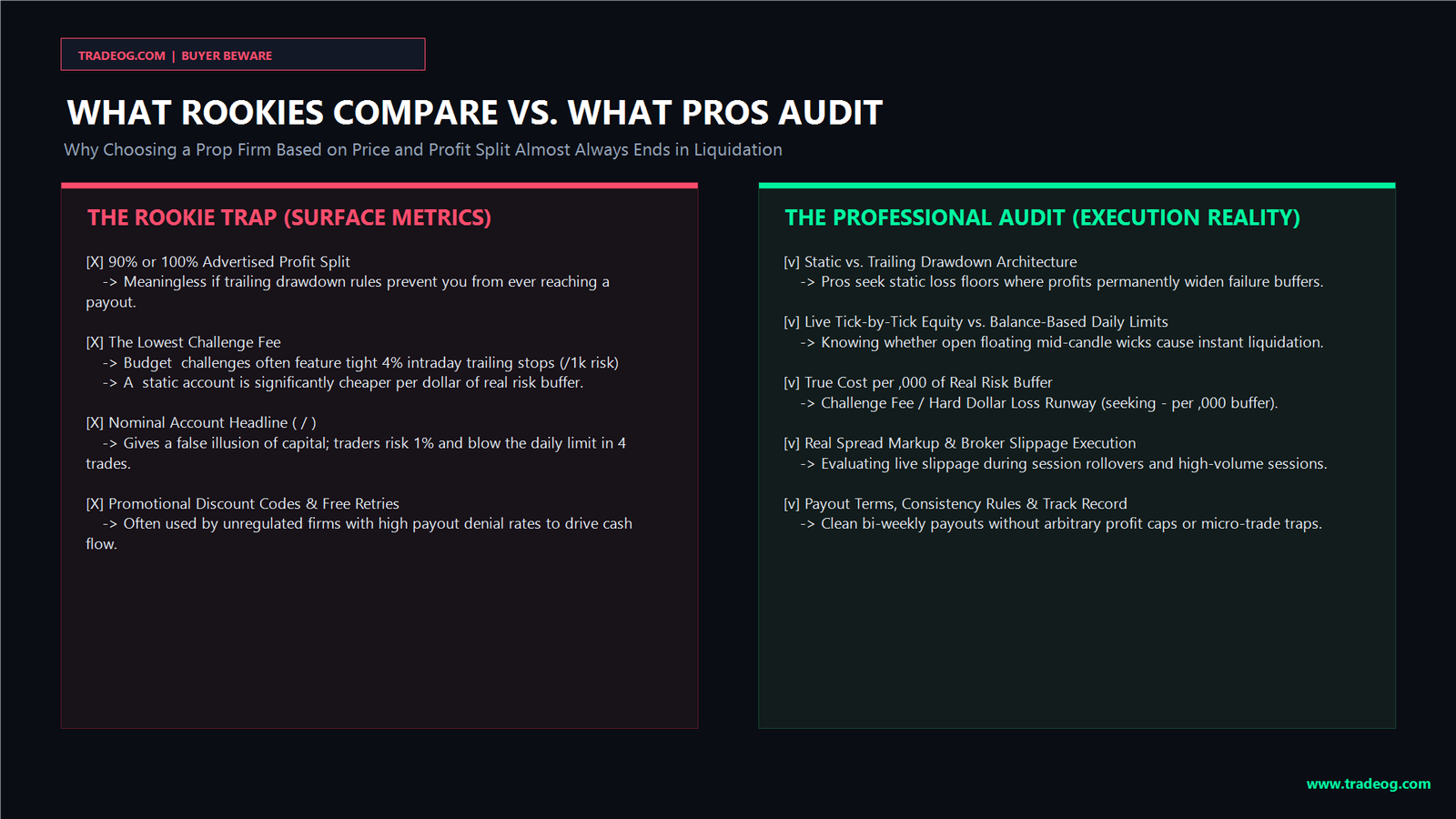
| Metric Category | What Rookies Focus On (Marketing Hype) | What Pros Audit (Execution Reality) |
|---|---|---|
| Headline Capital | $200,000 or $400,000 nominal balance | Real Dollar Failure Buffer ($8,000 vs. $16,000) |
| Profit Split | Advertised 90% – 100% payout shares | Payout frequency, buffer lock & minimum day hurdles |
| Challenge Cost | Lowest absolute price tag / promo discount | Cost per $1,000 of real risk runway ($45 vs. $95) |
| Drawdown Rule | “8% sounds generous” | Static vs. EOD Trailing vs. Intraday Peak Trailing |
| Daily Loss Limit | “I won’t lose 5% in a day” | Tick-by-tick Equity monitoring vs. Closed Balance |
| Broker Spreads | Assuming all platforms trade the same | Live spread markups, commissions, and rollover widening |
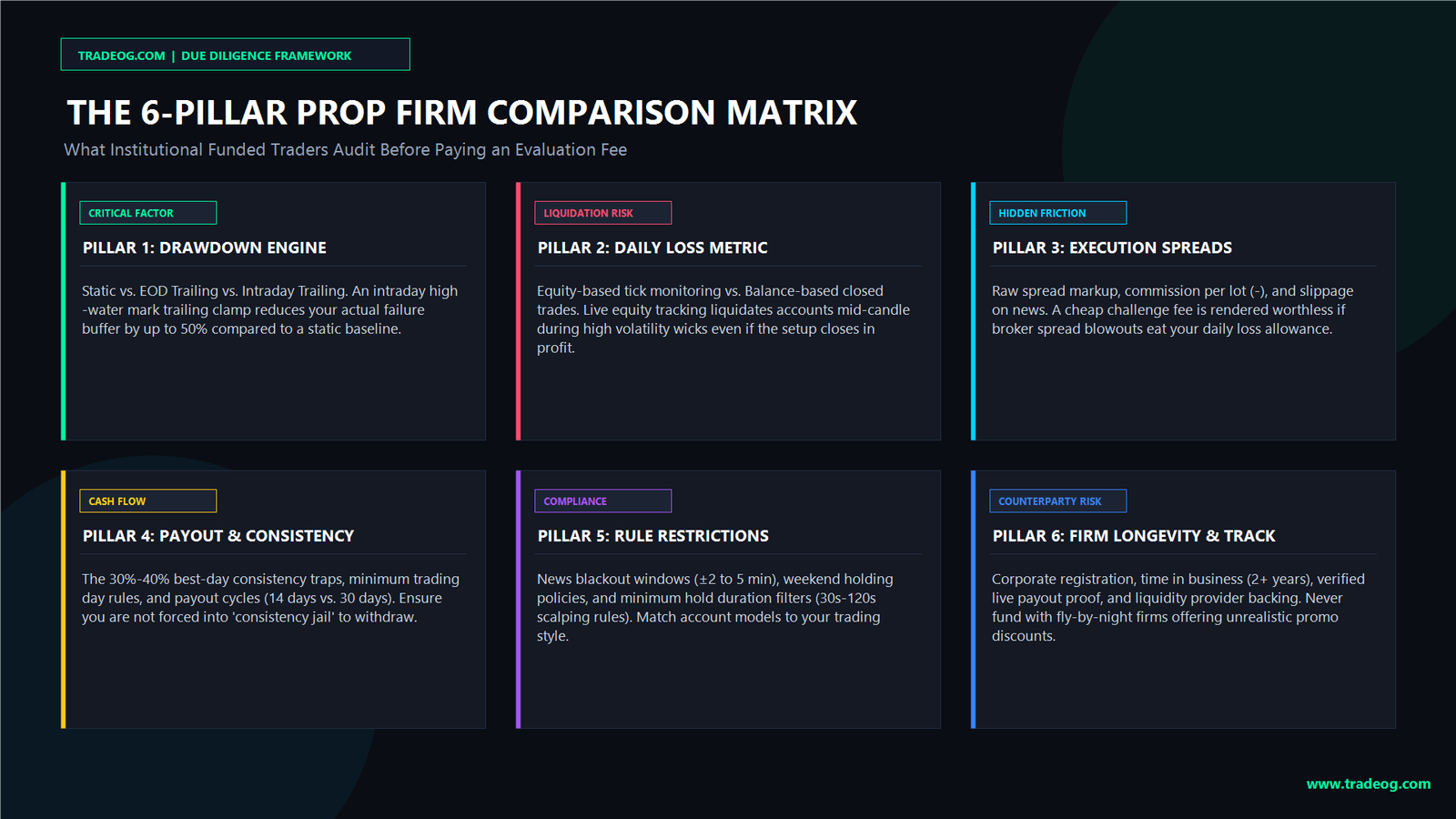
The 6 Pillars You Must Audit Before Buying Any Challenge
Pillar 1: The Drawdown Architecture (Static vs. Trailing)
The drawdown engine dictates whether your account can survive a normal statistical losing streak. Always confirm which of the three models the firm enforces:
- Static Drawdown (Best for Traders): The failure floor is permanently locked below your starting balance (e.g., $90,000 on a $100k account with a 10% limit). As you accumulate profits, your buffer expands. Every winning trade increases your breathing room.
- End-of-Day (EOD) Trailing: The floor trails your closing balance or equity at 5:00 PM EST. Intraday price spikes that retrace do not penalize you, making it suitable for intraday day traders.
- Intraday / Tick-by-Tick Trailing (Highest Risk): The floor trails your peak open unrealized profit in real time. If an open trade goes up +$2,000 and retraces to break-even, your floor moved up $2,000 while your P&L gained nothing. Avoid this model unless you are an ultra-short-term scalper who locks in profits immediately.
Pillar 2: Daily Loss Metric: Equity vs. Balance
Does the daily loss limit track closed balance, or does it monitor live tick-by-tick equity?
In Equity-based models (used by FTMO, FundedNext, and The 5%ers), a mid-candle spread spike or momentary drawdown will terminate your account instantly—even if the market reverses and hits your take-profit target 30 seconds later. Ensure you know whether open trades can trigger a breach while active.
Pillar 3: The True Cost per $1,000 of Risk Capital
Never compare challenge fees in isolation. Calculate the Cost Efficiency Ratio:
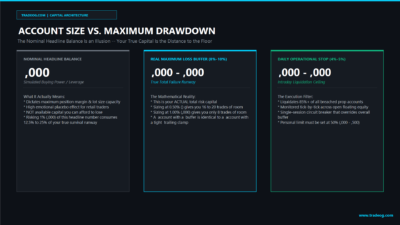
Cost per $1,000 Risk Capital = Challenge Fee / (Account Size × Max Drawdown %)A $350 challenge fee on a $100,000 account with a 4% trailing limit ($4,000 buffer) costs $87.50 per $1,000 of risk. Meanwhile, a $250 challenge on a $50,000 account with a 10% static buffer ($5,000 buffer) costs $50.00 per $1,000 of risk. The “cheaper” $100k account is actually 75% more expensive per dollar of survivable capital.
Pillar 4: Execution Feeds, Spreads & Commissions
Prop firms are not charities; many operate simulated B-book broker bridges that widen spreads or add commission markups ($5 to $7 per lot). Before buying:
- Test a free trial account to observe live spreads on your primary instrument during London Open and New York Open.
- Verify whether the platform charges raw commissions on indices, commodities, or crypto.
- Check slippage behavior during high-impact news releases.
Pillar 5: Secondary Rulebook Restrictions (The Fine Print)
Inspect the firm’s FAQ for the operational restrictions that void payouts:
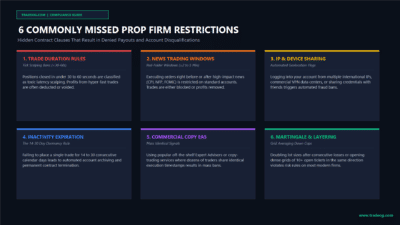
- Consistency Rules: Does the firm enforce a 30% or 40% best-day profit rule that forces you into “consistency jail”?
- Minimum Trade Hold Times: Is there a mandatory 30-to-120-second hold time on all closed tickets?
- Weekend & News Restrictions: Must positions be flattened before Friday 4:00 PM EST, or are you allowed to hold swings?
Pillar 6: Firm Longevity, Track Record & Payout Proof
A prop firm is only as good as its ability to pay out. Verify these counterparty safety signals:
- Operating History: Has the firm been operating continuously for at least 2+ years through major market cycles?
- Payout Speed & Channels: Does the firm process payouts within 24 to 48 hours via reliable methods (Rise, direct wire, crypto)?
- Corporate Transparency: Is the company registered as a legitimate legal entity with identifiable leadership and verifiable liquidity partner relationships?
The 5-Step Prop Firm Selection Scorecard
Before purchasing your next evaluation, run the challenge through this practical 5-step decision scorecard:
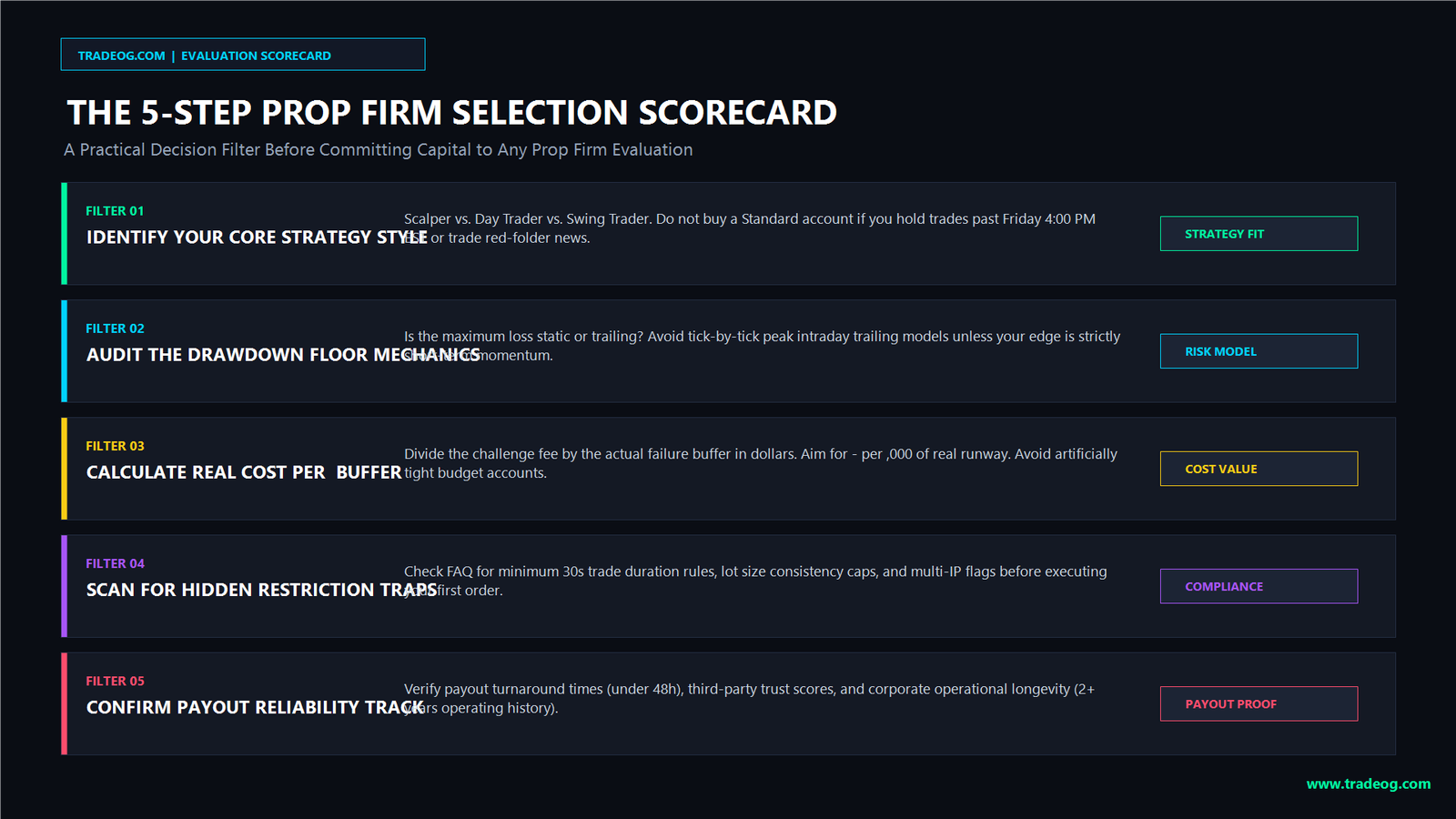
- Filter 01: Strategy Fit: Does your trading style require swing holding or news trading? If yes, eliminate Standard accounts and focus exclusively on designated Swing models.
- Filter 02: Risk Model Audit: Confirm whether the drawdown floor is static, EOD trailing, or tick trailing. Reject models that do not align with your average hold time and drawdown tolerance.
- Filter 03: Cost Efficiency Math: Calculate your cost per $1,000 of real risk buffer. Target options between $45 and $55 per $1,000 buffer.
- Filter 04: Compliance Check: Scan the rulebook for hidden duration filters (<30s scalping bans) and lot size variance caps.
- Filter 05: Payout Track Record: Confirm fast payout processing (under 48 hours) and verified third-party community reviews.
Frequently Asked Questions (FAQ)
Is a 1-step challenge better than a 2-step challenge?
Not necessarily. While a 1-step challenge only requires hitting one profit target (typically 9% to 10%), it almost always comes with tighter drawdown parameters (such as a 3% to 4% daily limit or trailing floor). A 2-step challenge has two phases, but typically offers a more forgiving static 5% daily / 10% max loss framework that is significantly easier to survive.
Do prop firms actually pay out 90% or 100% profit splits?
Legitimate firms do, but only if you satisfy all secondary compliance rules. Beware of new, unproven firms offering “100% profit splits with zero fees”—these business models are financially unsustainable and often rely on arbitrary rule violations to deny large withdrawals.
Which trading platform is best for prop firm trading?
Modern prop traders generally prefer cTrader, Match-Trader, or DXtrade over legacy MT4/MT5 due to superior execution speed, built-in risk management depth-of-market tools, and transparent server tick feeds.
Summary
A prop firm evaluation is an investment in your trading career. Treat it with the same institutional rigor as any capital deployment. Stop shopping for discounts and headline numbers. Audit the drawdown engine, calculate your true cost per dollar of risk runway, verify execution feeds, and choose a partner built to pay you consistently over the long run.