

When you click “Buy Challenge” and pay $150, $500, or $1,000 to a prop trading firm, what are you actually buying?
You are not depositing investment capital. You do not own the account equity. You cannot withdraw that $500 back to your bank account next week if you change your mind. Legally and operationally, you have purchased an audition fee for access to leveraged simulated capital.
Yet for many traders, the financial mechanics of prop firm fees remain shrouded in confusion. Why do top-tier firms refund 100% of your fee with your first payout, while others hit you with surprise activation charges? Where does the fee money actually go, what hidden costs erode your margins, and is paying an evaluation fee mathematically superior to simply trading a small personal account?
Here is an honest, institutional breakdown of how prop firm fee structures operate behind the scenes, the hidden costs you must budget for, and how to evaluate whether a fee provides genuine asymmetric value.
Where Does Your Prop Firm Fee Actually Go?
Related: $10K prop firm account cost and prop firm comparison.
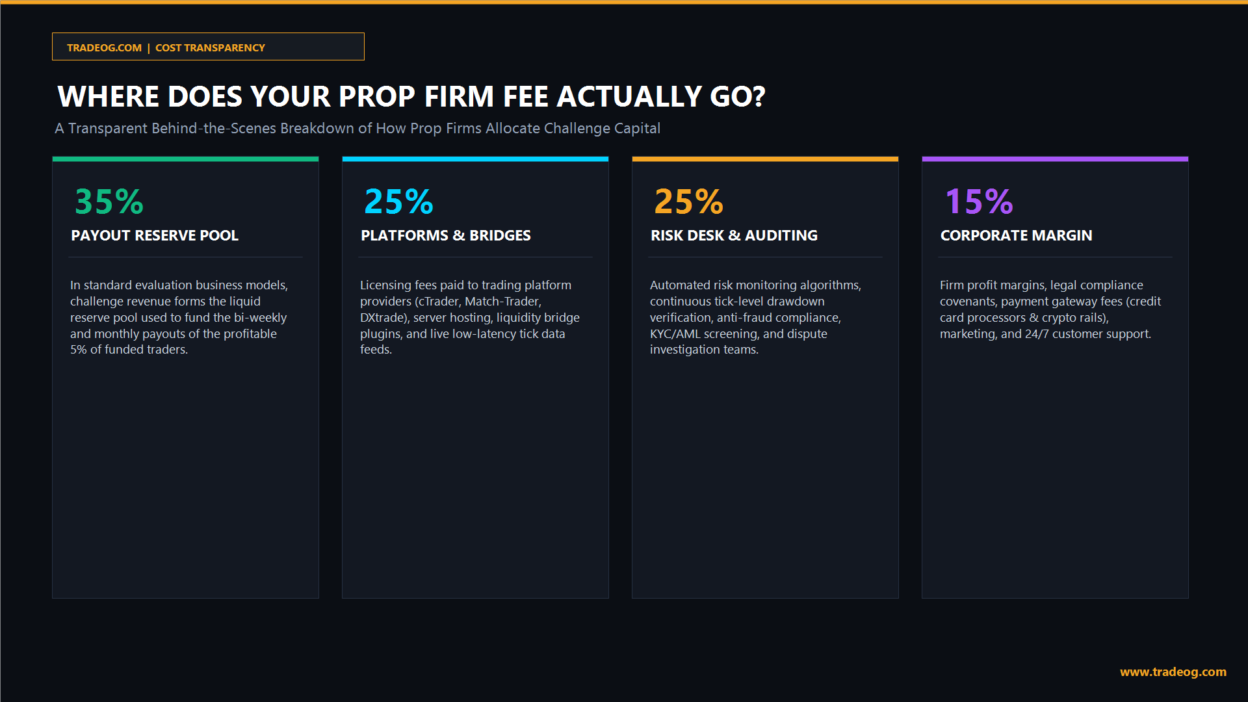
Prop firms are sophisticated fintech operations with substantial balance sheet obligations. When an evaluation fee is processed, it is distributed across four distinct institutional operational buckets:
- The Payout Reserve Pool (~35%): In standard evaluation business models, the vast majority of retail participants fail to reach funded status. The aggregated challenge fees from non-profitable participants form the liquid capital reserve used to pay out the consistent 5% of traders who successfully request withdrawals.
- Trading Platforms & Liquidity Bridge Licenses (~25%): Modern prop firms pay substantial software-as-a-service (SaaS) licensing fees to platform providers (cTrader, Match-Trader, DXtrade, or TradeLocker). In addition, integrating institutional bridge plugins (such as OneZero, PrimeXM, or Centroid) to route live price feeds costs thousands of dollars per month in server overhead.
- Risk Desk Monitoring & Compliance (~25%): Monitoring thousands of accounts in real time requires robust infrastructure. Automated risk engines evaluate live tick-by-tick equity, scan for toxic latency arbitrage, monitor IP geolocations, and verify KYC/AML documentation before approving payouts.
- Corporate Margins & Payment Rails (~15%): Payment gateways (credit card merchant processors and cryptocurrency rails) charge 3% to 6% per transaction. The remainder covers corporate legal counsel, customer support teams, and firm profit margins.
Why Do Prop Firms Refund Your Fee on the First Payout?
One of the most attractive features of tier-one prop firms (such as FTMO, FundedNext, and The 5%ers) is the 100% Refundable Challenge Fee model. If you pass Phase 1 and Phase 2, and subsequently generate eligible profit on your funded account, your initial evaluation fee is returned in full alongside your first profit split.
The Risk Desk Logic Behind Fee Refunds:
- Trader Retention: The refund acts as a powerful psychological milestone. It completely eliminates the trader’s sunk-cost risk, encouraging disciplined funded traders to remain with the firm for multiple payout cycles.
- The B-Book to A-Book Transition: When a trader proves they can pass an evaluation and extract consistent profits, the firm can comfortably transition that trader to an institutional copy-trading pool or live liquidity bridge. At that stage, the firm makes money from its share of your trading profits—meaning they no longer need to retain your challenge fee.
The 5 Hidden Fees Prop Firms Charge (The Fine Print)
The upfront challenge price is rarely the only expense associated with prop trading. Watch out for these five secondary costs that silently drain trader capital:
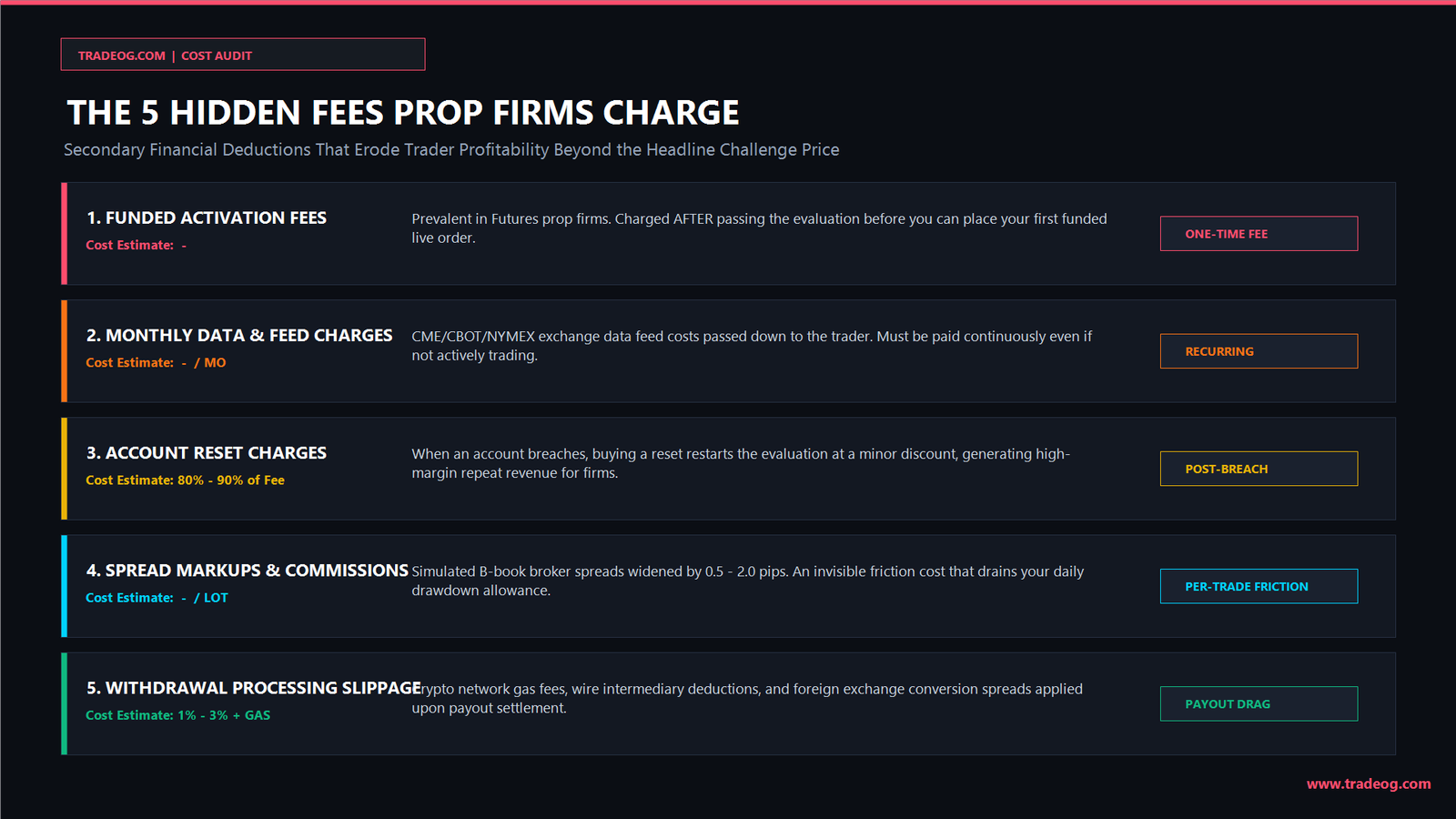
| Fee Type | Typical Cost | Where It Appears | How to Avoid / Mitigate It |
|---|---|---|---|
| 1. Funded Activation Fees | $140 – $250 per account | Futures prop firms (Apex, Bulenox) | Look for lifetime activation promos or choose CFD firms with zero activation fees. |
| 2. Monthly Exchange Data Feeds | $85 – $135 / month | Futures evaluations (CME/NYMEX data) | Ensure you are classified as “Non-Professional” to pay standard retail data rates. |
| 3. Post-Breach Account Resets | 80% – 90% of challenge fee | All prop firm evaluation dashboards | Do not buy impulsive resets on tilt; wait 48 hours to diagnose trading errors first. |
| 4. Spread Markups & Commissions | $3 – $7 / lot + 0.5-1.5 pip markup | Simulated B-book broker bridges | Audit raw spreads on demo accounts before buying; avoid firms with hidden slippage markups. |
| 5. Withdrawal Settlement Drag | 1% – 3% + crypto gas | Payout settlement processing | Use zero-fee direct payout partners (like Rise or direct SEPA/ACH wire transfers). |
Evaluation Fee vs. Personal Trading Capital: The Cold Math
Many skeptical traders argue: “Why would I pay $500 for a prop firm challenge when I could just deposit that $500 into my own personal trading account?”
Let’s run the mathematical comparison:
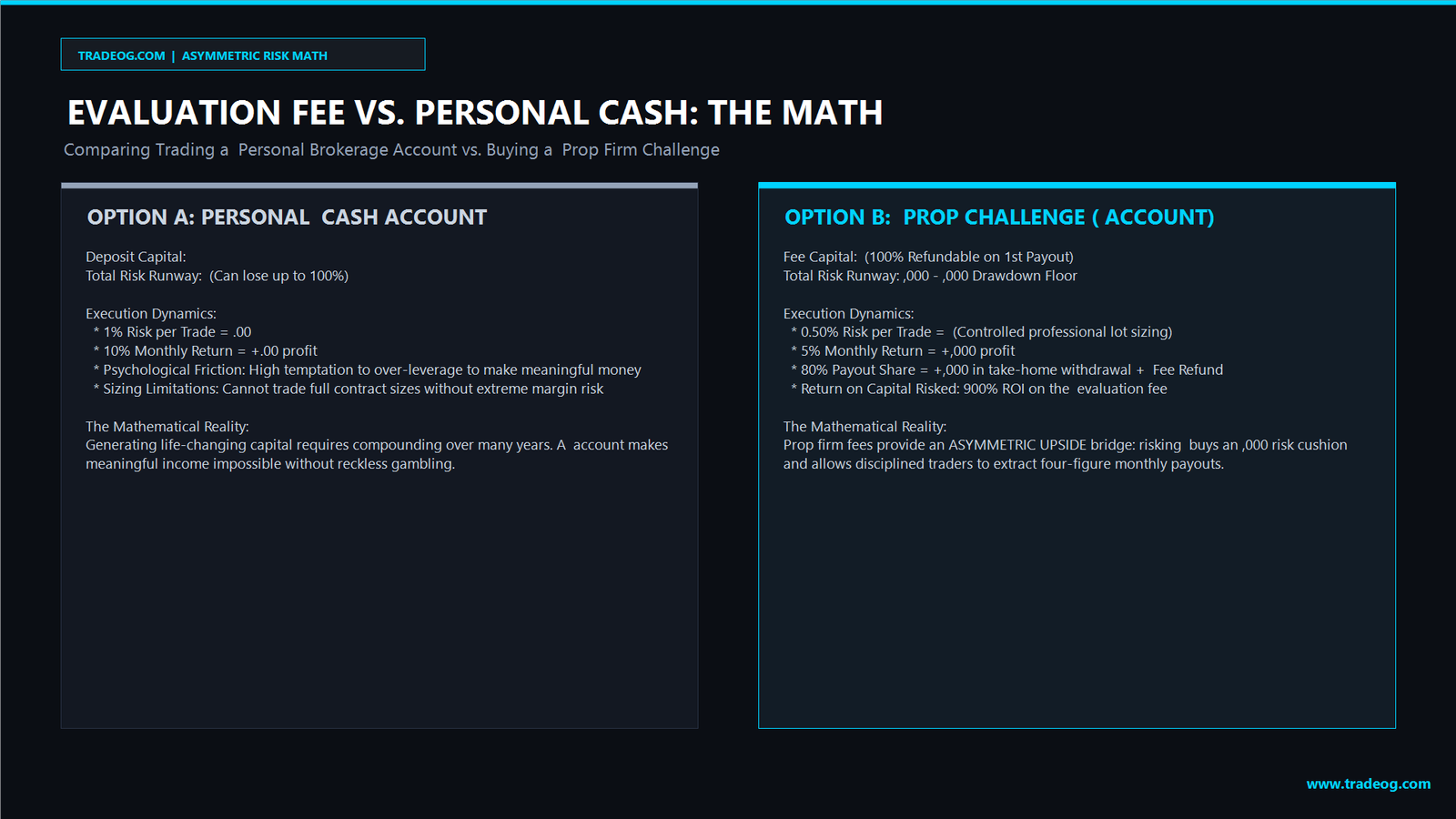
Option A: Trading a $500 Personal Cash Account
- Starting Capital: $500.
- Controlled Risk per Trade (1%): Exactly $5.00 per trade.
- Realistic Monthly Performance (10% Gain): +$50.00 profit.
- The Psychological Dilemma: Making $50 a month does not pay bills. To make meaningful income ($1,000+), the retail trader is forced to over-leverage, risking 10% to 20% per trade—which mathematically guarantees eventual account liquidation.
Option B: Buying a $500 Challenge ($100,000 Account)
- Capital at Risk: $500 (100% refundable upon passing).
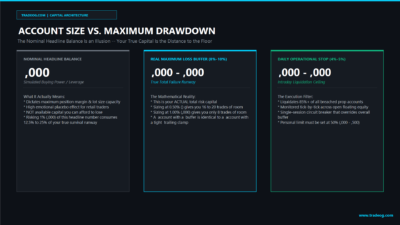
- Effective Risk Runway: $8,000 to $10,000 maximum drawdown buffer.
- Controlled Risk per Trade (0.50%): $500 per position (meaningful professional lot sizing).
- Realistic Monthly Performance (5% Gain): +$5,000 total profit.
- Net Trader Payout (80% Split + Fee Refund): +$4,500 cash withdrawal.
The Conclusion: Prop firm fees represent an asymmetric risk-to-reward vehicle. You cap your maximum downside at the $500 challenge fee, while purchasing an $8,000 drawdown buffer that allows a modest 5% monthly return to generate life-changing four-figure payouts.
The 4-Point Due Diligence Checklist Before Paying a Fee
Before entering your credit card or crypto wallet details on any prop firm checkout page, run through this final audit:
- Calculate the True Cost of Risk: Divide the fee by the actual dollar drawdown floor (
Fee / Max Loss Buffer). Ensure you are paying between $45 and $55 per $1,000 of real runway. - Check for Mandatory Activation Fees: Read the FAQ to confirm whether passing the evaluation triggers a secondary “Live Account Activation Fee” or recurring platform subscription.
- Confirm Fee Refund Eligibility: Verify the exact conditions required to receive your challenge fee refund (e.g., must hit 1st payout without trailing breach).
- Verify Payout Rails: Ensure the firm supports payout channels accessible in your country (Rise, crypto, or direct wire) without exorbitant intermediary wire deductions.
Frequently Asked Questions (FAQ)
Can you get a refund if you fail a prop firm challenge?
No. If you violate a drawdown rule or fail to meet the profit target, your evaluation fee is non-refundable. The fee pays for platform server usage, data feeds, and risk evaluation during your attempt.
Are prop firm fees tax-deductible?
In many jurisdictions (such as the UK, US, and EU), if you trade as an independent contractor, sole proprietor, or corporate entity, prop firm evaluation fees can be classified as legitimate business operating expenses. Always consult a qualified tax professional regarding your local tax laws.
Why are some prop firm fees significantly cheaper than others?
Budget prop firms cut costs by enforcing tighter intraday trailing drawdowns, widening broker spreads, charging secondary activation fees, or eliminating human customer support. A cheaper upfront fee almost always correlates with higher operational difficulty.
Summary
A prop firm fee is neither an investment deposit nor a charity ticket; it is the price of admission to institutional buying power. When you understand how fees fund payout reserves, calculate your true cost per dollar of failure runway, and avoid secondary activation traps, you can deploy your evaluation capital efficiently and turn funded trading into a profitable, scalable business.
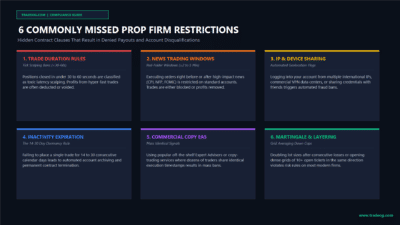
[…] If the firm insists on applying restrictive terms retroactively without notice, and customer support refuses to offer a reasonable transition, you have the right to request an official evaluation fee refund based on failure of consideration. For more on your customer protections, read our analysis on prop firm fees explained: what you are paying for. […]