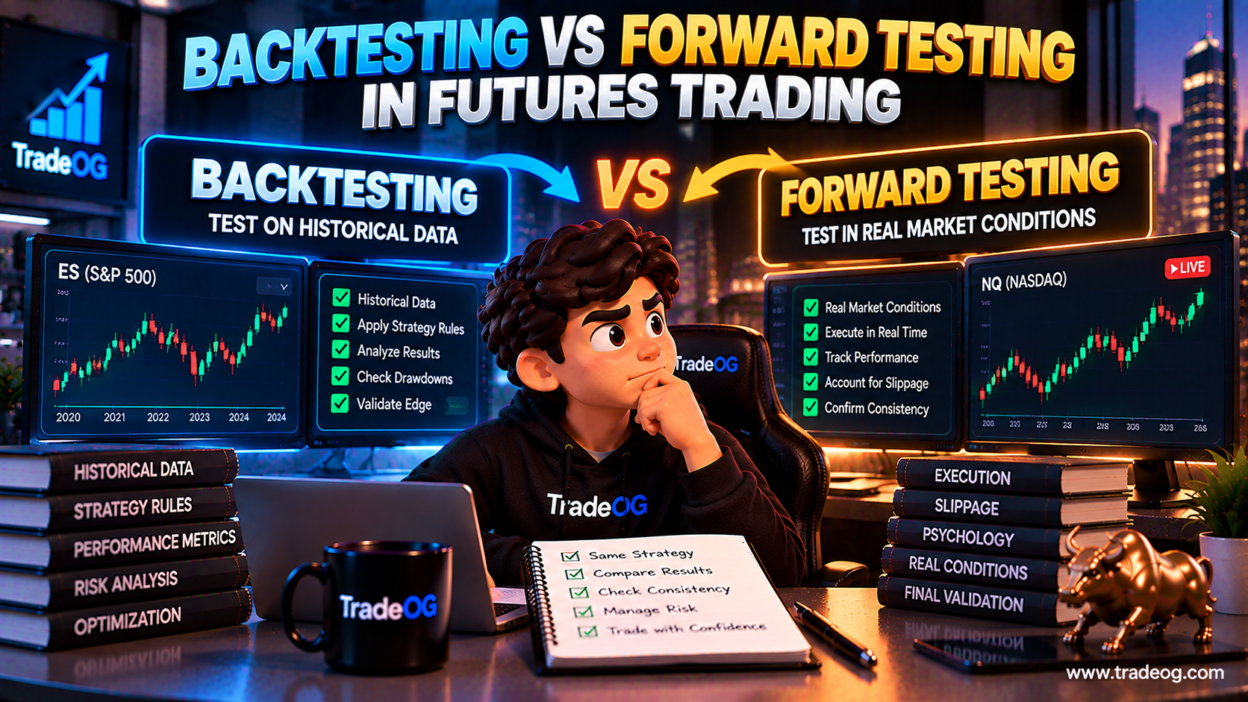
Backtesting and forward testing are two different stages of futures strategy validation. They are often discussed together, but they answer different questions. Backtesting asks whether a clearly defined trading method would have produced acceptable results on historical data. Forward testing asks whether those same rules can be executed consistently as new market conditions develop.
That distinction matters even more in futures trading because execution, contract specifications, volatility, slippage, commissions, trading sessions, contract expirations and prop-firm risk limits can all affect the outcome. A strategy can look attractive in a historical test and still behave differently when it is executed bar by bar in real time.
CME Group’s Trading Simulator, for example, provides futures and options markets using CME market data and includes tools for tracking trade history and performance. CME also states that its simulator can be used to backtest and forward-test methodologies. CME Group — Trading Simulator FAQ
What Is Backtesting in Futures Trading?
Backtesting means applying a predefined trading strategy to historical market data. Instead of waiting for the market to create each setup, you move through past sessions and determine what would have happened if the strategy had been traded according to its rules.
For futures traders, a backtest might cover ES, MES, NQ, MNQ, CL, GC or another contract across several months or years. The test can use daily, hourly, 15-minute, 5-minute or even more granular data depending on the strategy.
The important word is predefined. A useful backtest should not change the rules simply because the historical chart makes a different choice look better. If the strategy says to enter after a confirmed breakout, the same confirmation rule should be applied throughout the test.
A simple futures backtest example
Imagine a hypothetical NQ strategy with these rules:
- Trade only during a predefined U.S. session.
- Define the first 15-minute range.
- Enter long only after a confirmed breakout above the range.
- Use a predetermined stop distance.
- Use a fixed reward-to-risk target.
- Trade a fixed number of MNQ contracts during the initial test.
- Stop taking new trades after a predefined daily loss threshold.
You could apply those rules to historical sessions from several years. The resulting trade log could show win rate, average win, average loss, expectancy, profit factor, maximum drawdown, consecutive losses and other statistics.
The backtest therefore gives you a structured historical answer: How did this rule set behave on the data I tested?
What Is Forward Testing?
Forward testing takes the strategy into new market data that was not used to develop the rules. It is commonly performed with paper trading, a simulator or a demo environment rather than real capital.
FTMO Academy describes forward testing as testing a strategy using real-time market data and notes that it can reveal conditions that are difficult to reproduce with historical data, including order fills, slippage, spread changes and trading costs. FTMO Academy — Forward Testing of Trading Strategies
The key principle is simple: you should not keep changing the strategy every time a forward trade loses. The purpose is to see how the previously defined method behaves on unseen data.
Example of forward testing
Suppose you finished developing your MNQ breakout strategy using historical data through December. Starting in January, you stop changing the rules and record every valid setup as it happens.
You record:
- The exact setup time.
- Entry price.
- Stop price.
- Target price.
- Number of contracts.
- Whether the order would realistically have filled.
- Slippage or execution difference where applicable.
- Commission assumptions.
- Trade result in dollars and R-multiples.
- Market conditions and news environment.
After enough observations, you compare the forward-test results with the historical results.
Backtesting vs Forward Testing: The Core Difference
| Factor | Backtesting | Forward Testing |
|---|---|---|
| Data | Historical | New/current market data |
| Speed | Fast | Runs at market pace |
| Main purpose | Evaluate historical behavior | Validate behavior in new conditions |
| Sample coverage | Can cover many years quickly | Usually requires weeks or months |
| Execution realism | Depends on assumptions and data quality | Can expose real-time execution issues |
| Slippage | Must be modeled or estimated | Can be observed in simulated execution |
| Overfitting risk | Higher if rules are repeatedly optimized to history | Helps test whether the rules survive unseen data |
| Psychology | Usually limited | More realistic decision pressure, although simulated money is still different from live money |
| Best use | Strategy development and historical validation | Real-time validation and execution practice |
Neither method replaces the other. Backtesting provides breadth and historical context. Forward testing provides a reality check against new market behavior and the practical execution process.
Why Backtesting Should Usually Come First
Imagine a strategy that generates only two trades per week. Testing it forward from scratch could take many months before you know whether the underlying idea has any historical support.
Backtesting lets you examine a much larger historical sample before spending that time.
A structured historical test can answer questions such as:
- How often does the setup appear?
- Which sessions produce the most trades?
- What is the historical win rate?
- What is the average winning and losing trade?
- What is the maximum historical drawdown?
- How long are losing streaks?
- Does performance change across market regimes?
- What happens when trading costs are included?
- Does the strategy remain viable after conservative slippage assumptions?
FTMO Academy also recommends separating development from out-of-sample evaluation and using paper trading after backtesting to observe the strategy in real time. FTMO Academy — How to Backtest Trading Strategies
Why Backtesting Alone Is Not Enough
A backtest can be technically correct and still provide an unrealistic picture if its assumptions are too optimistic.
Common problems include look-ahead bias, curve fitting, unrealistic fills, ignoring commissions, ignoring slippage, using incomplete data, treating every historical price touch as an executable fill, and changing rules after seeing the result.
For example, suppose a historical candle has a high of 20,100 and a low of 19,950. If your strategy uses a stop order around one of those levels, you cannot automatically assume a perfect fill at the exact price simply because the candle reached it. The real execution sequence may have been more complicated.
This is particularly relevant to futures because the market can move quickly around economic releases and other high-volatility periods.
Why Forward Testing Adds Another Layer
Forward testing exposes the strategy to a market sequence that was not part of the original development sample. It can therefore reveal problems that are easy to overlook on historical charts.
1. Real-time decision making
A historical chart is already complete. A live market is not. During forward testing, you must make the decision without knowing the next candle.
2. Execution differences
Orders may fill differently from the price you expected. Slippage, market depth, volatility and order type can affect the final result.
3. News and event conditions
Economic releases can change volatility and liquidity rapidly. A historical strategy may look stable until you examine exactly how it behaves during event-driven moves.
4. Operational mistakes
Forward testing can reveal practical issues such as entering late, placing the wrong contract size, forgetting a stop, trading outside the intended session or missing a setup because the trader was not ready.
5. Strategy discipline
A strategy is not just an entry signal. It includes position size, stop placement, exit rules, trade frequency and conditions under which trading should stop. Forward testing shows whether the complete process is executable.
Historical Data vs Unseen Data
One of the most important concepts in strategy validation is unseen data.
If you use January 2022 through December 2025 to repeatedly modify a strategy, then the entire period has effectively become development data. You cannot treat the final result as a completely independent validation anymore.
A stronger workflow separates data into stages:
- Development sample: use historical data to define and refine the strategy.
- Out-of-sample sample: test the finalized rules on historical data that was not used for development.
- Forward sample: apply the unchanged rules to new market data as it arrives.
This does not guarantee future performance. It simply creates a more disciplined validation process.
Backtesting vs Out-of-Sample Testing vs Forward Testing
These terms are related but should not be treated as identical.
Backtesting
You apply rules to historical data. The main question is whether the strategy had acceptable historical behavior.
Out-of-sample testing
You use historical data that was deliberately kept separate from the strategy-development process. The goal is to see whether the rules generalize beyond the data used to build them.
Forward testing
You apply the finalized rules to new market information as it becomes available, often using a simulator or paper account.
A robust validation process can use all three.
Futures-Specific Factors You Must Include
Futures strategy testing has several details that can materially change results.
Contract specifications
ES, MES, NQ and MNQ do not have the same dollar value per point or tick. Your backtest must use the correct contract specifications.
CME’s futures resources provide contract information and risk-management guidance that can be used when defining position size and trade assumptions. CME Group — Position and Risk Management
Contract expiration and roll periods
Futures contracts expire. If your test covers multiple years, you need a defined method for handling contract transitions. Continuous futures data can be useful for research, but the construction method matters.
CME provides continuous price-series information for research and strategy development, including active-contract and historical data concepts. CME Group — Continuous Price Series
Trading hours
Your strategy should use the actual session you intend to trade. A strategy designed for the U.S. cash open should not silently include overnight behavior and then be evaluated as if all trades occurred during the same conditions.
Slippage
Slippage should be modeled conservatively in historical testing and recorded during forward testing. A strategy with very small average profit per trade can be highly sensitive to even modest execution differences.
Commissions and fees
Gross profit is not the same as net trading performance. Include realistic commissions and other applicable trading costs in your test.
How to Build a Good Backtest
Step 1: Write the rules first
Write the entry, exit, stop, target, position-size, session and no-trade rules before reviewing large quantities of historical results.
Step 2: Define the instrument
Specify the exact futures contract or product family. Do not mix products with different point values without adjusting the risk model.
Step 3: Define the timeframe
State whether the strategy operates on 1-minute, 5-minute, 15-minute, hourly or daily data.
Step 4: Define execution assumptions
Specify how market, limit, stop and stop-limit orders are treated. Decide how gaps and unavailable prices are handled.
Step 5: Include costs
Add commissions and a reasonable slippage assumption rather than evaluating only gross price movement.
Step 6: Record every valid signal
Do not selectively record only the trades that look clean. The test should include valid winners and valid losers.
Step 7: Measure more than win rate
At minimum, calculate:
- Total trades
- Win rate
- Average win
- Average loss
- Expectancy
- Profit factor
- Maximum drawdown
- Maximum consecutive losses
- Average R-multiple
- Net performance after costs
How to Forward Test a Futures Strategy
Once the historical rules are finalized, create a forward-testing protocol.
Use a fixed rule set
Do not modify the strategy after every losing trade. Record the outcome first. If you later decide to change a rule, treat the modified version as a new strategy and restart the validation process.
Use realistic contract sizing
If your intended prop-firm workflow uses MNQ rather than NQ, forward-test the intended product or a deliberately scaled equivalent. The objective is to understand the actual execution and risk characteristics you expect to face.
Record missed trades
A missed valid setup is information. Record why it was missed: late observation, platform issue, hesitation, unclear signal or another reason.
Record execution quality
For every trade, record expected entry, actual simulated fill, expected stop, actual exit and any observed slippage. This can expose a difference between theoretical and executable performance.
What Should You Compare After Forward Testing?
The most useful comparison is not simply “backtest profit versus forward-test profit.” Look at the structure of the results.
| Metric | Backtest | Forward Test | What to Examine |
|---|---|---|---|
| Win rate | Historical | New sample | Is the difference reasonable? |
| Average win | Historical | New sample | Are winners being captured similarly? |
| Average loss | Historical | New sample | Are execution and exits increasing losses? |
| Expectancy | Historical | New sample | Does the basic edge persist? |
| Drawdown | Historical | New sample | Is current behavior within the expected risk envelope? |
| Trade frequency | Historical | New sample | Is the setup appearing at the expected rate? |
| Slippage | Assumption | Observed | Are fills materially worse than assumed? |
A difference does not automatically mean the strategy is broken. A small forward sample can naturally deviate from the historical average. The goal is to identify whether the deviation is explainable by sample size and market regime or whether it points to a structural problem.
How Many Trades Are Enough?
There is no universal number that proves a strategy works. More observations generally provide more information, but the required sample depends on trade frequency, variability, strategy complexity and the question being tested.
FTMO Academy notes that a very small sample can be insufficient for judging whether a strategy is robust and discusses testing larger samples before drawing conclusions. FTMO Academy — Backtesting Your Strategy
For a futures strategy that trades frequently, you may be able to gather a meaningful sample faster. A low-frequency strategy may require substantially more calendar time.
Instead of choosing a number only because it sounds impressive, define the statistics you need to estimate and the market regimes you want represented.
Backtesting and Forward Testing for Prop Firm Challenges
Prop-firm trading adds another layer because a strategy does not operate in an unlimited-risk environment. A trader may face a maximum loss limit, daily loss limit, position-size limit, consistency condition or other program-specific rule.
Therefore, a strategy can be profitable in a generic backtest but still be poorly suited to a particular account structure if its drawdown profile conflicts with the account’s risk limits.
Your test should therefore include a simulated prop-firm layer:
- Starting account balance.
- Maximum permitted loss or drawdown.
- Daily loss rule where applicable.
- Maximum contract size.
- Trading-session restrictions.
- News or event restrictions where applicable.
- Commissions and realistic execution costs.
- Maximum number of trades per day if imposed by your own plan.
Always check the current rules of the specific prop firm and account model you are considering. Rules can change, and different programs can use different definitions of drawdown, daily loss, contract limits and trading hours.
A Simple Prop-Firm Backtest Stress Test
Suppose a hypothetical strategy produces a 1.5R average winning trade and a 1R average losing trade. The historical report looks positive, but the largest historical losing streak is six trades.
Do not stop at the headline return.
Ask:
- What happens if the next sample contains eight consecutive losses?
- What happens if slippage increases during volatile sessions?
- What happens if the strategy experiences a lower win rate?
- Does the daily loss rule stop the strategy before its normal recovery sequence?
- Does the maximum contract limit prevent the intended position size?
- Does the strategy still have positive expectancy after commissions?
This kind of stress testing is especially useful when the objective is to survive a drawdown constraint rather than simply maximize historical return.
Common Backtesting Mistakes
1. Changing rules after seeing every result
If you repeatedly optimize the strategy to historical outcomes, the test can become a record of how well you fitted the past rather than evidence that the rules generalize.
2. Using perfect fills
Assuming every order fills exactly at the most favorable historical price can materially distort results.
3. Ignoring costs
A high-frequency strategy can look very different after commissions and slippage are included.
4. Testing only favorable market periods
A strategy should be examined across different market environments rather than only during a period in which its preferred pattern was common.
5. Stopping after a small winning sample
A handful of winning trades cannot establish long-term robustness.
6. Ignoring losing streaks
Two strategies can have similar average returns while having very different drawdown and losing-streak profiles.
7. Confusing paper trading with live trading
Forward testing is valuable, but simulated trading does not reproduce every aspect of real-money execution and psychology.
Common Forward Testing Mistakes
Changing the strategy mid-test
If you change the entry after a loss, you are no longer testing the original strategy.
Skipping trades
Selective participation can make a forward test look better than the strategy actually performed.
Trading larger because the test is going well
Position size should be predetermined. Otherwise, the test mixes strategy performance with discretionary risk changes.
Ignoring execution details
Forward testing should capture actual simulated fills, not only whether the chart eventually moved in the expected direction.
Declaring failure too early
A small sample can contain an unusually good or bad sequence. Evaluate the complete sample and compare its structure with the historical distribution.
When Should You Move From Backtesting to Forward Testing?
A practical transition point is when the strategy rules are specific enough that another person could apply them without asking what you meant.
You should know:
- What creates an entry.
- What invalidates an entry.
- Where the stop goes.
- How the target is determined.
- How position size is calculated.
- When trading is prohibited.
- How commissions and slippage are modeled.
- How a trade is recorded.
If those rules are still changing every session, forward testing becomes difficult to interpret.
A Practical Validation Workflow
For a futures trader building a new strategy, the following workflow is straightforward:
- Write the strategy rules.
- Collect quality historical data.
- Backtest across multiple market periods.
- Include commissions and conservative execution assumptions.
- Measure expectancy, drawdown and losing streaks.
- Freeze the rules.
- Run an out-of-sample historical test.
- Forward test in real time using a simulator or paper account.
- Compare forward results with historical expectations.
- Investigate material differences rather than immediately changing the rules.
- If rules change materially, repeat the validation cycle.
Backtesting vs Forward Testing: Which One Is More Important?
They serve different purposes, so treating one as universally superior misses the point.
Backtesting is valuable because it gives you historical breadth. You can examine many market environments without waiting years for those environments to occur again.
Forward testing is valuable because it tests the finalized strategy against new information and real-time execution conditions. It also forces the trader to follow the strategy without seeing the next candle.
The strongest process is therefore not backtesting versus forward testing. It is backtesting followed by disciplined forward testing, with the results compared objectively.
Backtesting and Forward Testing Checklist
- ☐ Strategy rules are written before final testing.
- ☐ Entry and exit conditions are objective.
- ☐ Futures contract specifications are correct.
- ☐ Session times are defined.
- ☐ Contract expiration and roll handling are defined.
- ☐ Slippage is included or stress-tested.
- ☐ Commissions and fees are included.
- ☐ Historical sample contains different market conditions.
- ☐ Development and validation data are separated.
- ☐ Forward test uses unchanged rules.
- ☐ Every valid signal is recorded.
- ☐ Missed trades are recorded.
- ☐ Execution differences are measured.
- ☐ Drawdown and losing streaks are tracked.
- ☐ Results are compared using more than win rate.
- ☐ Prop-firm rules are modeled separately when relevant.
Final Thoughts
Backtesting tells you how a futures strategy behaved on historical data. Forward testing tells you how that finalized strategy behaves when new market information arrives and you have to execute the rules in real time.
For futures traders, the distinction is important because execution, slippage, contract specifications, costs, volatility and risk limits can change the practical outcome of a strategy.
A useful validation process does not try to prove that a strategy will make money. Instead, it tries to discover how the strategy behaves, where its assumptions break down, what level of drawdown and losing streak it can experience, and whether its historical characteristics remain reasonably consistent when tested on unseen data.
Before using a strategy with a prop-firm account or real capital, consider treating backtesting and forward testing as separate checkpoints rather than one combined exercise. Historical results can generate a hypothesis; out-of-sample and forward testing can then challenge that hypothesis.
Frequently Asked Questions
Is forward testing the same as paper trading?
Paper trading is a common way to perform forward testing. Forward testing describes the validation process using new market data, while paper trading describes the simulated execution method.
Can a strategy pass a backtest and fail forward testing?
Yes. Differences can arise from overfitting, changing market conditions, execution assumptions, slippage, costs, insufficient sample size or differences between historical and real-time implementation.
How long should I forward test a futures strategy?
There is no universal calendar period. The required period depends on the strategy’s trade frequency and the market conditions you want represented. Focus on obtaining a meaningful sample rather than choosing an arbitrary number of days.
Should I backtest before paper trading?
For most systematic strategy-development workflows, historical testing is useful first because it can quickly reveal whether the basic idea has enough historical evidence to justify more time-consuming real-time testing.
Should slippage be included in a futures backtest?
Yes. At minimum, use a conservative assumption and then compare it with actual observed execution during forward testing. Strategies with small average trade profits are particularly sensitive to execution costs.
Can I use TradingView for backtesting and forward testing?
TradingView can be useful for historical strategy analysis and paper trading, but the exact capabilities depend on the strategy, market, data source and platform configuration. Always verify that the data and execution assumptions match the futures product you intend to trade.
What metrics should I compare between the two tests?
Compare win rate, average win, average loss, expectancy, profit factor, maximum drawdown, consecutive losses, trade frequency, average R and execution costs. Comparing only total profit can hide important differences.
Does forward testing guarantee live profitability?
No. Forward testing improves the validation process but cannot guarantee future profitability. Live trading introduces additional factors such as real financial consequences, actual liquidity, broker or platform behavior and trader psychology.