

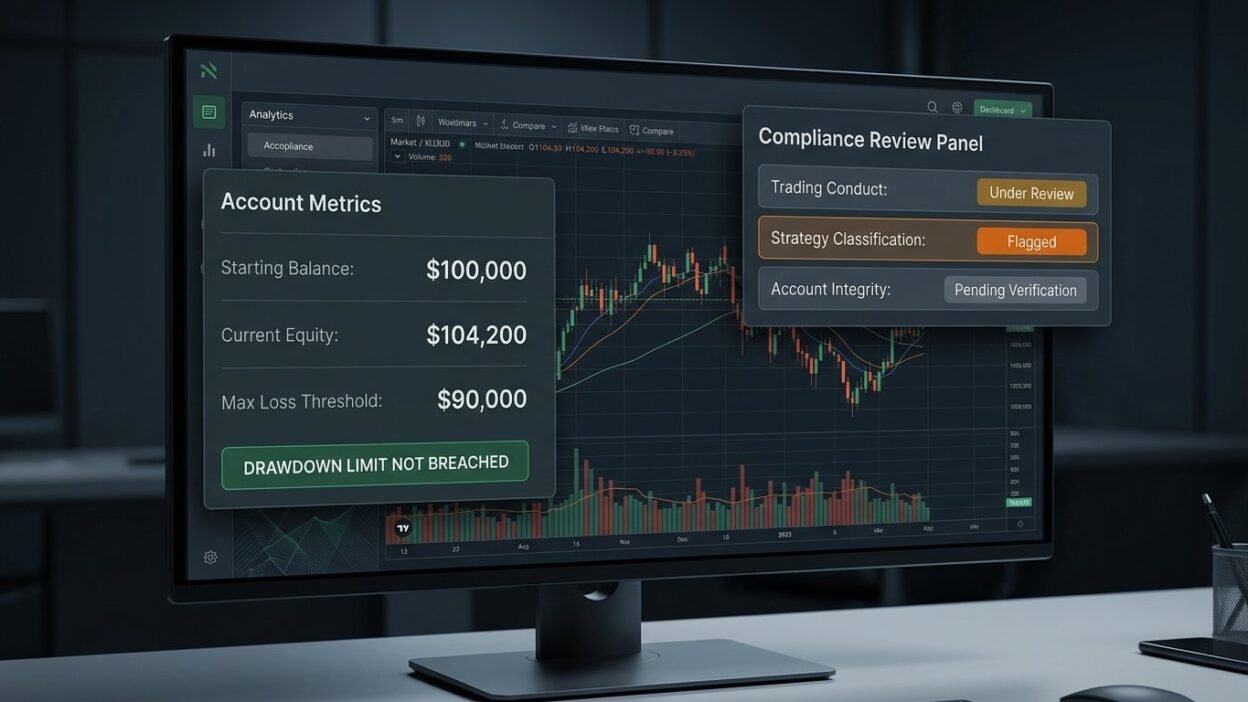
Yes. An open trade can contribute to a prop firm breach if the firm’s loss or drawdown calculation includes floating or unrealized P&L. In an equity-based system, a losing open position can reduce equity below the permitted threshold even though the trade has not been closed and the account balance has not changed. Whether this applies to your account depends entirely on the firm’s specific rules — not every prop firm calculates drawdown the same way.
Can an Open Trade Really Cause a Prop Firm Breach?
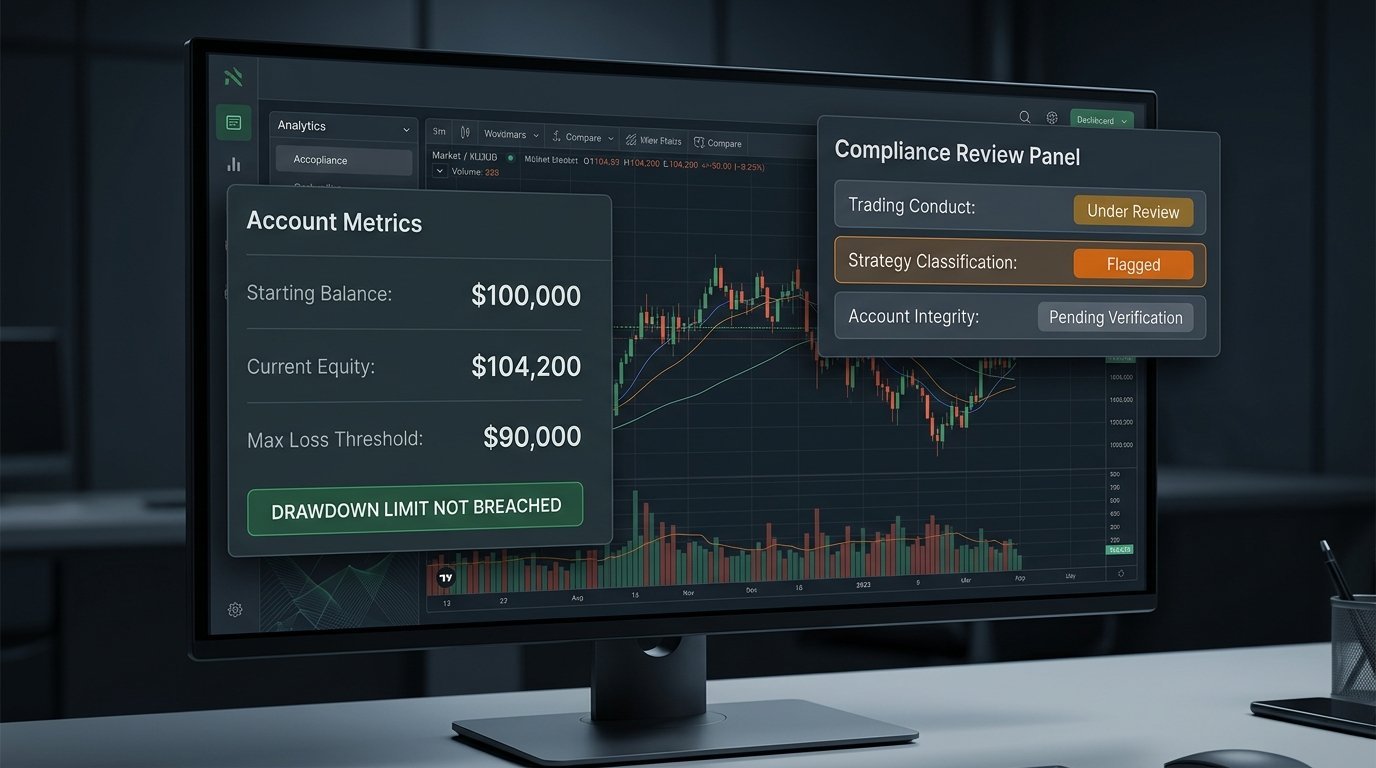
The short answer is yes — depending on how the firm’s risk engine works.
When you open a trade and it moves against you, that loss is unrealized. It has not been locked in. The trade is still live, the position can recover, and your account balance — the figure showing closed-trade results — has not changed. So far, no realized loss has occurred.
However, most modern CFD-based proprietary trading firms do not wait for a position to close before evaluating your risk. Instead, their risk engines monitor equity in real time: your balance adjusted for any open floating profit or loss. If equity — not balance — determines whether you breach a rule, then an open losing position counts right now, not after you close it.
Here is a direct illustrative example:
- Account Balance: $100,000
- Open Trade Floating Loss: -$5,500
- Current Equity: $94,500
- Daily Loss or Drawdown Threshold: $95,000
In this scenario, under a firm that uses equity-based loss monitoring, the account would be flagged as a breach even though the trader has not closed the trade and the balance still displays $100,000. The loss is unrealized — but the firm’s rule considers it current.
This example is illustrative. Actual breach calculations depend on the specific firm’s terms, account type, and the applicable rule.
What Happens to Equity When a Trade Is Open?
Understanding this sequence is fundamental to managing a prop firm account safely.
- Trader opens a position. At the moment of execution, balance typically remains unchanged. However, transaction costs (spread, commission) may be factored in immediately depending on the platform.
- Price begins moving. The position has entered the market. Every price tick in the trader’s favour is unrealized profit; every tick against them is unrealized loss.
- Floating P&L fluctuates continuously. This figure updates on every price change from the liquidity provider.
- Equity updates in real time. A firm using real-time equity monitoring sees this number changing on every tick.
- The risk engine evaluates compliance. Depending on how the firm’s daily loss or drawdown rule is structured, floating equity can trigger automated intervention.
The key insight: once you open a position, your account’s risk exposure is live. Equity tells the honest story of your account at every moment; balance only tells you what happened in the past.
Balance vs Equity: What Each Figure Actually Means
These two figures appear on every trading terminal, but they represent fundamentally different things:
Balance is the realized cash value of your account. It changes when:
- A trade closes (profit or loss crystallized)
- A commission or swap is posted to the ledger
- An administrative credit or debit is applied
Equity is the live mark-to-market value of your account at any given moment:
Equity = Balance + Floating P/L ± Applicable Costs
When no positions are open, equity equals balance. The moment a position is opened, equity starts moving with the market. The table below shows how a $100,000 account’s figures diverge as a trade progresses:
| Situation | Balance | Floating P/L | Equity |
|---|---|---|---|
| Position opened, no movement | $100,000 | $0 | $100,000 |
| Trade moves +$1,000 in profit | $100,000 | +$1,000 | $101,000 |
| Trade moves -$2,000 against | $100,000 | -$2,000 | $98,000 |
| Trade moves -$5,500 against | $100,000 | -$5,500 | $94,500 |
Watching balance alone while an open position runs deeply negative is one of the most common and costly mistakes in prop trading. The balance looks fine. Equity does not. Under an equity-based rule, equity is what determines whether the account has breached.
For a complete breakdown of this topic, see our guide on prop firm equity vs balance and which one determines your breach.
Can You Breach Without Closing the Trade?
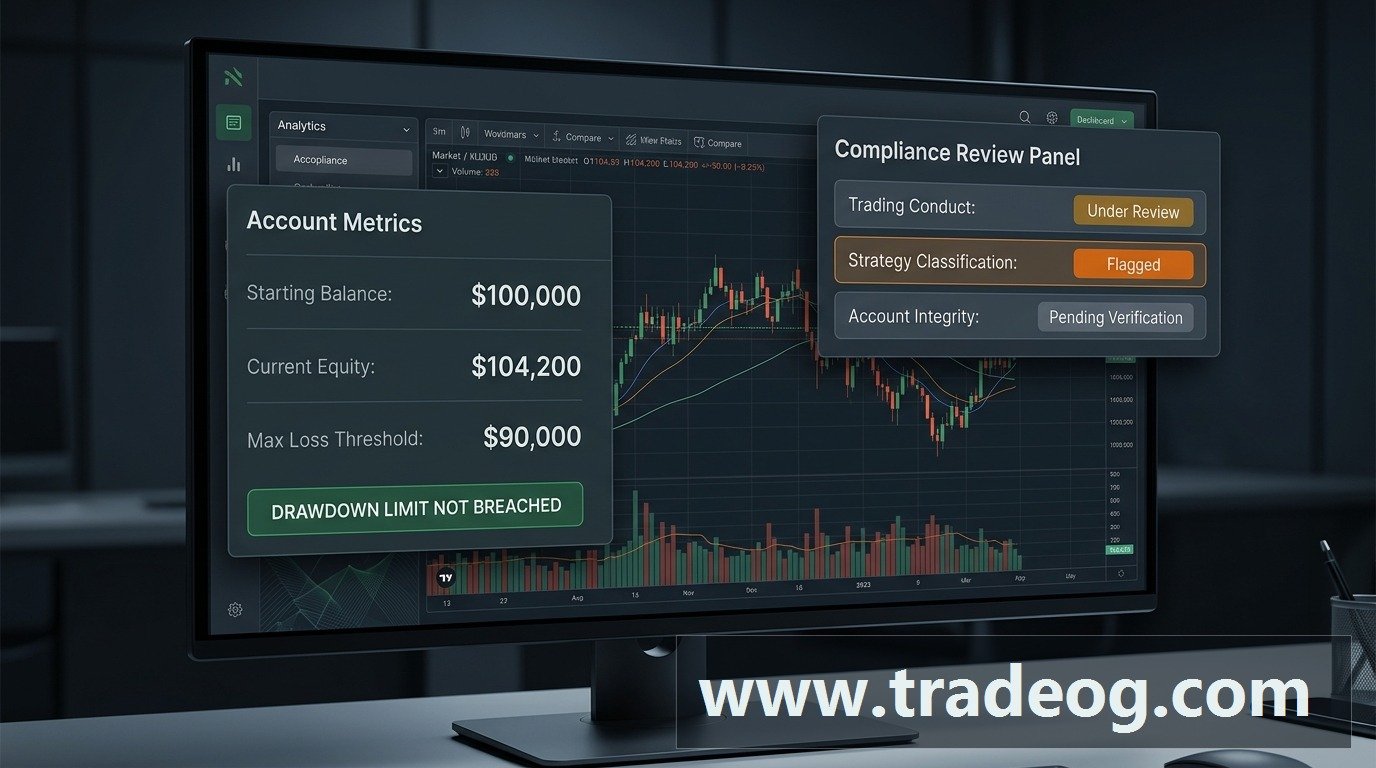
Yes — under an equity-based calculation, a sufficiently large floating loss can push the account across a threshold before any trade has been closed. This is not a loophole or an unusual situation; it is the standard operation of equity-based risk monitoring at the majority of modern CFD prop firms.
The specific circumstances depend on the firm:
- Firms using real-time equity monitoring: The risk server checks equity on every price tick. A floating loss that crosses the applicable limit for even a fraction of a second can trigger automated liquidation.
- Firms using closed balance only: A floating loss does not breach any rule until the trade closes and becomes a realized loss.
- Firms using end-of-day (EOD) equity: The server checks equity once per day at the daily settlement time. A floating loss that recovers before that point does not breach the account.
- Firms using EOD balance: Only the closed-trade balance at the daily reset determines compliance.
- Firms that use different calculations for different rules: A firm may use equity for its daily loss limit but balance for its overall maximum drawdown, or vice versa.
This variation is exactly why assuming your firm operates identically to another is a serious risk. Always verify directly from the firm’s official rules documentation.
How an Open Trade Can Trigger Maximum Daily Loss
Maximum Daily Loss is typically the tightest constraint on a prop account. It restricts how much the account can decline from the opening reference point within a single trading day, resetting at the firm’s specified server time.
Here is an illustrative example of how an open trade interacts with a daily loss rule:
- Starting/Reference Balance: $100,000
- Daily Loss Limit (5%): $5,000 (Threshold: $95,000)
- Open Position Floating Loss: -$4,700
- Round-Trip Commission Debited: -$60
- Swap Deducted at Rollover: -$40
- Current Equity Impact: -$4,800
The equity sits at $95,200 — $200 above the threshold. The trader is technically within the limit. But markets do not stay static:
- Additional market move against the position: -$300
- New total equity impact: -$5,100
- Current equity: $94,900
Equity has now crossed the $95,000 floor. In an equity-based real-time system, the account is breached. The trade is still open. The balance still reads $100,000. Yet the account has reached its daily loss limit.
What makes this scenario particularly important for traders to understand is the contribution of costs. The raw market move of -$4,700 was within limits. It was the accumulated commission, swap, and a modest additional price move that combined to push equity over the line. See our article on does commission count toward prop firm drawdown for a full analysis of how fees interact with your risk buffer.
How an Open Trade Can Trigger Maximum Drawdown
Maximum Drawdown (sometimes called Maximum Loss) is the upper boundary for cumulative losses across the entire life of the challenge or funded account. Unlike the daily limit, it does not reset — it represents the total tolerated decline from a defined reference point.
Two distinct models govern how this limit is applied:
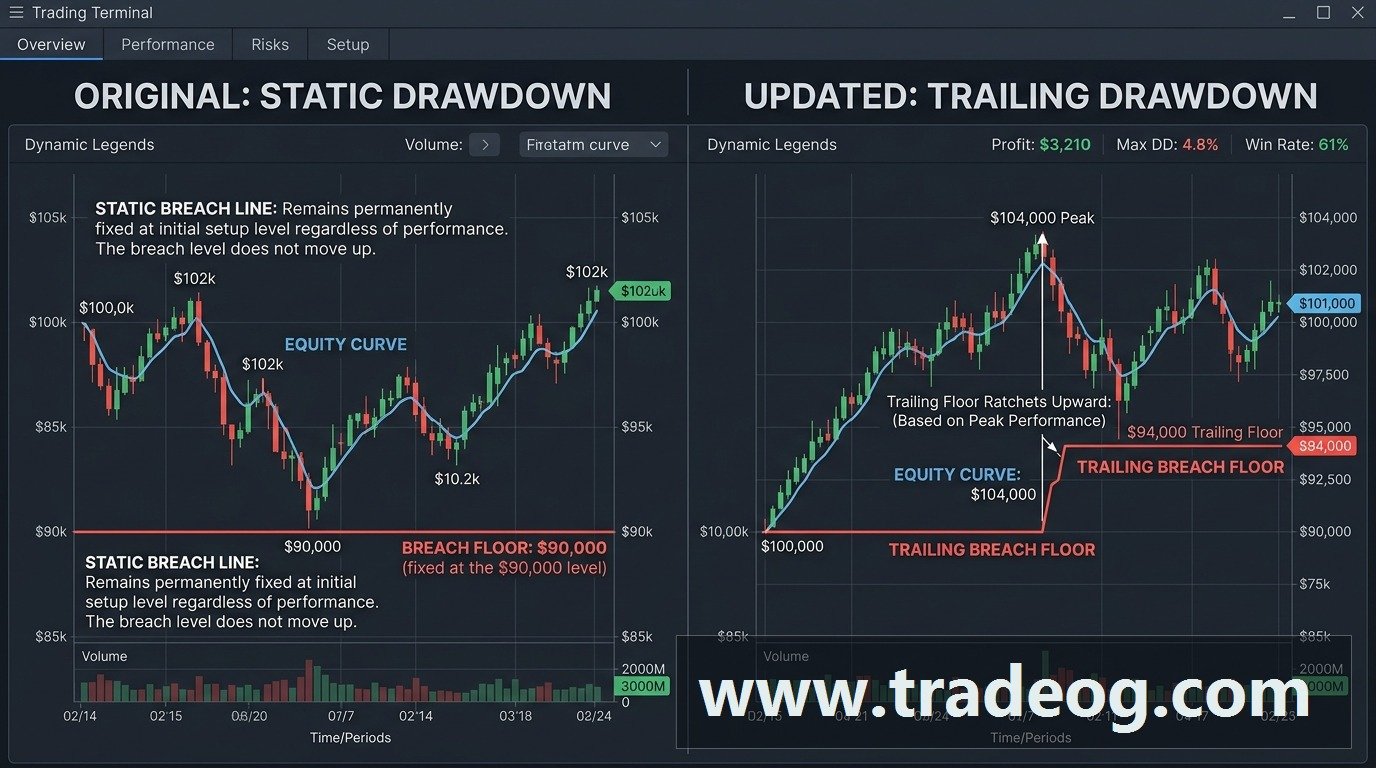
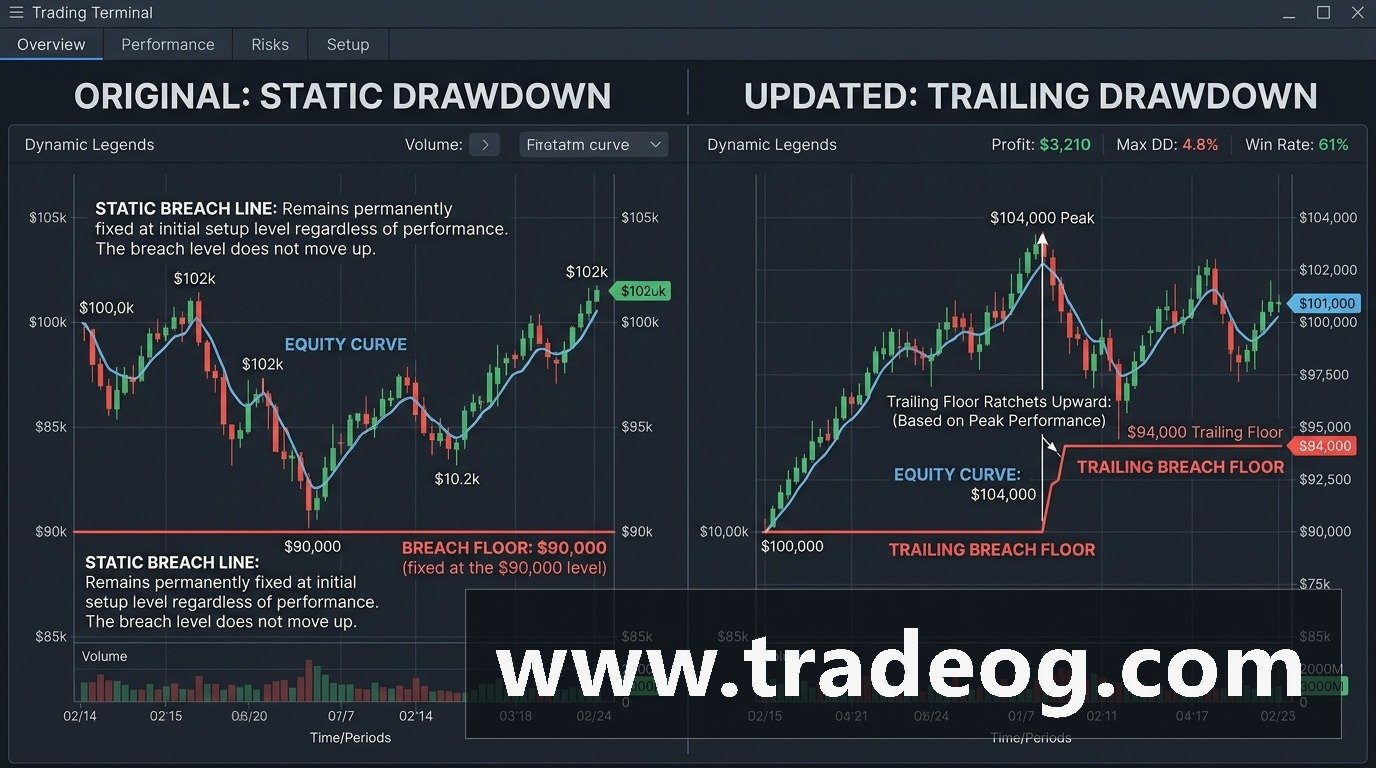
Static Drawdown
The maximum loss threshold is fixed permanently at a defined floor below the starting balance. On a $100,000 account with a 10% static drawdown, the breach line is permanently set at $90,000 regardless of subsequent account growth. Under a static model, the account must grow to $110,000 for that floor to be considered in more favourable terms.
Open trades matter in a static equity-based system because floating losses still count toward the $90,000 floor in real time.
Trailing Drawdown
The threshold moves upward with account performance. If the account reaches $106,000, the floor might trail upward toward $100,000 (assuming a 6% trailing model). Two critical questions arise here:
- Does the trailing drawdown update based on open equity or only closed balance? If it trails on peak equity, a floating profit of $6,000 moves your floor upward before you have even closed the trade. Then, if the trade reverses, the floor stays at the new high-water mark while equity retreats.
- Is the trailing drawdown static once the floor reaches the initial balance? Many firms cap trailing drawdowns at the account starting balance to prevent the floor from exceeding it.
The answer to both questions is entirely firm-specific and may also be account-type-specific within the same firm.
Can a Profitable Open Trade Protect You From a Breach?
In an equity-based system, a position running in profit does increase your live equity — and this can widen your distance from a drawdown threshold. If you are holding a $2,000 floating profit, equity currently reads $102,000, expanding the cushion between you and a $95,000 daily floor.
However, this provides no reliable protection for several reasons:
- The trade can reverse. A floating profit can evaporate in seconds during news events, gap openings, or sudden liquidity pulls. The moment the position turns negative, equity drops.
- If the firm uses trailing drawdown on peak equity, that $2,000 profit may already have moved your trailing floor upward. When the trade retraces to breakeven, your available buffer is smaller than before the trade existed.
- Multiple positions can interact. A profitable trade on EUR/USD does not offset a separate large losing trade on NAS100. Your equity reflects the net sum of all open floating P&L simultaneously.
- End-of-day rules may apply. Some firms evaluate equity at the daily settlement time, not during the trading session. A floating profit during the day does not prevent an EOD breach if conditions change before the reset.
Never treat a profitable open trade as a guaranteed safety buffer. Monitor your actual live equity against the exact threshold at all times.
Can Spread Expansion Make an Open Trade Breach?
Yes, under certain conditions, spread expansion can directly alter the displayed floating P&L of an open position and therefore affect equity calculations.
A trading position’s live unrealized P&L is typically calculated against the current bid or ask price — not the mid-price. When the bid-ask spread widens significantly during:
- High-impact economic announcements (NFP, CPI, central bank decisions)
- The 5:00 PM EST daily rollover window when interbank liquidity thins
- Illiquid overnight periods, particularly for exotic or cross-currency pairs
- Flash crash events or severe one-sided order-flow moments
…the position’s displayed P&L can deteriorate sharply without the underlying instrument price having moved in a sustained directional sense. A position sitting at a -$3,200 floating loss can suddenly display -$4,800 when spreads expand during rollover — potentially pushing equity through a threshold that the trader believed was safely distant.
Whether or not this constitutes a breach, and whether the firm offers any allowance for documented spread anomalies, depends entirely on the firm’s terms. Most equity-based risk systems capture the equity figure as-displayed, regardless of whether the underlying cause was a directional price move or a temporary spread widening.
Our dedicated article on can spread expansion cause a prop firm breach covers this in much greater depth.
Can Slippage on an Open Trade Cause a Breach?
Slippage affects realized outcomes, but it can interact with breach calculations in two distinct ways:
Stop-Loss Slippage
A stop-loss order is an instruction to close a position at a specified price — not a guarantee of execution at that price. During high-volatility events, market gaps, or thin liquidity windows, your stop-loss may execute significantly worse than intended. A stop set at a -$3,000 loss may execute at -$4,500. The position closes — but the realized loss is larger than planned, potentially putting both the daily loss limit and the overall maximum drawdown at risk.
Entry Slippage
If your trade opens at a worse price than targeted (for example, entering at 1.1005 instead of 1.1000 on EUR/USD in a buy order), the position begins with a worse starting point. The floating loss starts larger, reducing the remaining buffer for normal price fluctuation.
Slippage is not a matter of strategy failure — it is a structural feature of market execution during volatility. Planning position size with meaningful buffers rather than using the full permitted drawdown limit is the only reliable mitigation.
Can Commission and Swap Affect an Open Trade’s Breach Risk?
Both transaction costs directly reduce equity in the way most prop firm risk engines measure it.
Commission
Commissions are typically charged per lot traded and debited immediately upon order execution. If you open a 5-lot EUR/USD position with a per-lot commission of $7 round-trip, $35 is debited from your equity at the moment the order fills — before the trade moves a single pip. On large position sizes or high-frequency strategies, cumulative commissions can consume meaningful portions of your daily buffer without any market exposure.
Swap (Overnight Financing)
Swap fees are charged when a position is held open past the daily rollover — typically 5:00 PM EST for most forex and CFD instruments. On instruments with negative swap rates, this cost is debited directly from your account at the rollover, reducing balance and therefore equity. Holding multiple swing positions through multiple rollovers accumulates a real monetary cost that compounds the risk of the existing floating loss.
For a focused analysis of how overnight financing affects prop accounts, read our article on can swap fees trigger a prop firm drawdown.
What Happens to an Open Trade During Major News Events?
Major scheduled news events — central bank rate decisions, employment reports, inflation prints — compress risk into seconds. For traders holding open positions through these announcements, several things can happen simultaneously:
- Rapid directional price movement: A 100-pip move on EUR/USD in under five seconds is not unusual during major events. On meaningful position sizes, this translates to thousands of dollars in floating P&L change within a single candle.
- Spread expansion: Bid-ask spreads on major pairs can temporarily widen by 10–30 pips during announcements. This adds artificial drag to displayed floating P&L as described above.
- Stop-loss slippage: If price gaps through a stop, execution can occur at a significantly worse price.
- Broker/platform intervention: Some prop firms restrict trading during specific news windows or flag accounts for review if stop-loss orders execute with extreme slippage during high-impact events.
Traders who hold large open positions through major news events face the simultaneous risk of directional loss, spread expansion, and slippage — all of which can interact with equity-based limits.
Can an Open Gold (XAU/USD) Trade Breach a Prop Firm Account?
Gold is one of the most traded instruments on prop firm evaluation accounts, and also one where unexpected floating losses can develop very quickly. Here is why:
Gold’s standard tick value means that even modest lot sizes represent significant dollar risk per price move. Consider the following illustrative calculation:
- Instrument: XAU/USD (Gold)
- Position Size: 2 lots
- Dollar Value Per Pip (approximately): $20 per pip, per lot
- Price Move Against Position: 130 pips
- Floating Loss: 2 lots × $20 × 130 = -$5,200
- Account Equity: $100,000 – $5,200 = $94,800
- Daily Loss Threshold (5%): $95,000
Under an equity-based monitoring system, this account is already in breach — despite the trade being open and the loss being entirely unrealized. A 130-pip intraday move on gold is not exceptional; during US CPI releases or Federal Reserve announcements, gold regularly moves 200–400 pips within minutes.
Overnight, gold also attracts swap fees that accumulate with each rollover, compressing the available buffer further. Traders holding large gold positions into high-impact news events, or through multiple overnight sessions, should calculate the combined impact of pip movement, spread, and accumulated swap in their risk planning.
These figures are illustrative and approximate. Actual pip values depend on account currency, exact contract specifications, and the broker’s pricing structure.
Can an Open Forex Trade Breach a Prop Firm Account?
Yes, by the same mechanism as any other instrument. Here is an illustrative EUR/USD example:
- Instrument: EUR/USD
- Position Size: 5 lots
- Dollar Value Per Pip: $50 per pip (standard for 5 lots)
- Price Move Against Position: 85 pips
- Floating Loss: 5 lots × $10 × 85 = -$4,250
- Commission (Round-Trip): -$35
- Current Equity: $100,000 – $4,285 = $95,715
- Daily Loss Threshold (5%): $95,000
In this case, there is still $715 of cushion. But if price moves another 15 pips against the position:
- Additional Loss: 5 lots × $10 × 15 = -$750
- New Equity: $95,715 – $750 = $94,965
Equity has crossed the threshold. The account can breach with the trade still open — and with the trader’s closed balance still showing a pristine $100,000.
Exact pip values depend on account currency, lot size, instrument, and broker specifications. These figures are illustrative only.
Why Balance Can Look Safe While Equity Is Not
This is arguably the most important practical concept in this article — and the root cause of many preventable account failures.
Consider this example:
- Balance: $100,000
- Open Trade Floating Loss: -$4,900
- Equity: $95,100
- Daily Loss Threshold: $95,000
The balance reads $100,000. The firm’s dashboard prominently displays this figure. The trader, watching their balance, thinks: I have $5,000 of daily loss room remaining. In reality, they have $100 of equity cushion remaining before breach.
Now a small additional market movement:
- Additional Floating Loss: -$200
- New Equity: $95,100 – $200 = $94,900
Breach. The account is liquidated. The balance still reads $100,000 at the moment of termination.
This scenario happens because trading terminal UIs — on MetaTrader 4, MetaTrader 5, cTrader, and most prop firm web dashboards — display balance as the primary, most visually prominent figure. Equity is typically shown in a smaller adjacent cell or a secondary header. Traders psychologically anchor to the number they see most often, which is balance.
The rule: always monitor live equity, not balance, when open trades are active.
What If a Trade Is Profitable but Your Account Still Breaches?
Traders sometimes encounter a confusing scenario: one of their open trades is in profit, yet the account has been terminated. Possible explanations include:
- Another position is losing more than the profitable one is gaining. Net floating P&L is what matters, not individual trade results.
- Commissions or swaps tipped the balance. A small additional cost on multiple positions can close the gap between equity and the threshold.
- The trailing drawdown floor moved upward. If the firm trails the floor on open peak equity, the profitable trade may have already pulled the floor higher before it reversed.
- The daily loss benchmark changed after a previous profitable close. Some firms recalculate the daily loss reference based on the start-of-day balance, which may be higher than the original starting capital if previous days were profitable.
- A different calculation method applies to the breached rule. The profitable trade may be calculated against the maximum drawdown rule (which uses equity), while the breach occurred on the daily loss limit (which uses a different reference).
When a breach occurs that appears inconsistent with what you saw on the dashboard, the first step is to request a full breakdown of the specific calculation from the firm’s compliance team — citing the exact equity figure, the timestamp, and the applicable formula from the terms of service.
Open Trade Breach Calculator: Conceptual Framework
Before entering a trade, it helps to calculate how much cushion you actually have — including existing open positions, costs, and the trade you are about to place.
Equity = Current Balance + Total Floating P/L ± Applicable Costs
Distance From Breach = Current Equity − Applicable Threshold
Worked Example
- Current Balance: $99,200 (after closing a previous trade for -$800)
- Existing Open Trade Floating Loss: -$1,400
- Accumulated Commission: -$45
- Swap Deducted Last Night: -$55
- Current Equity: $99,200 – $1,400 – $45 – $55 = $97,700
- Daily Loss Threshold (5% of $100,000): $95,000
- Distance From Breach: $97,700 – $95,000 = $2,700
- Planned New Trade Estimated Max Loss: $2,000
- Planned Trade Commission: $28
- Effective Available Buffer After New Trade: $2,700 – $2,000 – $28 = $672
With $672 of residual buffer, any further adverse market movement on either the existing or new position could push equity through the threshold. A trader who simply looked at their $99,200 balance and thought “I have $4,200 left” would have significantly misjudged the situation.
Prop firm risk engines can include additional calculation factors. Always use your firm’s official formula as the definitive reference.
Can an Open Trade Breach Your Account on Specific Firms? — Real Documentation Example
Rather than listing rules for multiple firms (which change frequently), we can reference one well-documented public example to illustrate how a real firm specifies this:
FTMO — Official Documentation
According to FTMO’s publicly available trading objectives documentation, the Maximum Daily Loss rule is calculated as follows:
Current Daily Loss = Day Start Balance − Current Equity
FTMO’s published formula explicitly uses current equity — not closed balance — in real time. Their documentation further clarifies that Current Equity = Balance + Open Positions P/L ± Swaps − Commissions. This confirms that open trades, along with their associated costs, count directly toward the daily loss calculation.
Additionally, FTMO states that if the account starts a new trading day with an equity higher than the starting balance (due to a previous profitable day), the daily loss reference point uses whichever is higher — starting equity or starting balance. This protects against the daily limit being calculated from a lower base after profitable sessions.
This reflects FTMO’s published documentation as understood at the time of writing. Rules can change. Always verify directly with the firm’s current official terms of service before trading.
How to Monitor an Open Trade Safely
These are not guaranteed breach-prevention steps — markets are unpredictable. But they represent sound operational practice for managing a prop firm account with open positions:
- Monitor equity, not balance. Configure your terminal to keep equity visible at all times. In MetaTrader 5, the Toolbox > Trade tab shows equity in real time. In cTrader, the account summary ribbon displays equity continuously.
- Know the exact threshold. Calculate your specific breach floor before placing a trade. Do not assume a round-number estimate.
- Maintain a personal buffer of at least 20% below the limit. If the daily limit is $5,000, plan to stop trading when the day’s equity decline reaches $4,000. This absorbs slippage, spread widening, and commission costs.
- Track cumulative floating P/L across all open positions. One profitable trade does not neutralize a losing trade on a different instrument from a breach-risk perspective — it depends on net equity.
- Account for commissions before sizing. Add estimated round-trip commission costs to your planned maximum loss per trade when sizing positions.
- Factor in rollover timing. Know your firm’s daily reset time and be cautious about holding large positions through the rollover window, where spread can widen unexpectedly.
- Review the trailing drawdown floor if applicable. If your firm uses trailing drawdown on peak equity, any floating profit move upward may have already tightened your available buffer.
How to Check Whether Your Prop Firm Uses Equity or Balance

Before you open a trade on any prop firm account, run through this verification checklist against the firm’s official documentation:
- Open the official rules, FAQ, or terms of service from the firm’s website — not a third-party summary.
- Search the document for the word “equity.”
- Search for “balance.”
- Search for “floating loss” or “unrealized P/L.”
- Locate the Maximum Daily Loss rule and read the full definition — specifically what “current value” means in their formula.
- Locate the Maximum Drawdown or Maximum Loss rule and check whether it uses the same or a different metric.
- Confirm whether commission is included in real-time equity calculations.
- Confirm whether swap is included in daily loss evaluations.
- Note the daily loss reset time in server time and convert it to your local timezone.
- Determine whether the maximum drawdown is static, balance-trailing, or equity-trailing.
- Check whether the rules differ between account types (e.g. Standard vs. Swing accounts).
- If any wording is ambiguous, submit a written support ticket asking the exact question: “Does an open trade’s floating loss count toward my daily loss limit in real time, and is the calculation based on current equity or closed balance?” Save the written response.
If your firm has recently updated its rules, compare the current documentation with any archived version. Firms occasionally revise drawdown calculation methodologies. Our guide on what happens when a prop firm changes its rules after you buy a challenge explains your options in that scenario.
Questions to Ask Your Prop Firm About Open Trade Risk
Use these questions in a support ticket or live chat to get written confirmation of your firm’s approach:
- Does an open trade’s floating loss count toward my daily loss limit in real time?
- Is the daily loss calculation based on current equity or closed account balance?
- Does floating P/L count toward the maximum drawdown calculation?
- If my equity briefly dips below the threshold and recovers in the same session, is that a hard breach?
- Are commissions included in the equity figure used for drawdown calculations?
- Are overnight swaps included in the daily loss calculation?
- If spreads widen temporarily and push my equity below the threshold, does that trigger an automated breach?
- What happens to my open trades if the daily loss threshold is crossed — are they all closed automatically?
- At what exact server time does my daily loss limit reset?
- Is my drawdown static, balance-trailing, or equity-trailing?
- If my account is equity-trailing, does a floating profit (not yet closed) move the trailing floor?
- Where is the exact formula for daily loss published in the official terms?
8 Common Mistakes Traders Make With Open Positions
- Monitoring balance instead of equity. Balance is a historical figure. Equity is the live one. Watching balance while a trade runs against you is one of the most common causes of sudden, unexpected account termination.
- Ignoring floating P/L across multiple simultaneous positions. Traders often track individual trade risk but fail to monitor the combined net floating exposure across all open tickets.
- Using the full permitted drawdown as a planning number. If your limit is $5,000, planning a trade that risks $4,900 leaves no room for slippage, commission, swap, or spread changes. A 20% personal buffer should be standard practice.
- Ignoring commission and swap contributions. A trade that loses $4,800 and has $200 in accumulated costs has actually consumed $5,000 of buffer — crossing a $5,000 daily limit despite the “trade” losing only $4,800.
- Not understanding the trailing drawdown mechanism. Traders on trailing drawdown accounts who run positions into strong profit — and then allow those positions to retrace — frequently discover their available drawdown is smaller after the trade closes than it was before.
- Holding positions through rollover without accounting for spread widening. The 5:00 PM EST rollover window is one of the highest-risk moments for open positions, especially on cross-currency pairs and gold, due to temporary spread expansion. Read our analysis on can spread expansion cause a prop firm breach.
- Assuming all prop firms operate identically. Moving from a balance-based firm to an equity-based firm without adjusting position sizing and monitoring discipline leads to early terminations.
- Not re-reading the rules after a policy update. Prop firms occasionally revise drawdown calculation methodologies. A rule that worked one way when you purchased the challenge may have been updated. Check release notes and announcement channels regularly.
Understanding the Soft Breach vs Hard Breach Distinction
Some prop firms distinguish between two types of rule violations:
- Hard Breach: An automatic, immediate, and permanent account termination triggered by crossing a firm threshold. In equity-based real-time monitoring systems, this is what happens when equity crosses the daily loss floor or maximum drawdown floor.
- Soft Breach: A less severe violation — typically a rule infraction that the firm may issue a warning for, request a correction to, or monitor before making a final determination. Not every firm uses this distinction.
In the context of open trades, most equity-based loss breaches are treated as hard breaches — there is no “warning period” because the automated liquidation system acts the moment equity crosses the threshold. However, this varies between firms. Some platforms may only close out positions manually after compliance review, particularly in funded accounts.
Our full breakdown is available in the article on prop firm soft breach vs hard breach explained.
Recovering After a Drawdown — What Comes Next
If you have experienced a breach caused by open-trade floating losses, the mathematical challenge of recovery is significant. Recovering a percentage loss requires a larger percentage gain on the remaining capital.
For example, a trader who loses 10% of their capital needs an 11.1% gain on the remaining balance to return to breakeven. A 20% loss requires a 25% gain. This asymmetry is why risk management discipline — specifically managing open-trade exposure — is not optional.
For a full breakdown of the mathematics involved, see our guide on drawdown recovery: how much profit is needed after a loss.
Frequently Asked Questions
Can an open trade breach a prop firm account?
Yes, in firms that use equity-based drawdown monitoring. An open position with a floating loss directly reduces live equity. If equity crosses the applicable loss threshold, the account can be terminated before the trade is closed.
Can floating loss cause a prop firm breach?
Yes, if the firm’s calculation includes floating P/L. Under equity-based rules, unrealized losses count in real time. Under balance-only or EOD rules, floating losses do not count until the trade is closed or the daily settlement point is reached.
Can I breach a prop firm without closing a trade?
Yes. In equity-based real-time monitoring systems, a sufficiently large floating loss can push equity below the applicable threshold while the trade remains open and the balance has not changed.
Do prop firms use equity or balance for drawdown?
It depends on the firm and the specific rule. Most modern CFD prop firms use equity for daily loss monitoring. Some firms use balance for overall maximum drawdown. Others use end-of-day calculations. Some firms apply different metrics to different rules within the same account.
Does floating P/L count toward maximum daily loss?
It depends on the firm. In most modern CFD prop firm structures, yes — floating P/L is included in the equity figure used for daily loss calculations. In balance-based or EOD systems, no — only realized results and EOD snapshots count.
Does floating P/L count toward maximum drawdown?
In equity-based trailing drawdown systems, yes. Open floating profit may even move the trailing floor upward before the trade is closed. In static balance-based drawdown systems, floating P/L does not count until the trade is closed.
Can a profitable open trade increase equity?
Yes. A profitable open position increases live equity and widens the distance between current equity and a drawdown threshold. However, that profit is unrealized and can reverse, and trailing drawdown mechanisms may have already moved the floor upward.
Can spread expansion cause a breach on an open trade?
It can. If the displayed floating P/L deteriorates due to spread widening — and the firm’s risk engine captures equity at that widened spread level — the threshold can be crossed. Whether this constitutes a permanent breach depends on the firm’s methodology.
Can slippage on an open trade cause a breach?
Slippage on a stop-loss order converts a controlled planned loss into a larger realized loss. If the realized loss exceeds the permitted daily or maximum drawdown, a breach occurs at the moment of execution.
Do commission and swap count toward drawdown on an open trade?
In most equity-based systems, yes. Commissions are debited immediately upon execution, and swaps are debited at the daily rollover. Both reduce equity and can contribute to a breach when the account is operating close to a threshold.
Can an open gold trade breach a prop firm account?
Yes. Gold’s volatility means that even 2–3 lot positions can generate thousands of dollars in floating loss within a single session during major news events. The same equity-based mechanisms apply regardless of the instrument.
How do I know what figure my prop firm uses?
Read the official rules, search specifically for the terms “equity,” “balance,” “floating loss,” and “unrealized P/L” in relation to the daily loss and maximum drawdown rules. Contact support for a written confirmation if anything is unclear.
[…] a broader understanding of how losses affect equity and account calculations, our article on can an open trade breach your prop firm account explains the mechanics in […]
[…] to $3,600, terminating the account. To avoid floating equity traps, read our analysis on how an open trade and drawdown […]
[…] equity buffer. Learn how floating positions interact with risk engines in our analysis of how an open XAUUSD position and drawdown […]
[…] your equity cushion. For an in-depth exploration of this relationship, read our guide on how an open trade and prop-firm drawdown […]
[…] For a detailed analysis of how open positions interact with risk engines, read our guide on open trades and prop firm drawdown. […]